Be sure to see additional Civil War Images under Stereos, Tintypes, Daguerreotypes,Ambrotypes, and Large Albumen Images.
Other Civil War-related CDVs are listed on the Political CDV page.
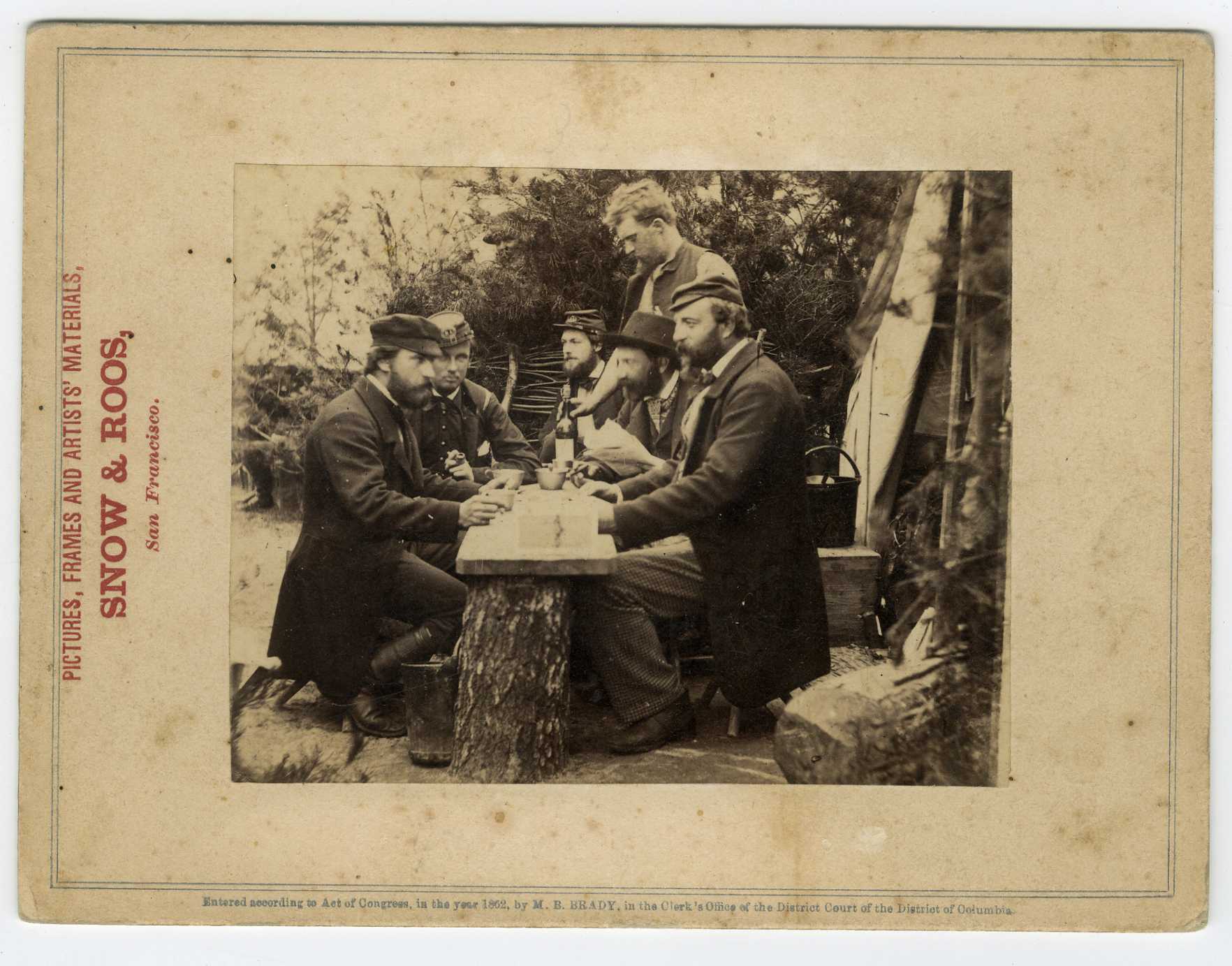

CWCAB4. M.B. Brady. Photo taken by James F. Gibson. Brady’s Album Gallery. No. 357. Group. Comte de Paris, Duc de Chartres, Prince de Joinville, and Friends, Camp Winfield Scott, near Yorktown, May 1, 1862. Brady’s 1862 copyright line on bottom recto. Card has the stamp of Snow & Roos, San Francisco in left margin and a label from Roos & Wunderlich, Depot of Goupil & Co., San Francisco on verso. VG. $375
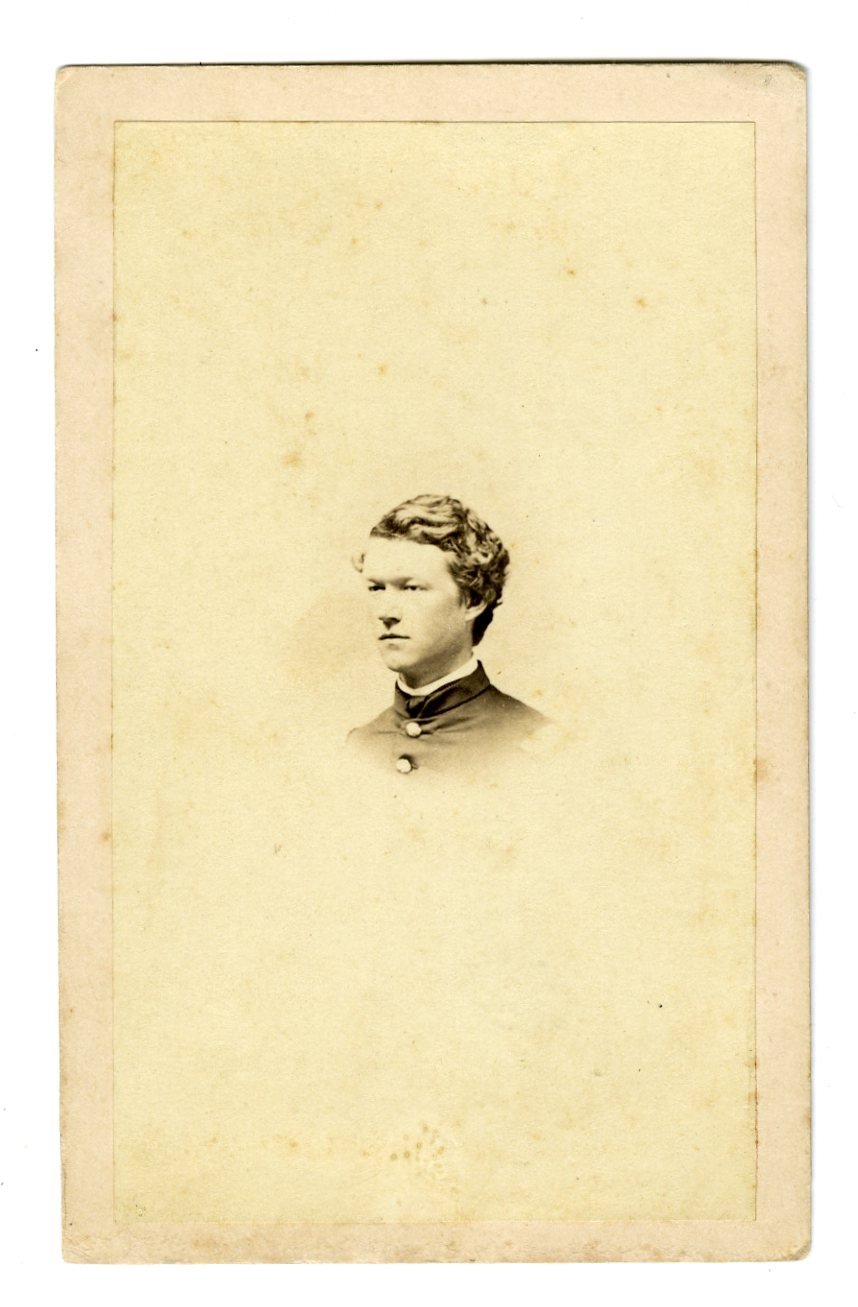
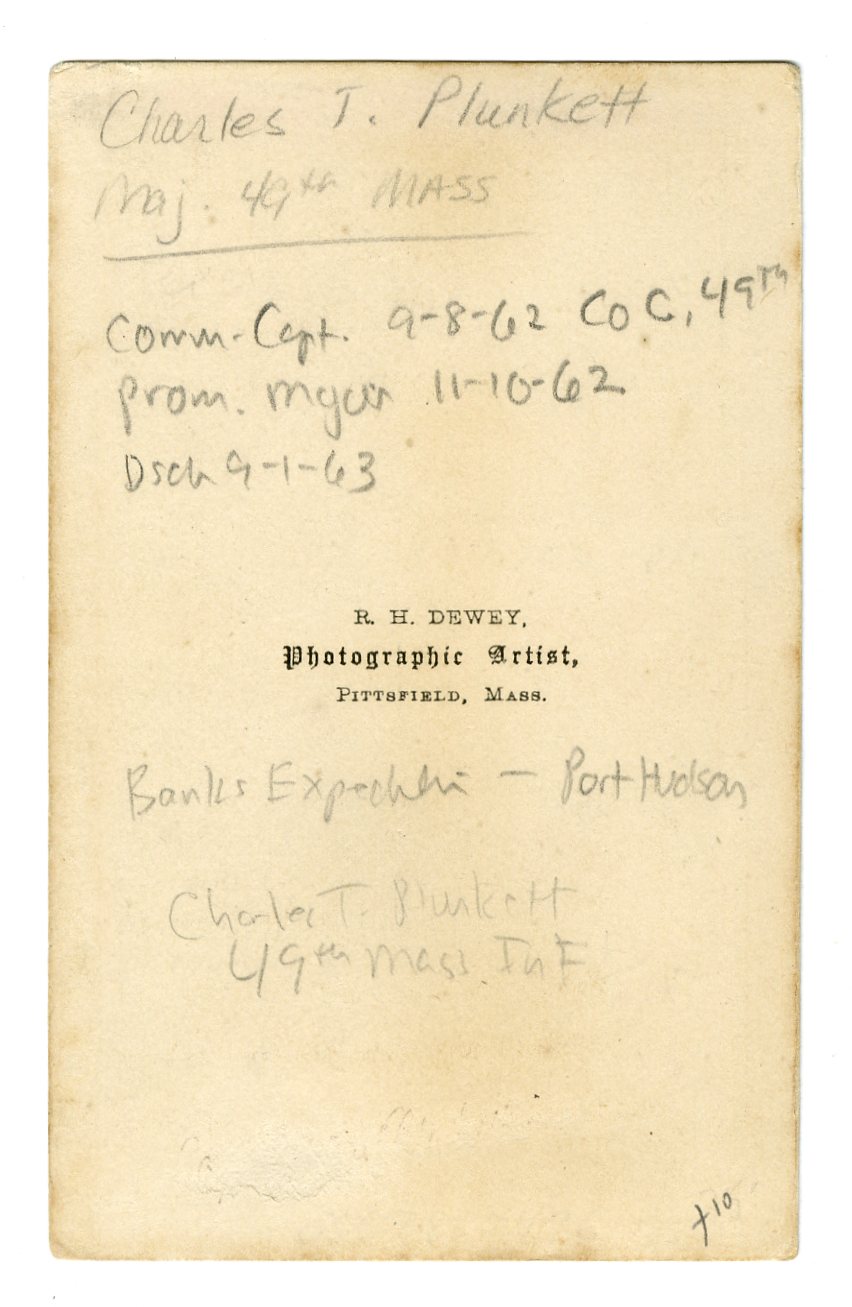
CWCDV770. R.H. Dewey, Photographic Artist, Pittsfield, Mass. “Charles T. Plunkett, Maj. 49th Mass.,” written on back. Residence Pittsfield MA; a 22 year-old Manufacturer. Enlisted on 9/8/1862 as a Captain. On 9/19/1862 he was commissioned into “C” Co. MA 49th Infantry. He was Mustered Out on 9/1/1863 at Pittsfield, MA. Promotions: * Major 11/10/1862. Intra Regimental Company Transfers: * 11/10/1862 from company C to Field & Staff. VG. $150
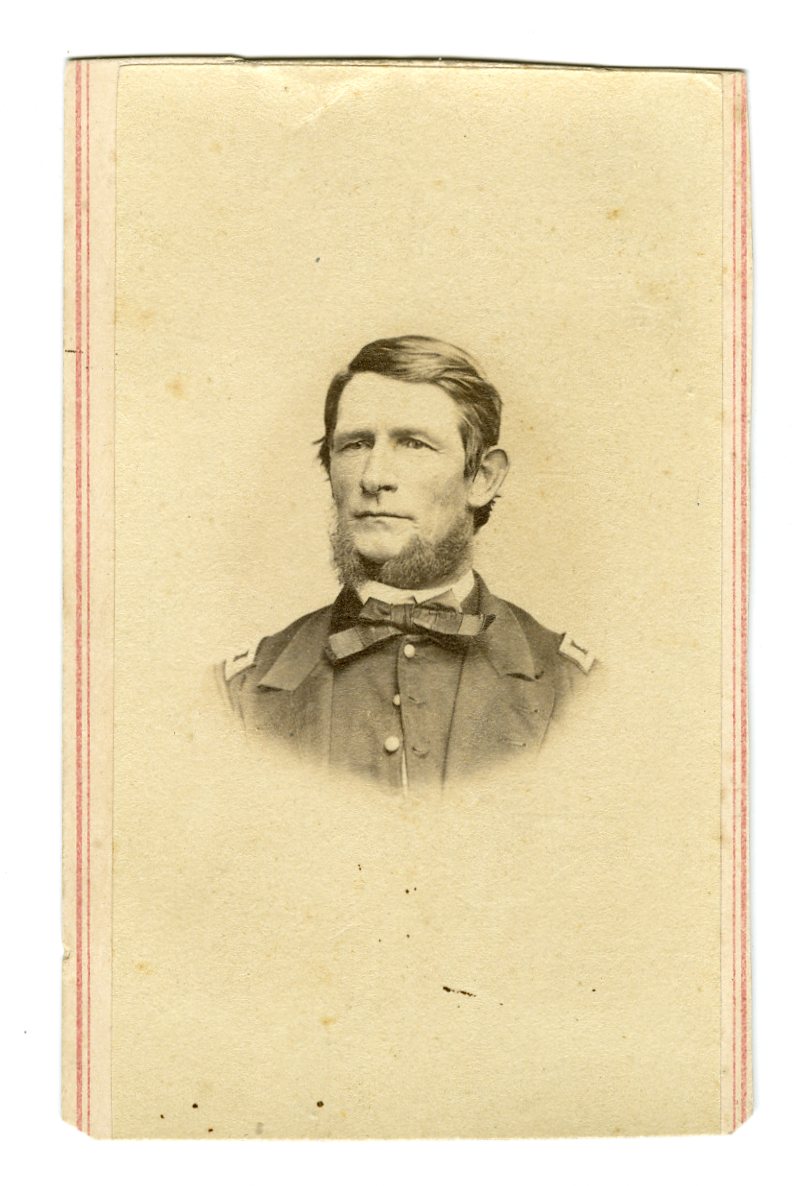

CWCDV906. R.A. Lewis, NY. Inscribed and signed on back “To John & Charity, from their Brother, Wm. Earle.” William Earle, Acting Master, 17 December, 1861. Honorably discharged 15 January, 1866. William Earle was the Acting Master of the USS Merrimac when she sunk. USS Merrimac was a sidewheel steamer first used in the Confederate States Navy that was captured and used in the United States Navy during the Civil War. Merrimac was purchased in England for the Confederate government in 1862. After a successful career as a blockade runner, she was captured by USS Iroquois off the coast of Cape Fear River, North Carolina, 24 July 1863. Purchased by the Navy from New York Prize Court 10 March 1864, Merrimac commissioned at New York 1 May 1864, Acting Master William P. Rogers in command. After joining the East Gulf Blockading Squadron in June 1864, she was ordered to cruise in the Gulf of Mexico. She captured Cuban sloop Henrettasailing from Bayport, Florida, with cotton for Havana. However, late in July yellow fever broke out amongMerrimac’s crew and she sailed north to allow her crew to recover. Upon arriving in New York she debarked her sick sailors at quarantine, and got underway for a cruise in the northwest Atlantic as far as St. John’s Newfoundland. Early in 1865 Merrimac was reassigned to the East Gulf Blockading Squadron. She got underway for the gulf early in February, but encountered extremely bad weather which forced her to stop at Beaufort, North Carolina, on the 7th and at Charleston, South Carolina on the 12th. Underway for Key West the next day, Merrimac ran into still worse weather which she fought until turning north on the 14th to seek the first port. On the afternoon of 15 February 1865, Acting Master William Earle ordered the crew to abandon ship after its tiller had broken, two boilers given out and the pumps failed to slow the rising water. That night, when the crew had been rescued by mail steamer Morning Star, Merrimac was settling rapidly as she disappeared from sight. Trimmed top and bottom. G. $300
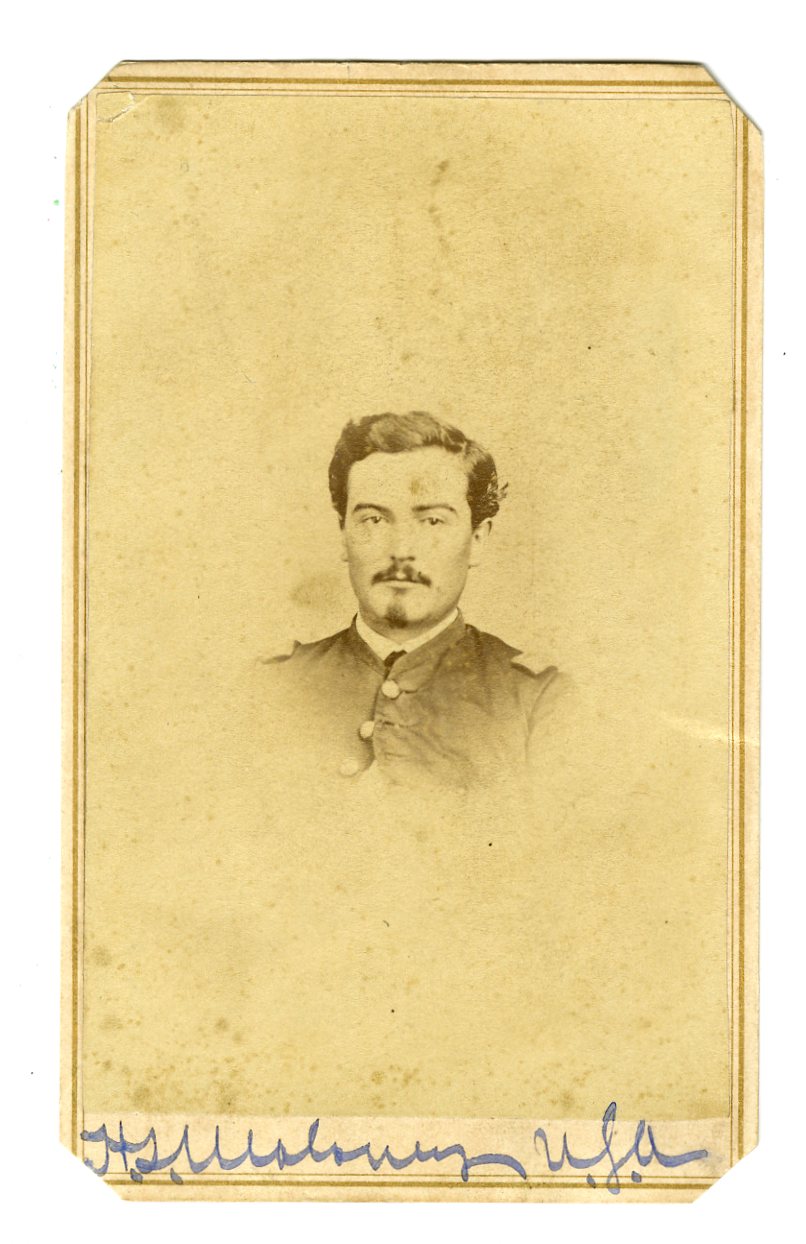
CWCDV987. Robinson & Murphy, Artists, Huntsville, Ala. Signed at bottom “Lt. J. Mahoney, USA.” Josiah Mahoney. Residence was not listed; 27 years old. Enlisted on 7/1/1864 as a 2nd Lieutenant. On 7/1/1864 he was commissioned into “D” Co. TN 8th Cavalry. He was Mustered Out on 9/11/1865 at Knoxville, TN. Corners clipped. G. $250
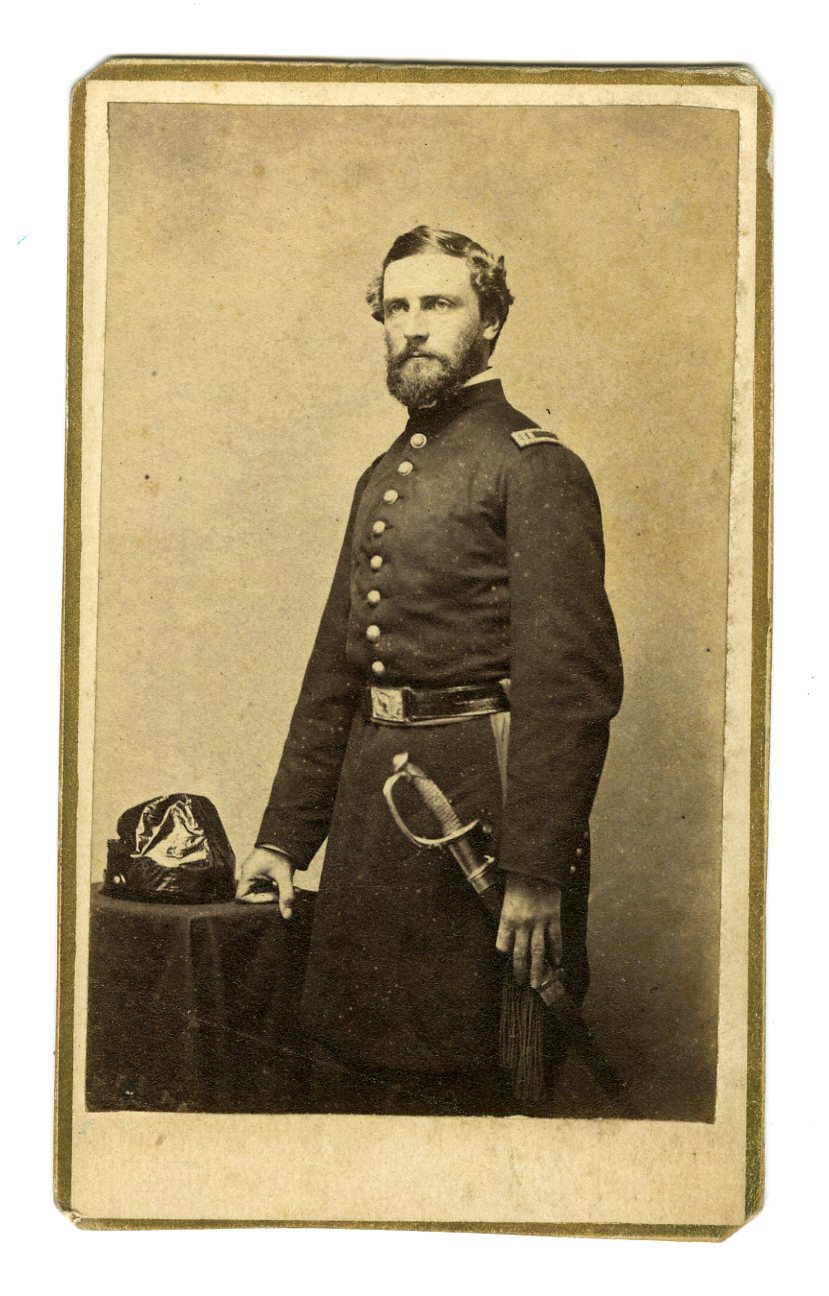
CWCDV1187. D. Appleton & Co., NY. A.A. Turner, Photographer. Written on verso “George Merrill, Aid to Gen Sherman.” The “Sherman” referred to here is Gen. Thomas W. Sherman (not William Tecumseh). Residence was not listed; 30 years old. Enlisted on 9/3/1861 at Washington, DC as a 1st Lieutenant. On 10/8/1861 he was commissioned into “K” Co. NY 2nd Infantry. He was discharged for promotion on 4/26/1862. On 4/26/1862 he was commissioned into US Volunteers Adjutant Genl Dept. He Resigned on 9/25/1862 Promotions: * Capt 4/26/1862 (Captain & Asst Adjutant General). Other Information: born in New Hampshire. VG. $150
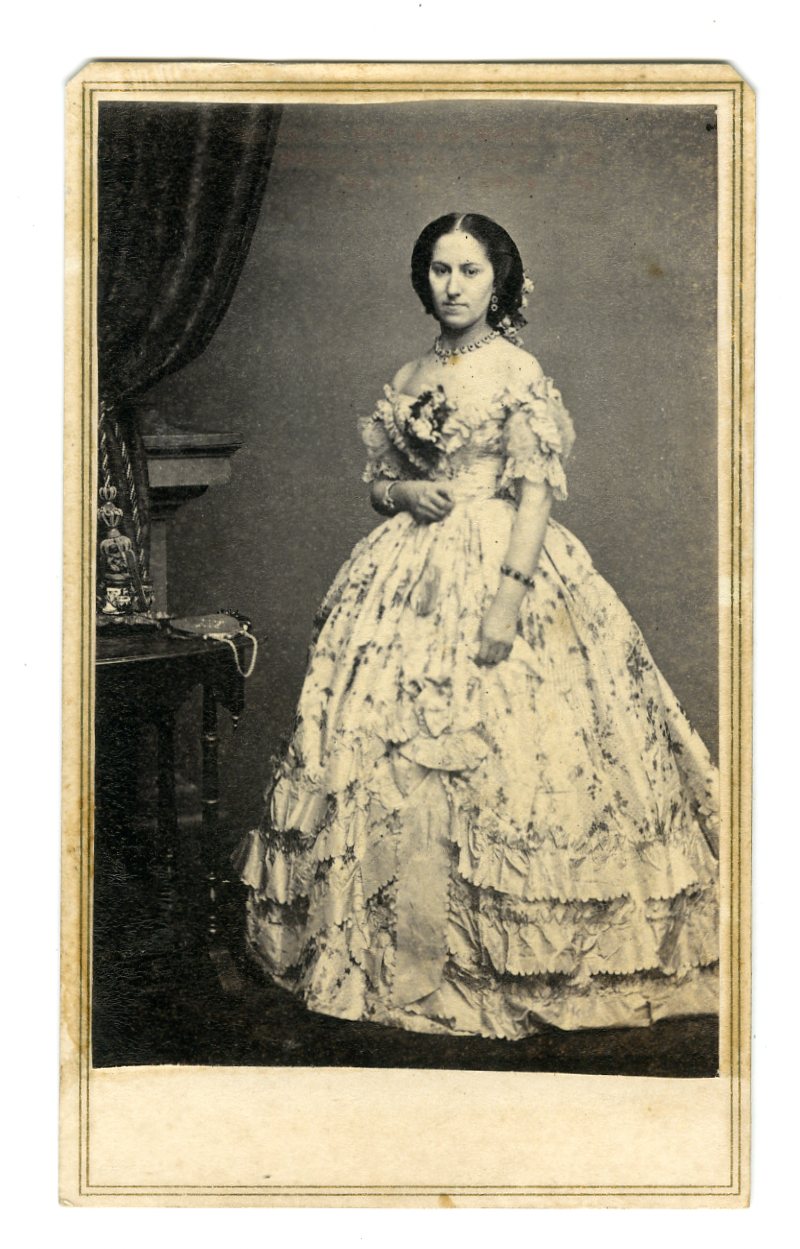
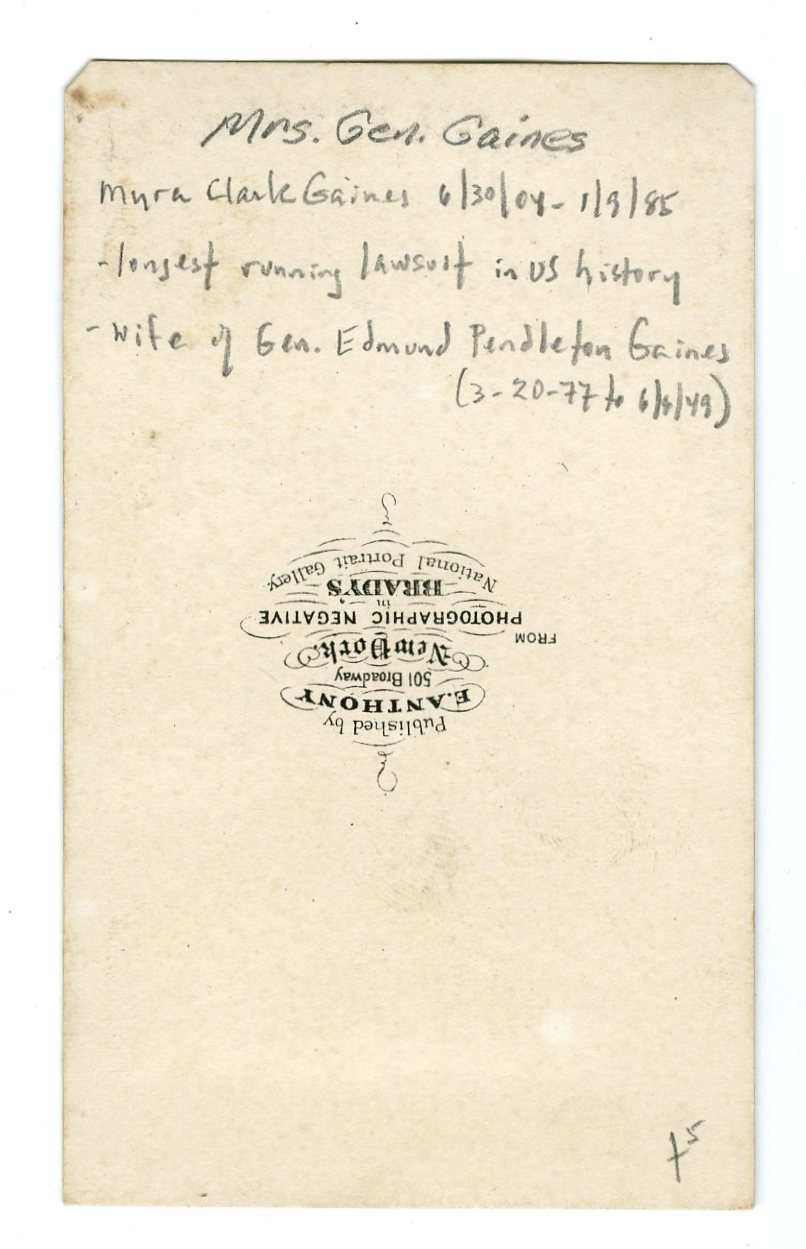
CWCDV1342. Photographic negative by Brady’s National Portrait Gallery, published by E. Anthony. Mrs. General Gaines, Myra Clark Gaines (6/30/04-1/9/85). Wife of Gen. Edmund Pendelton Gaines (3/20/1777-6/6/49). She was involved in the longest running lawsuit in US history. VG. $75
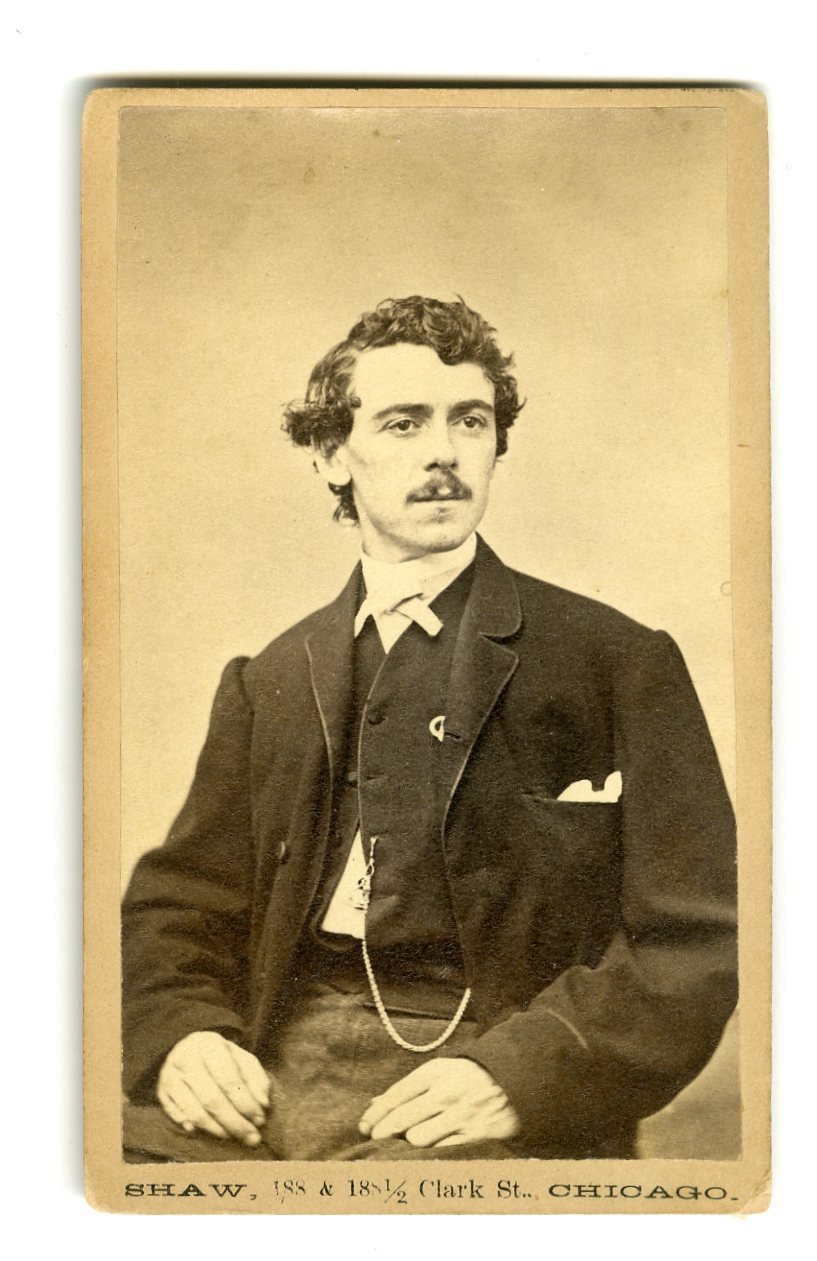
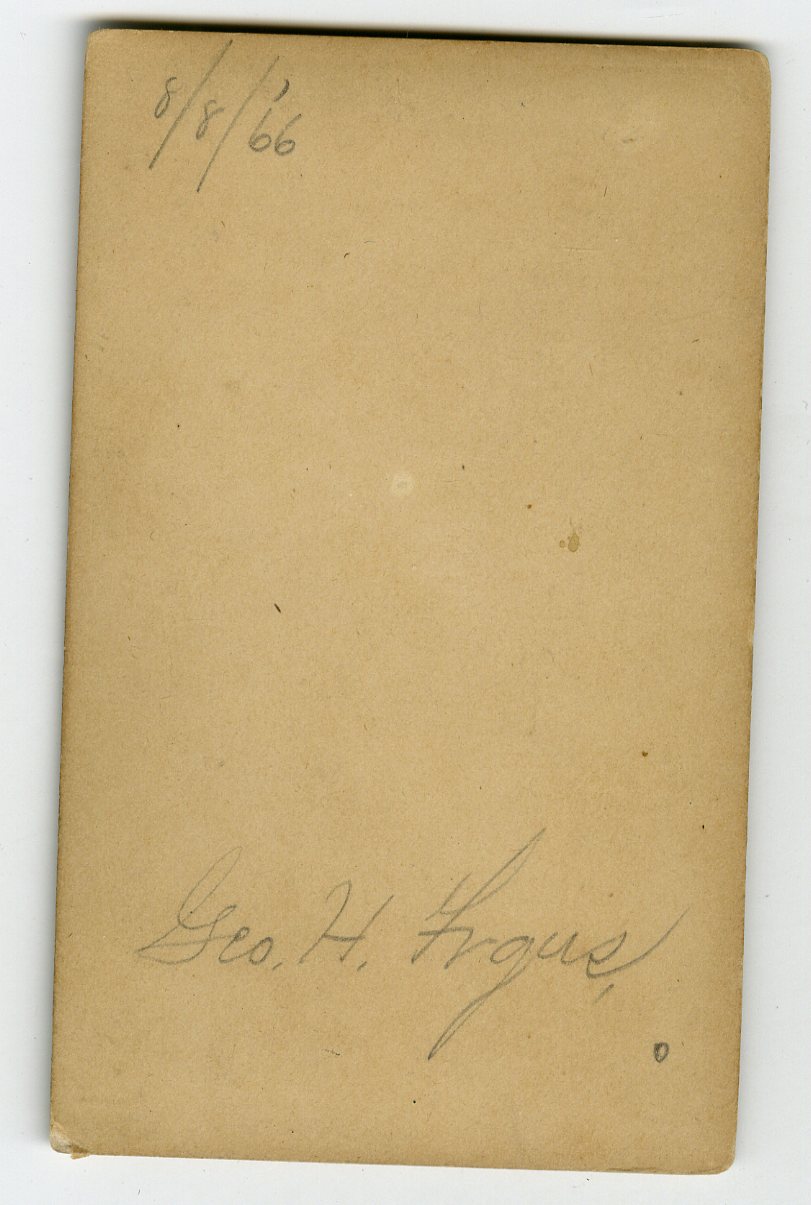

PPCDV152. Shaw, Chicago. George H. Fergus (1840-1911), book & job printer; lieutenant Co. K, NY 11 Infantry (Ellsworth’s Zouaves); collector of Chicago data; born in a house that stood on the ground of where the Olympic Theater was in 1811. Referred to in the newspaper article shown above as a “Human Directory.” VG. $85
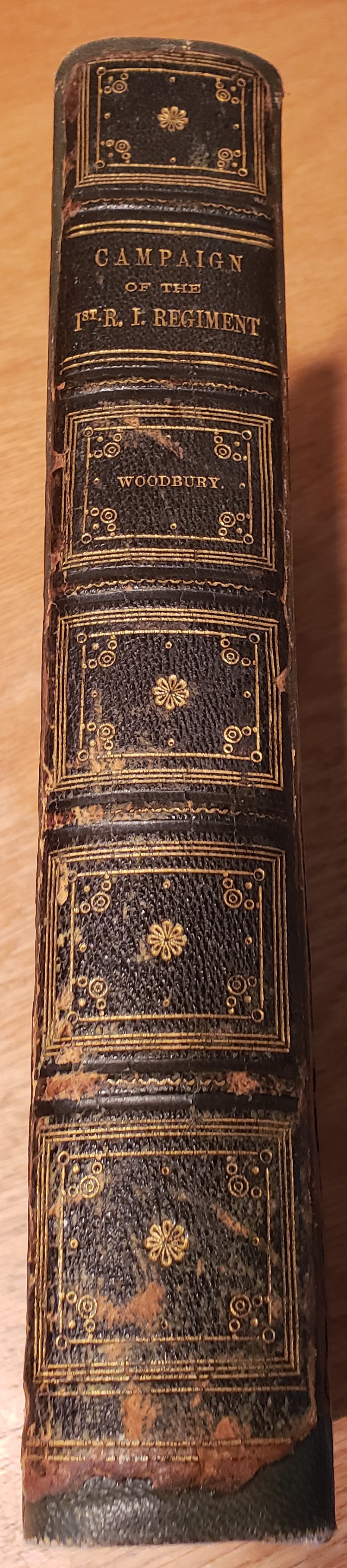

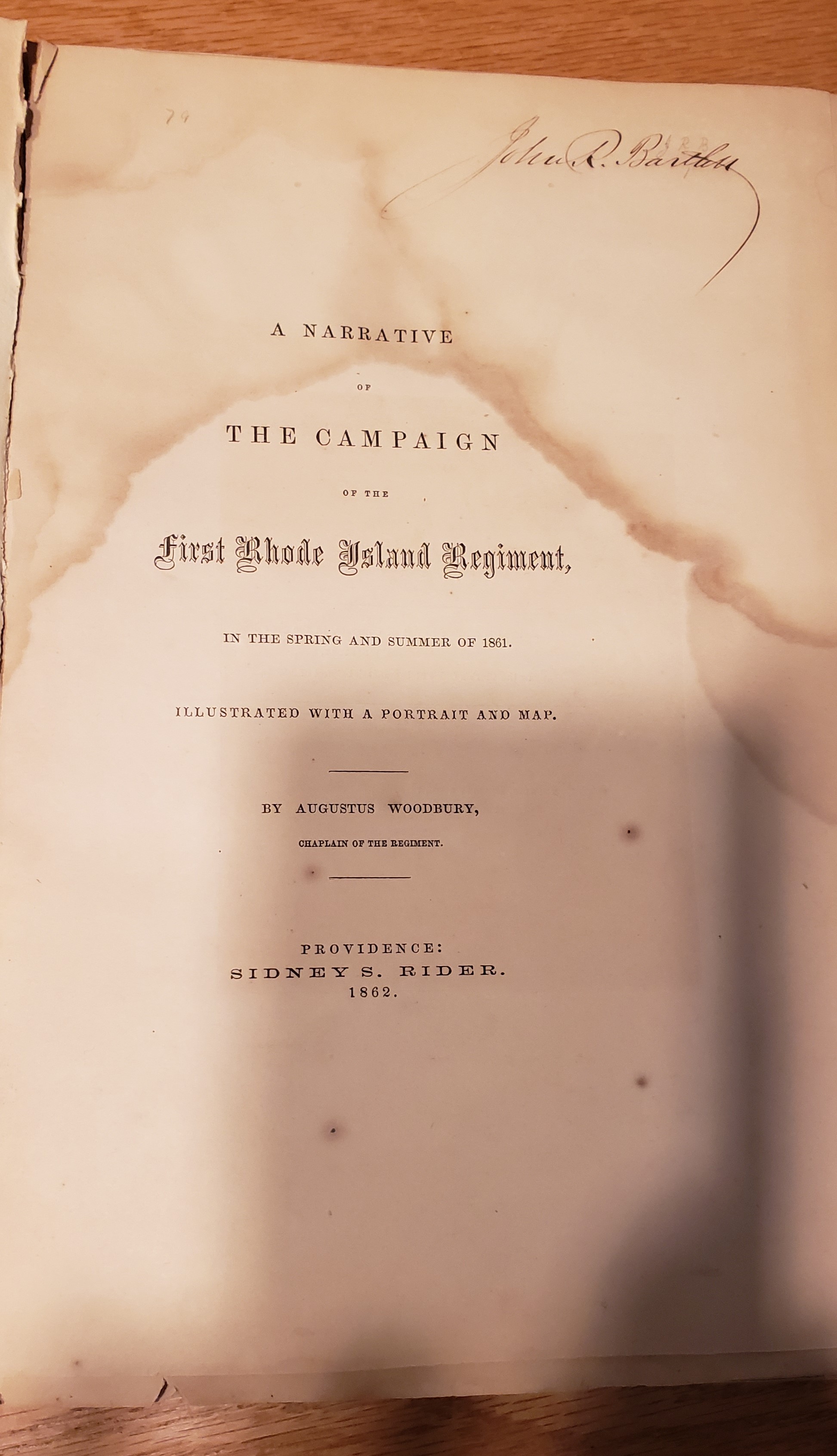
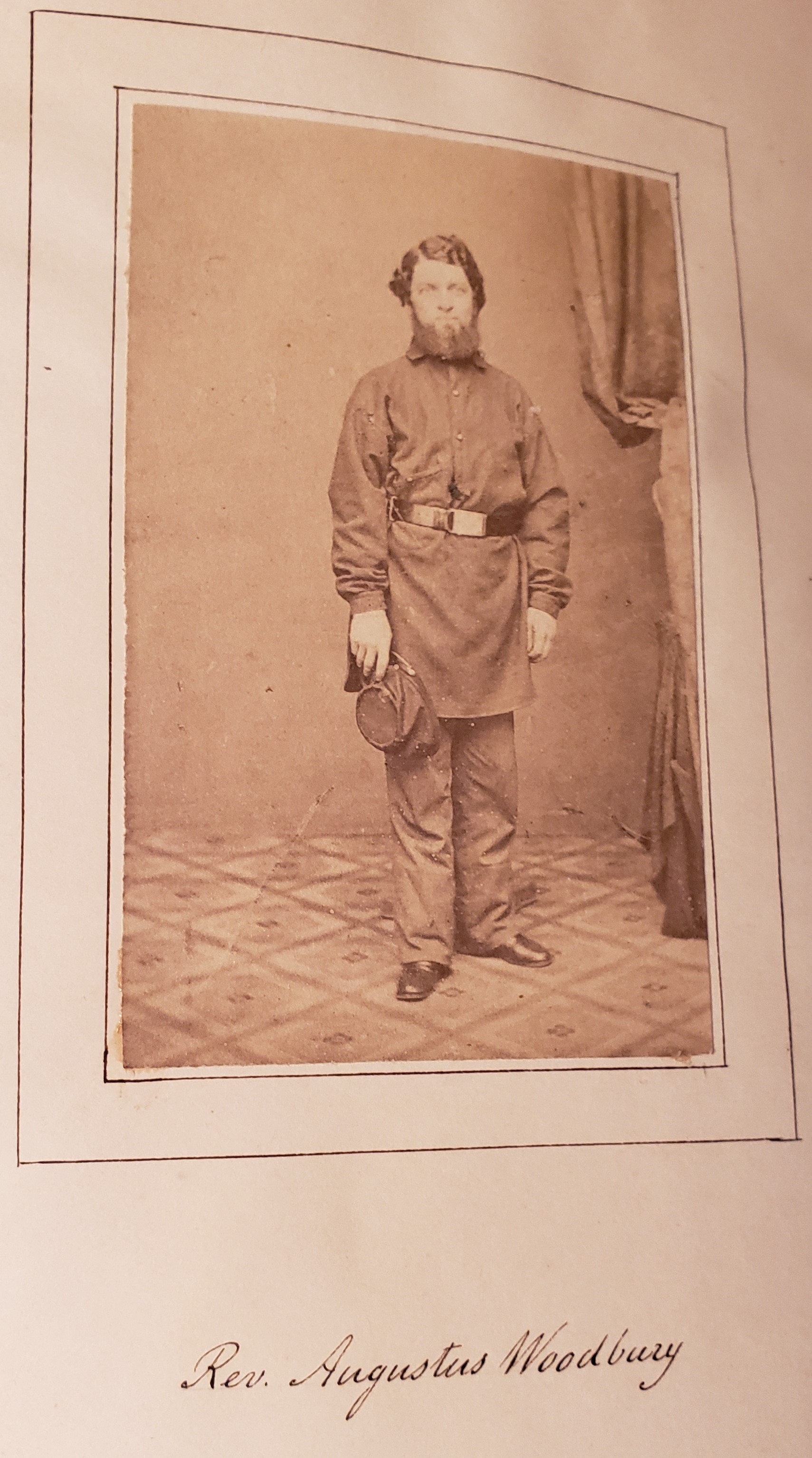
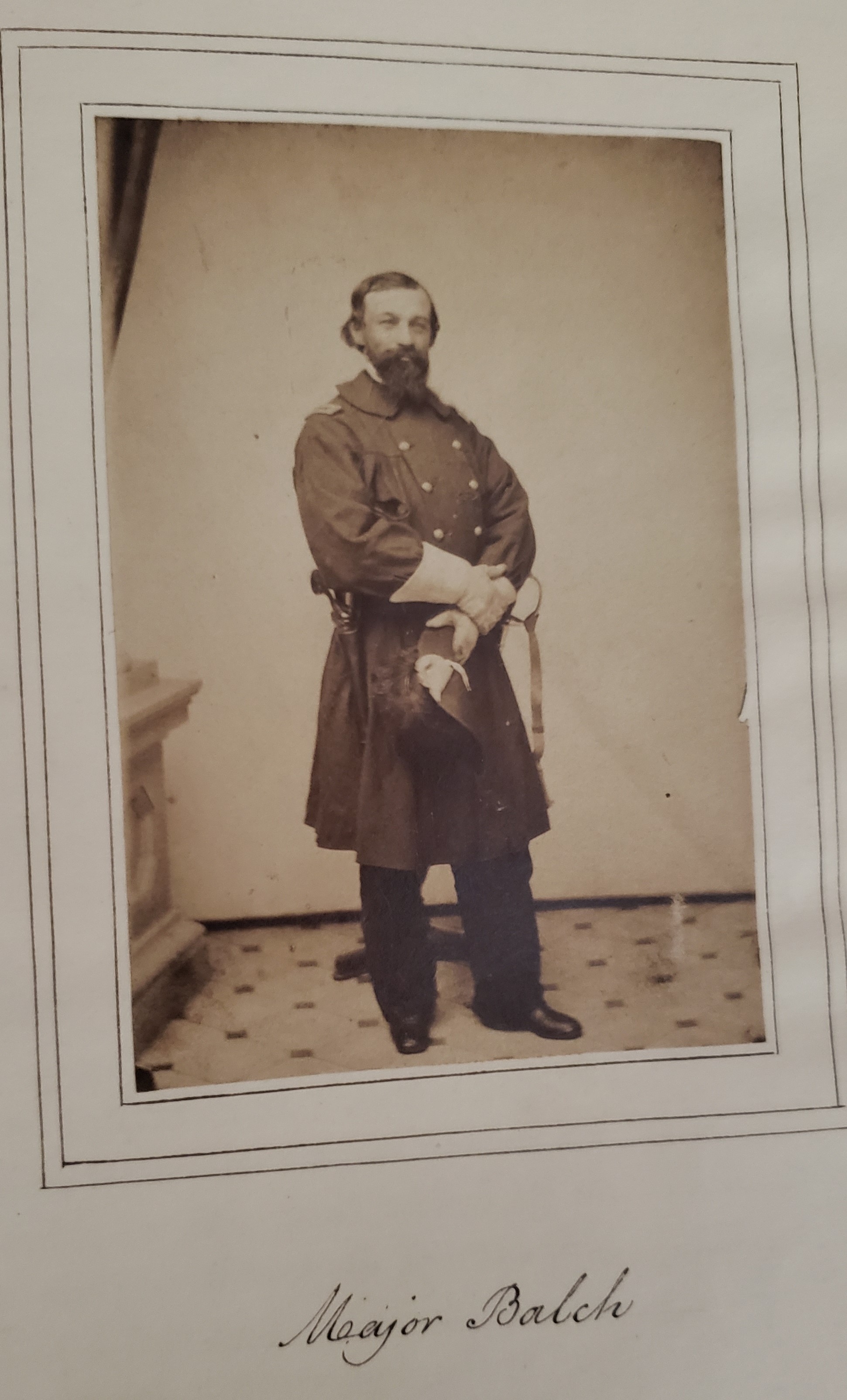


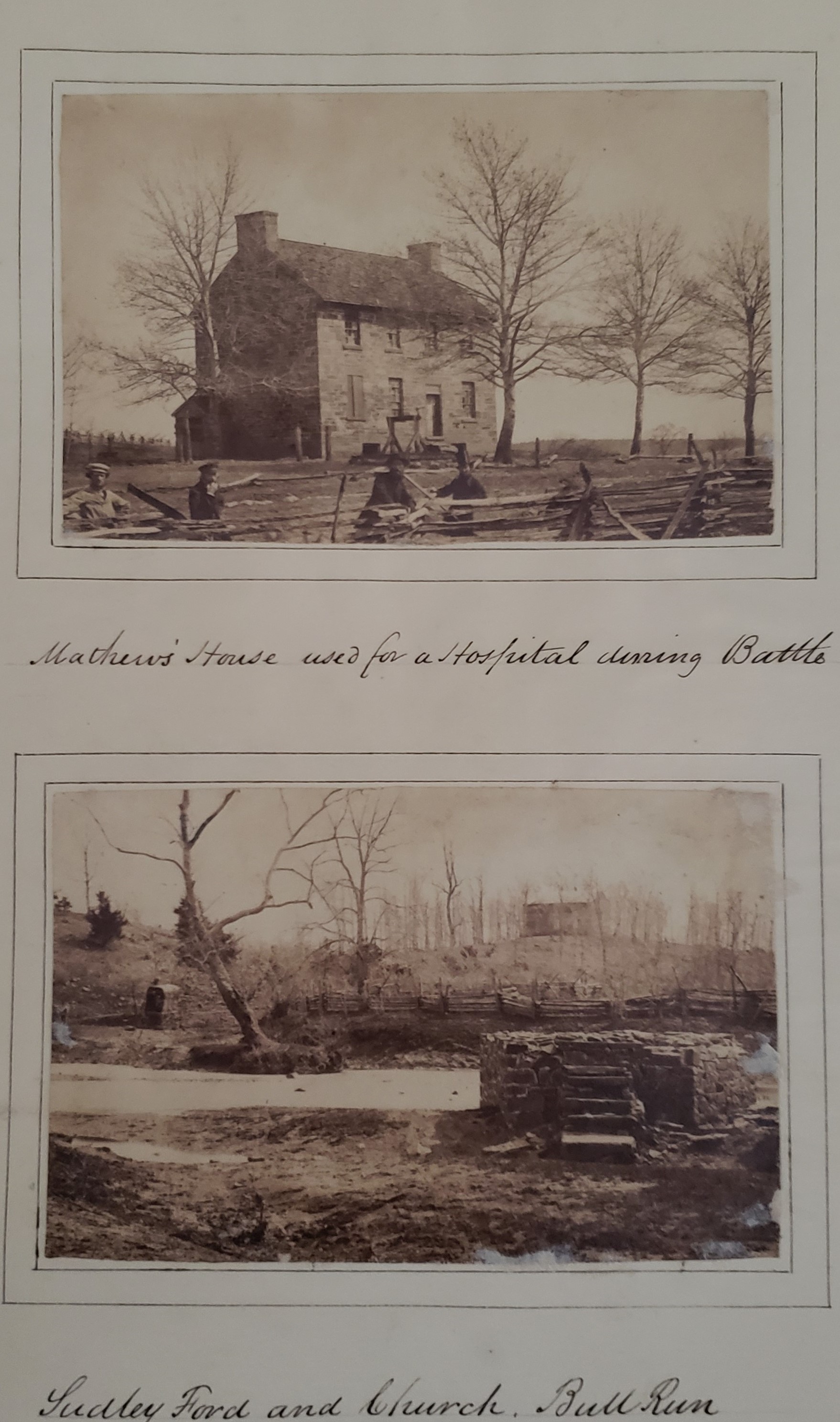
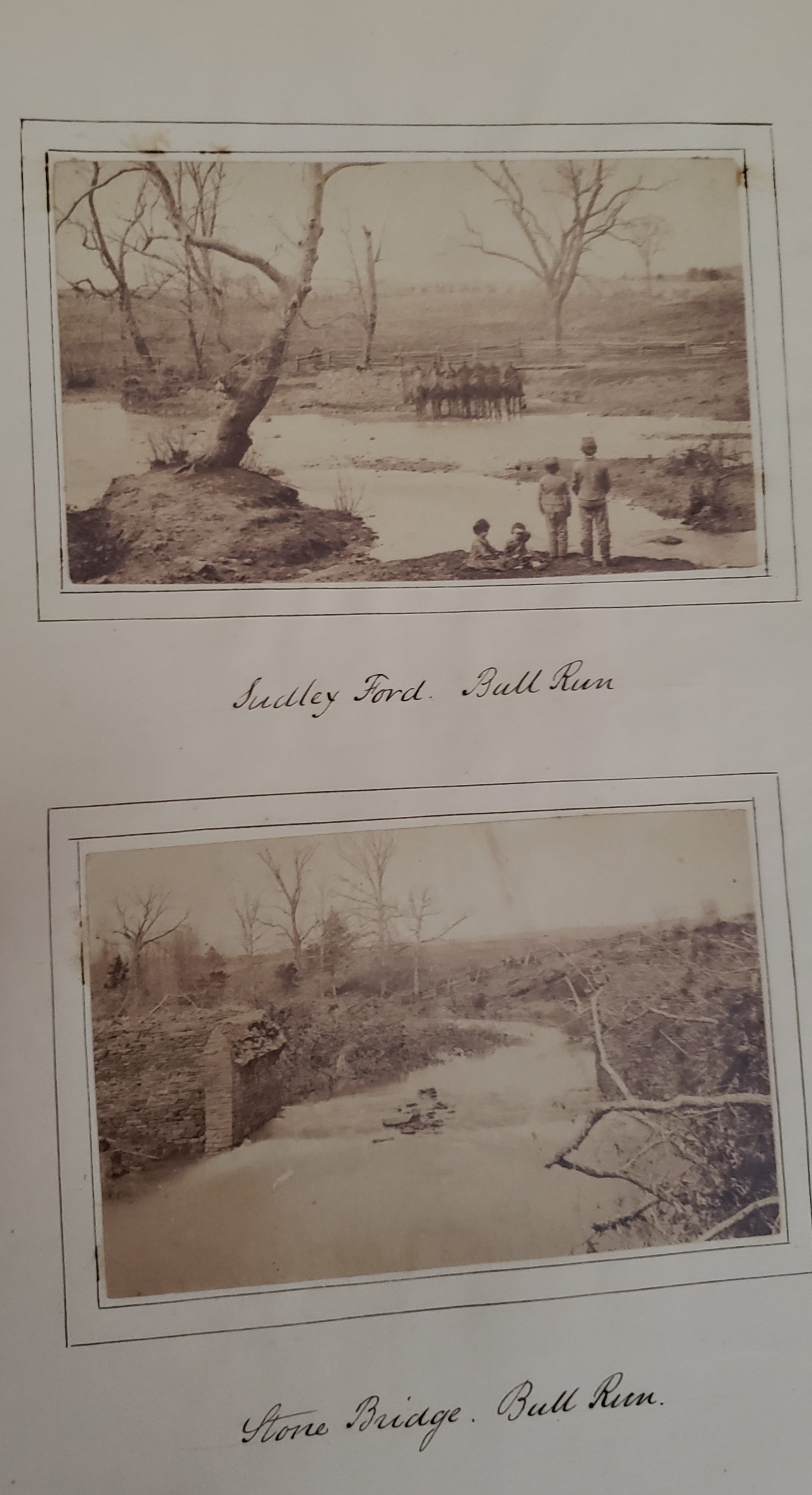
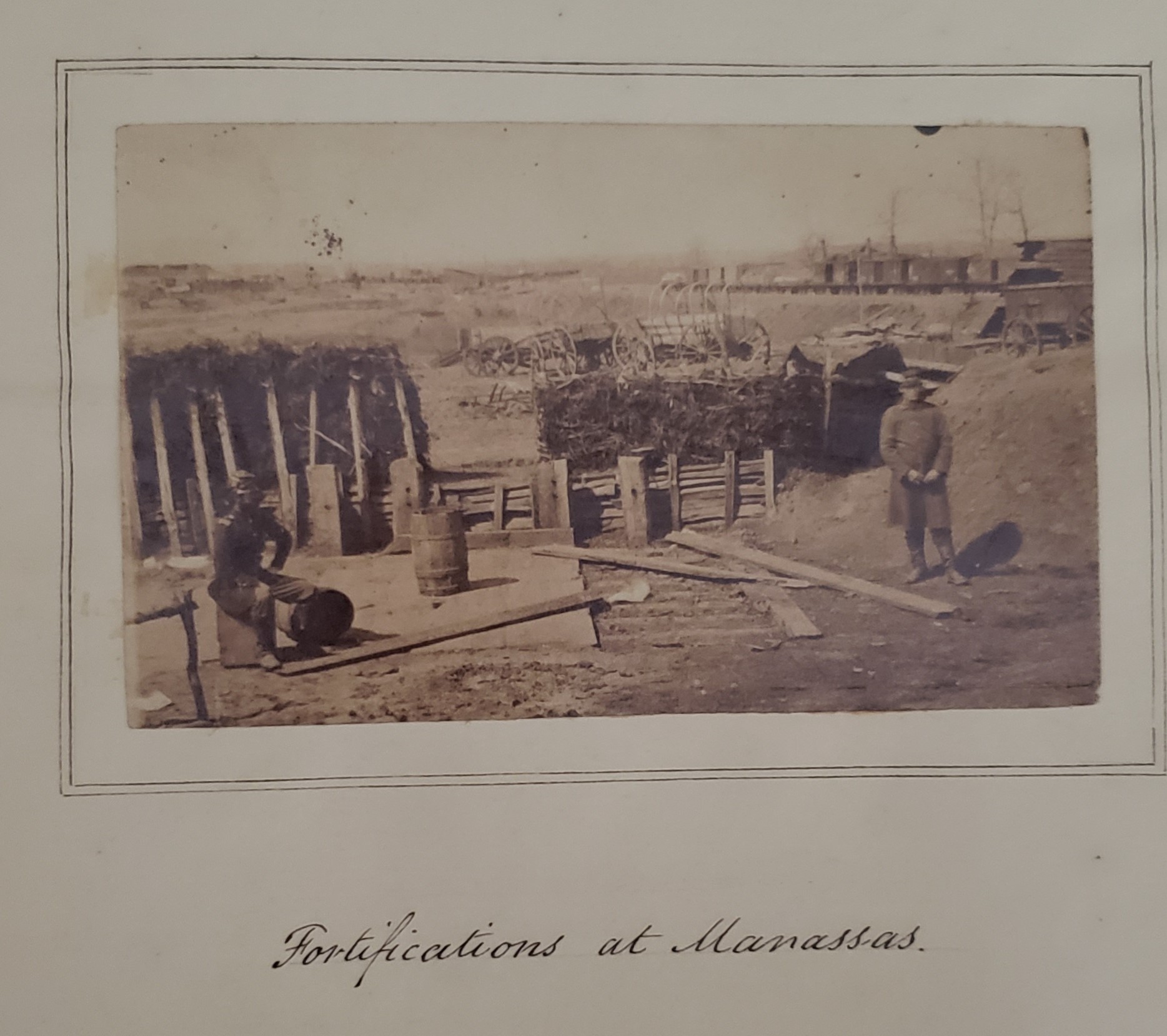
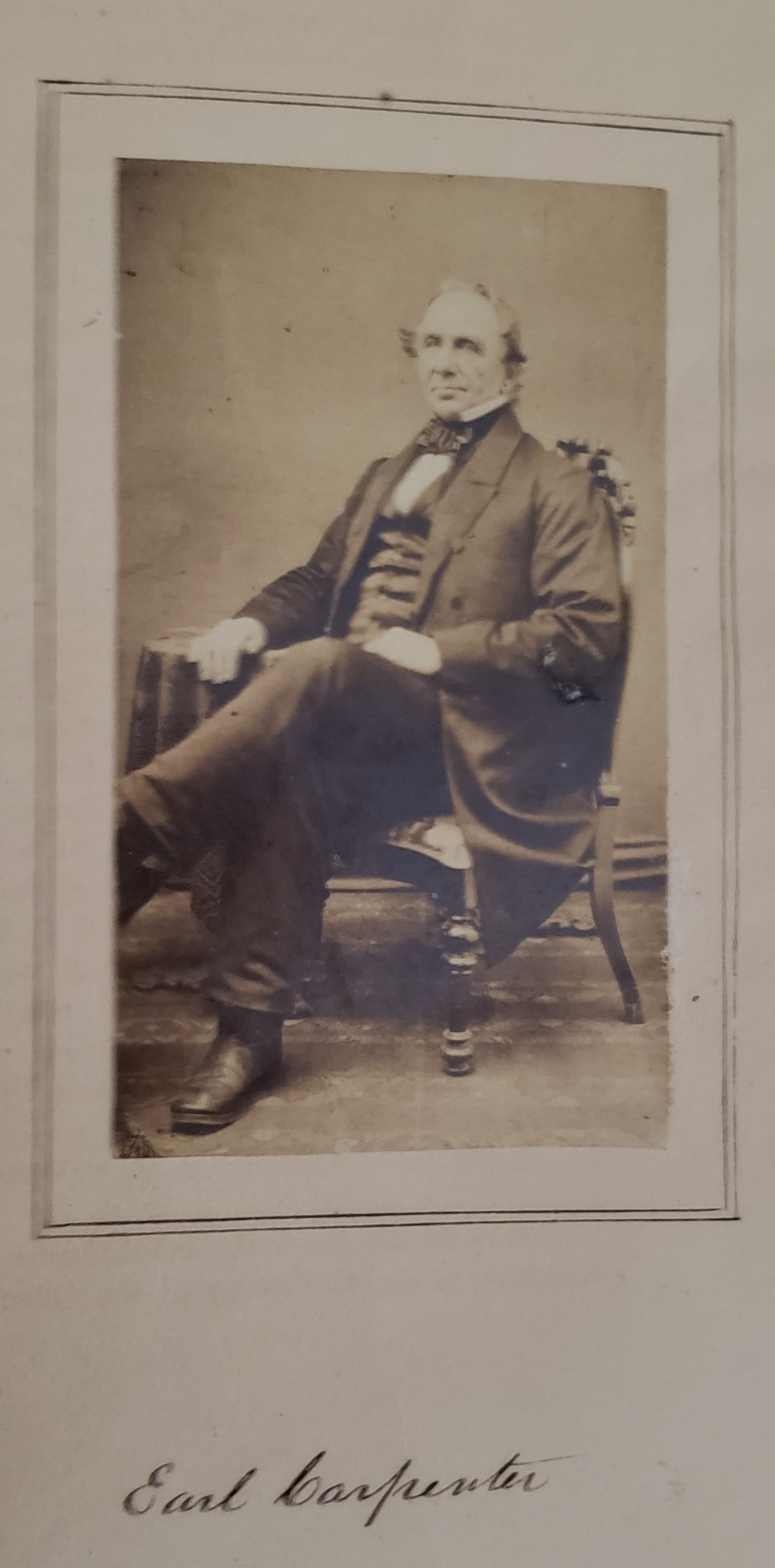
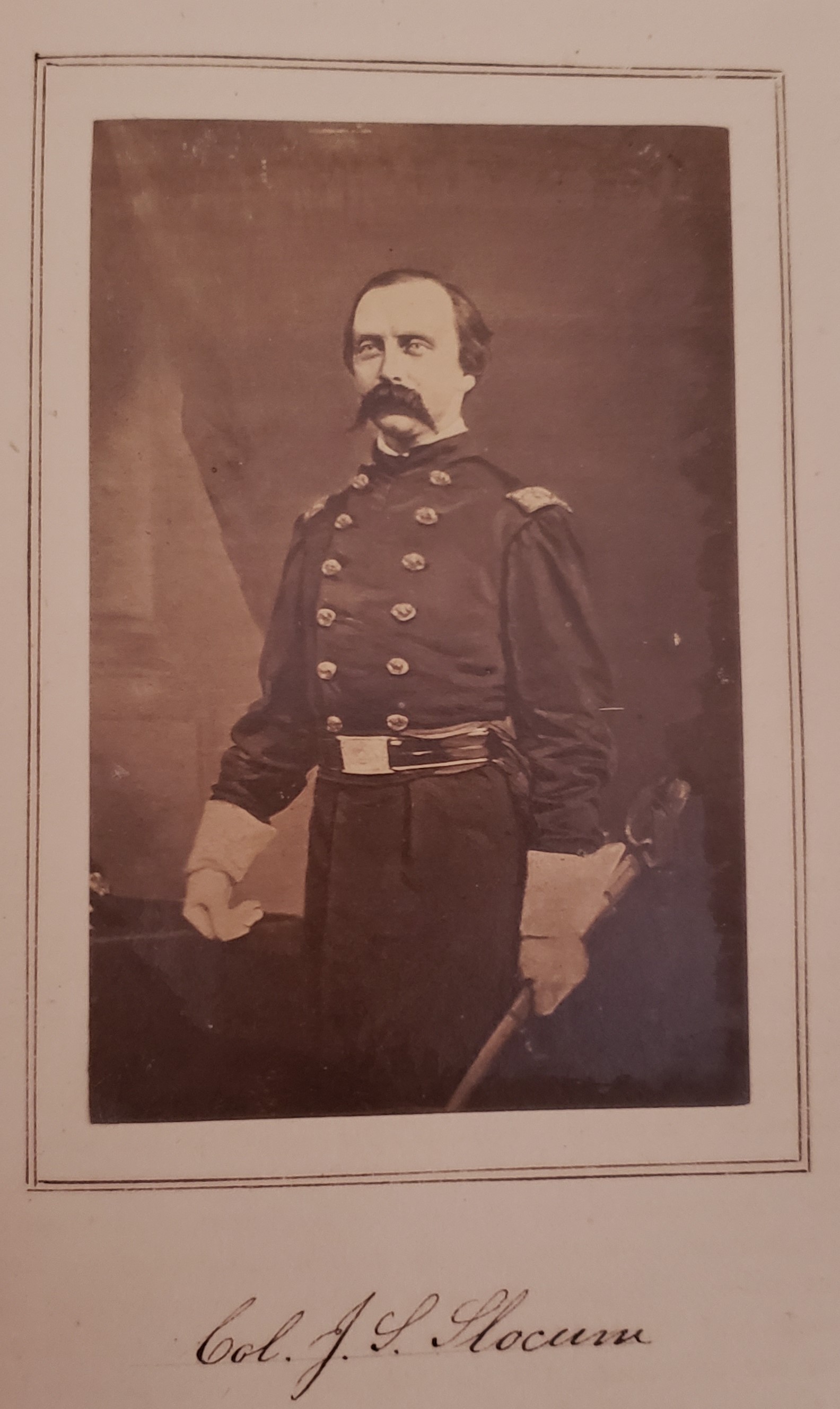
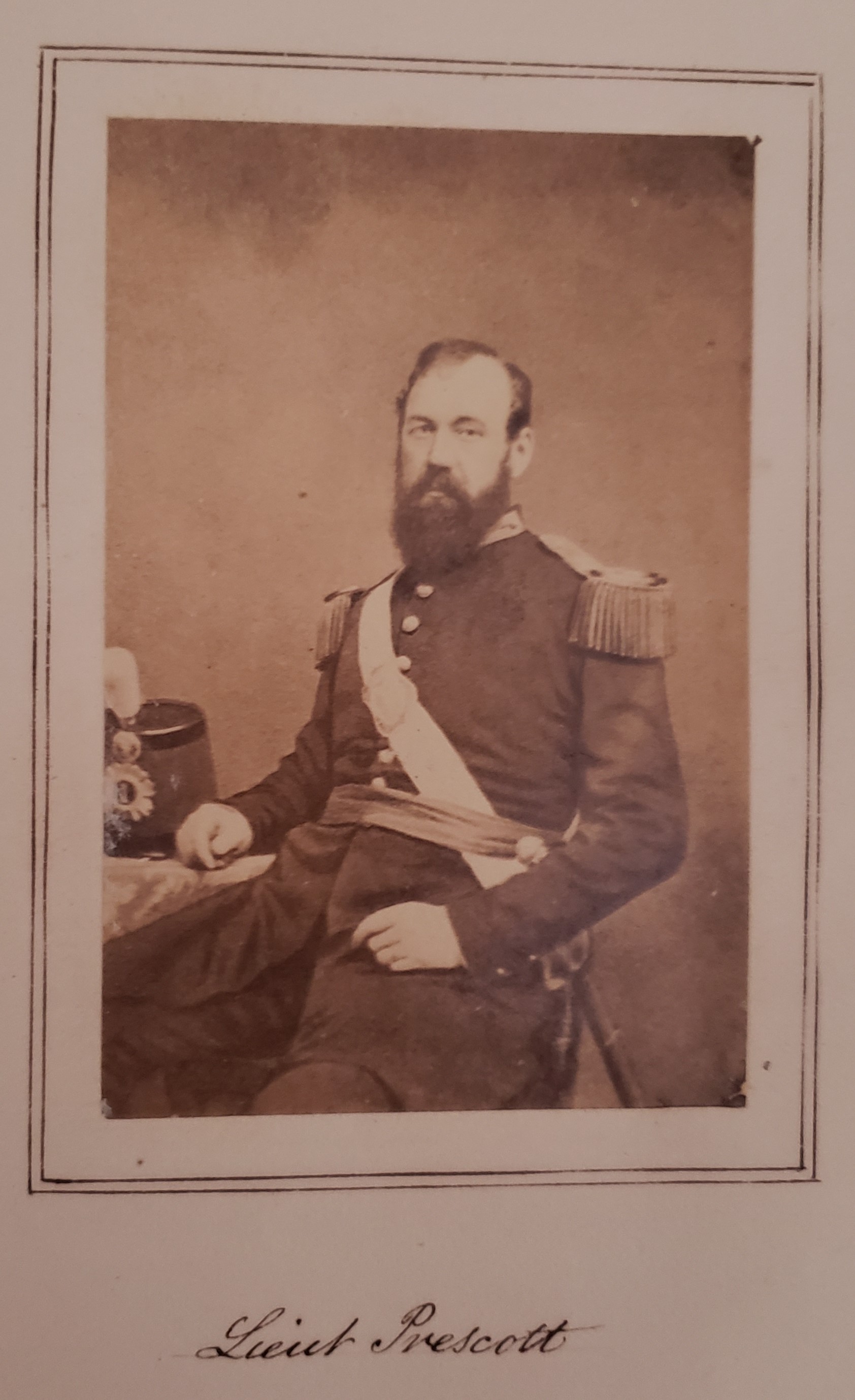
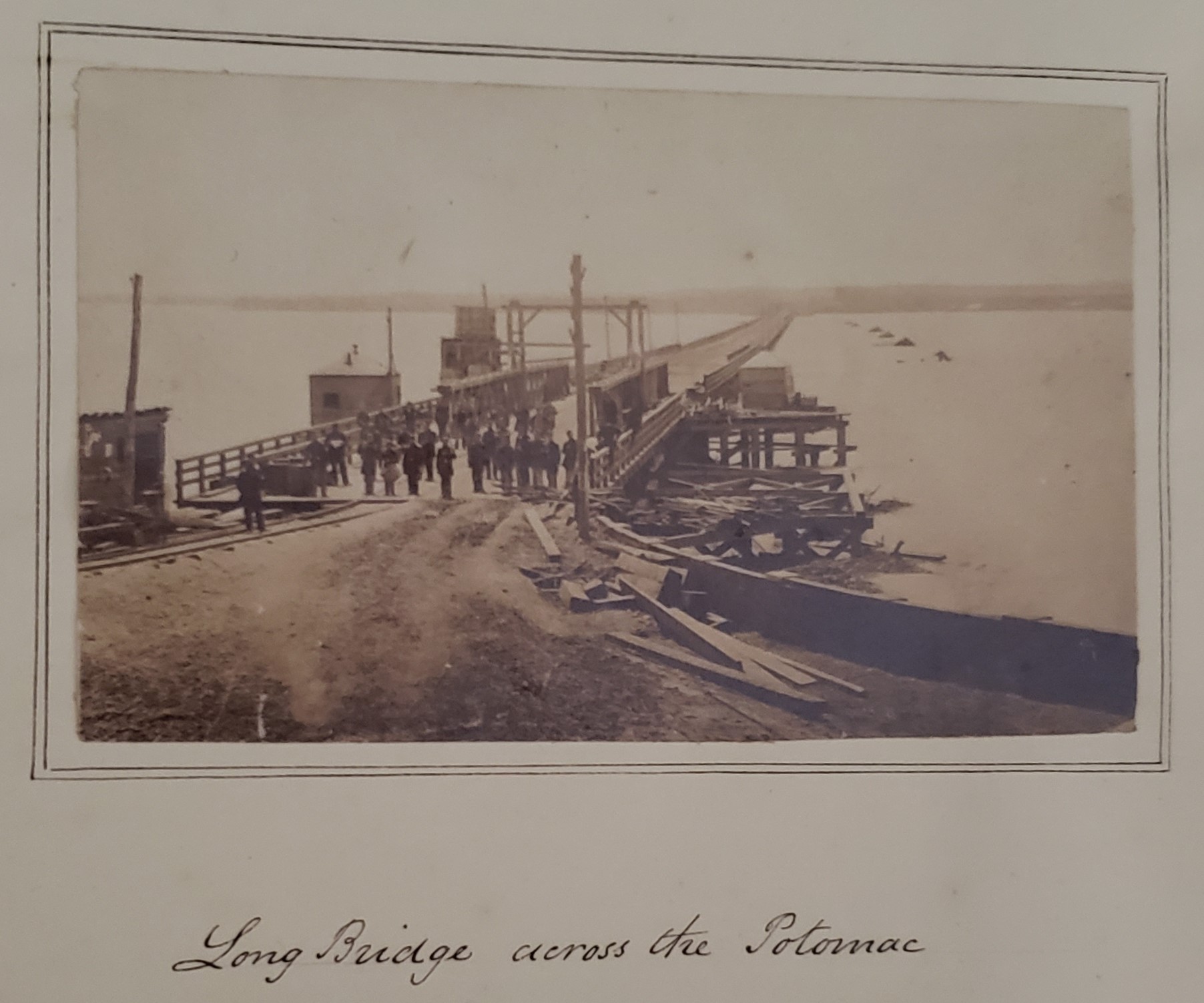
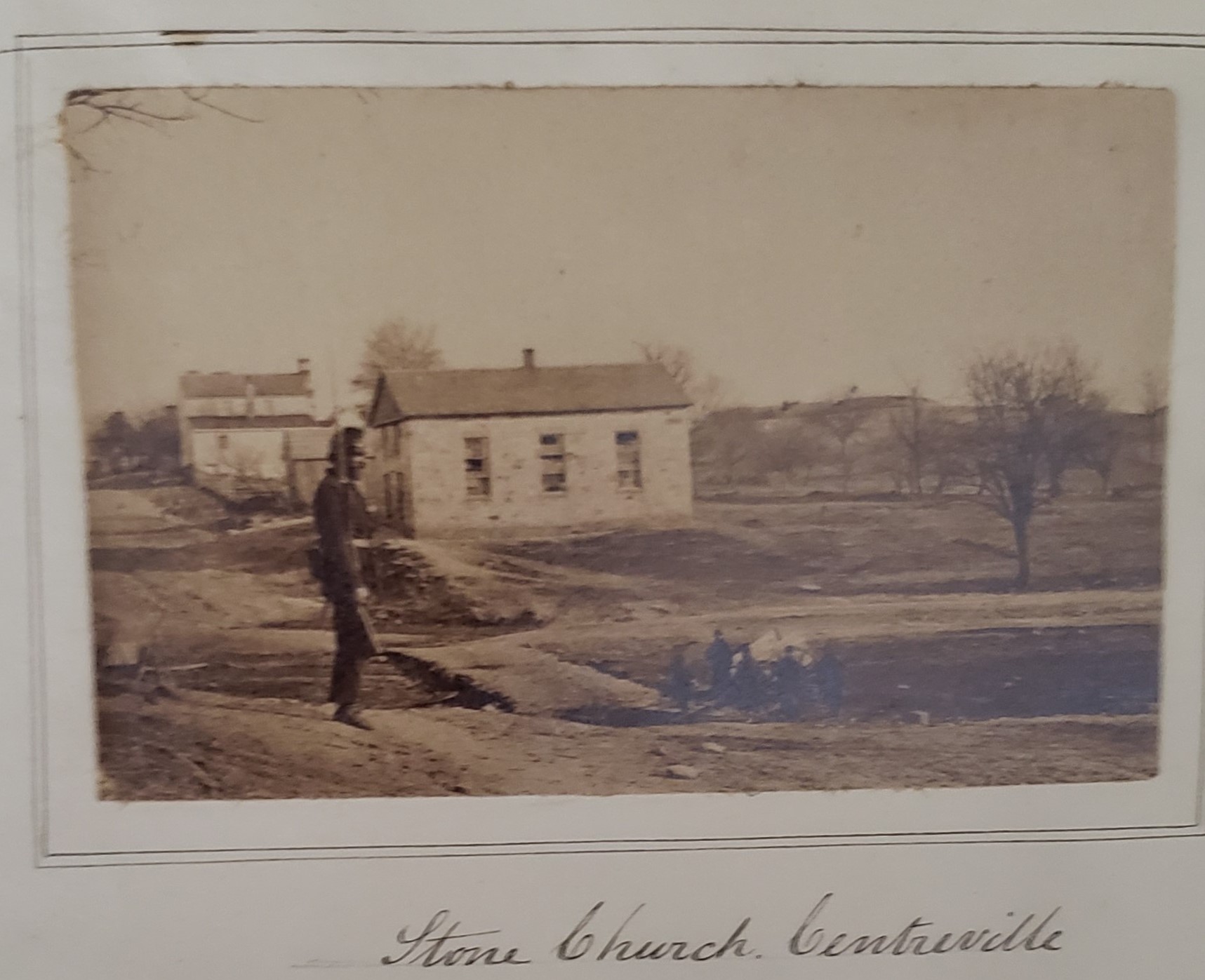
Woodbury, Augustus, Chaplain of the Regiment. A Narrative of the Campaign of the First Rhode Island Regiment, in the Spring and Summer of 1861. Providence: Sidney S. Rider, 1862. Signed by John R. Bartlett at top right of the title page. There are 17 tipped-in photographs in the book. The frontispiece is a photo of Burnside, 4.5″ x 3.5.” The rest of the images are CDV size. Titles are: Rev. Augustus Woodbury; Major Balch; Falls Church; Fairfax Court House; Sudley Church, Bull Run; Hetacomb at Sudley Church where over 100 Federal troops were buried; Mathews’ House used for a hospital during Battle; Sudley Ford and Church, Bull Run; Sudley Ford, Bull Run; Stone Bridge, Bull Run; Fortifications at Manassas; Earl Carpenter; Col. J.S. Slocum; Lieut. Prescott; Long Bridge Across the Potomac; & Stone Church Centreville. The images are in VG-E condition. There are also many steel engravings of generals, scenes, Lincoln, etc. bound in as well a map of Bull Run. The book measures 10.25″ x 7.25,” in original old boards. There is an old waterstain along the top of the volume, not affecting text or photos. There are some old newspaper reviews laid in. A very rare volume with 17 tipped-in photos. All copies that I have been able to find have just one image tipped-in. G. $3000
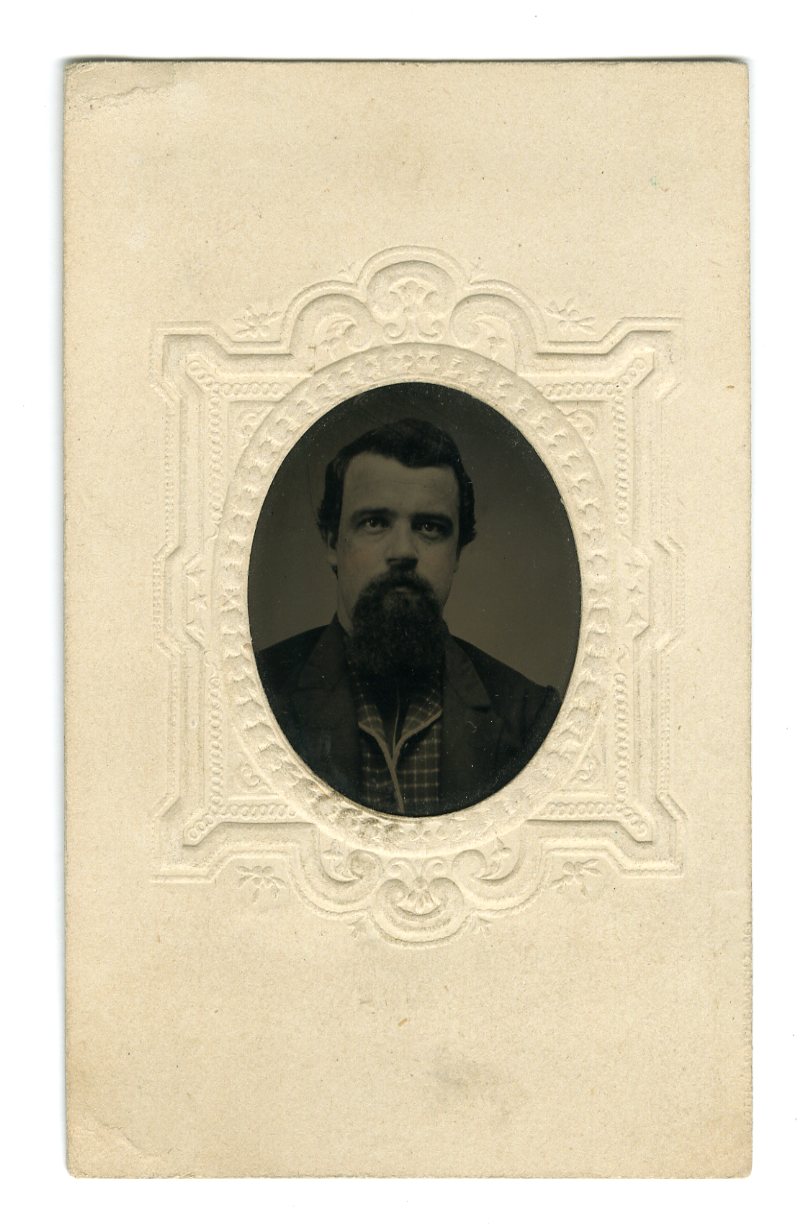
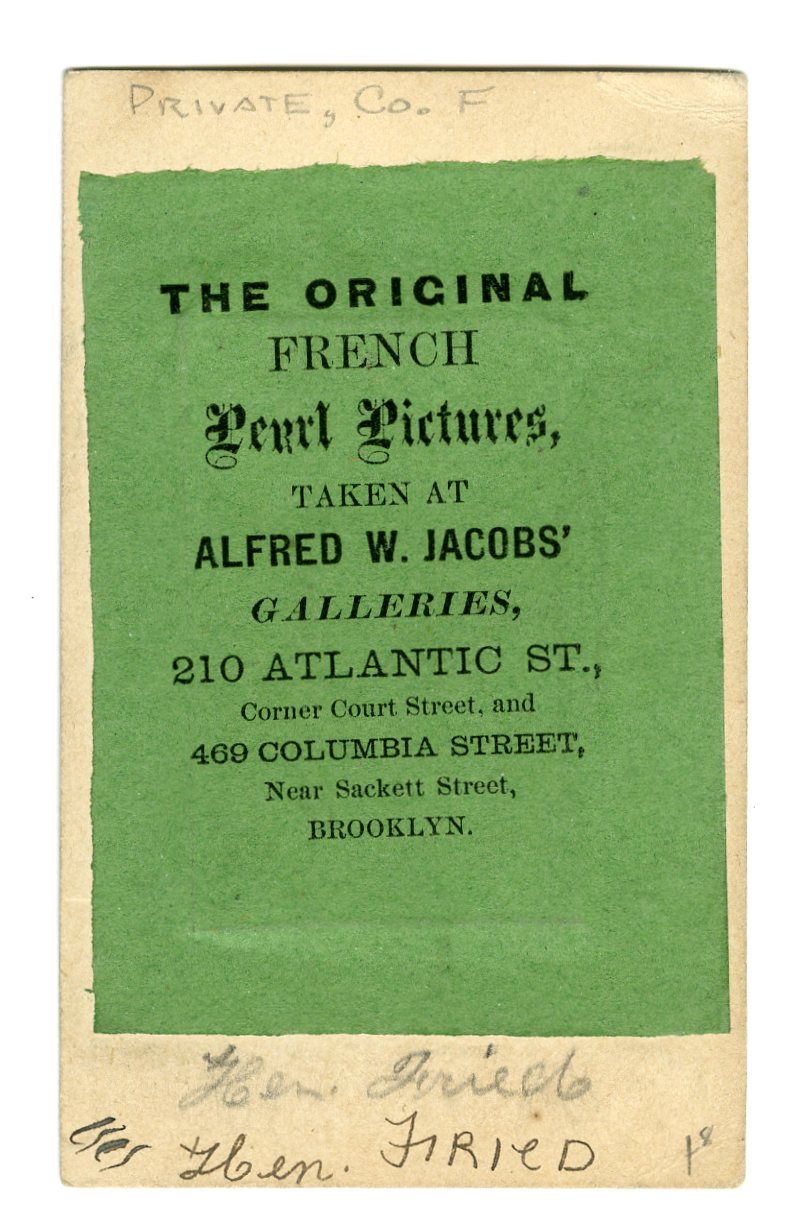
CWCDV1445. The Original French Pearl Pictures, taken at Alfred W. Jacobs’ Galleries, 210 Atlantic St., Corner Court Street, and 469 Columbia Street, near Sackett Street, Brooklyn. William Henry Fried. Co. F, PA 47 Inf. Term of Service: 30 August 1861 – 26 September 1864 (discharged on Surgeon’s Certificate of Disability, Fort Jefferson). Rank: Private. Honors/Service Distinctions: Discharged at Washington, D.C. on a Surgeon’s Certificate of Disability 26 September 1864. Veteran Volunteer (re-enlisted at Fort Jefferson, Dry Tortugas, Florida 19 October 1863). Tintype in paper mat. VG. $125
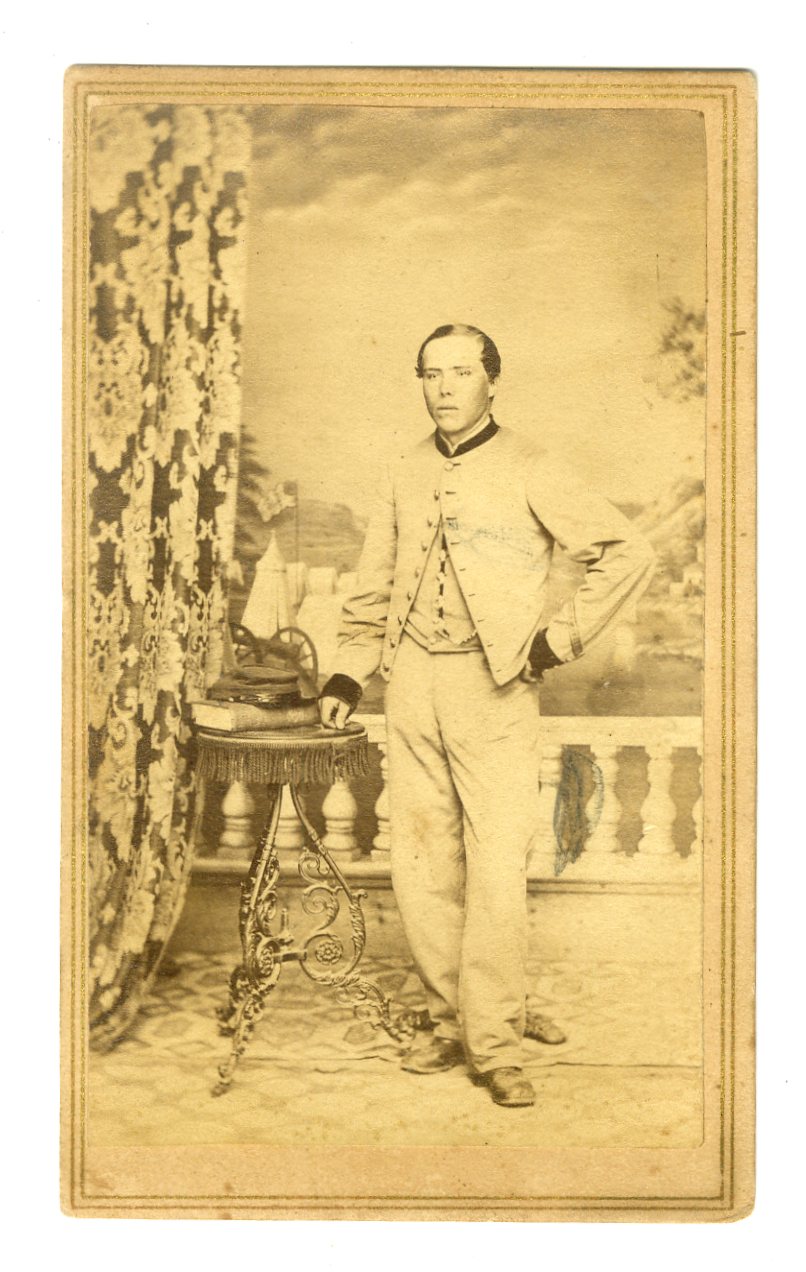
CWCDV1498. Jno. Holyland, Washington, DC. Unidentified VRC soldier before studio Civil War backdrop. VG. $150
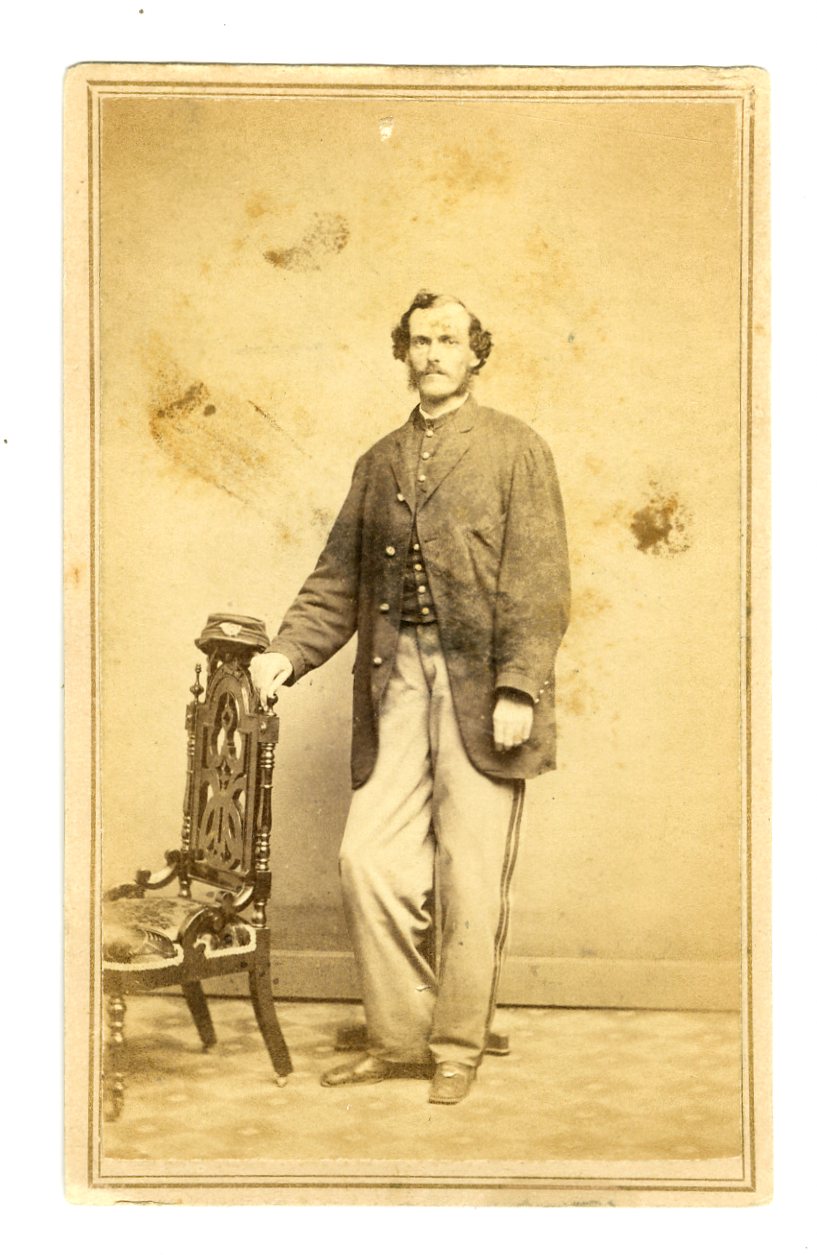
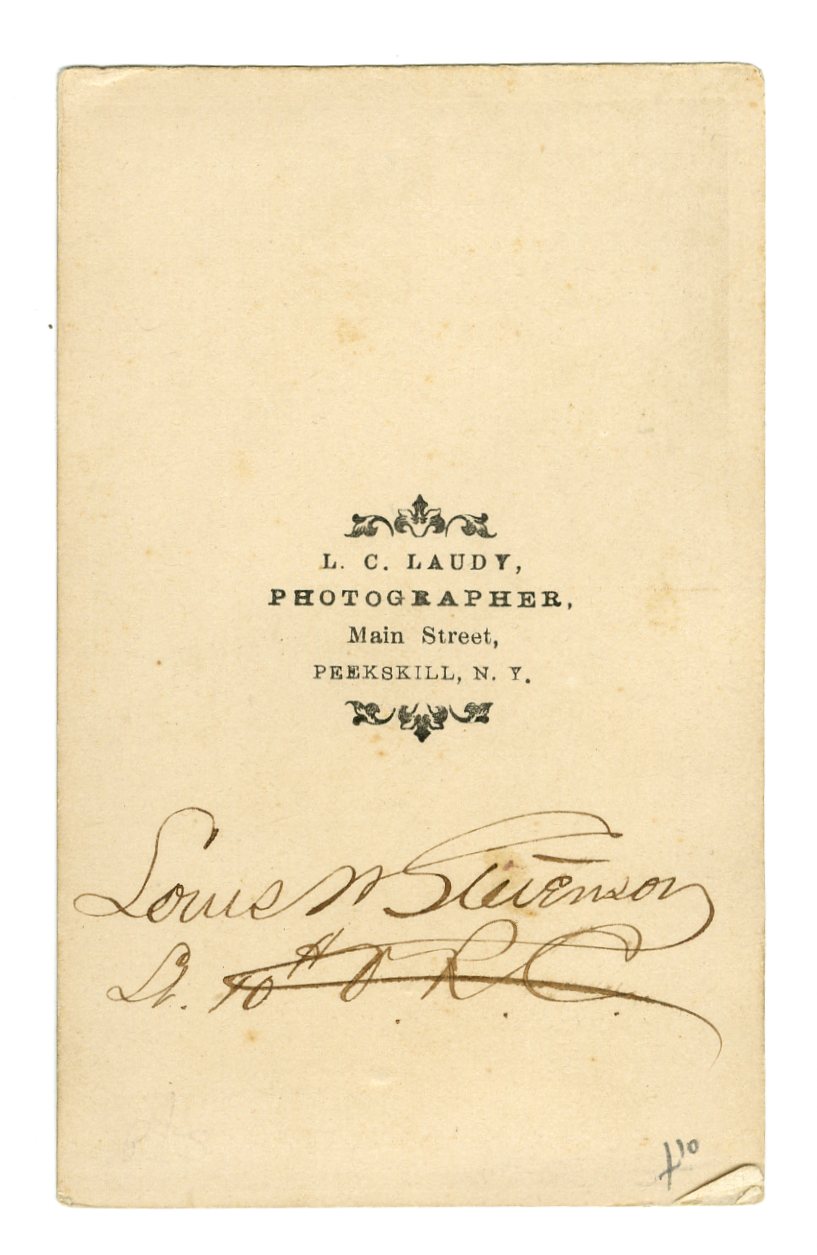
CWCDV1509. L.C. Laudy, Peekskill, NY. Signed on verso “Louis W. Stevenson Lt. 10th V.R.C.” 28 years old. Enlisted on 12/18/1862 at Brooklyn, NY as a 2nd Lieutenant. On 12/18/1862 he was commissioned into “B” Co. NY 176th Infantry. He was Mustered Out on 8/8/1864 He was listed as: * POW 6/23/1863 Brashear City, LA * Paroled 7/24/1864 (place not stated). [The following is from a sales posting by The Horse Soldier in 2005 when they were offering for sale a group of items belonging to Stevenson, including his letter about the execution of Wirz]. “Stevenson was captured & wounded 6/25/63 at Brashier, LA in an engagement with the enemy & held as a POW until approximately 7/22/64. In April 1865 he was appointed 2nd Lt. 10th Regt. Vet. Reserve Corps, serving with that unit until 2/2/68 when he was discharged. While a POW, Stevenson was confined at Camp Ford, Tyler, TX. The wound he received at Brashier City is listed in the records as “wounded in the ankle by a ball.” Stevenson’s pension records indicate that while at Tyler, TX he became very weak & generally incapacitated & when released was on crutches and very weak.” Stevenson wrote an important letter detailing his eyewitness account of the death of Henry Wirz, Commandant of Andersonville Prison. Again, from the sales post by the Horse Soldier: “He was executed in Nov. ’65 by the Federal Gov’t for his part in permitting Andersonville’s intolerable conditions. He was the only officer to be executed for war crimes. Stevenson writes a fantastic 2 page letter, 8″ x 10,” in ink. . . . Letter date lined ‘General Court Martial Rooms Washington DC, Nov. 10, 1865. Dear Aunt: The fiat has gone forth & the miserable wretch Wirz is no more. I & my friend Foot were the first on the ground, long before the outsiders were admitted. The troops were formed in a square around the scaffold (214 & 195th Penn V.). The V.R.C. as usual did the honors-waited on him – & acted as body guard – escort. There were crowds of people all around the prison-tops of houses & tree tops were filled-with soldiers. Everything was done in a very orderly manner. Wirz, behaved in the coolest manner. He walked with a firm step up the steps, took his seat on the platform, & while the charges, etc. were being read conversed with his counsel in a quiet cool manner. He refused to say anything to the public, shook hands with all on the platform, & then stood up for the adjustment on the rope – a piece of which I cut off & enclose. Some of the soldiers in the top of the trees just as he swung, sang out ‘Andersonville’-others from …. sang out disparaging remarks, which would not look well in writing. The day was lively-the Goddess of liberty looked down on him from the dome of the Capital, very approvingly which added solemnity to the occasion.” The sales post by the Horse Soldier also indicates that Stevenson attended Lincoln’s funeral, although it does not state where. G. $250
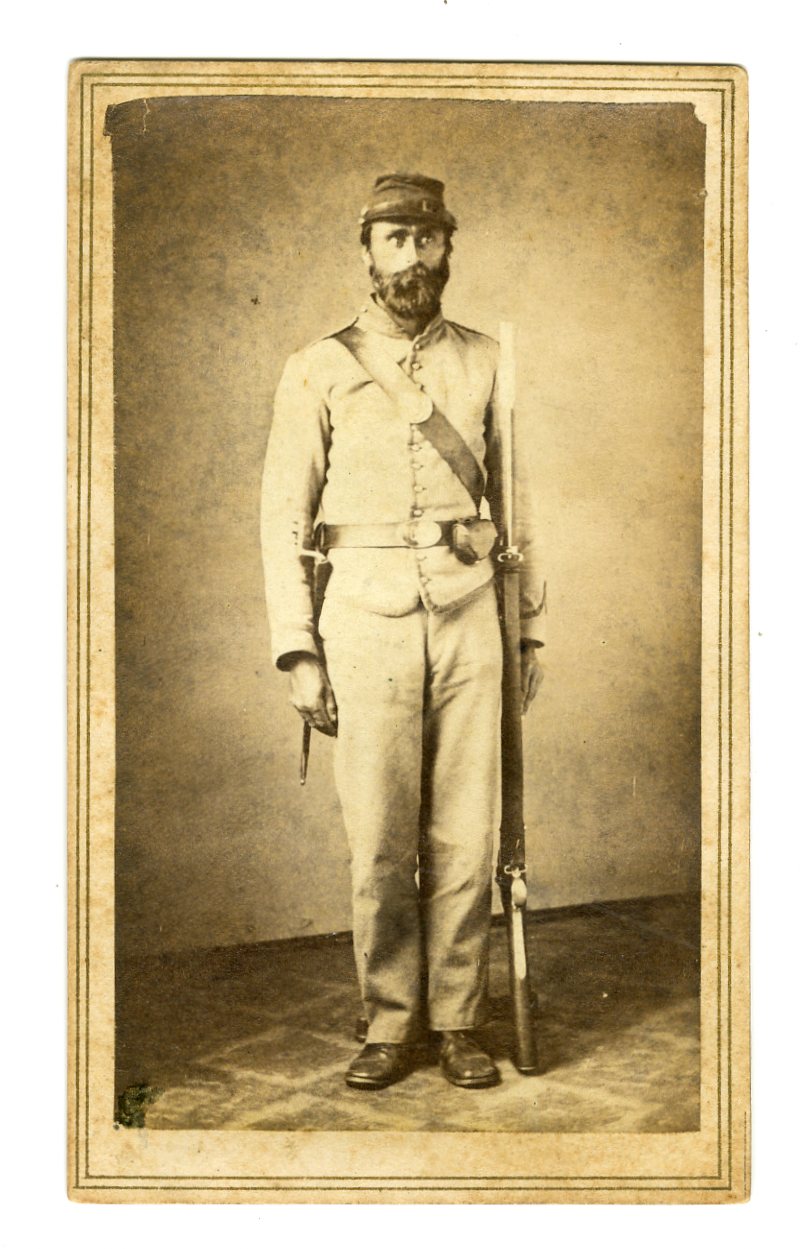
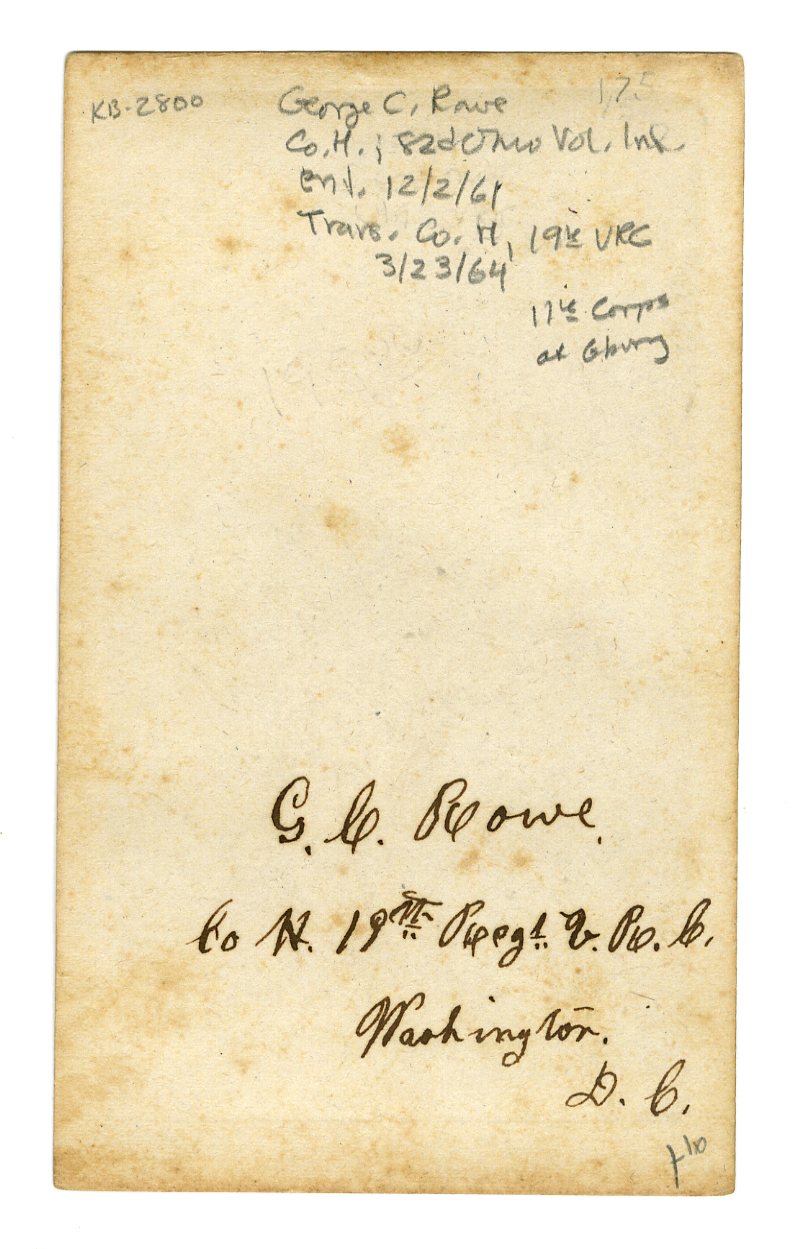
CWCDV1511. No photographer ID. Signed on verso “G.C. Rowe Co. H 19th Regt. V.R.C. Washington, DC.” George C. Rowe. Residence was not listed; 35 years old. Enlisted on 12/2/1861 as a Private. On 12/2/1861 he mustered into “B” Co. OH 82nd Infantry. He was transferred out on 3/23/1864. On 3/23/1864 he transferred into “H” Co. Veteran Reserve Corps 19th Regt (date and method of discharge not given).
The 82 Ohio Infantry was organized at Kenton, Hardin County, from Oct. to Dec., 1861, to serve for three years, with an aggregate of 968 men. In Jan., 1862, it moved for Western Virginia, and was first under fire at the battle of Bull Pasture Mountain. It joined in the pursuit of Jackson up the valley; fought in the Battle of Cross Keys, was also present at Cedar Mountain, and participated in a sharp skirmish at Freeman’s Ford. The destruction of Waterloo Bridge being ordered, the work was entrusted to this regiment and a select party dashed forward under a brisk fire, ignited the timbers, and in a few moments the work of destruction was complete. At the Second Bull Run the regiment lost heavily. It went into winter quarters at Stafford Court House and in the following April moved on the Chancellorsville Campaign. In the battle of that name it moved steadily into the entrenchments and opened a rapid fire upon the advancing foe. As the enemy swept around the flanks of the regiment it was forced to retreat and when it reached its new position only 134 men were with the colors. It was on duty in the trenches or on the picket line until the army commenced to retire. The regiment went into action at Gettysburg with 22 commissioned officers and 236 men, of whom 19 officers and 147 men were killed, wounded or captured, leaving only 3 officers and 89 men; but this little band brought off the colors safely. In the autumn following the regiment was ordered to join the Army of the Cumberland and at Wauhatchie, Tenn., it led the advance up the steep and rugged slope, driving the Confederates from the summit. It was held in reserve during the engagement at Orchard knob, but it moved up under a heavy fire from the batteries on Missionary ridge and assisted in the skirmishing which followed that engagement, and in building the entrenchments. In November it moved to the relief of Knoxville, but Longstreet having raised the siege it returned to Lookout Valley. There, of 349 enlisted men present, 321 were mustered into the service as veteran volunteers in Jan., 1864. After a furlough home the regiment, rejoined its brigade in March and soon afterward entered upon the Atlanta Campaign. It participated in the charge at Resaca, but sustained little loss, as the enemy was too much surprised and embarrassed to fire effectively. It was one of the first regiments in position at Peachtree Creek and lost not less than 75 in killed and wounded. During the siege of Atlanta it held an important and exposed position on a hill adjoining Marietta Street, being within range both of artillery and musketry, and on one occasion a cannon shot carried away the regimental colors, tearing them to shreds. The regiment remained in camp at Atlanta, engaged in work on the fortifications for a time, and then started with Sherman’s army for Savannah. It met with nothing worthy of particular note until Wheeler’s cavalry was encountered at Sandersville, where one company assisted in dislodging the enemy. The regiment moved on the Carolinas Campaign and performed its full share of marching, foraging and corduroying. It participated in the affairs at Averasboro and Bentonville, having 10 men wounded in the former and in the latter 11 wounded and 14 missing. It was mustered out on July 24, 1865. The regiment is honored by a monument at Gettysburg. VG. $450

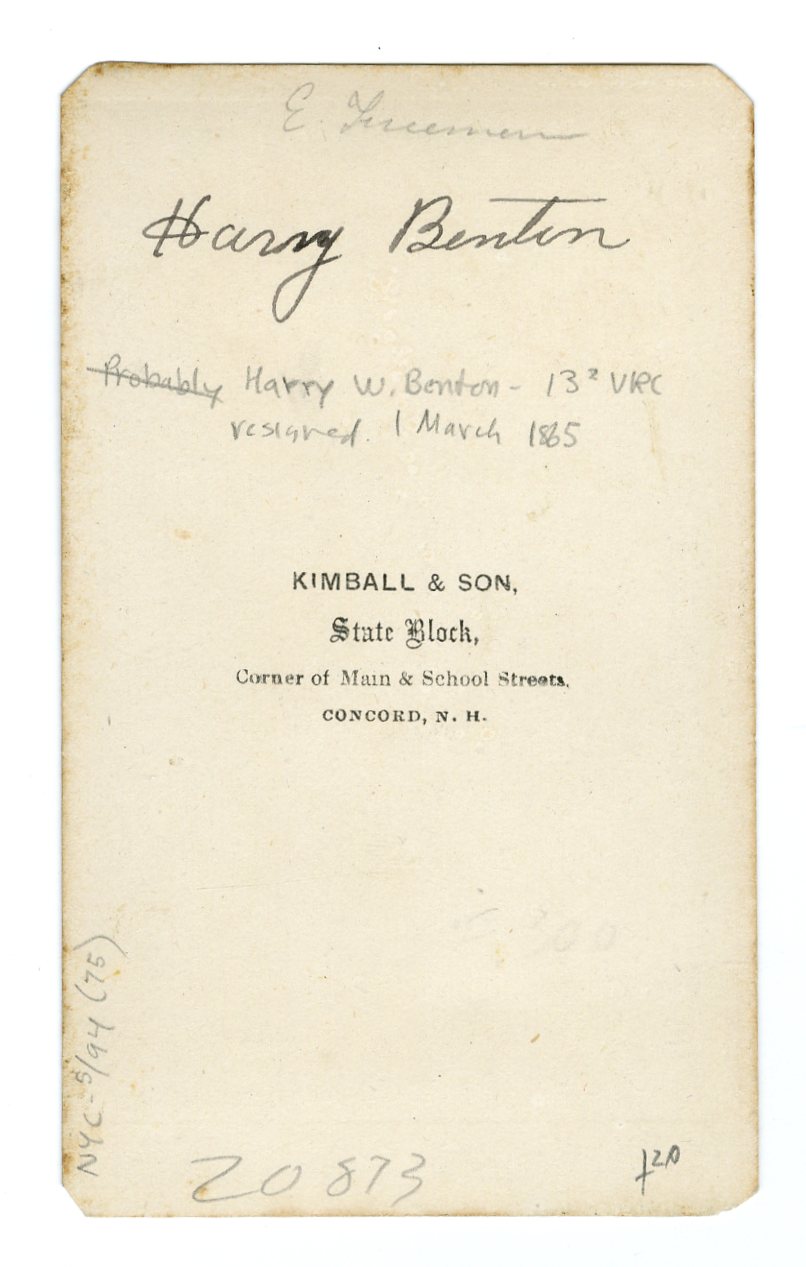
CWCDV1513. Kimball & Son, Concord, NH. Written on verso, possibly signed “Harry Benton.” Also the word “probably” crossed out. Accompanied by print out from Henry Deeks indicating that Benton was involved in organizing the first company of the Invalid Corps. VG. $250
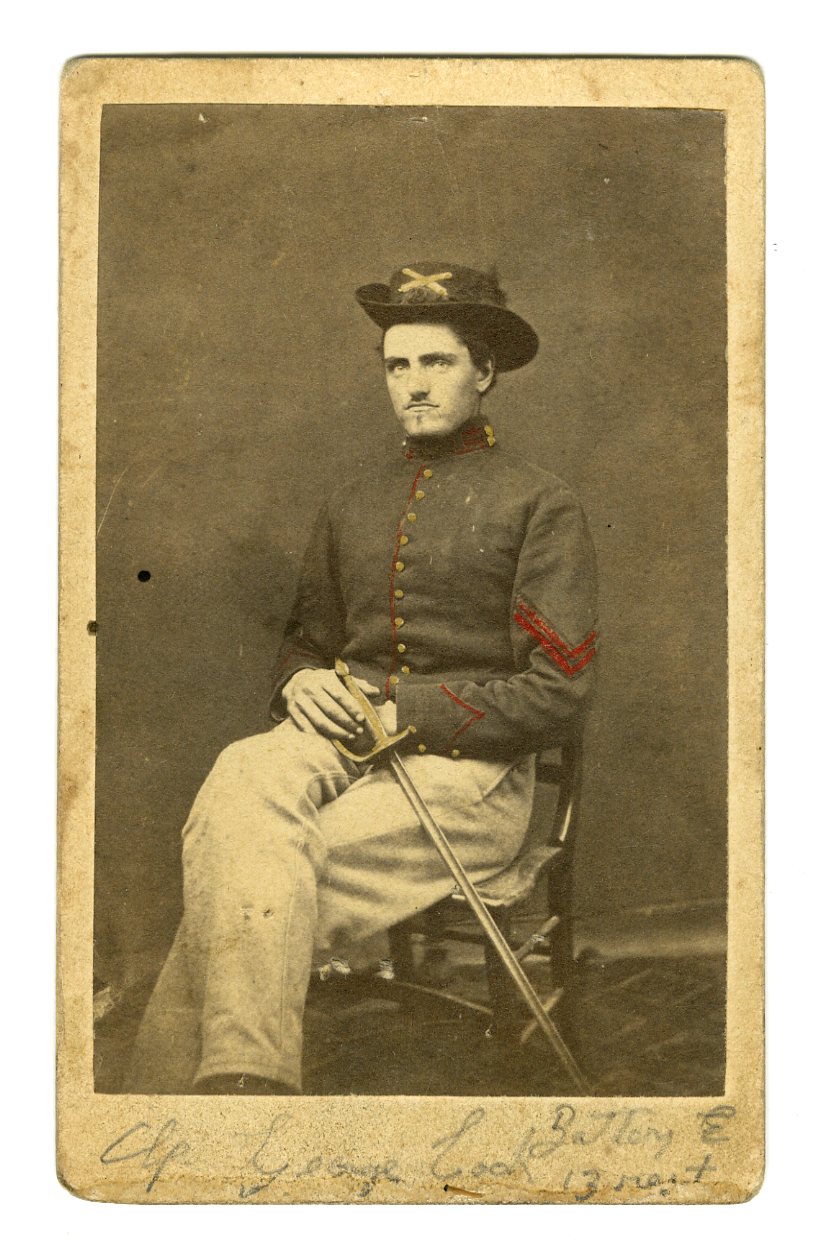
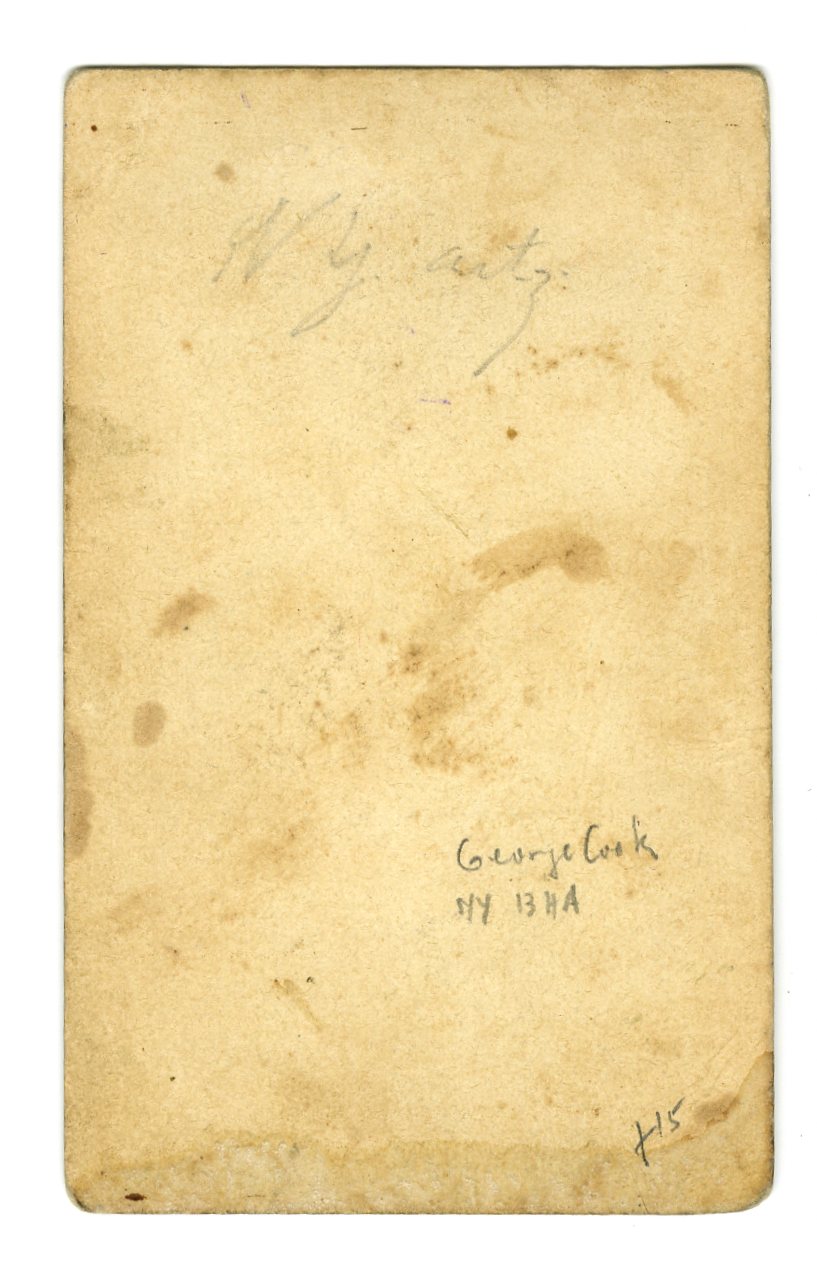
CWCDV1515. No photographer ID. Inscribed bottom recto Cpl. George Cook, Battery E, 13 regt. Residence was not listed; 19 years old. Enlisted on 1/5/1864 at Ephratah, NY as a Private. On 3/10/1864 he mustered into “E” Co. NY 13th Heavy Artillery. There is no info in his listing about a promotion so not certain of the ID. He was Mustered Out on 7/18/1865 at Norfolk, VA. Tinted chevrons. G. $200
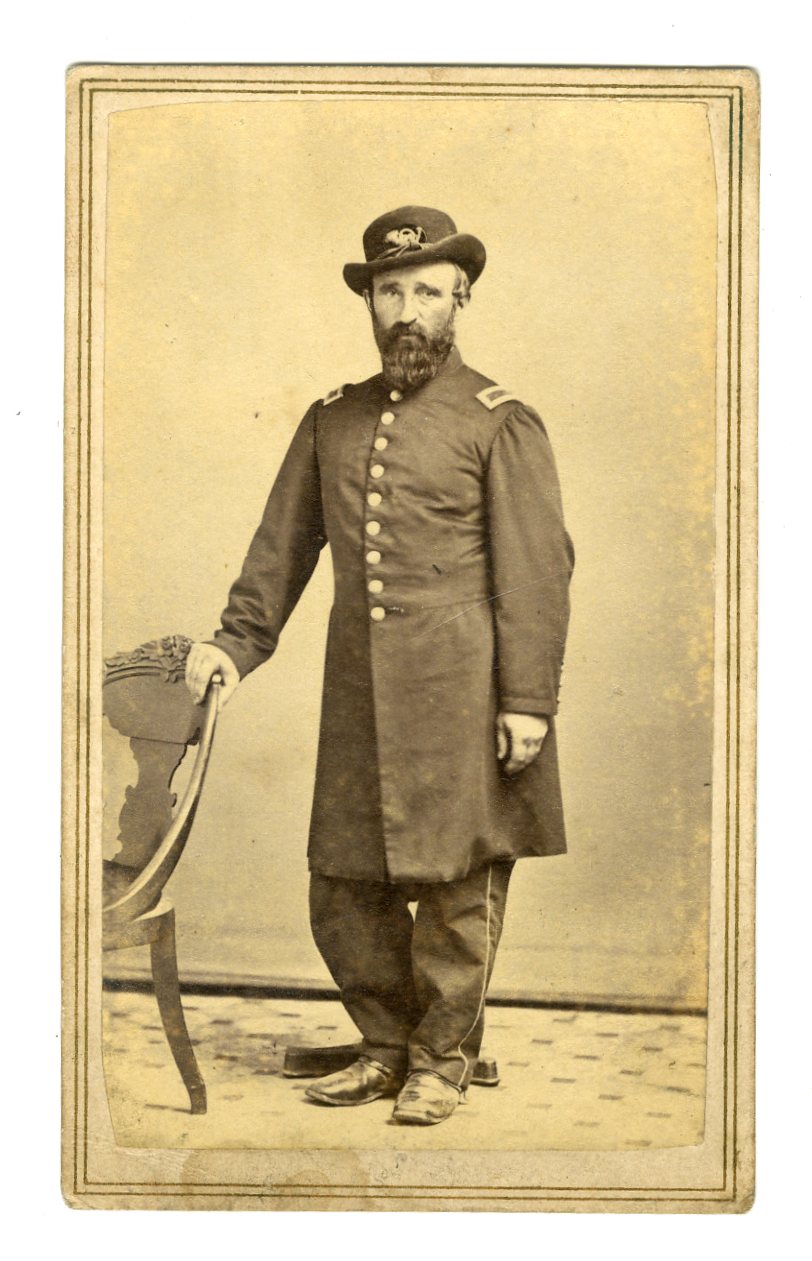
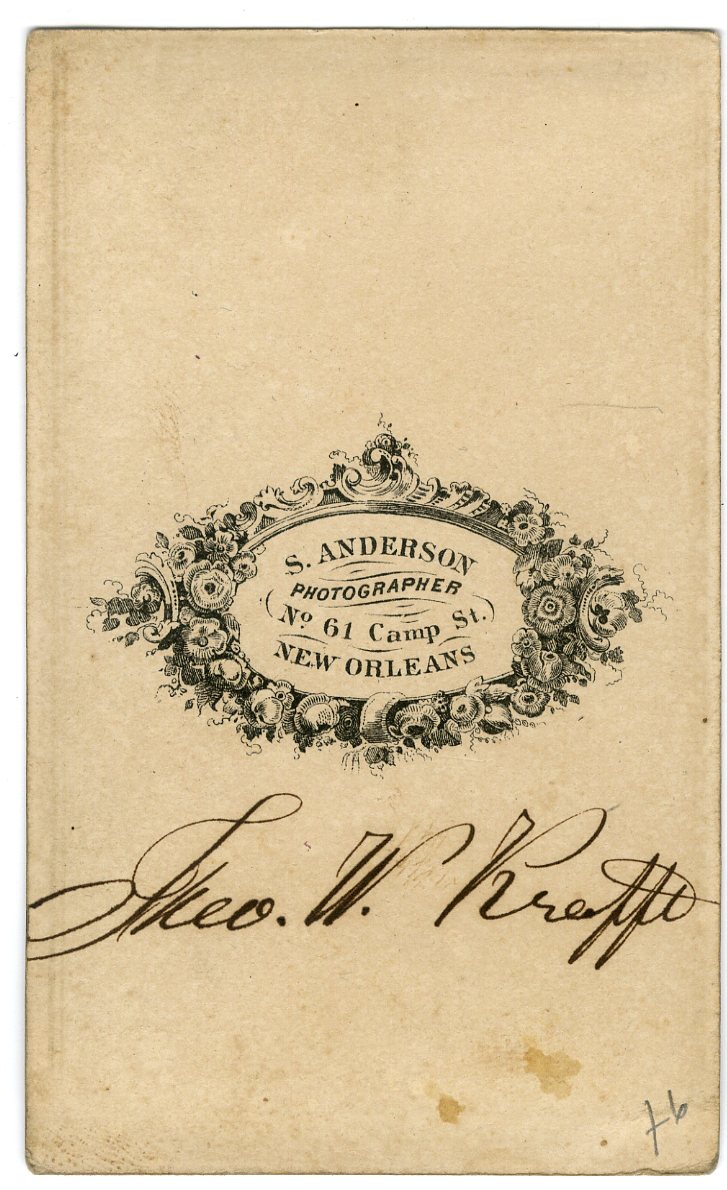
CWCDV1554. CDV by S. Anderson, New Orleans, La. Signed on verso “Theo. W. Kraft.” Theodore W. Kraft. Enlisted on 8/9/1862 at Ghent, NY as a Corporal. On 8/11/1862 he mustered into “A” Co. NY 128th Infantry. He was Mustered Out on 7/12/1865 at Savannah, GA. He was listed as: * Wounded 10/19/1864 Cedar Creek, VA * Paroled 2/22/1865 (place not stated). Promotions: * Sergt 4/30/1863 * 2nd Lieut 9/6/1863 * 1st Lieut 6/17/1865. He also had service in: NY 165th Infantry (Prior service). Other Information: died 6/1/1895. Buried: Chatham Rural Cemetery, Chatham, NY. (Buried with: Dorothy M. Hogeboom, Wife, Mar 14, 1898, 82; Theodore W. Jr. 1848-1884; Elizabeth Cheever, Wife of Theodore Jr.). VG. $200
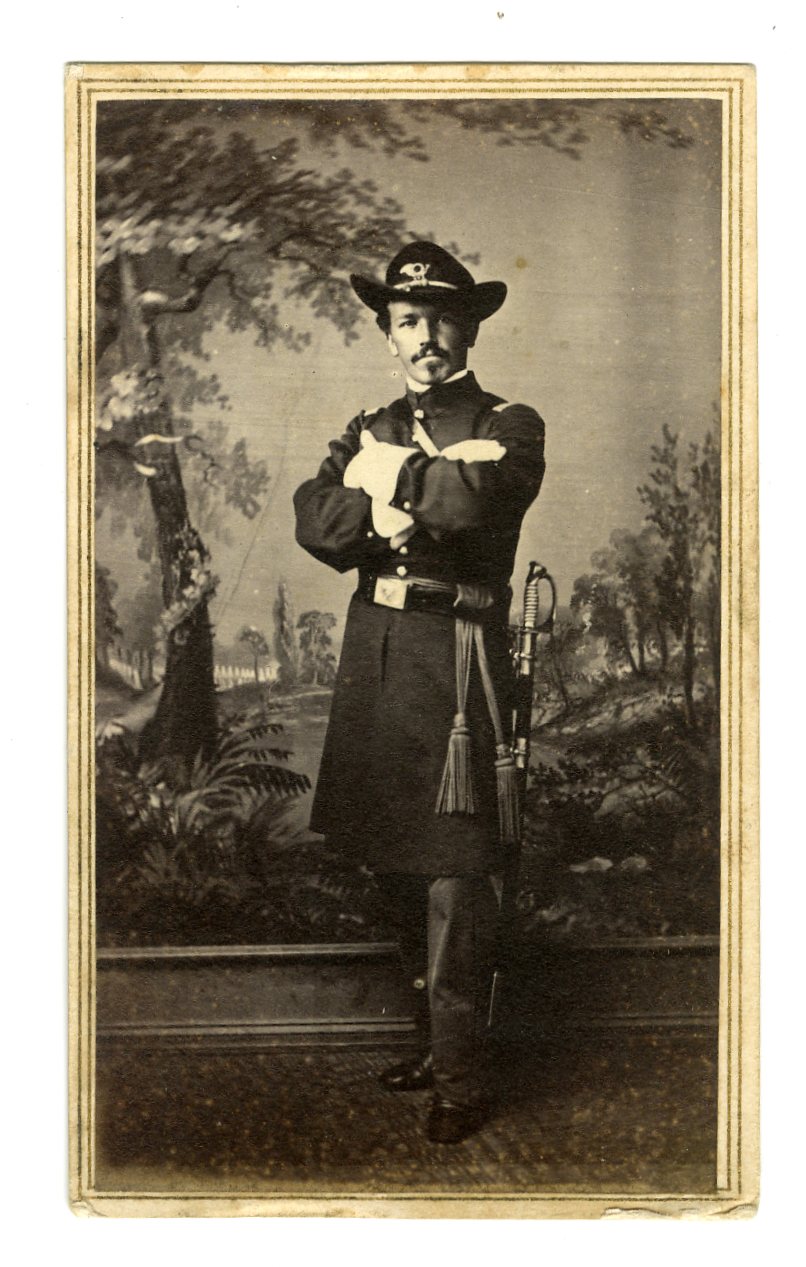
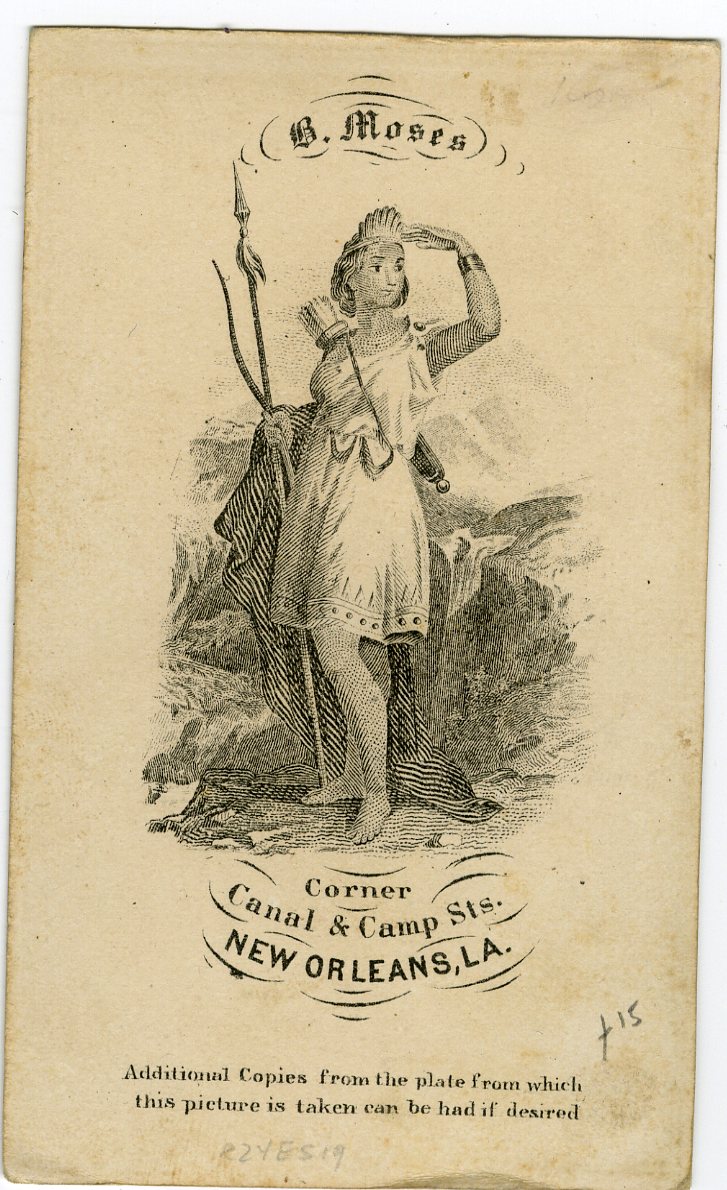
CWCDV1555. S. Moses, New Orleans, La. I received the following from collector and researcher Dale Baur: “Charles P. Wilson served as an enlisted man in company B of the 18th Ohio (3 month unit) and later company F, 79th Ohio. If you go to the ‘Civil War Index’ and its listing for the 79th Ohio and then click on its ‘roster’ you will find notation that Wilson was promoted to 2nd Lieutenant in the 90th US Colored Infantry. It served in LA and the notation I made on the image I recorded was that it carried a Moses, New Orleans photographer’s backmark. Unfortunately I do not recall where I happened upon the image (most likely it was just randomly in the course of doing Civil War research on-line). I recorded it because I was tracking and recording images with documented painted backdrops and if the soldier was identified I recorded that too. Hope this helps.” VG. $250
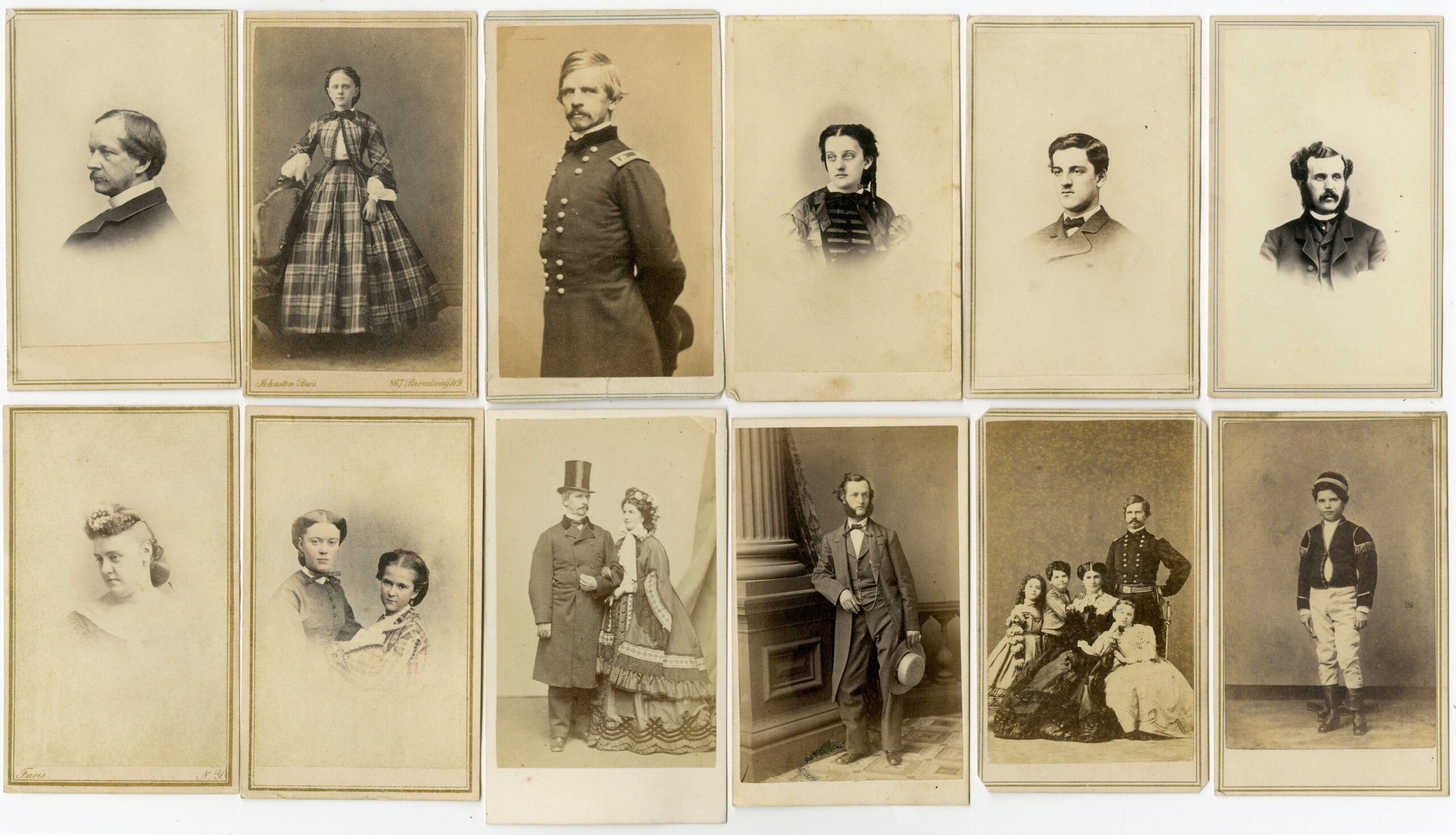

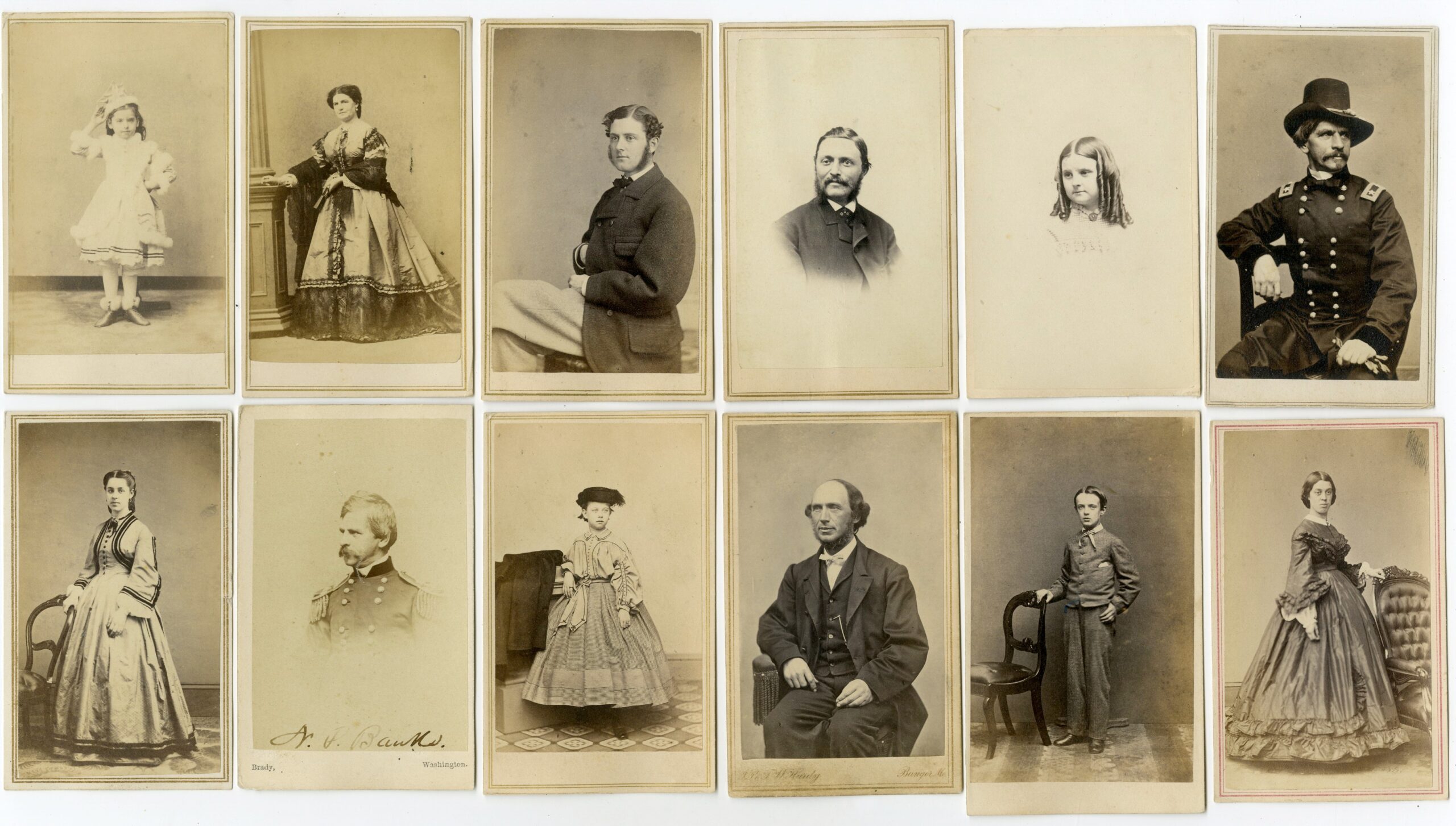
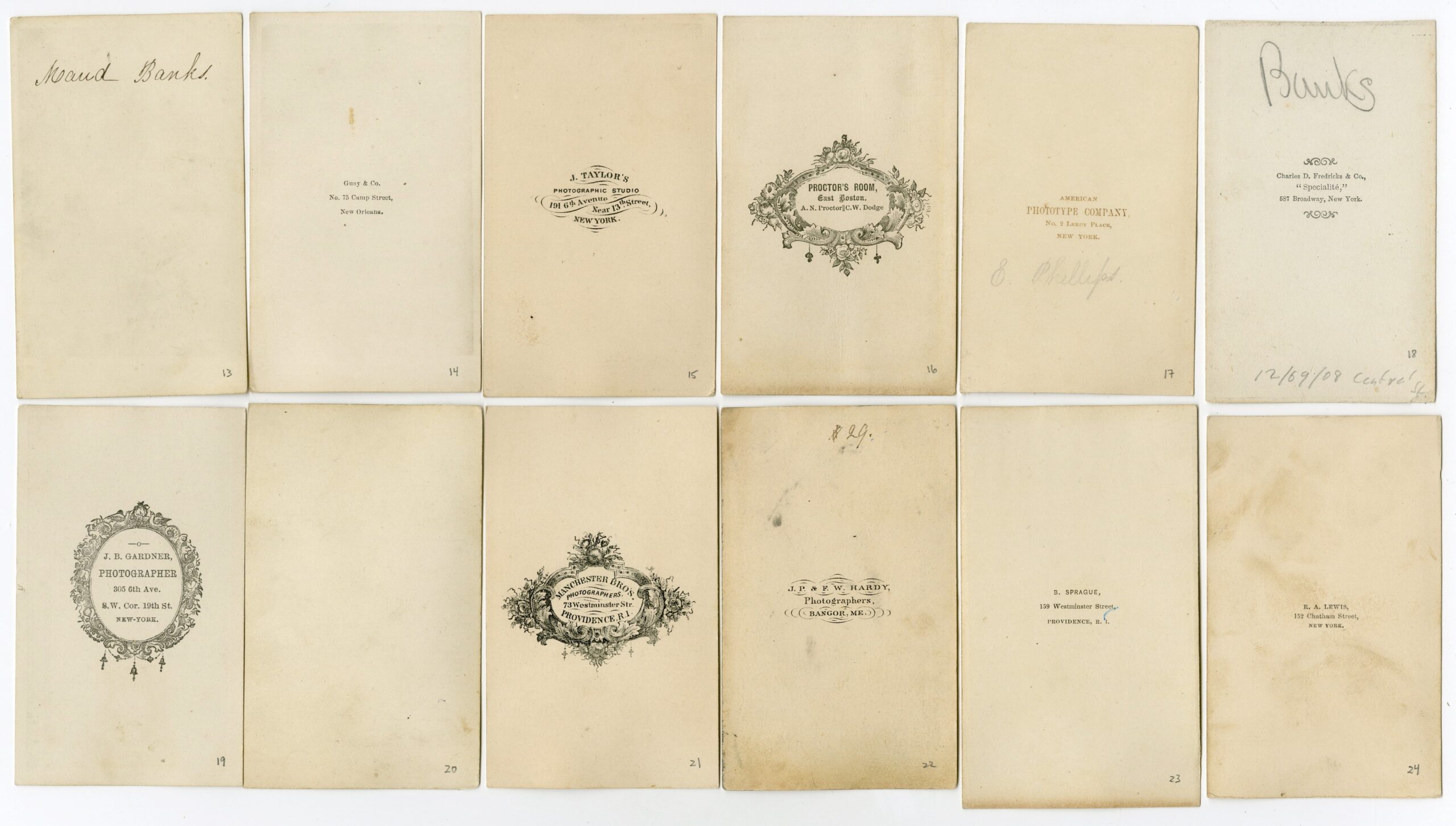
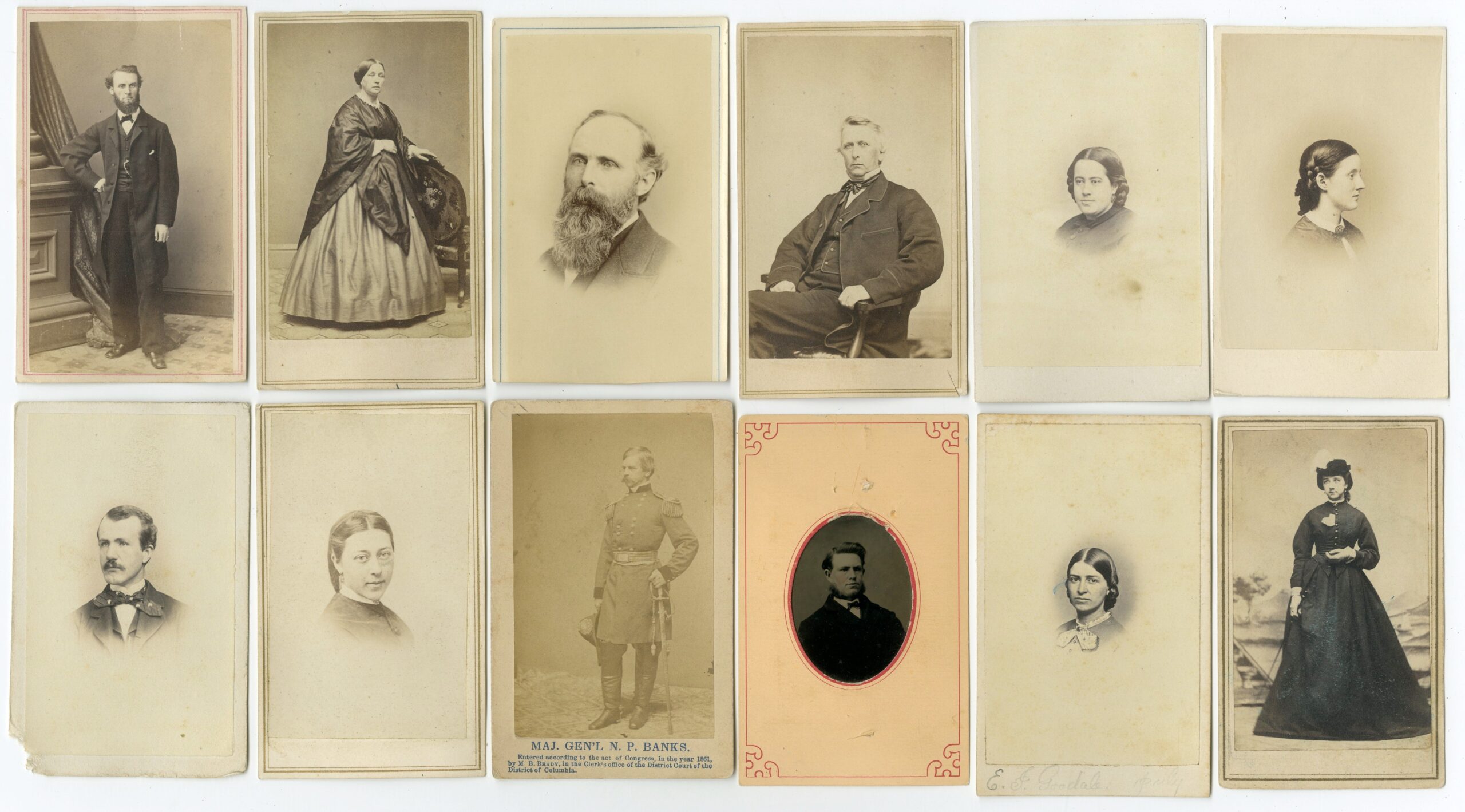
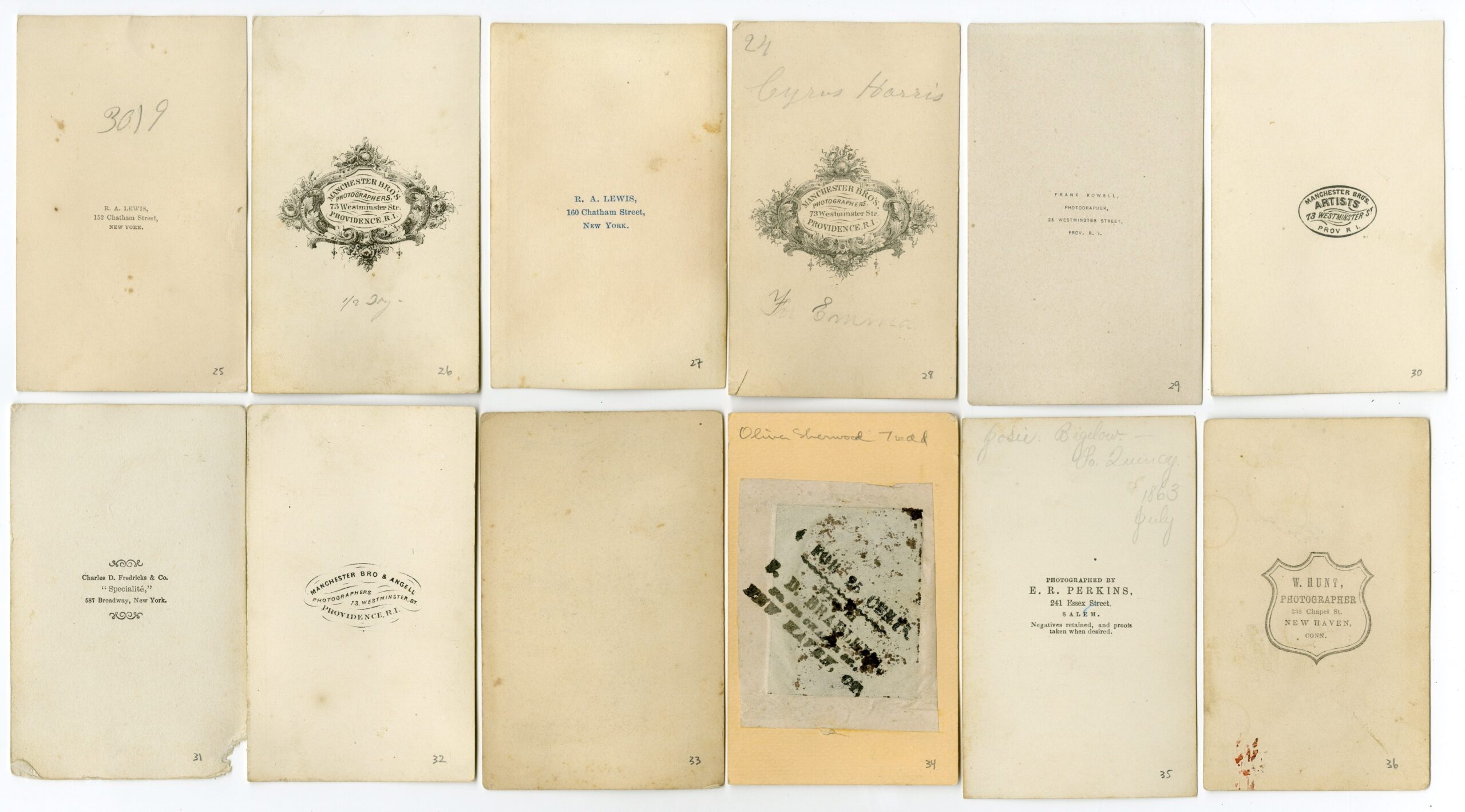
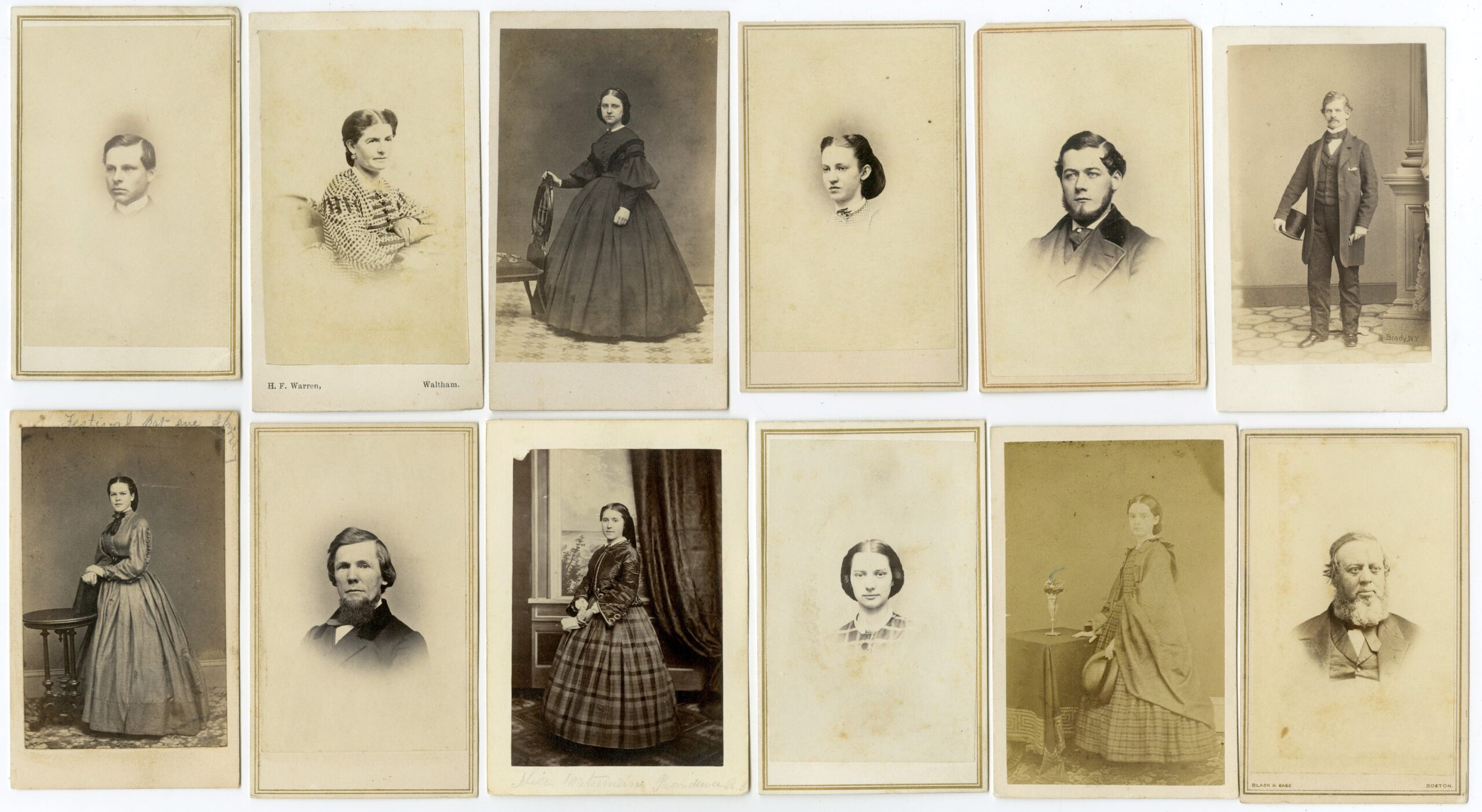
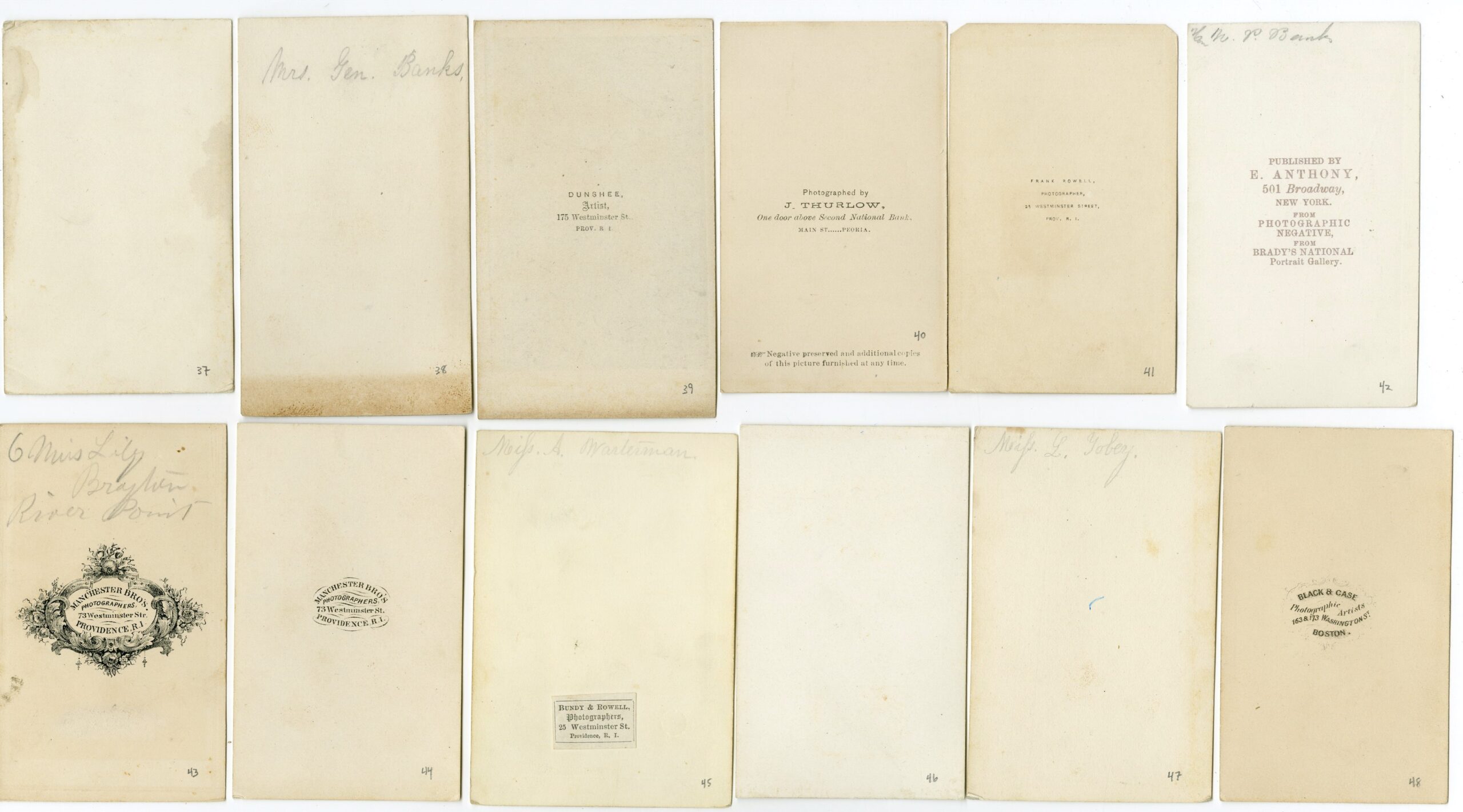
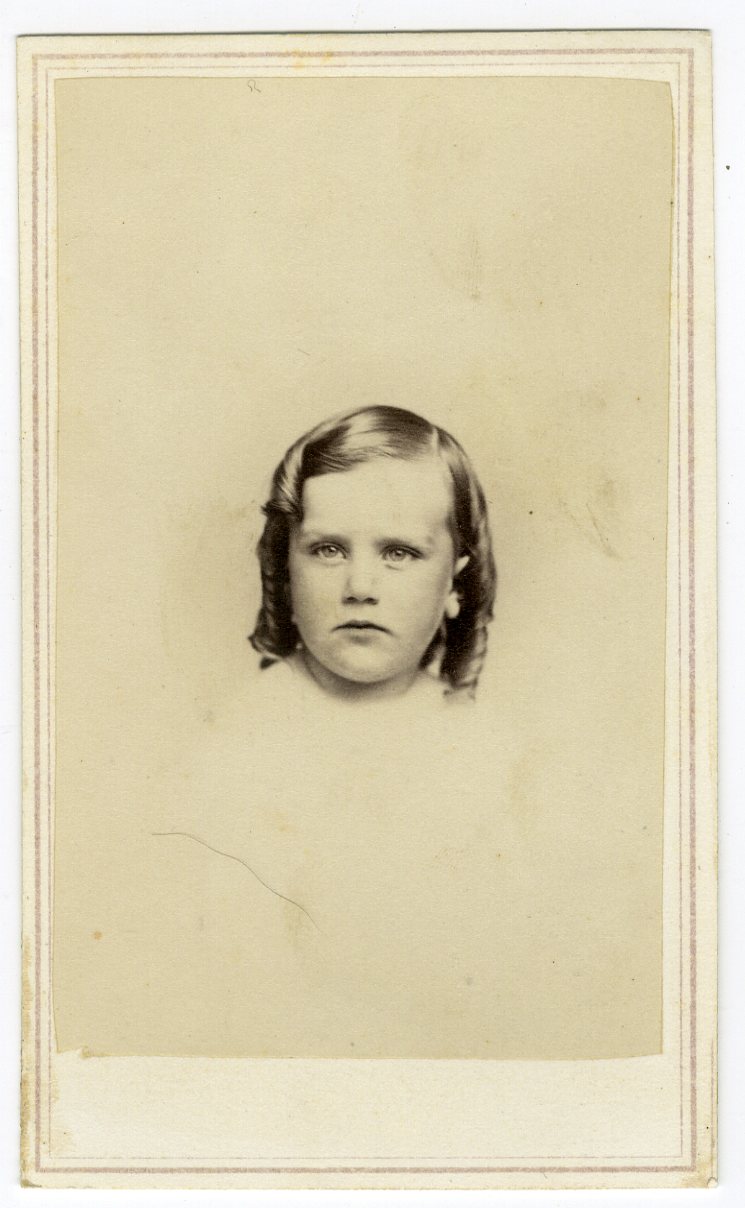
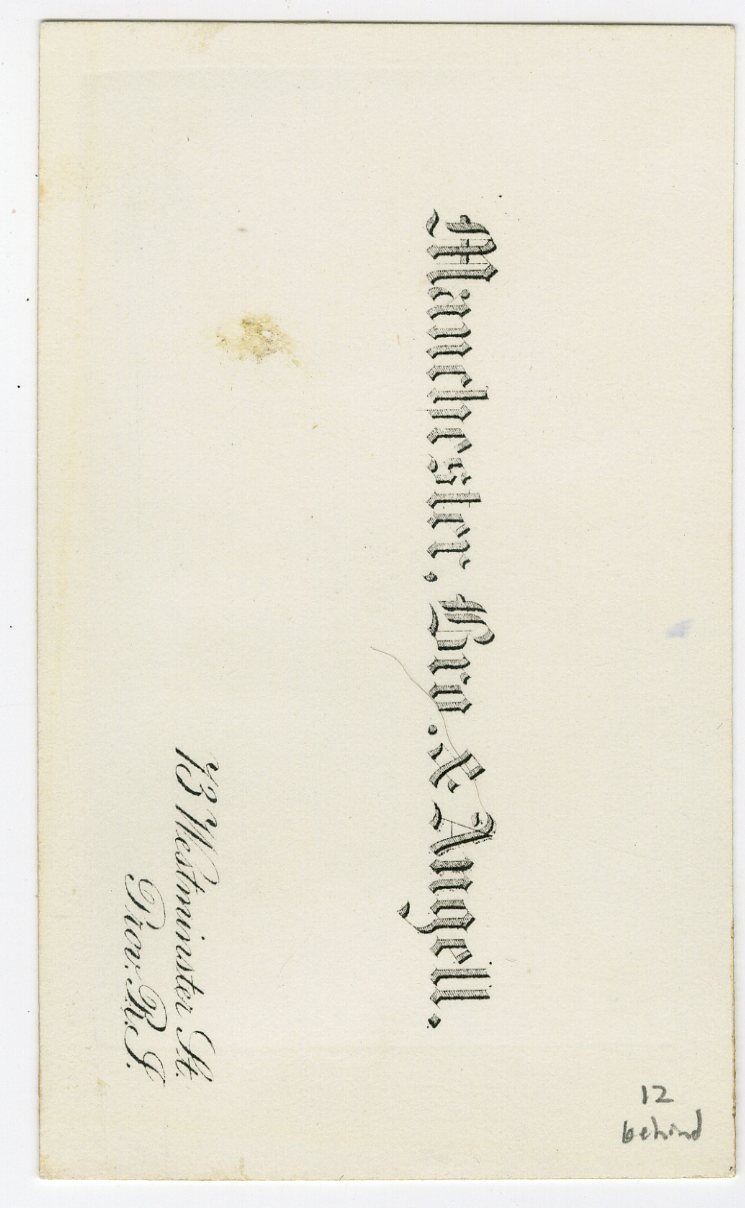

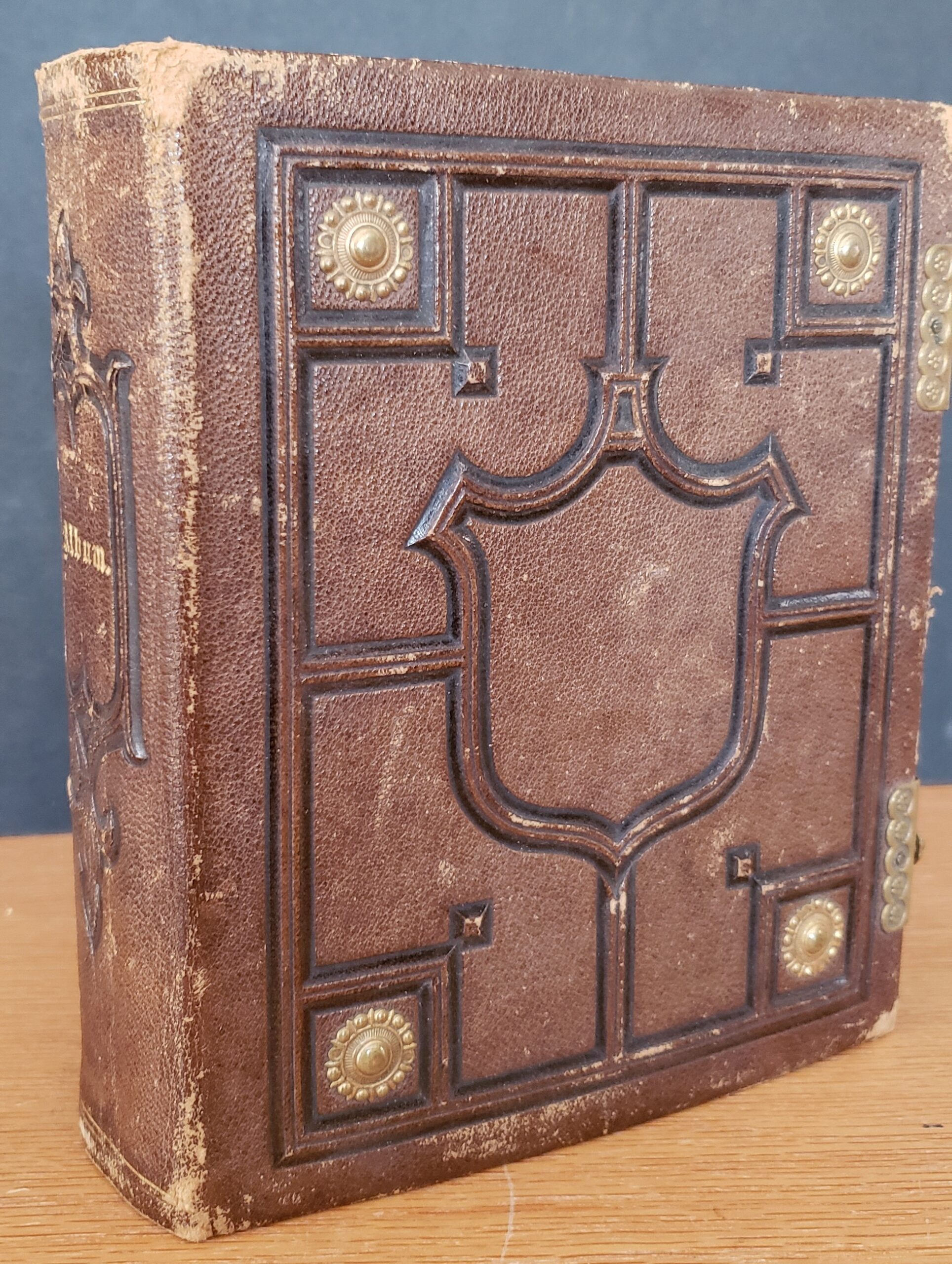
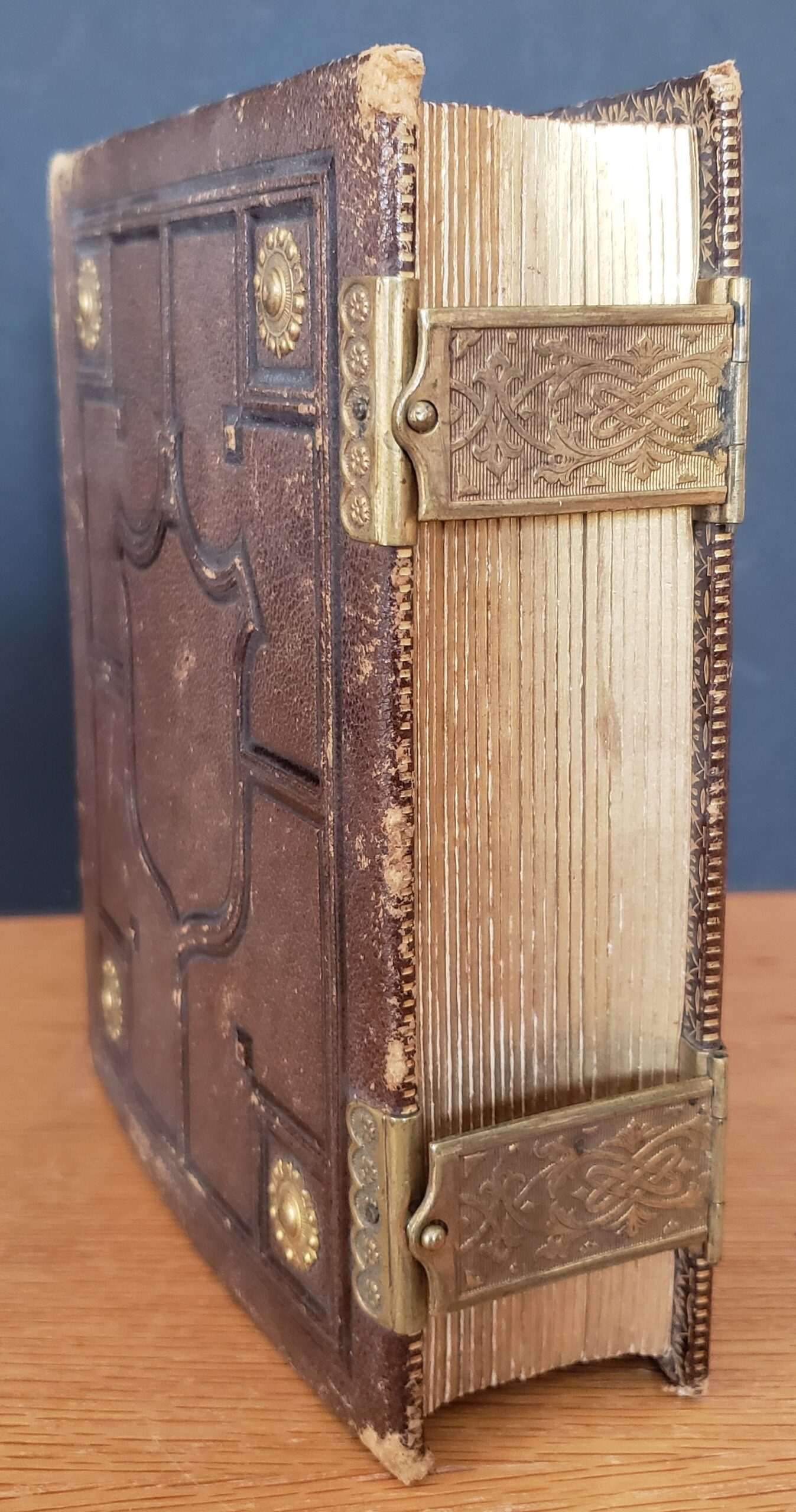
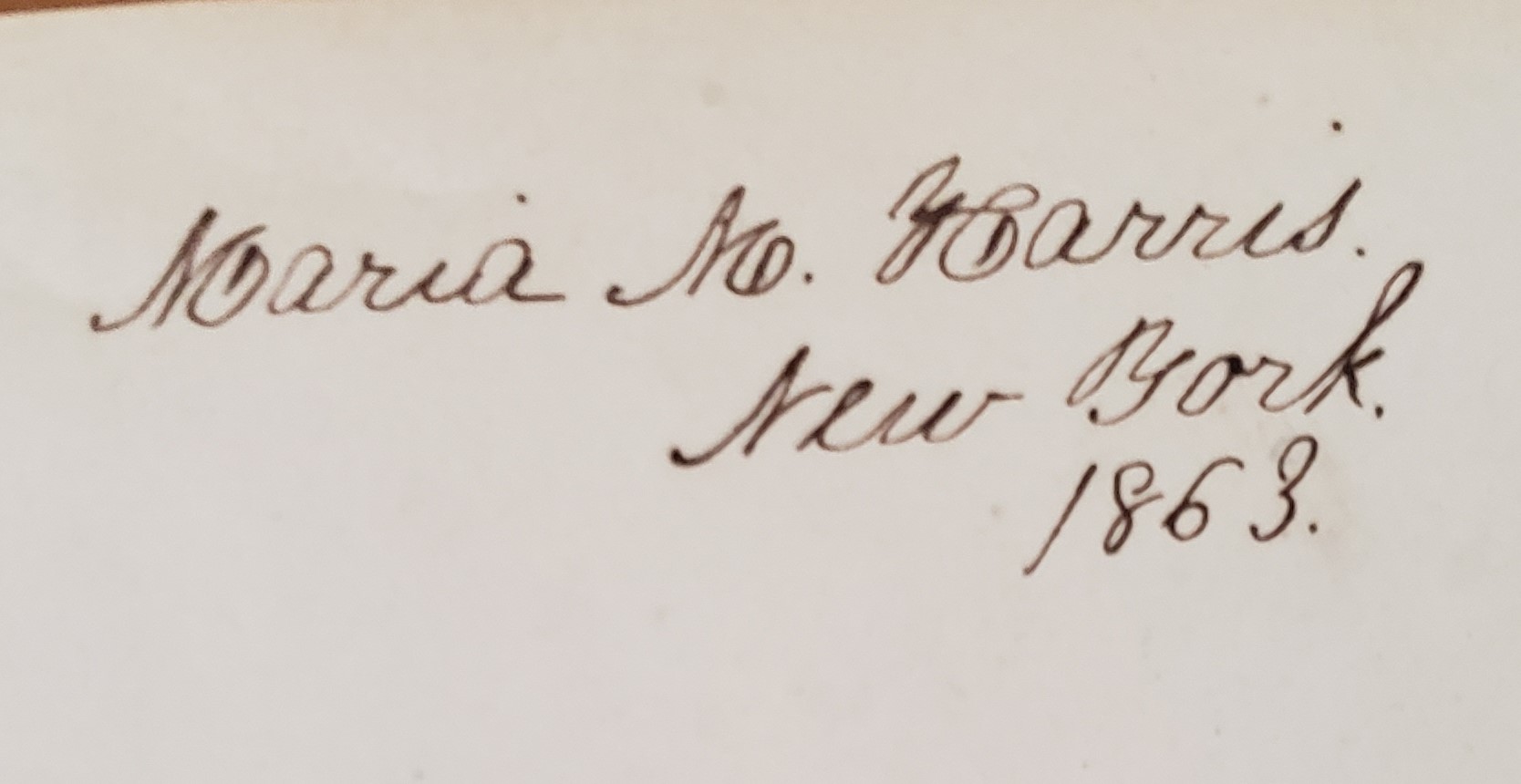
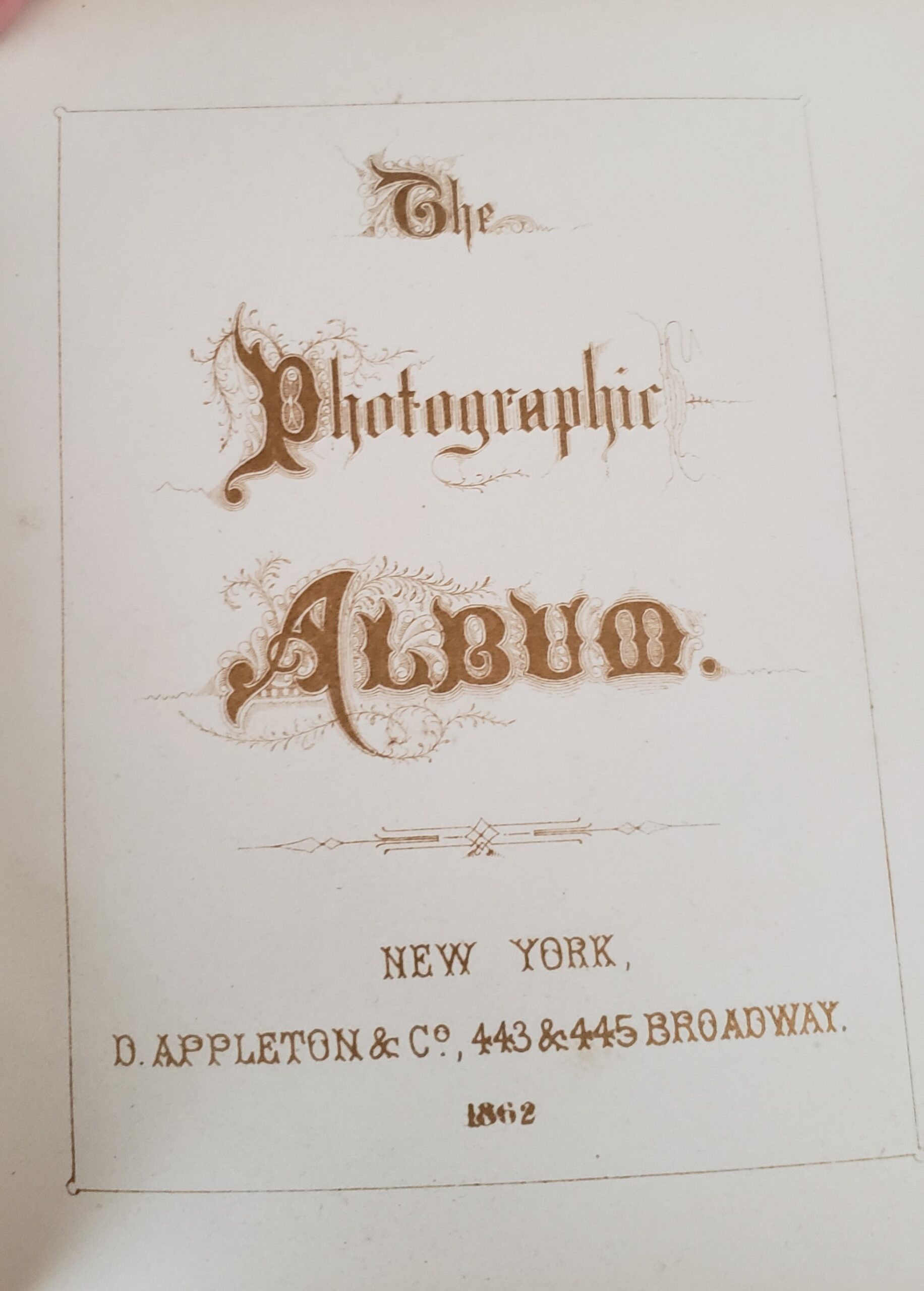
CWALB13. Nathaniel Banks family album. This album is original and intact. There are 48 slots for images and there are 49 images, as one image had a CDV behind another. The album is annotated with many names beneath the images. I have removed all of the images from the album and noted their places in the album by consecutively numbering them in the lower right versos. Each of the images above is described here. Each scan is described from top left, across, then bottom left, and across. There are many images of Nathaniel Banks, including one signed image, as well as members of his family. I assume the others are family friends, etc.
Inscription on front page: “Maria M. Harris, New York 1863.”
“The Photographic Album. New York. D. Appleton & Co., 443 & 445 Broadway. 1862.”
First and second scans:
Inscription in German above first CDV. (cannot make it out).
- Unidentified gentleman by Manchester Bros. & Angell, Photographing House, 73 Westminster Street, Prov. R.I.
- Fannie Martin, N.Y. by Johnston Bros., 867 Broadway, New York.
- Nathaniel Banks, by Charles D. Fredricks & Co., “Specialite,” 587 Broadway, New York. 1” split at left bottom of card.
- Ella Childs by Johnson, Williams & Co., Photographers, Nos. 952, 954 & 956 Broadway, Cor. Madison Square, (23d St.), Opposite Fifth Ave. Hotel, New York.
- On verso “J.P.C. Jr. to M.M.H. Thanksgiving 1865.” At top of album page is written: ‘“Always keep your hand(s) in practice.” J.P.C. Jr. Sept. 8th, 1865.’ Beneath image: “John Crosby, N.Y.”
- Harry Williams, N.Y., by J.H. & J.L. Abbott, Photographers, 480 Broadway, Albany, N.Y.
- Fannie Brush, N.Y., by Faris, 751 Broadway.
- Unidentified woman and girl by George G. Rockwood, Photographer, 839 Broadway, New York.
- Gen. & Mrs. Banks, by Warren, Post Office Block, Cambridgeport, mass.
- Ned Slocum, N.Y. by R.A. Lewis, 152 Chatham St., N.Y.
- Gen. Banks Family, by E. Jacobs, 93 Camp St., New Orleans, La.
- Joe Banks, Wm. Guay, No. 75 Camp Street, New Orleans.
Third and fourth scans:
- Maud Banks, no backmark.
- Mrs. Banks, by Guay & Co., No. 75 Camp Street, New Orleans.
- Jim Platt, Oswego, N.Y.. by J. Taylor’s Photographic Studio, 191 6th Avenue near 13th Street, New York.
- George Rodeo, R.I. by Proctor’s Room, East Boston, A.N. Proctor/C.W. Dodge.
- Edith Phillips, N.Y., by American Phototype Company, No. 2 Leroy Place, New York.
- Banks, by Charles D. Fredricks & Co., “Specialite,” 587 Broadway, New York.
- Miss Chittenden, N.Y. by J.B. Gardner, Photographer, 305 6th Ave. S.W. Cor. 19th St., New-York.
- Signed “N.P. Banks,” by Brady, Washington.
- Unidentified young girl by Manchester Bros., Photographers, 73 Westminster Str., Providence, R.I.
- Unidentified gentleman by J.P. & F.W. Hardy, Photographers, Bangor, Me.
- Unidentified young man by S. Sprague, 159 Westminster Street, Providence, R.I.
- Mrs. Pease, R.I., by R.A. Lewis, 152 Chatham Street, New York.
Fifth & sixth scans:
- Mr. Pease, by R.A. Lewis, 152 Chatham Street, New York.
- Unidentified woman by Manchester Bros., Photographers, 73 Westminster Str., Providence, R.I.
- Unidentified gentleman, by R.A. Lewis, 160 Chatham Street, New York.
- Cyrus Harris, Uncle Cyrus, by Manchester Bros., Photographers, 73 Westminster Str., Providence, R.I.
- Sarah Anthony, by Frank Rowell, Photographer, 25 Westminster Street, Prov., R.I.
- Lillie Treat, by Manchester Bros., Artists, 73 Westminster St., Prov., R.I.
- Mr. Lawrence, N.Y., by Charles D. Fredricks & Co., “Specialite,” 587 Broadway, New York.
- Lucy Green, by Manchester Bro & Angell, Photographers, 73 Westminster St., Providence, R.I.
- Maj. Gen’l N.P. Banks, by M.B. Brady, Washington, DC. 1861 copyright line bottom recto.
- Oliver Sherwood, tintype by R.D. Bradley, New Haven, Ct.
- Josie Bigelow, So. Quincy, 1863, July, by E.R. Perkins, 241 Essex Street, Salem.
- Bettie Lee, New Haven, by W. Hunt, Photographer, 332 Chapel St., New Haven, Conn.
Seventh & eighth scans:
- Uncle Caleb, no backmark.
- Mrs. Gen. Banks, by H.F. Warren, Waltham.
- Rachel Brown, by Dunshee, Artist, 175 Westminster St., Prov. R.I.
- Julia Cockle, Ill., by J. Thurlow, One door above Second National Bank, Main St., Peoria.
- Martin Goohin, N.Y. by Frank Rowell, Photographer, 25 Westminster Street, Prov., R.I.
- N.P. Banks, from photographic negative from Brady’s National Portrait Gallery, published by E. Anthony.
- Miss Lily Brighton, River Point, by Manchester Bros., Photographers, 73 Westminster St., Providence, R.I.
- Prof. Lincoln, by Manchester Bros., Photographers, 73 Westminster St. Providence, R.I.
- Alice Waterman, by Bundy & Rowell, Photographers, 25 Westminster St., Providence, R.I.
- Julia Allen, Oswego, N.Y., no backmark.
- Miss Lillie Toby, R.I., no backmark.
- Mr. Anthony, R.I., by Black & Case, Photographic Artists, 163 & 173 Washington St., Boston.
Ninth & tenth scans:
- This CDV was behind the CDV of Joe Banks. It is an unidentified young man by Manchester Bro. & Angell, 73 Westminster St., Prov., R.I
Album is intact, clasps present. Overall VG. $2000
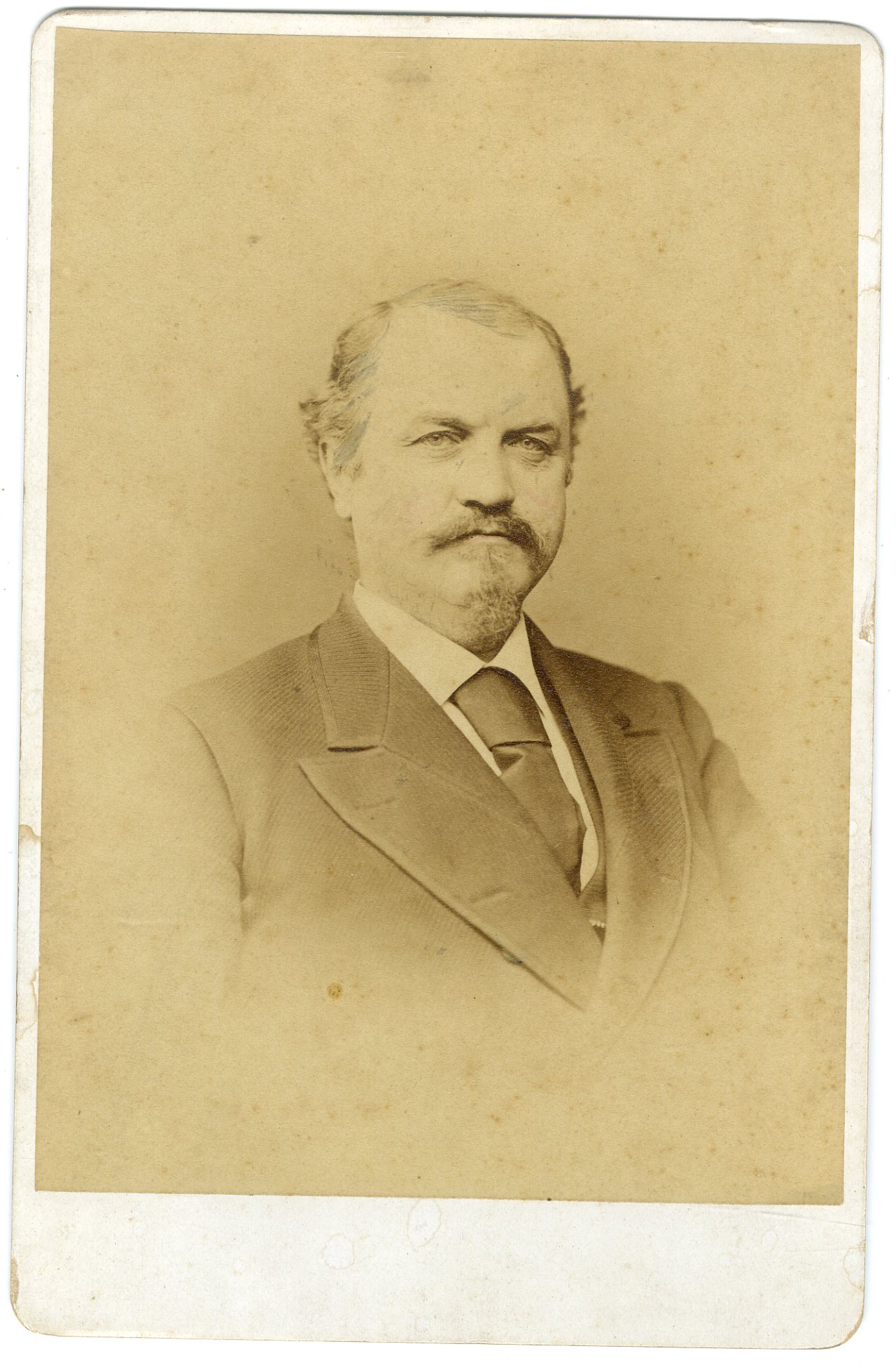


CWCAB37. Fine and unique Civil War pair of items regarding General William Woods Averell. The first item is a Cabinet Card of Averell later in life by Broadbent & Phillips, Philadelphia. The second item is a greeting to “Gen. Averell, A happy New Year to you & yours,” written in pen by Gen’l Fitz John Porter on one of his cards with his address printed as “68 West 68th Street.” The card measures 1.75″ x 3.25.” William Woods Averell (November 5, 1832 – February 3, 1900) was a career US Army officer and a cavalry general in the Civil War. He was the only Union general to achieve a major victory against the Confederates in the Valley Campaigns of 1864 prior to the arrival of Philip Sheridan, at the Battle of Rutherford’s (Carter’s) Farm and at the Battle of Moorefield. After the war, Averell was appointed by President Andrew Johnson as a diplomat to British North America, serving 1866 to 1869. Also an entrepreneur and inventor with interests in the coal, steel and related infrastructure industry, Averell became wealthy by inventing an improved technique for laying asphalt pavement. He co-wrote a history of the Third Pennsylvania Cavalry, Sixtieth Regiment Pennsylvania Volunteers during the Civil War years; it was published in 1905. He wrote a memoir of his Army years from 1851-1862 but did not publish it and the manuscript was lost for a time. It was discovered in the late 20th century and published in an annotated edition in 1978. VG. $175
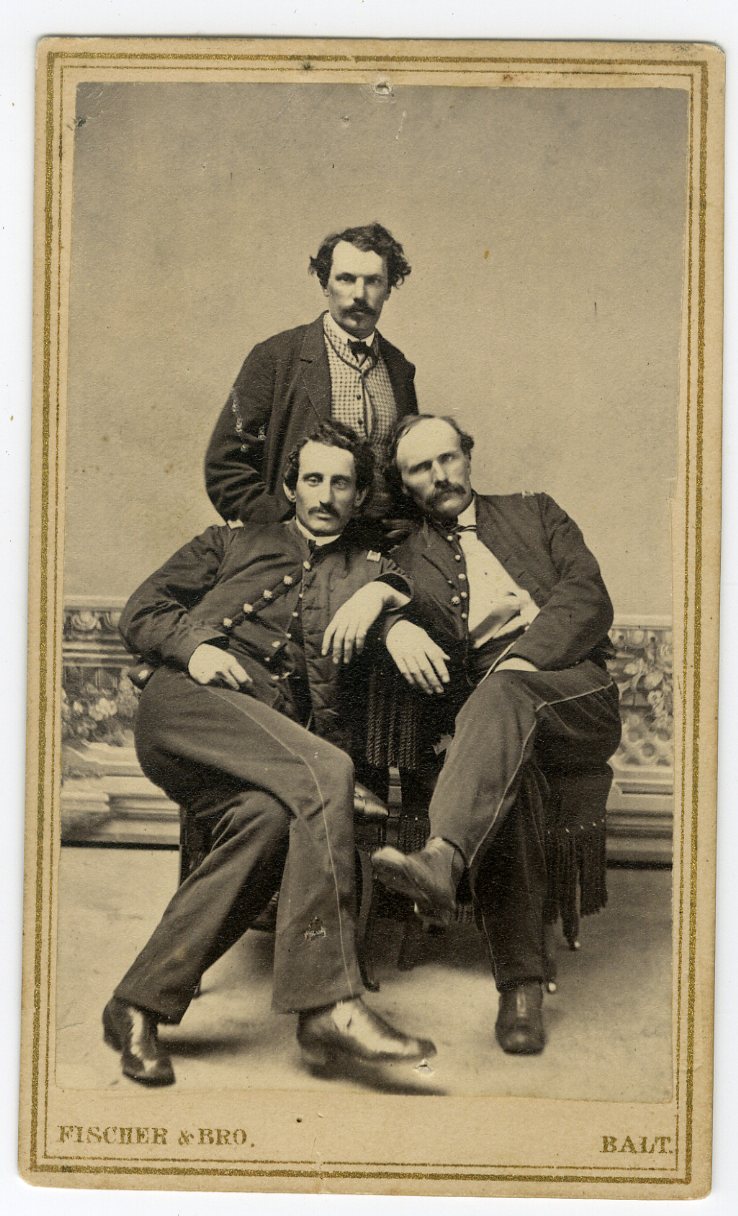
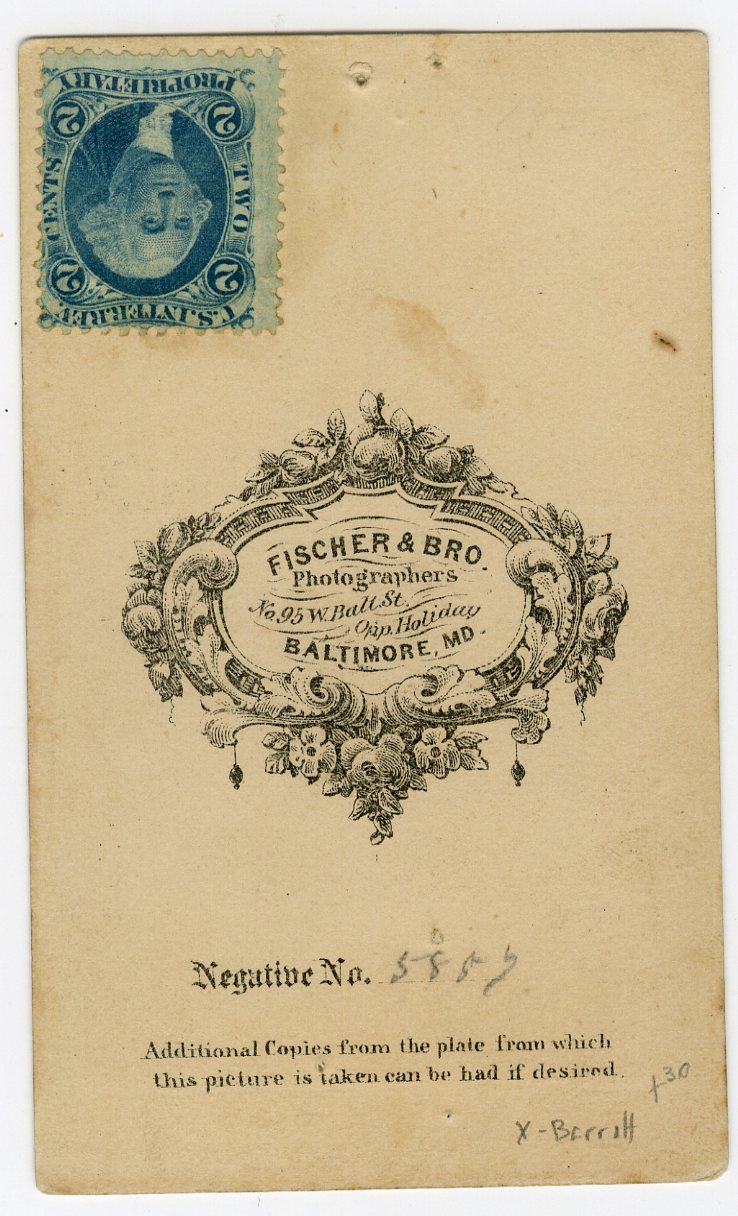
CWCDV1612. Fischer & Bro., Baltimore, MD. CDV from the Gil Barrett Collection. 2-cent uncancelled tax stamp on verso. Civil War buddies, 2 in uniform, one in civilian dress. Fanciful pose. VG. $450
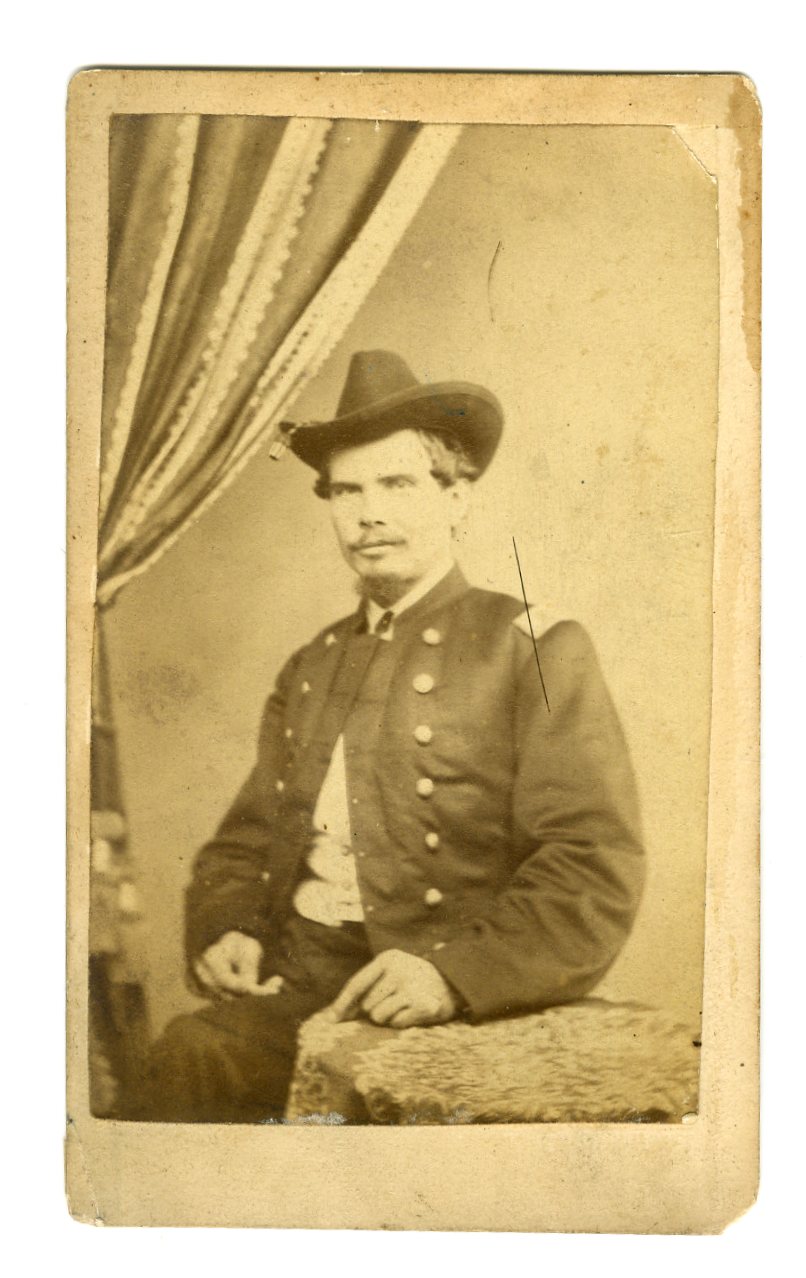
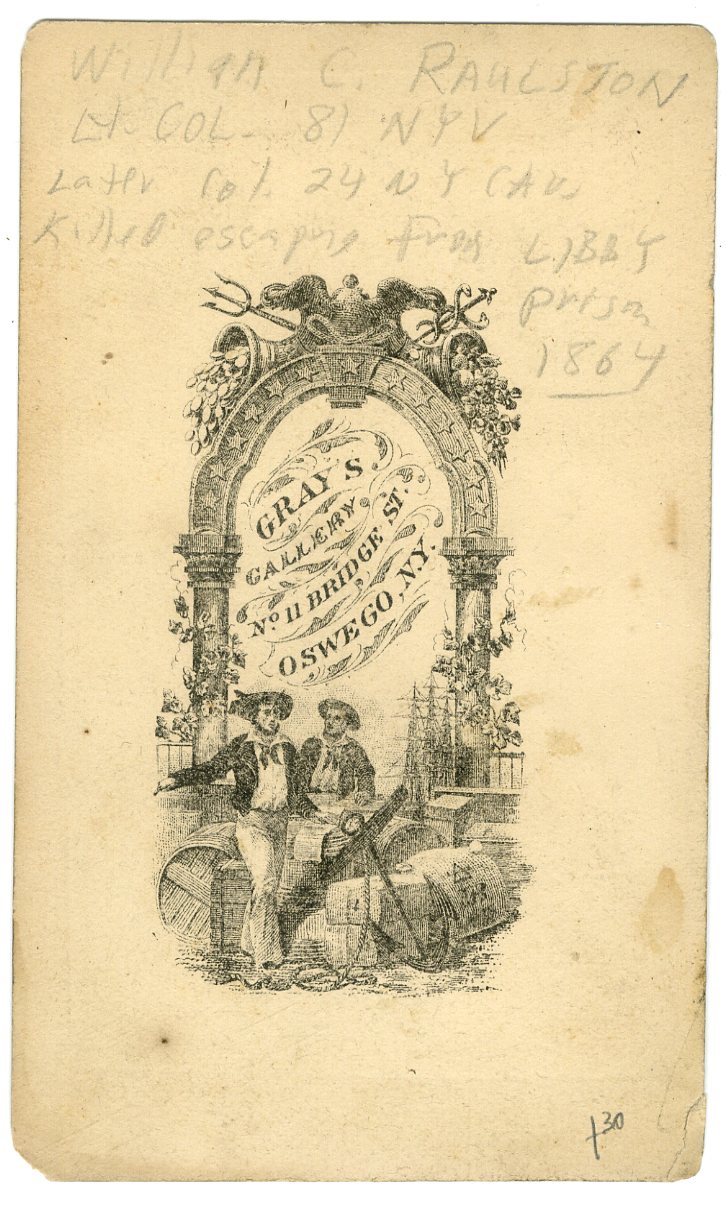
CWCDV1614. CDV by Gray’s Gallery, Oswego, NY of William C. Raulston. Enlisted on 8/24/1861 at Oswego, NY as a Captain. On 9/14/1861 he was commissioned into “A” Co. NY 81st Infantry. He was discharged on 9/6/1863. On 1/27/1864 he was commissioned into Field & Staff NY 24th Cavalry. He died of wounds on 12/15/1864. He was listed as: Confined Danville, VA (date not stated); Confined Libby Prison, Richmond, VA (date not stated); Wounded 6/18/1864 Petersburg, VA; POW 9/30/1864, Poplar Grove Church, VA; Wounded 12/10/1864 Sussex Court House, VA (While attempting to escape from Danville). He died from these wounds 5 days later. Promotions: Major 5/31/1862; Lt Colonel 7/7/1862; Colonel 1/27/1864 (As of 24th NY Cavalry); Intra Regimental Company Transfers: 6/20/1862 from company A to Field & Staff. VG. $475
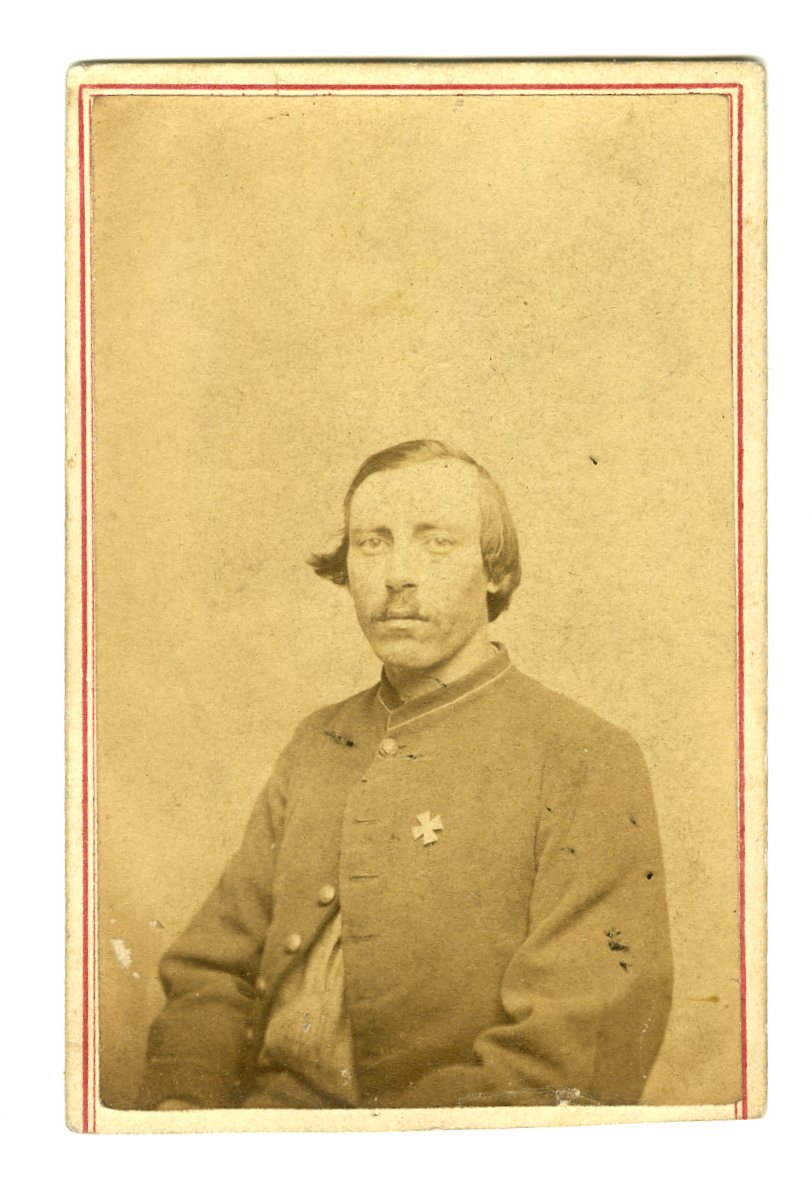
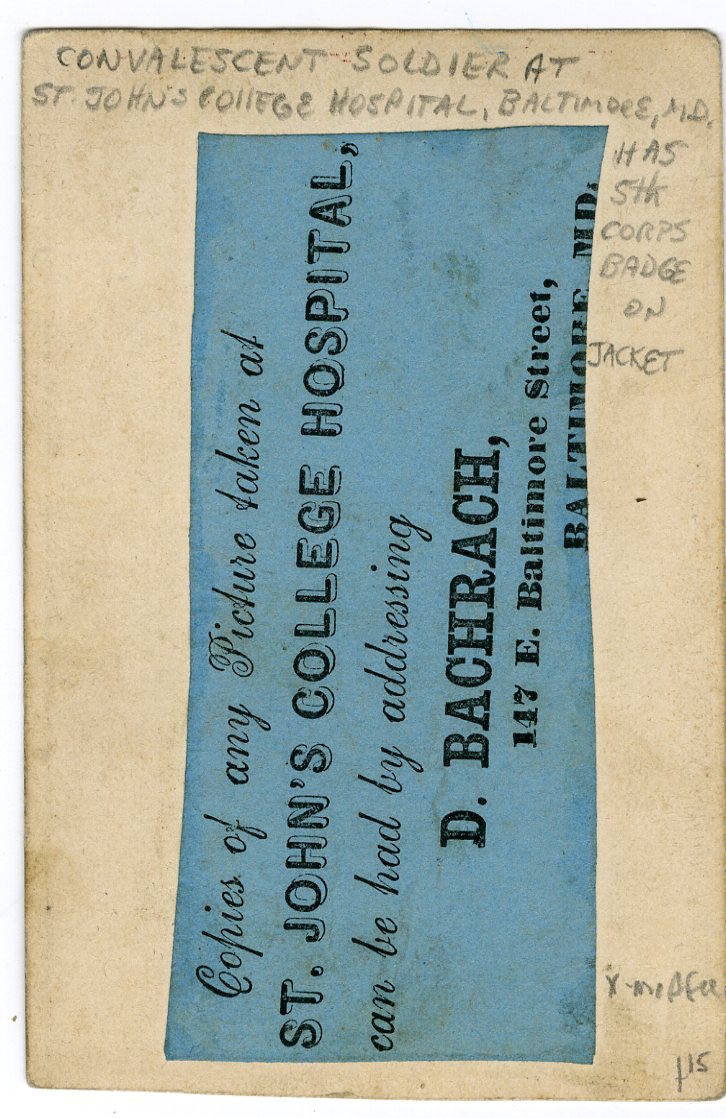
CWCDV1615. D. Bachrach, Baltimore, MD. Convalescent soldier at St. John’s College Hospital, Baltimore, MD. He has a 5th Corps badge on jacket. This is a rare back paper label. CDV is from the Mike McAfee Collection. VG. $325
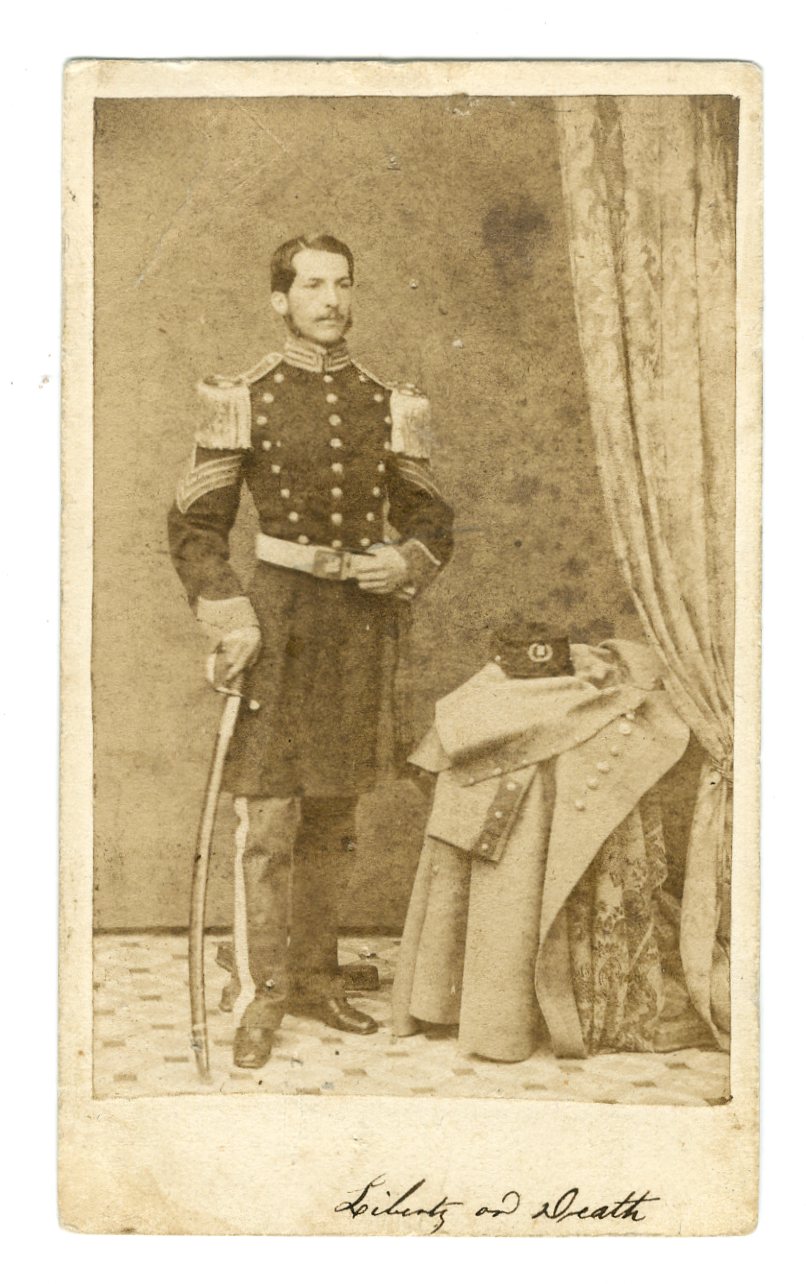
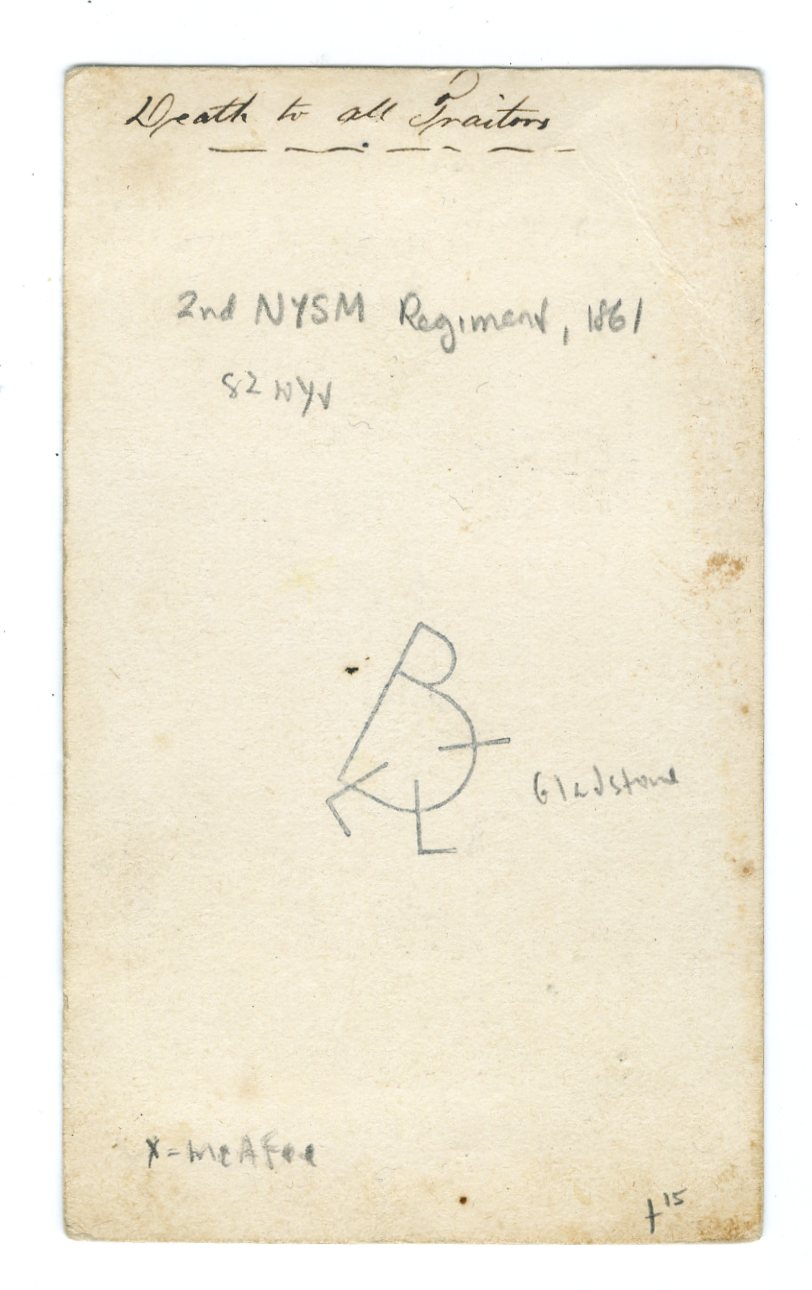
CWCDV1621. The soldier is an unidentified member of the 2nd NYS Militia Regiment, 1861 (82 NY Vols.). On the bottom recto is written “Liberty or Death.” On the top verso is written “Death to all Traitors.” These are original inscriptions, undoubtedly by the hand of the soldier. On back is the collector mark of William (Bill) Gladstone, the walking “B” symbol. In addition, this CDV comes from the collection of the late Mike McAfee. G. (binder) $250
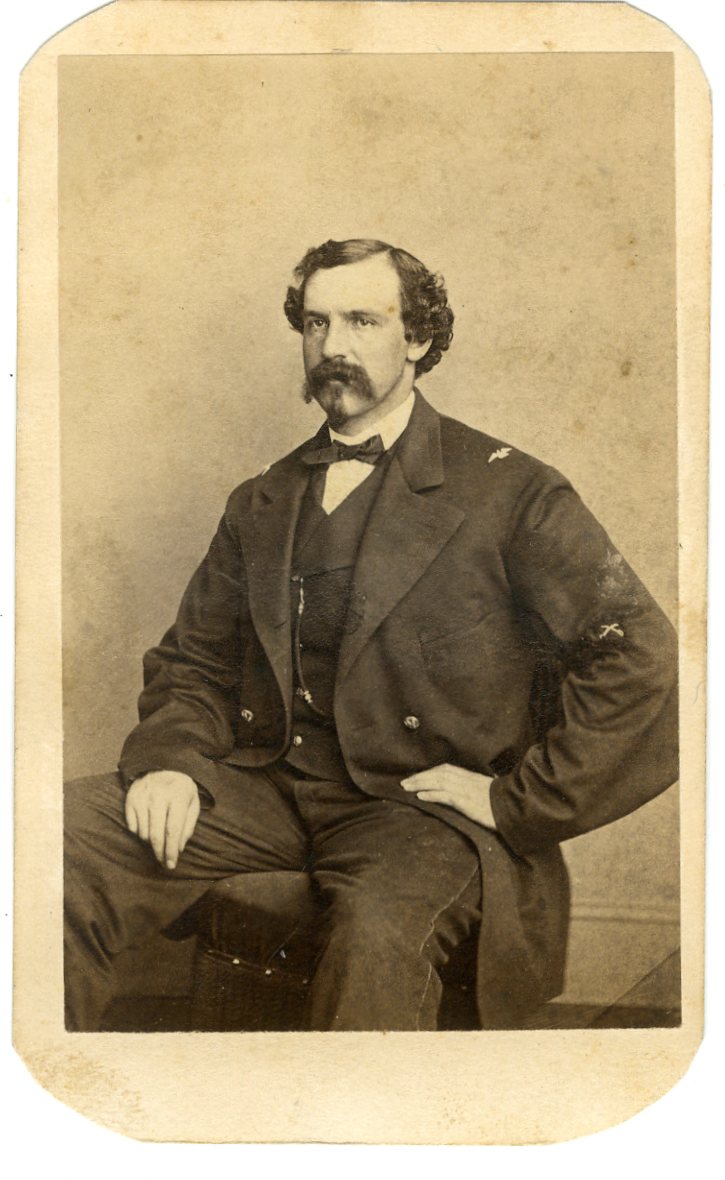
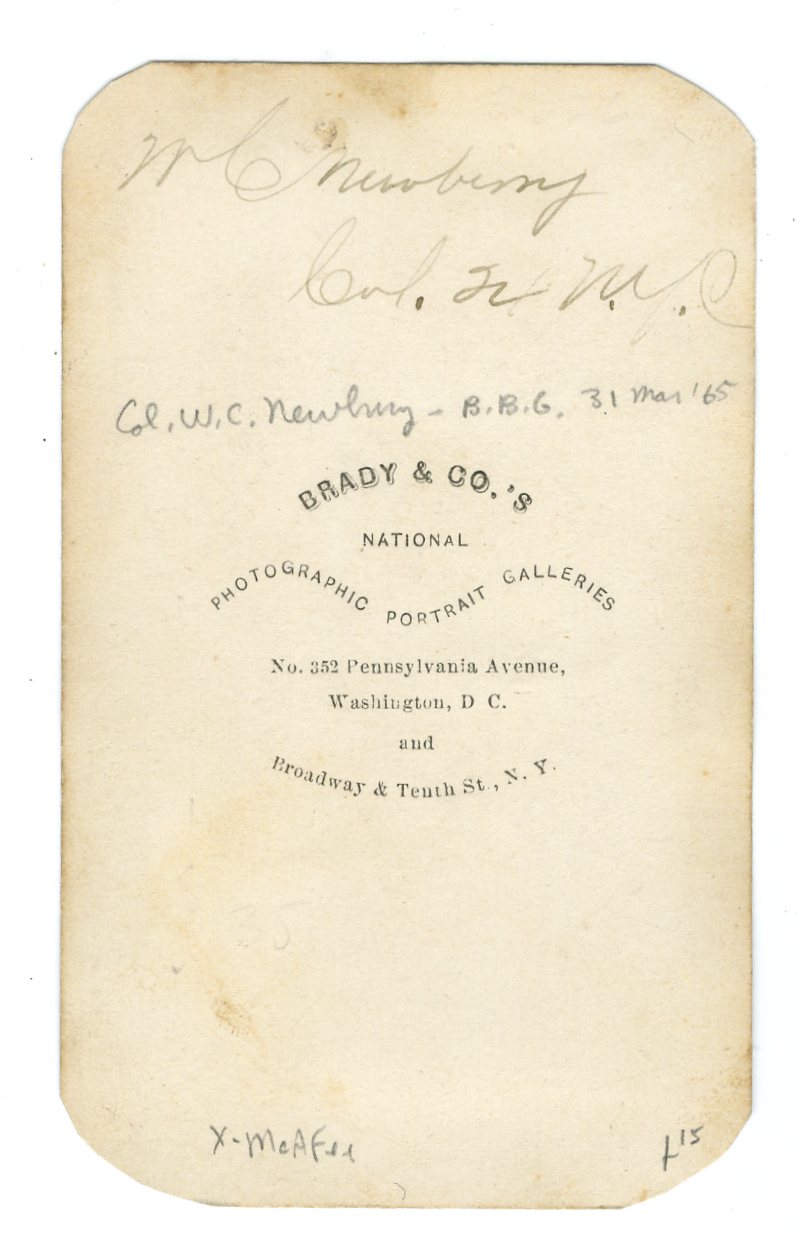
CWCDV1622. Brady & Co.’s National Photographic Portrait Galleries, Washington DC and NY. Walter Case Newberry. Enlisted 10/19/1861 at Waterville, NY as a 1st Lt. On 11/4/1861 he was commissioned into E Co. NY 81 Inf. On 1/10/1864 he was commissioned into Field & Staff NY 24th Cavalry. He mustered out on 6/24/1865 at Cloud’s Mills, VA. He was listed as: WIA 6/18/64 Petersburg, VA; WIA 7/30/64 Petersburg, VA; WIA 3/30/65 place not stated. Promotions: Capt. 6/1/62; Major 1/10/64; Lt. Col. 2/6/64; Col. 12/15/64; Brig-Gen’l 3/31/65 by Brevet. Born 12/23/1835 in Waterville, Oneida County, NY; died 7/20/1912 in Chicago, IL. G. (binder) $275
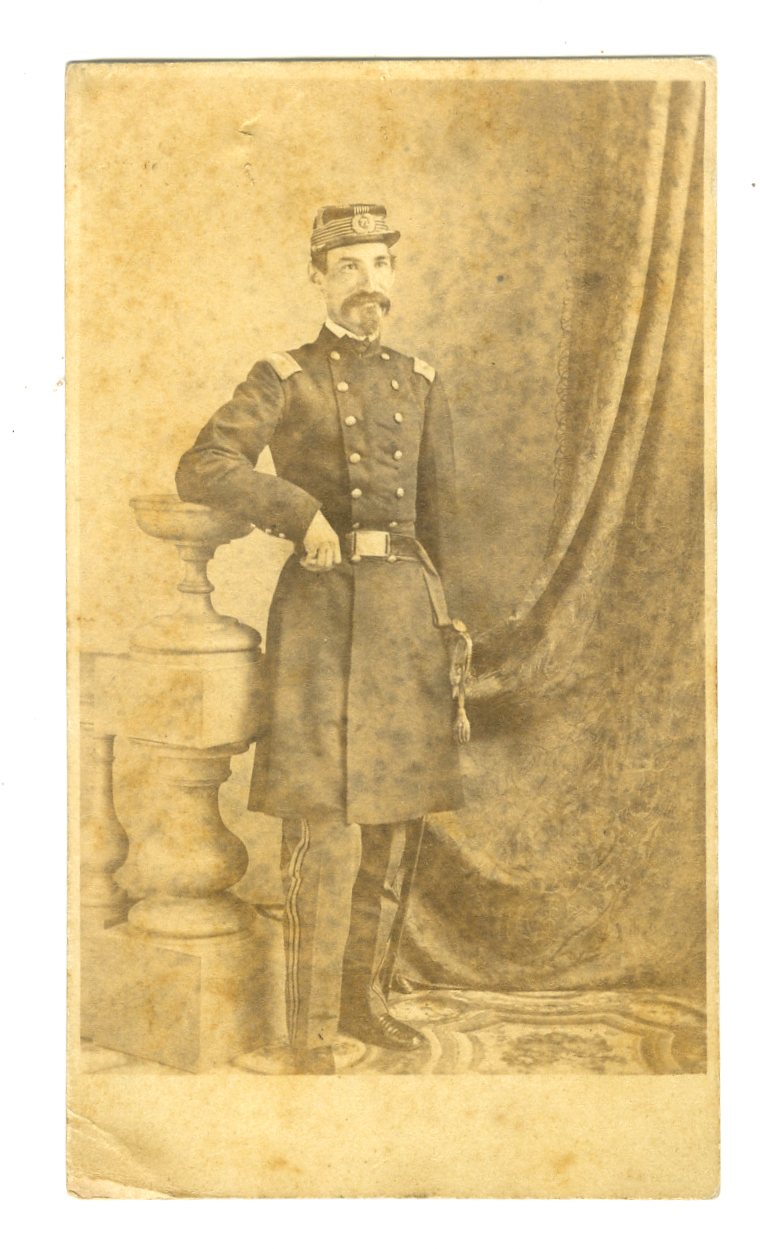
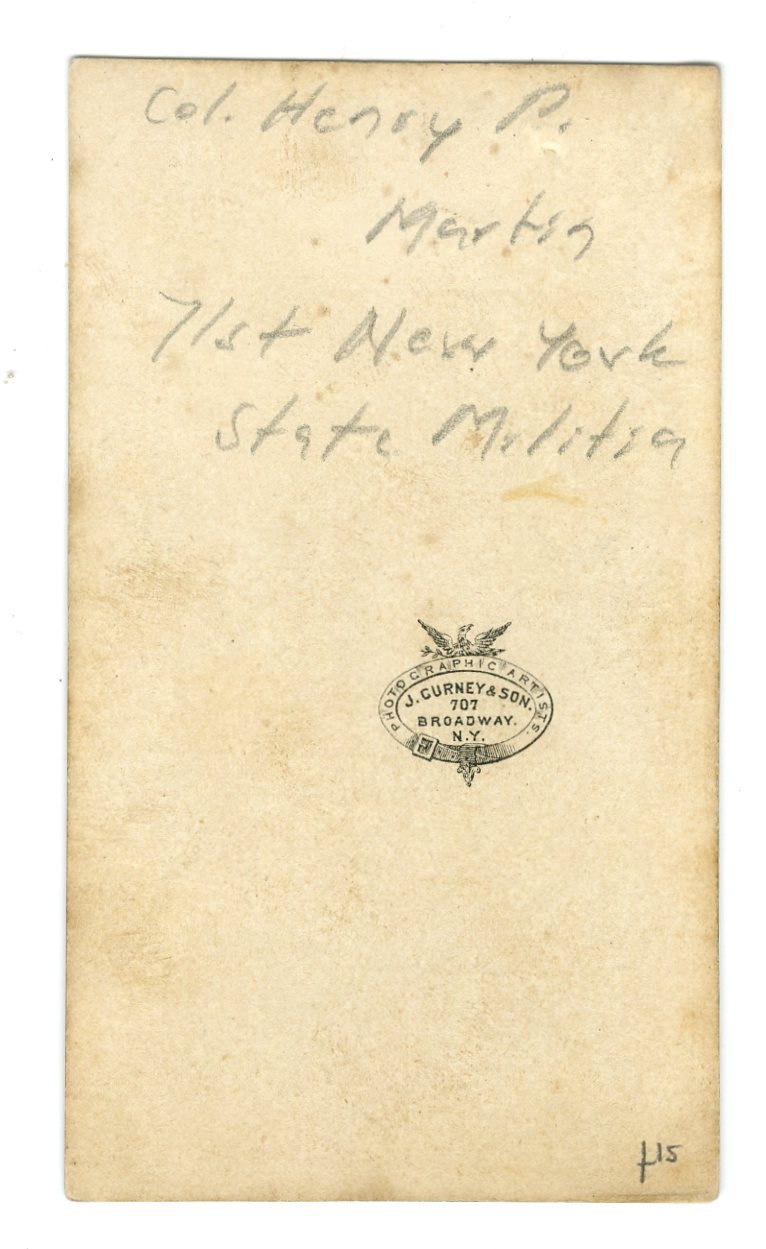
CWCDV1625. J. Gurney & Son, NY. Henry Patchen Martin. Enlisted 4/19/61 at NYC as a Lt. Col. On 5/3/61 he was commissioned into Field & Staff NY 71st Inf. He mustered out on 7/31/61 at NYC. On 5/28/62 he was commissoned into Field & Staff NY 71st Inf. He mustered out 9/2/62 at NYC. Promotions: Col. 6/3/61. Fair. $125
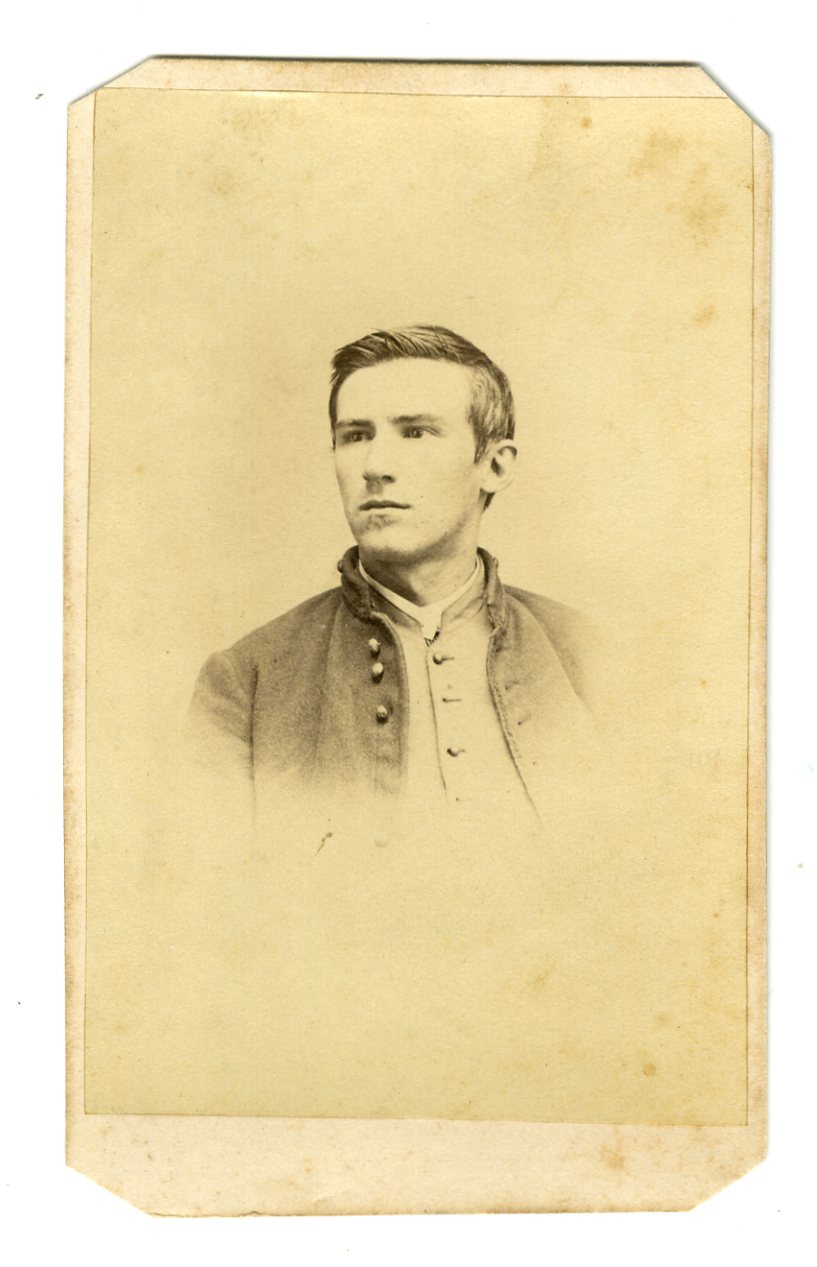
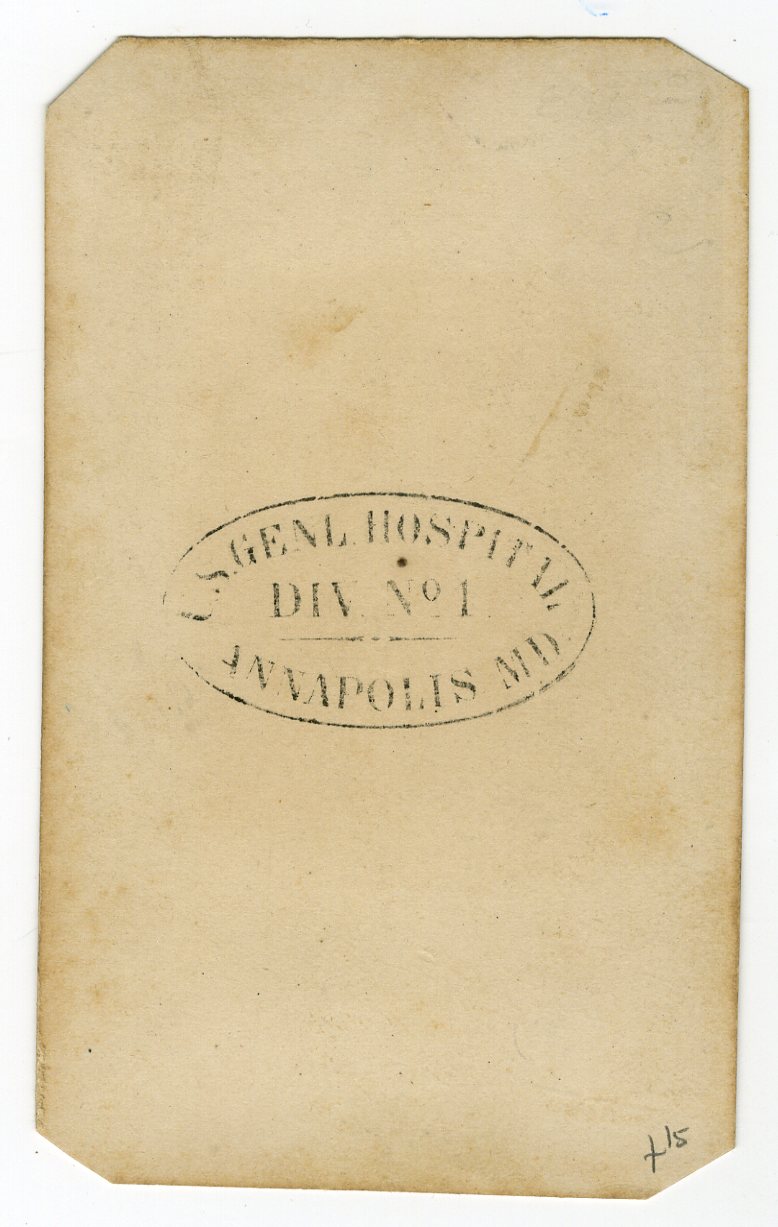
CWCDV1632. U.S. General Hospital, Div. No. 1, Annapolis, Md. Unidentified soldier likely recuperating from his wounds. Rare backmark. VG. $200
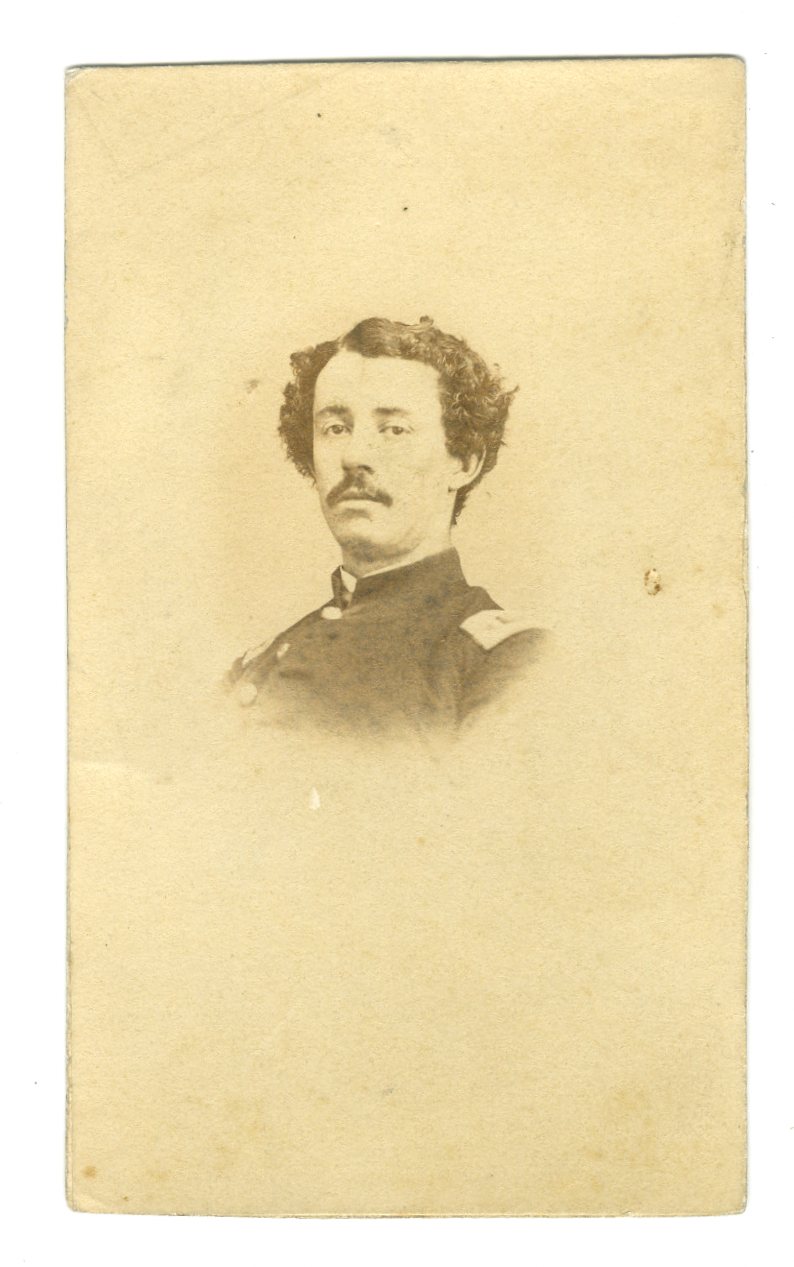

CWCDV1636. O. Pierre Havens, Sing Sing, NY. Signed on verso “Chellis Swain, Adjt, 1st Lt. Cav.” Chellis D. Swain. Enlisted 8/17/62 as a 2nd Lt. Commissioned into B Co. NY 11th Cav. Discharged on 3/7/64. Promotions: 2nd Lt 8/17/62 by brevet; 2nd Lt. 9/1/62 (As of Co. K); 1st Lt. 11/1/62 (1st Lt. & Adjt). Appears to have returned to service: Enlisted 3/27/65 at NYC as a 1st Lt. On 3/27/65 he was commissioned into Field & Staff NY 26th Cav. He mustered out on 7/7/65 at Albany, NY. Promotions: 1st Lt. 3/23/65 (1st Lt. & Adjt). G. (binder) $175
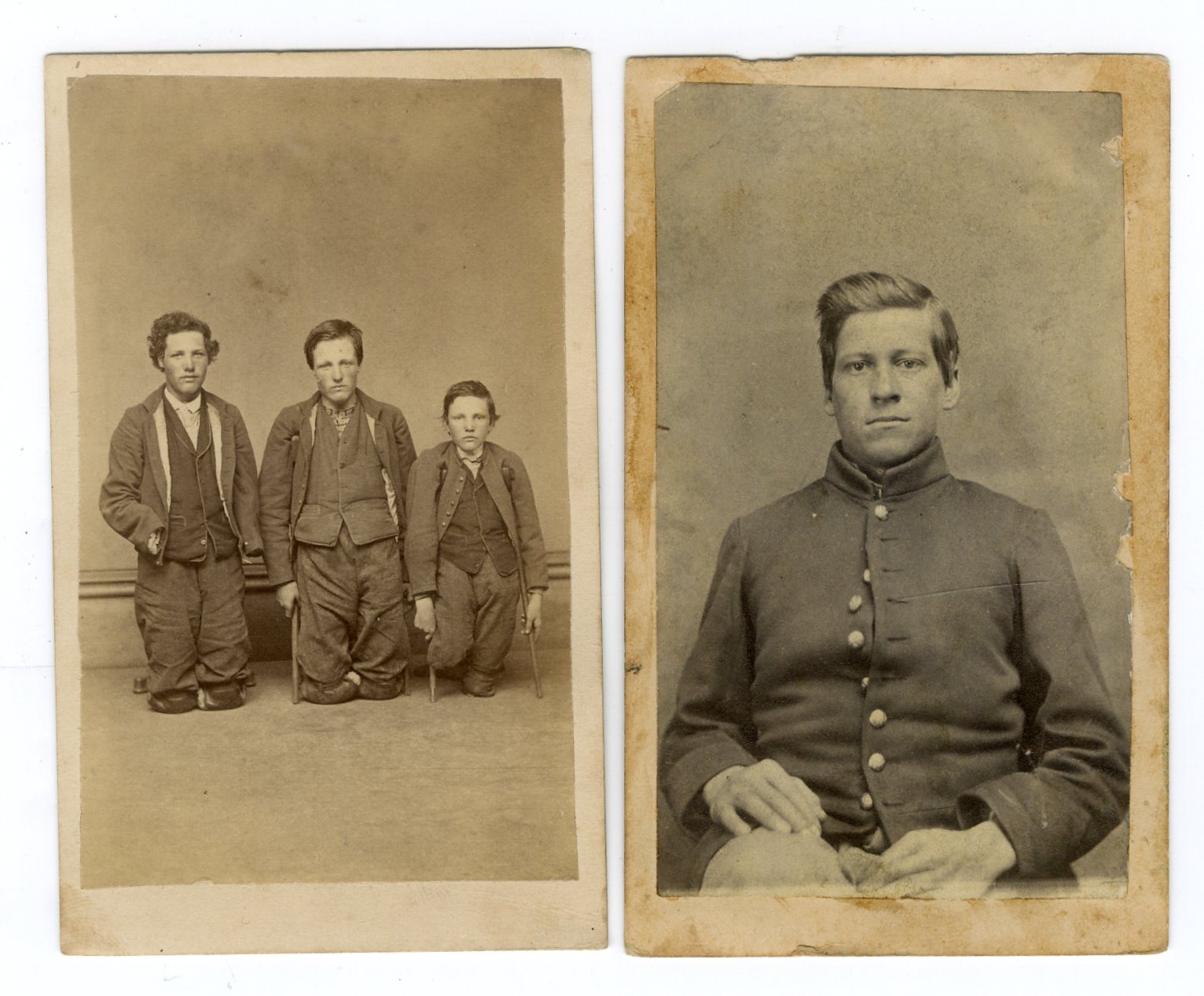
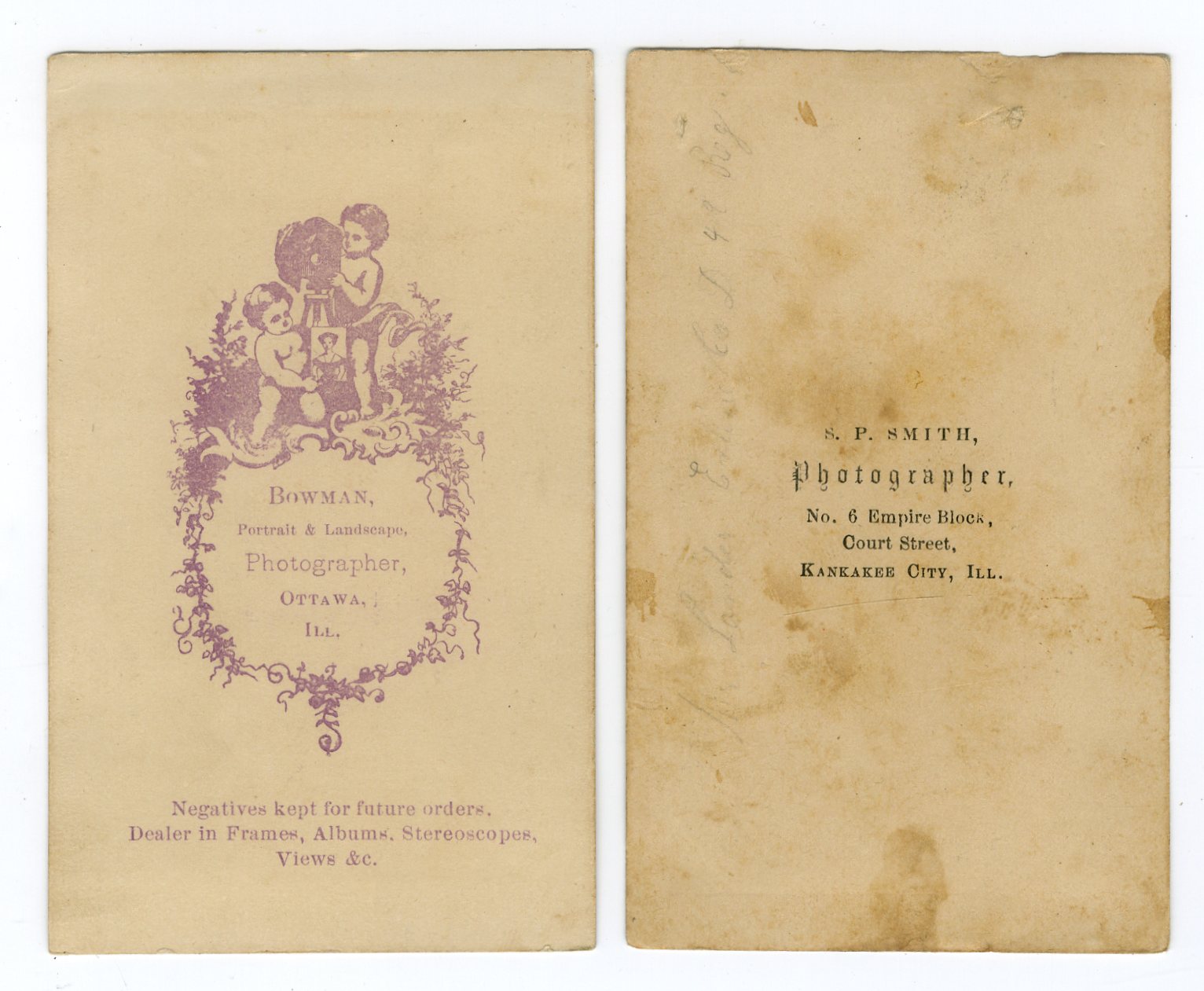
CWCDV1672. Pair of CDVs, one by S.P. Smith, Kankakee, Ill., and the other by Bowman, Ottawa, Ill. The man in the single image is pictured at center in the image of the three amputees. The amputee at left appears to have lost both legs and both hands. The other two have lost their legs but appear to have their hands, although the man at center has only one hand visible and only one wooden crutch, so he is likely a triple amputee. Unidentified. VG. $950
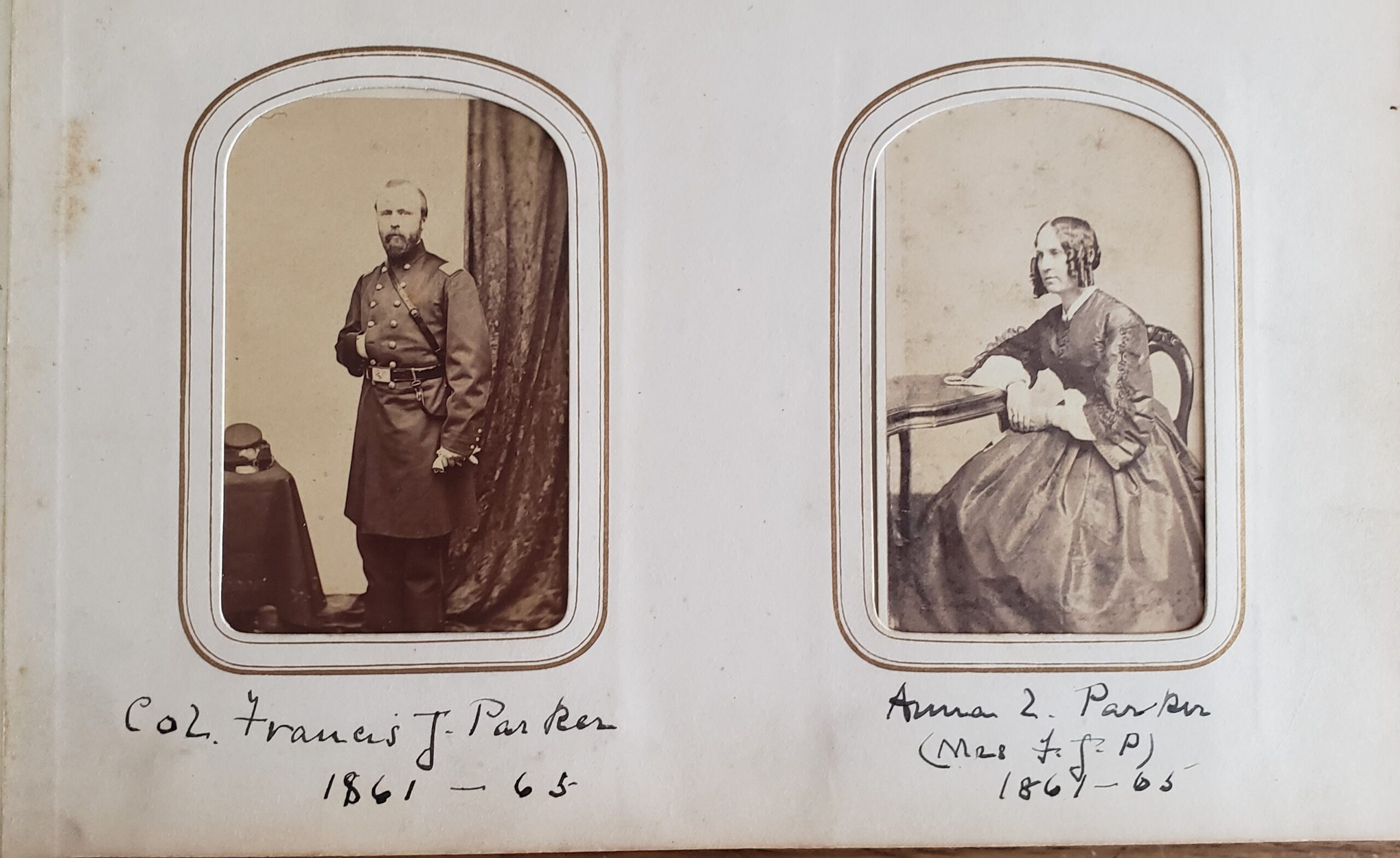
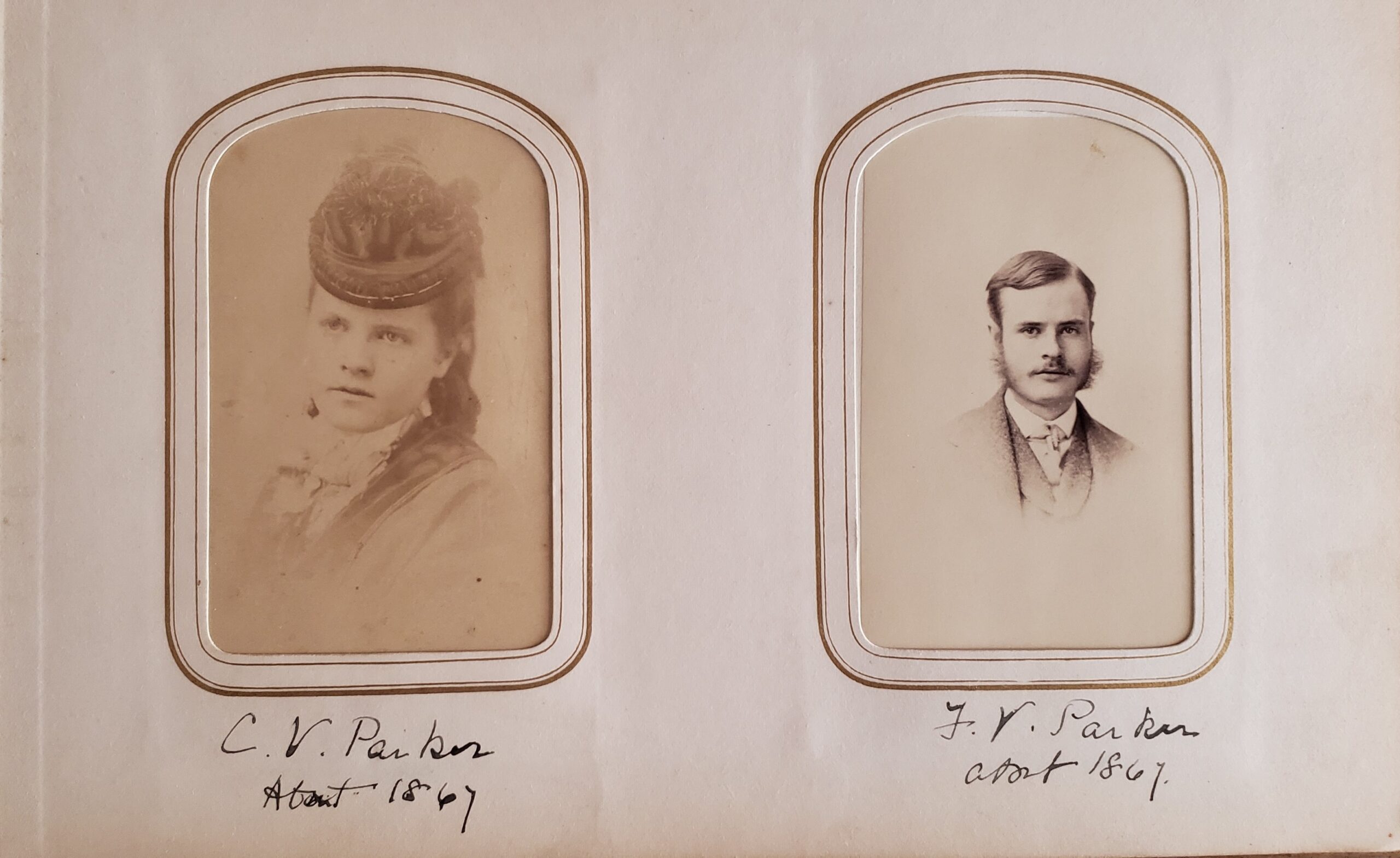
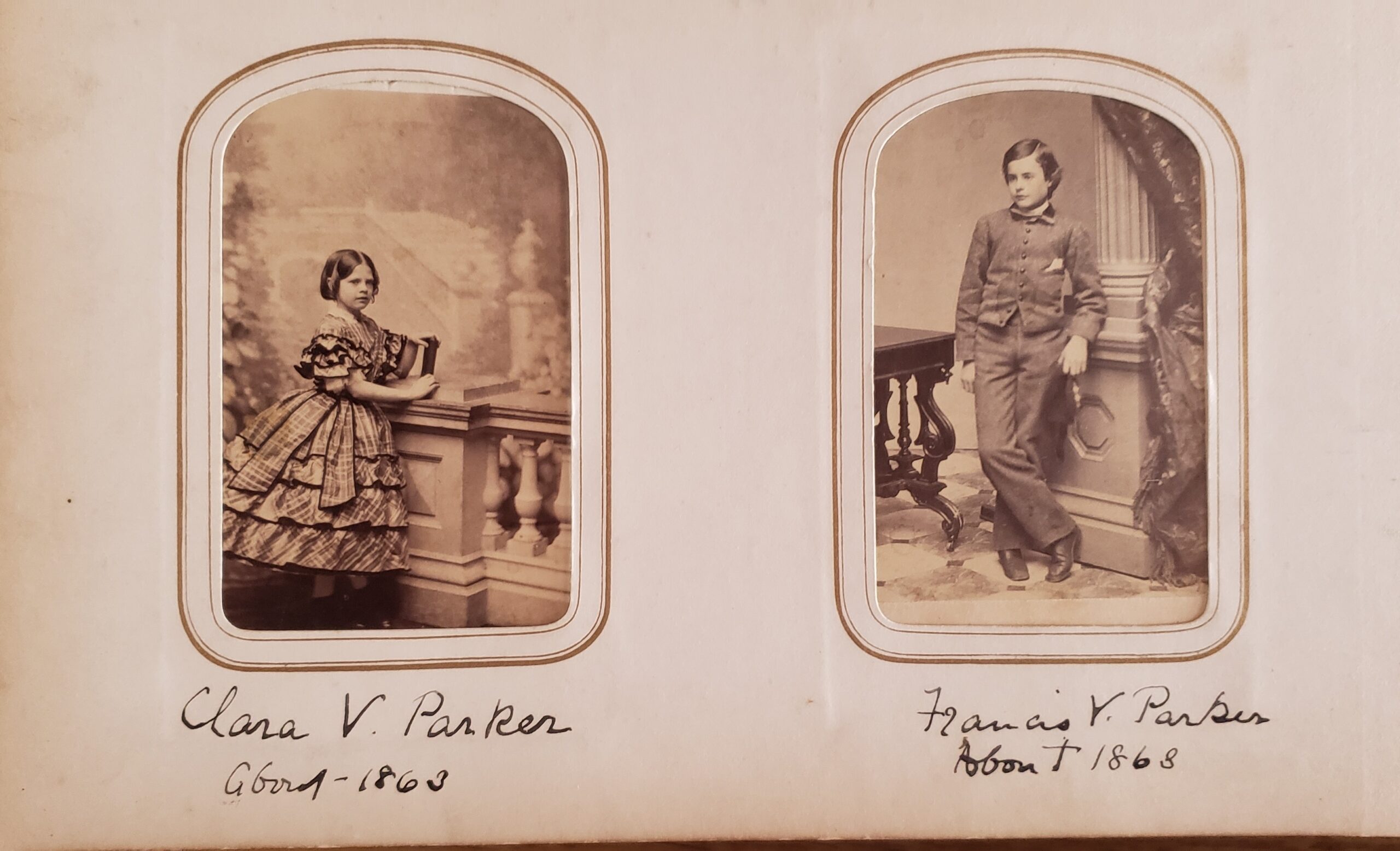
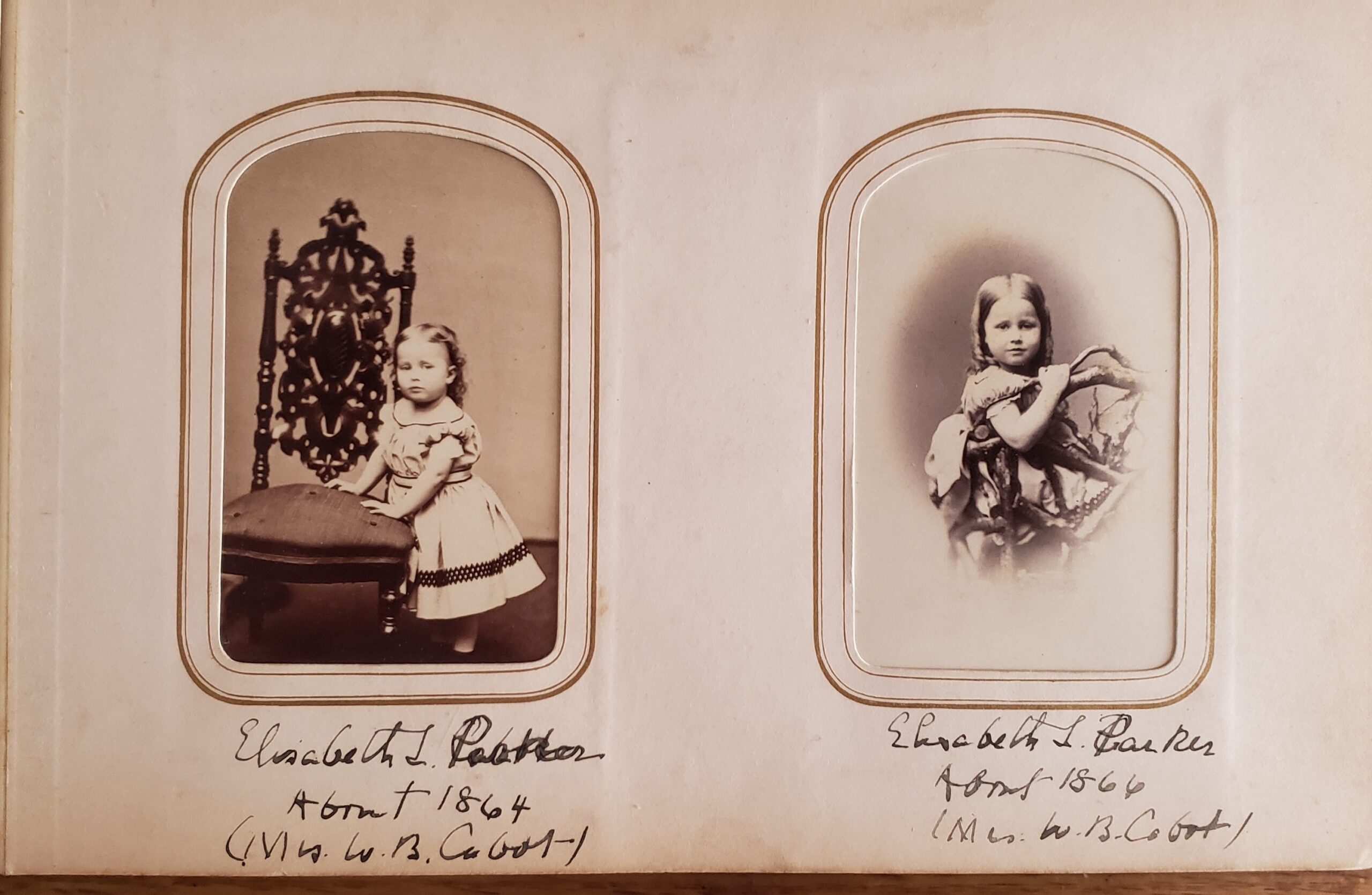
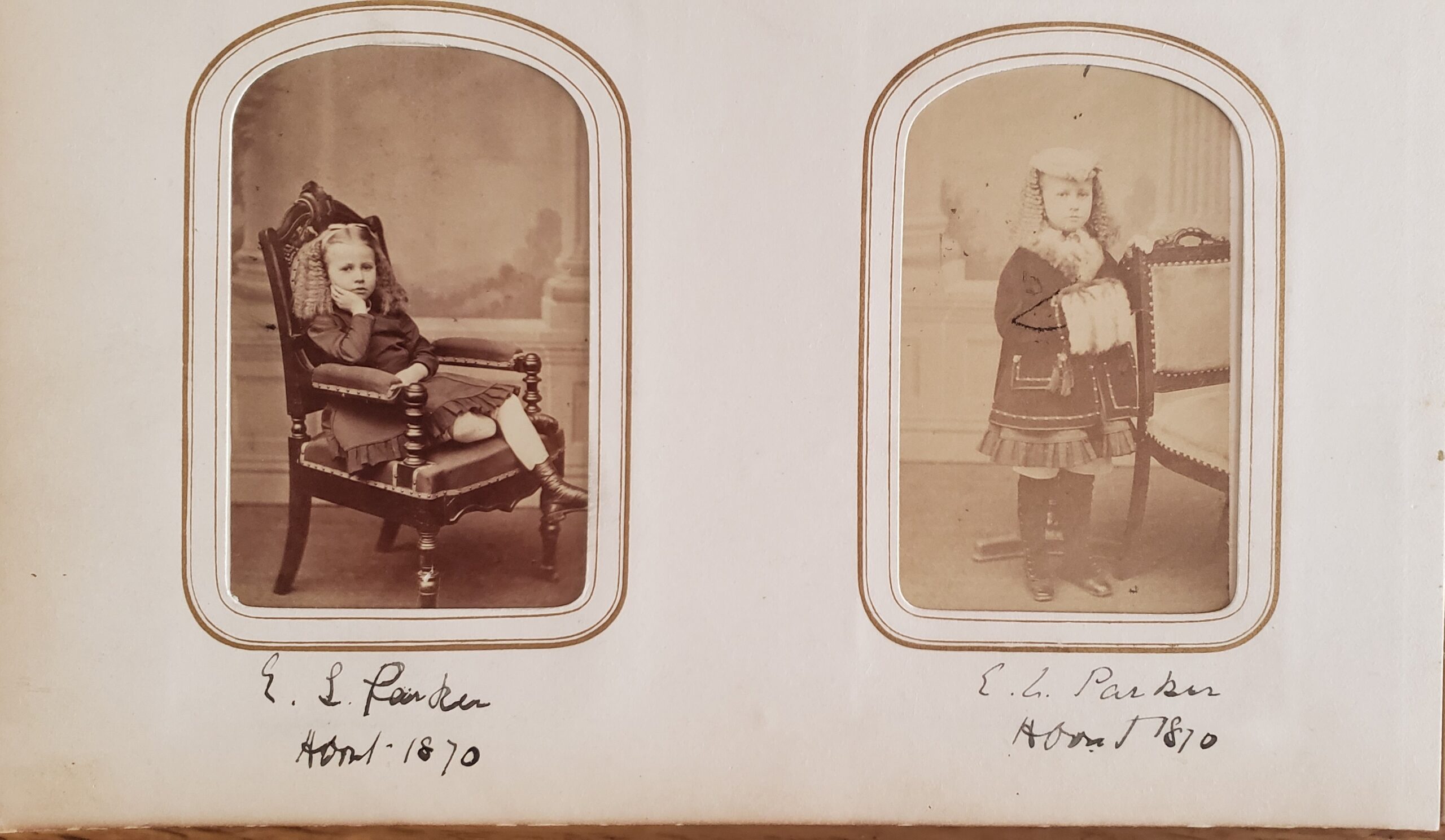
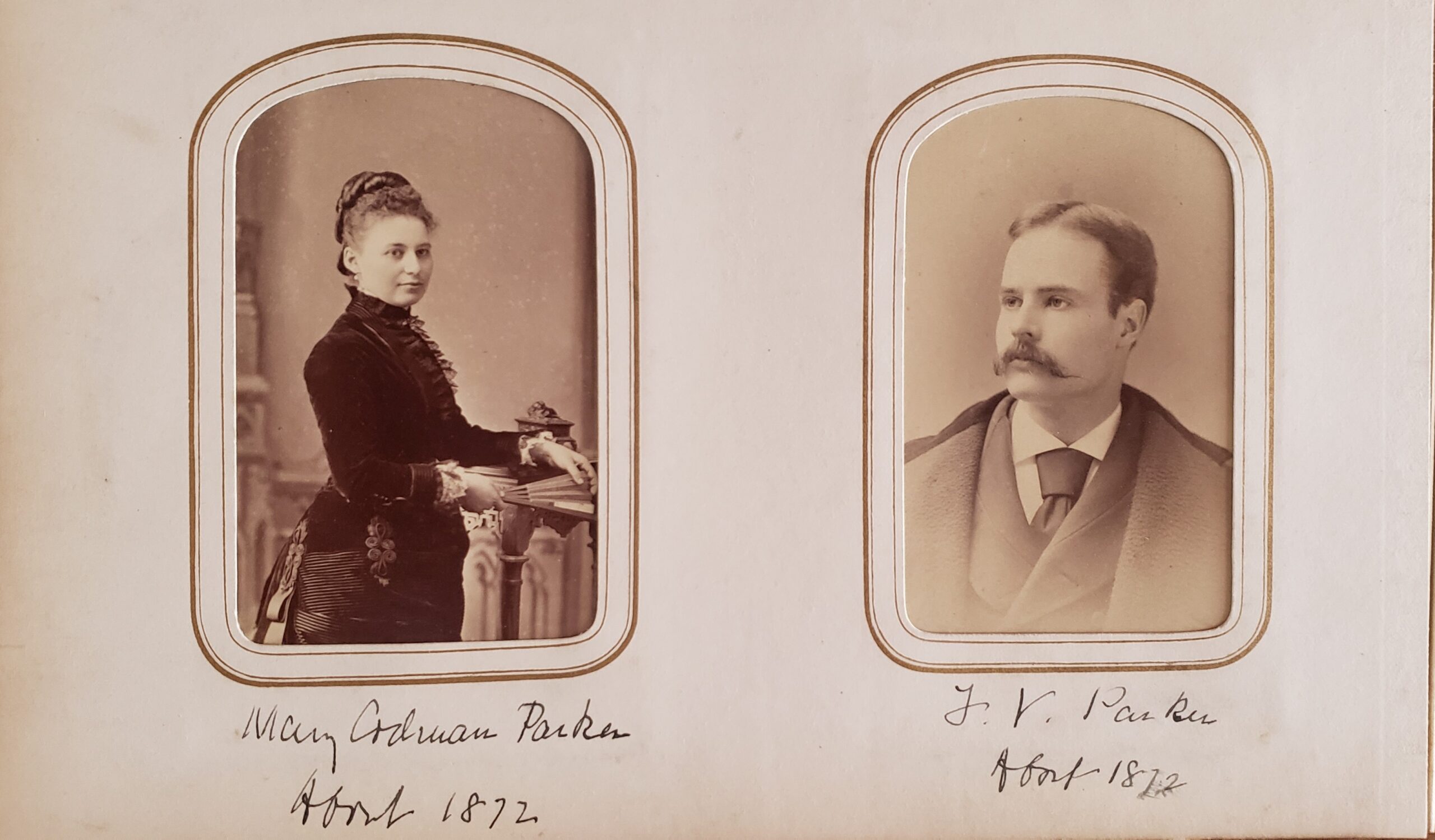
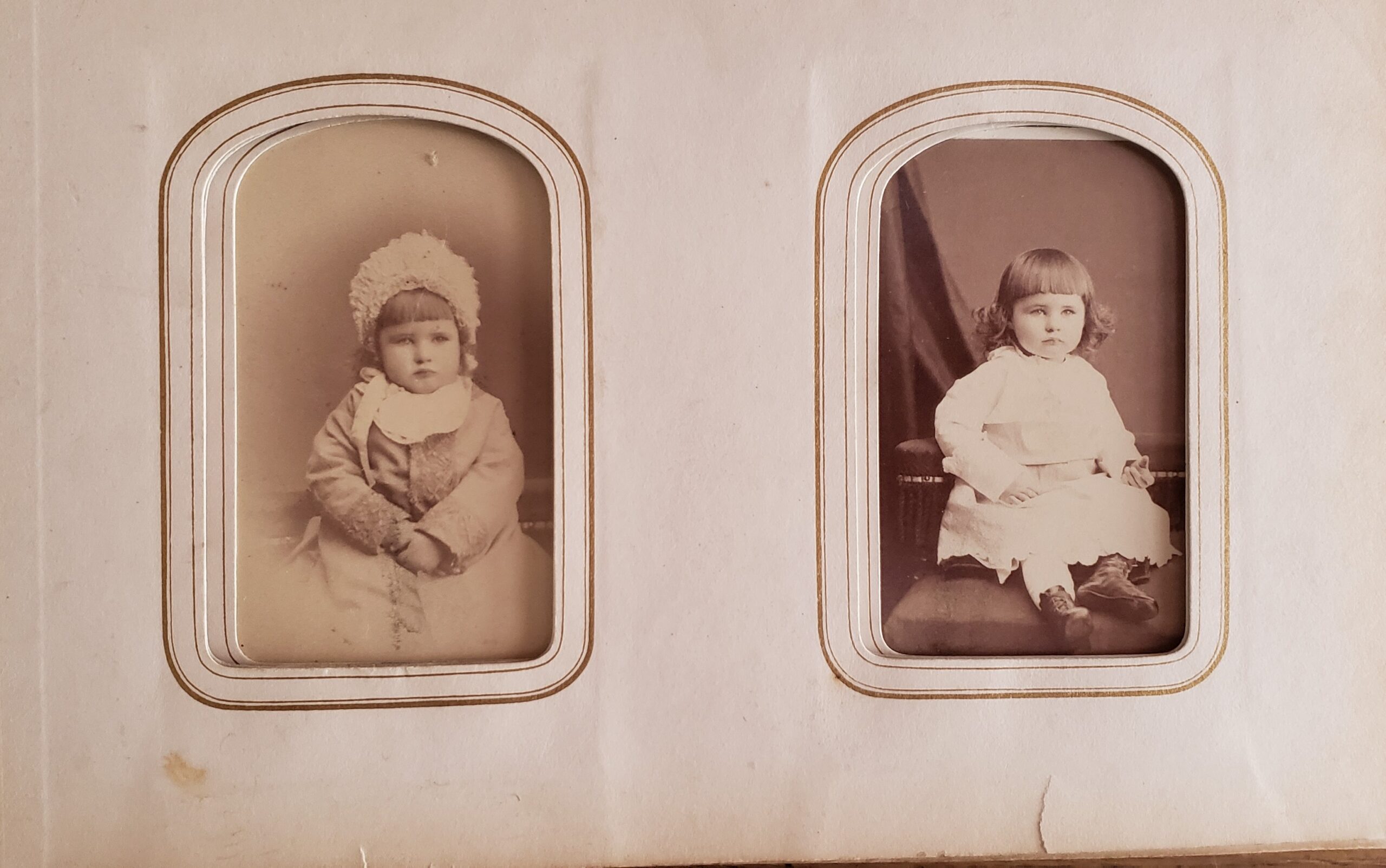
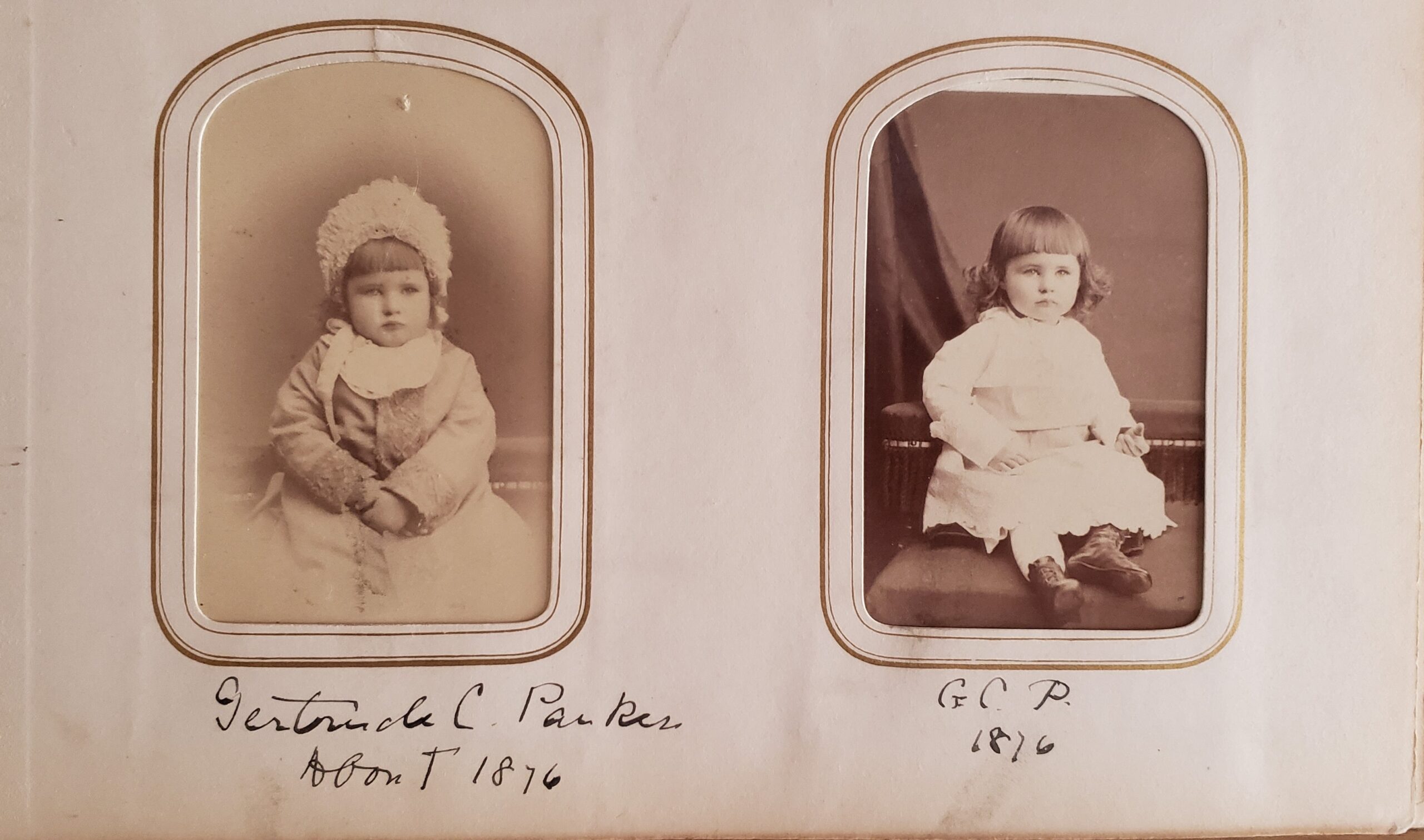
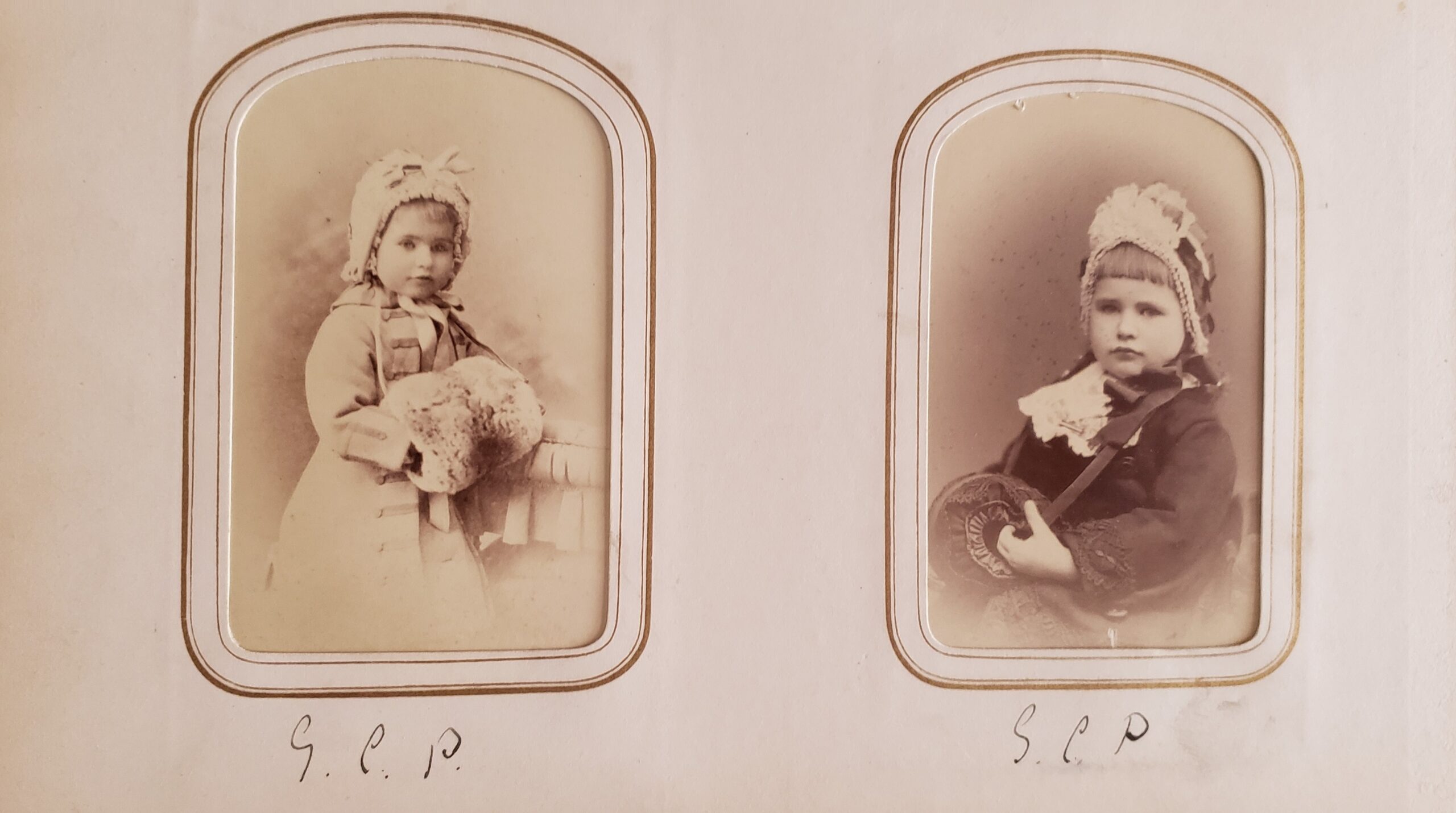
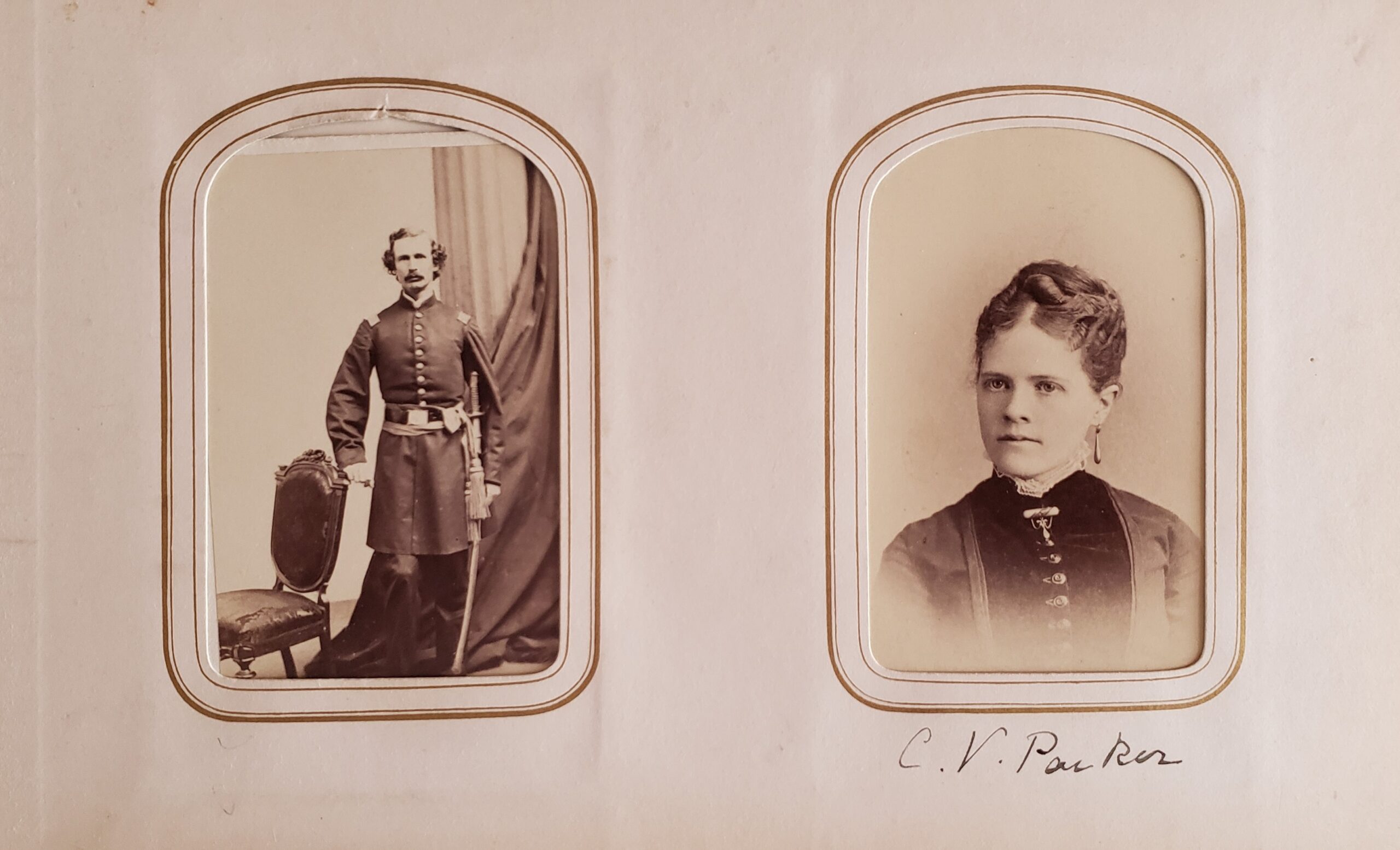
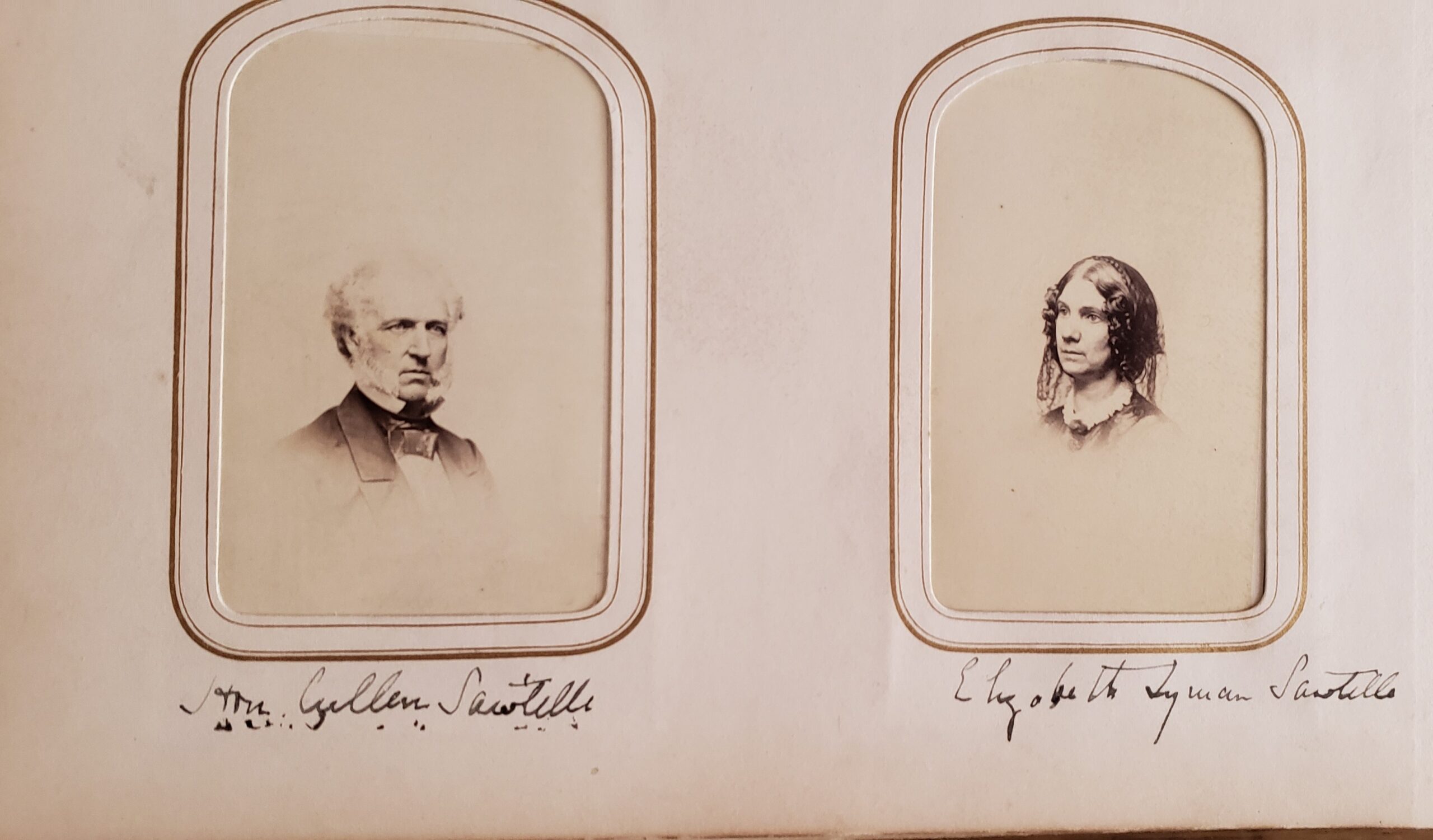
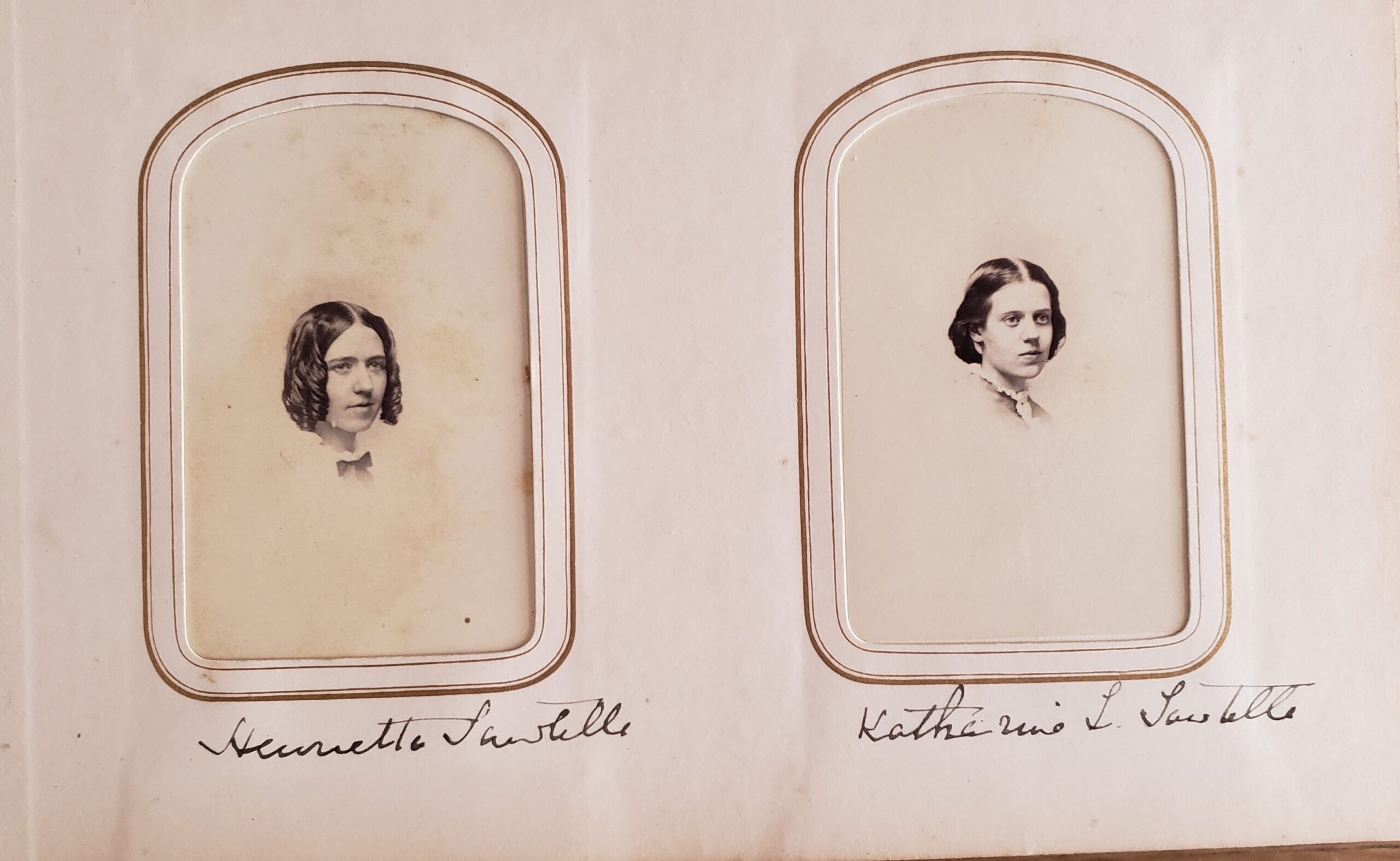
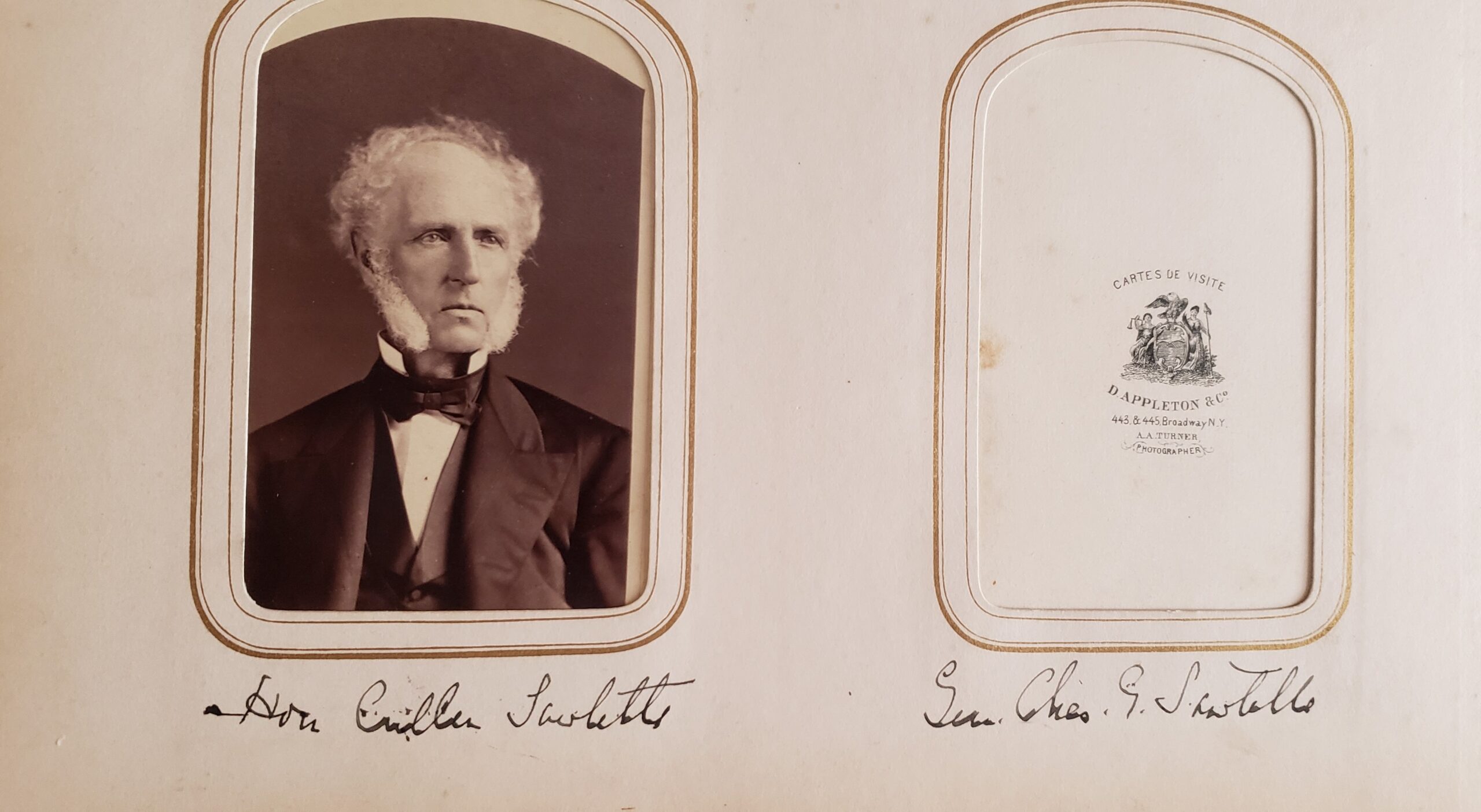
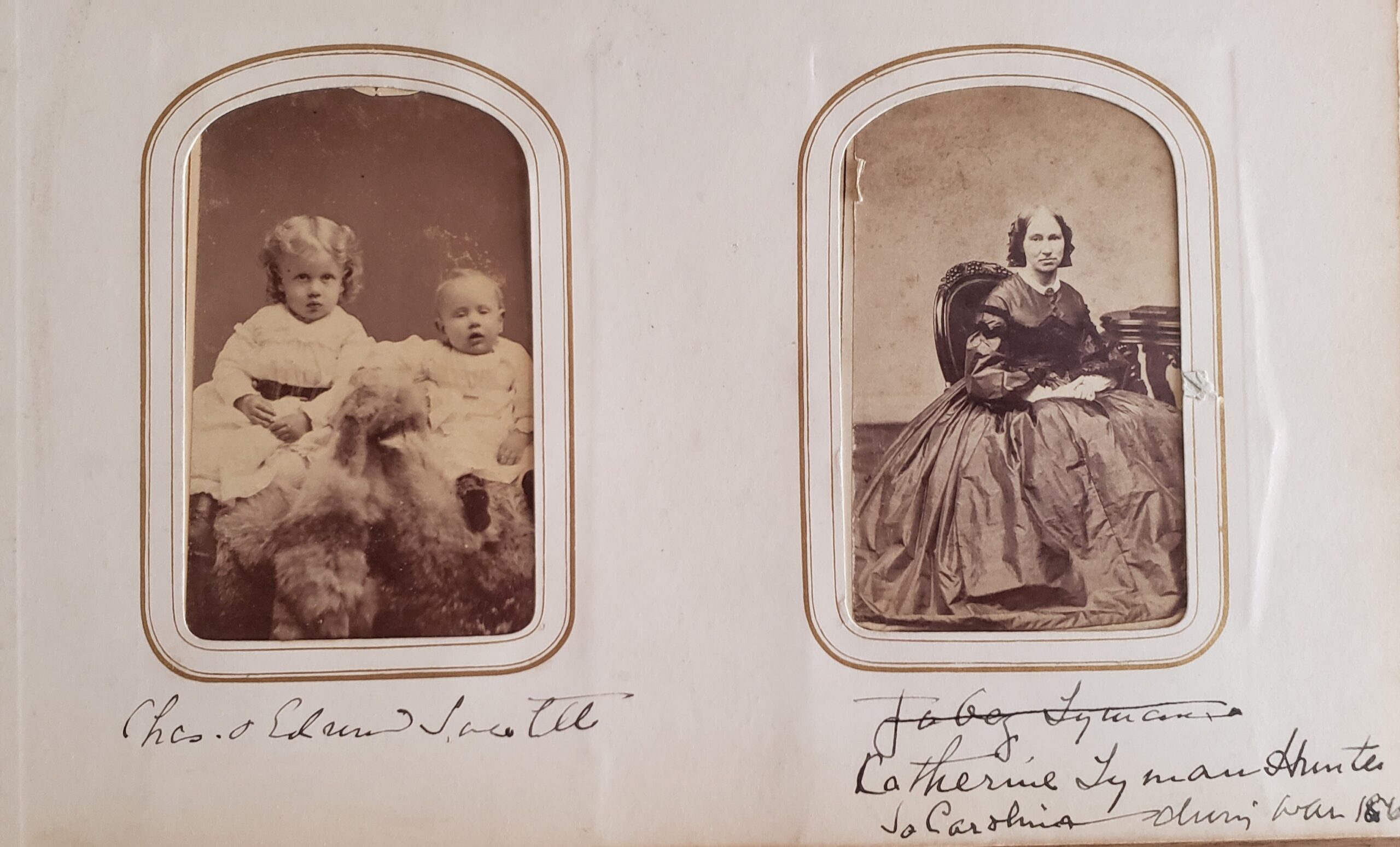
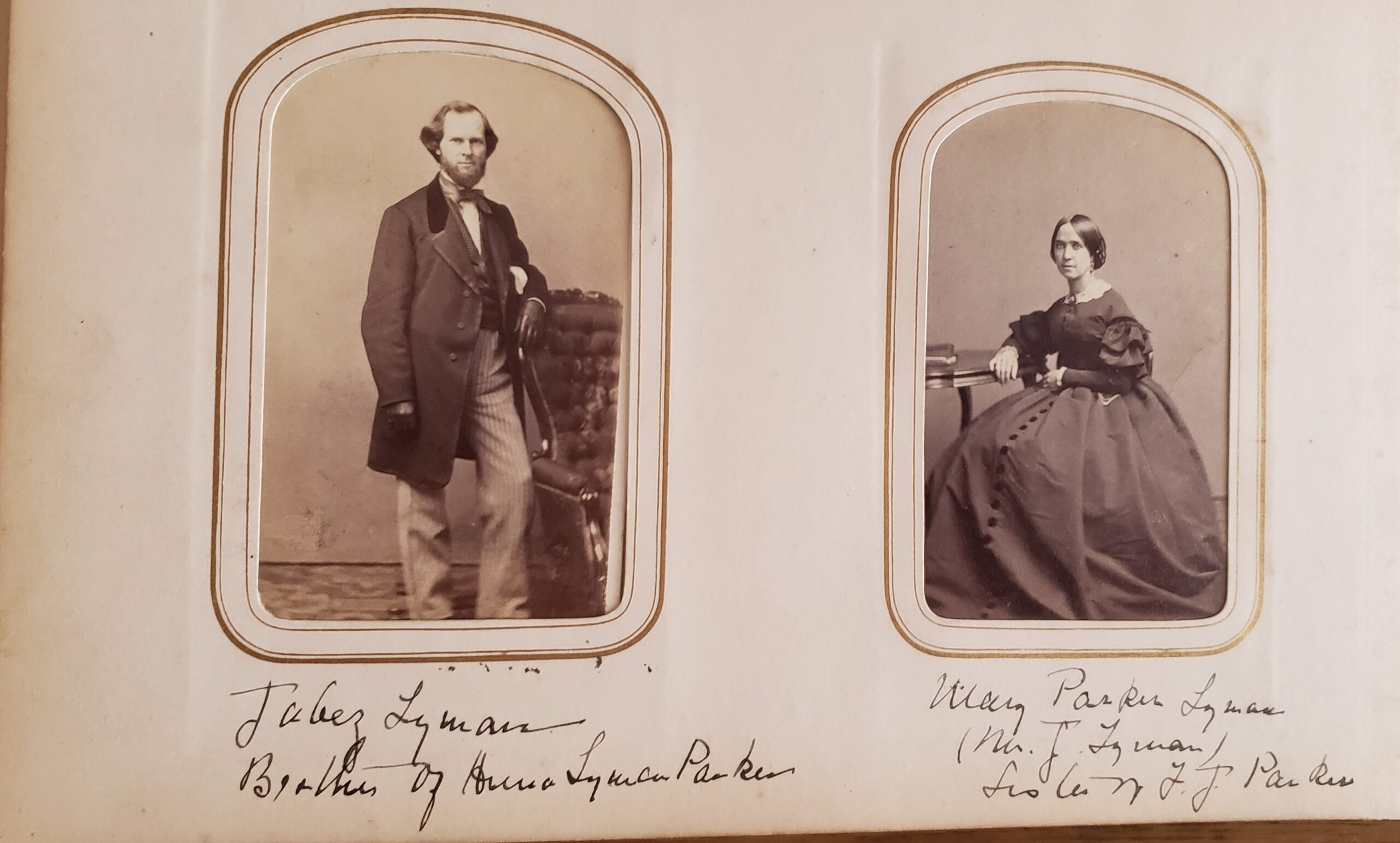
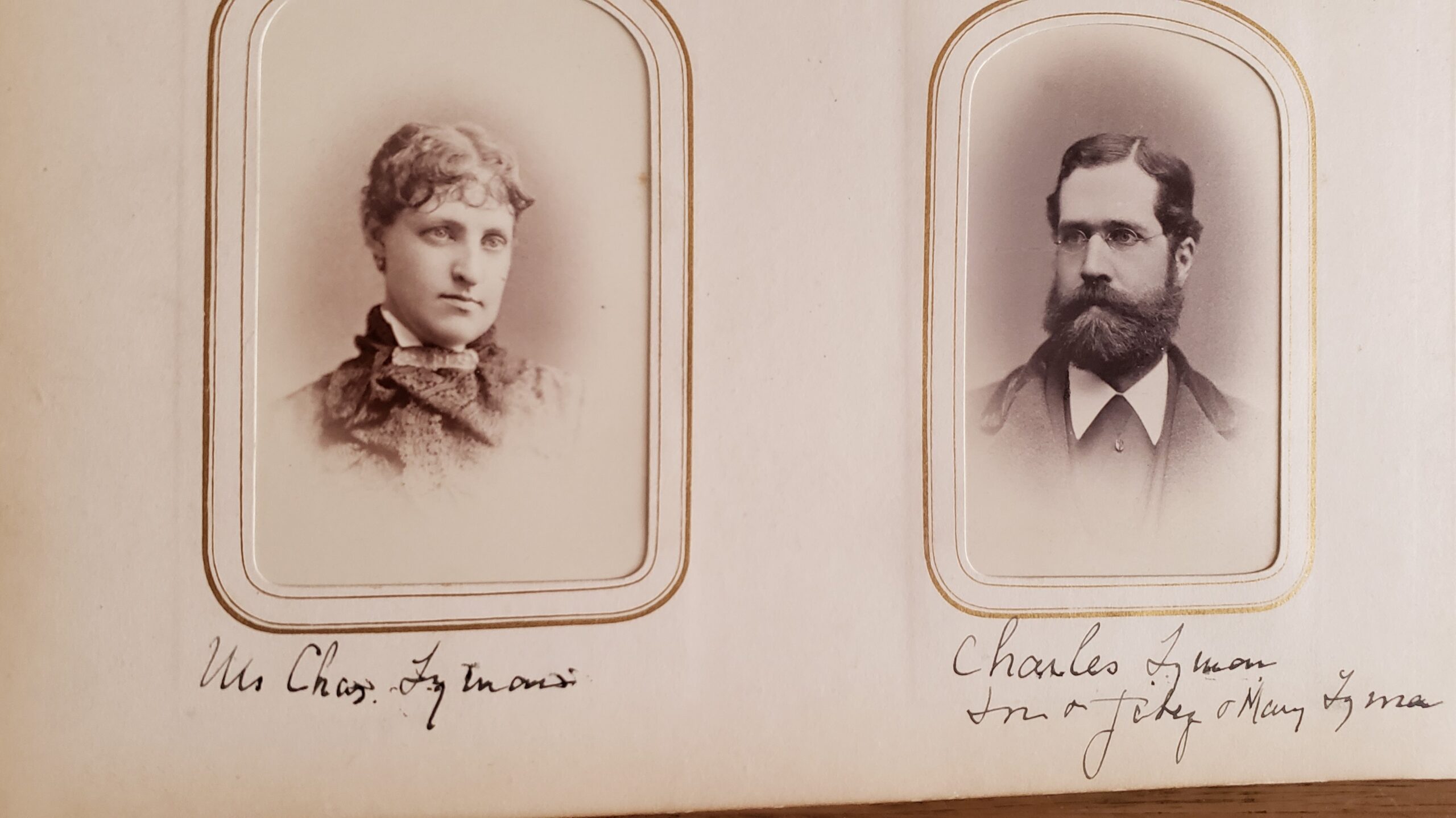
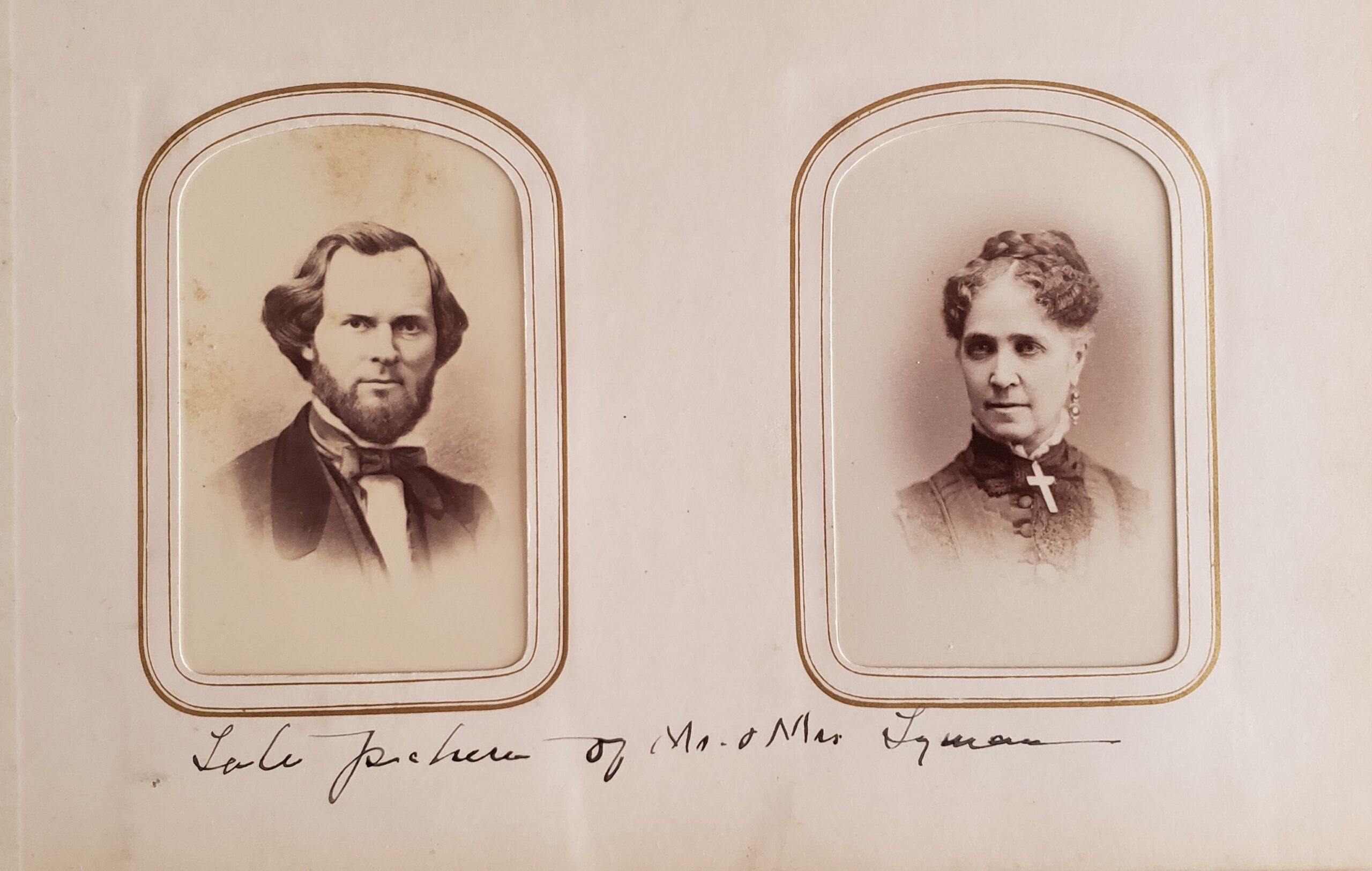
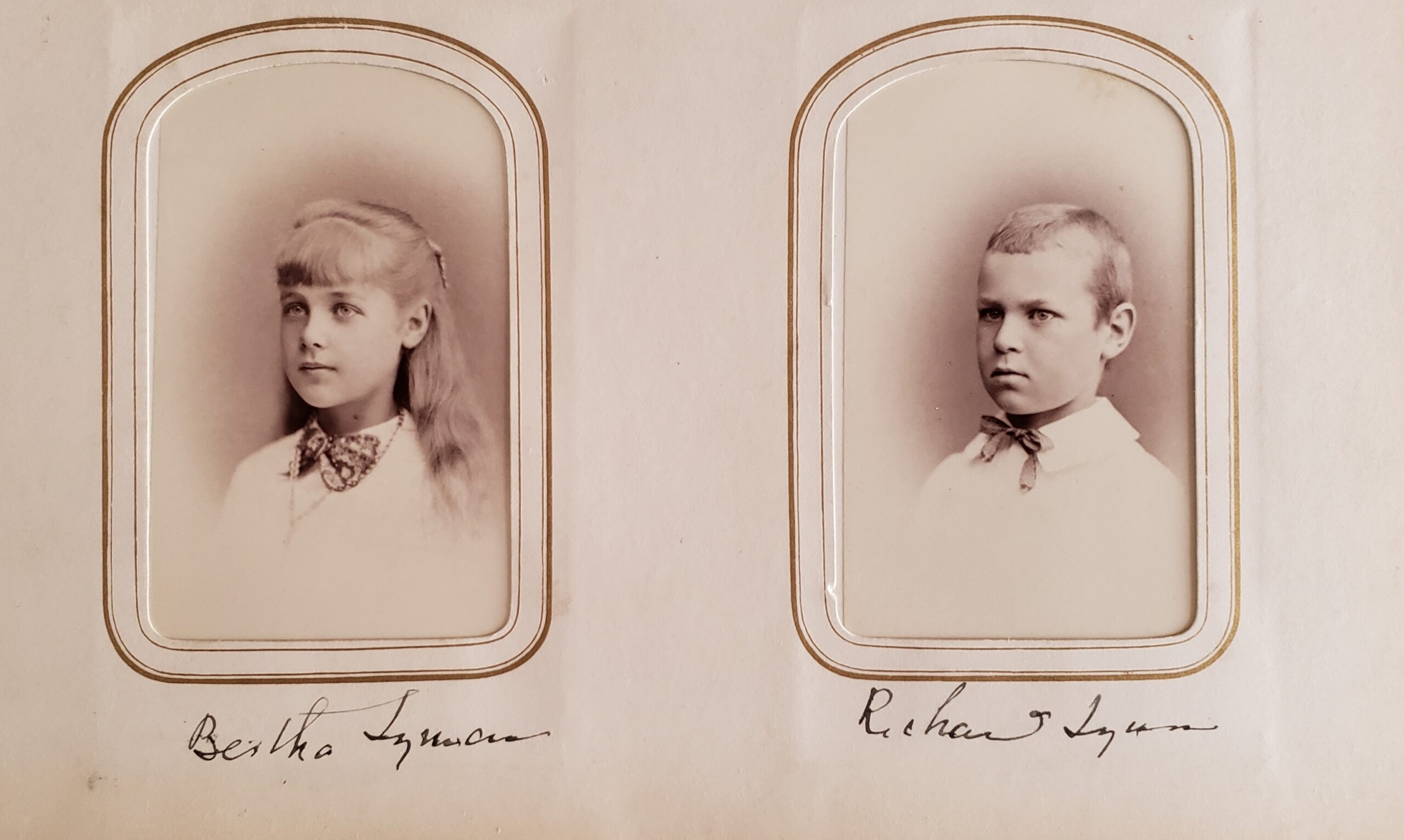
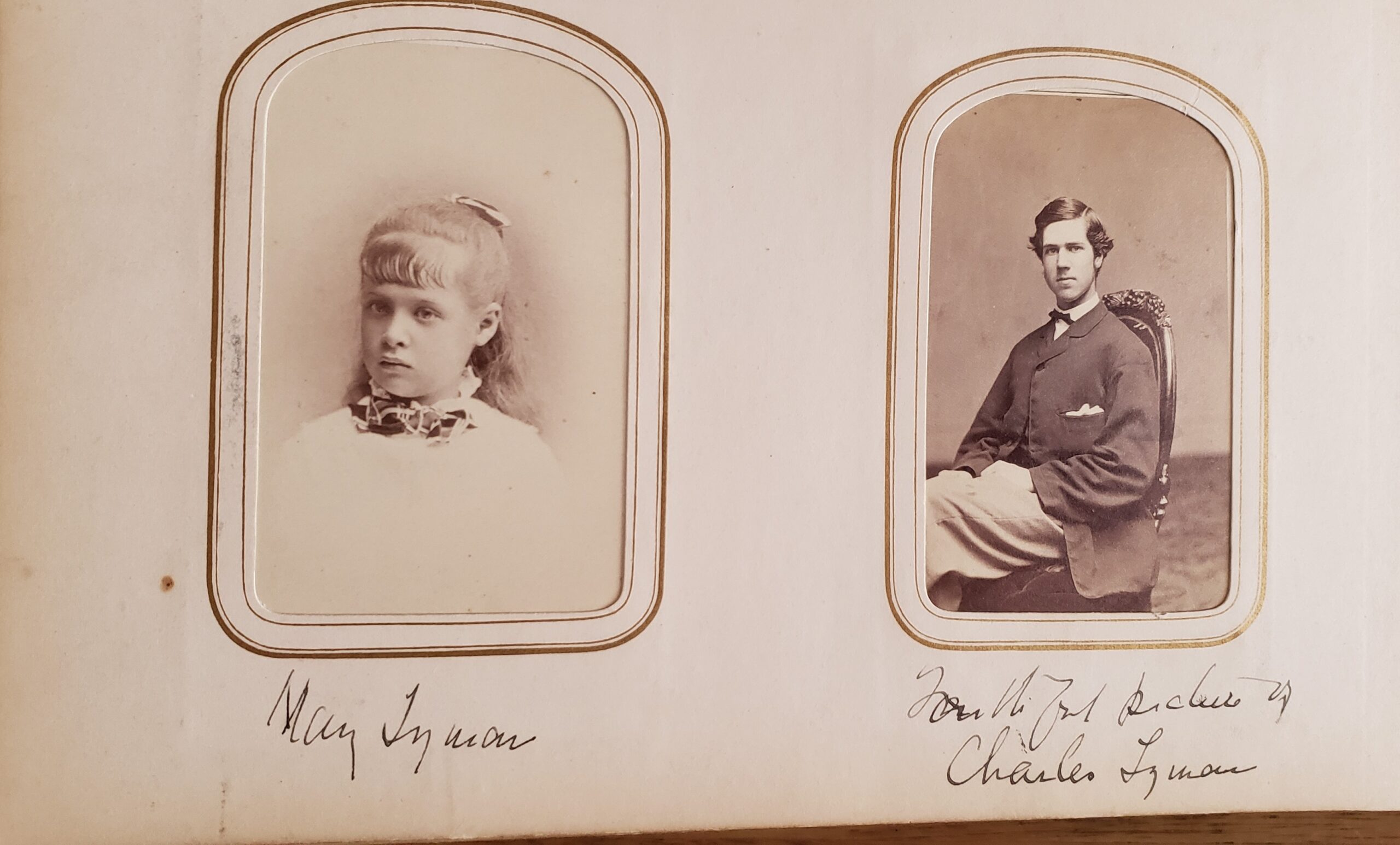
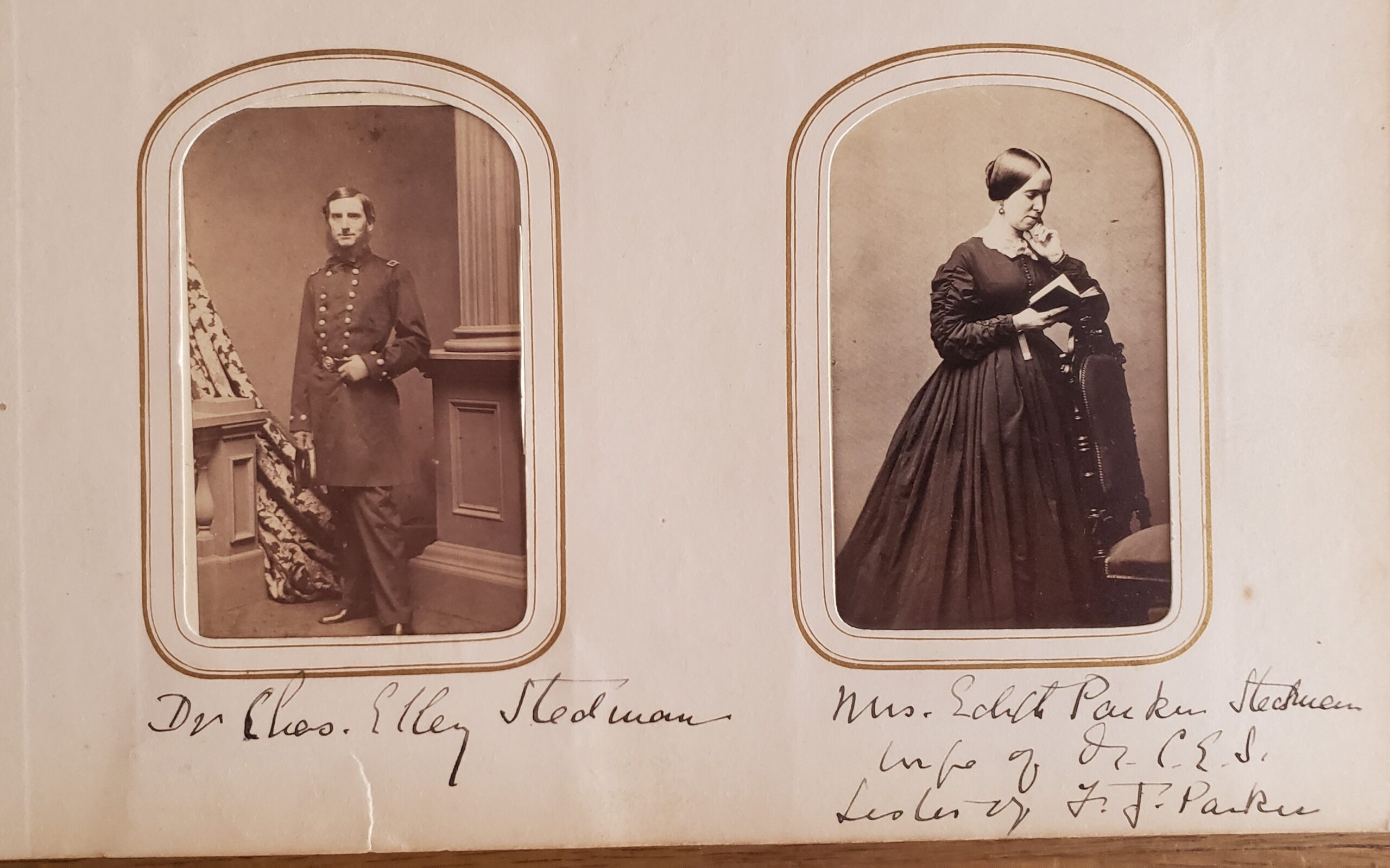
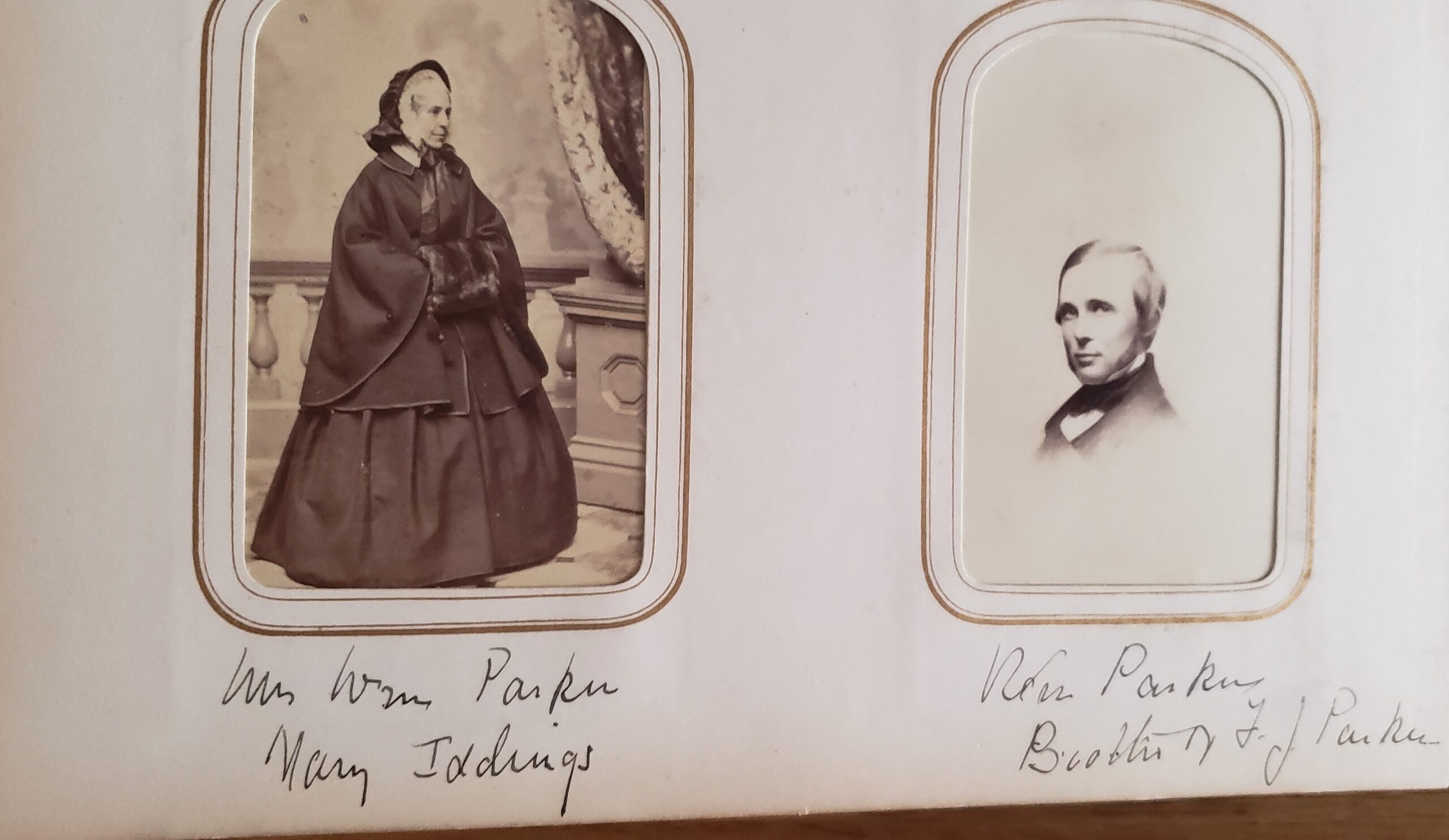
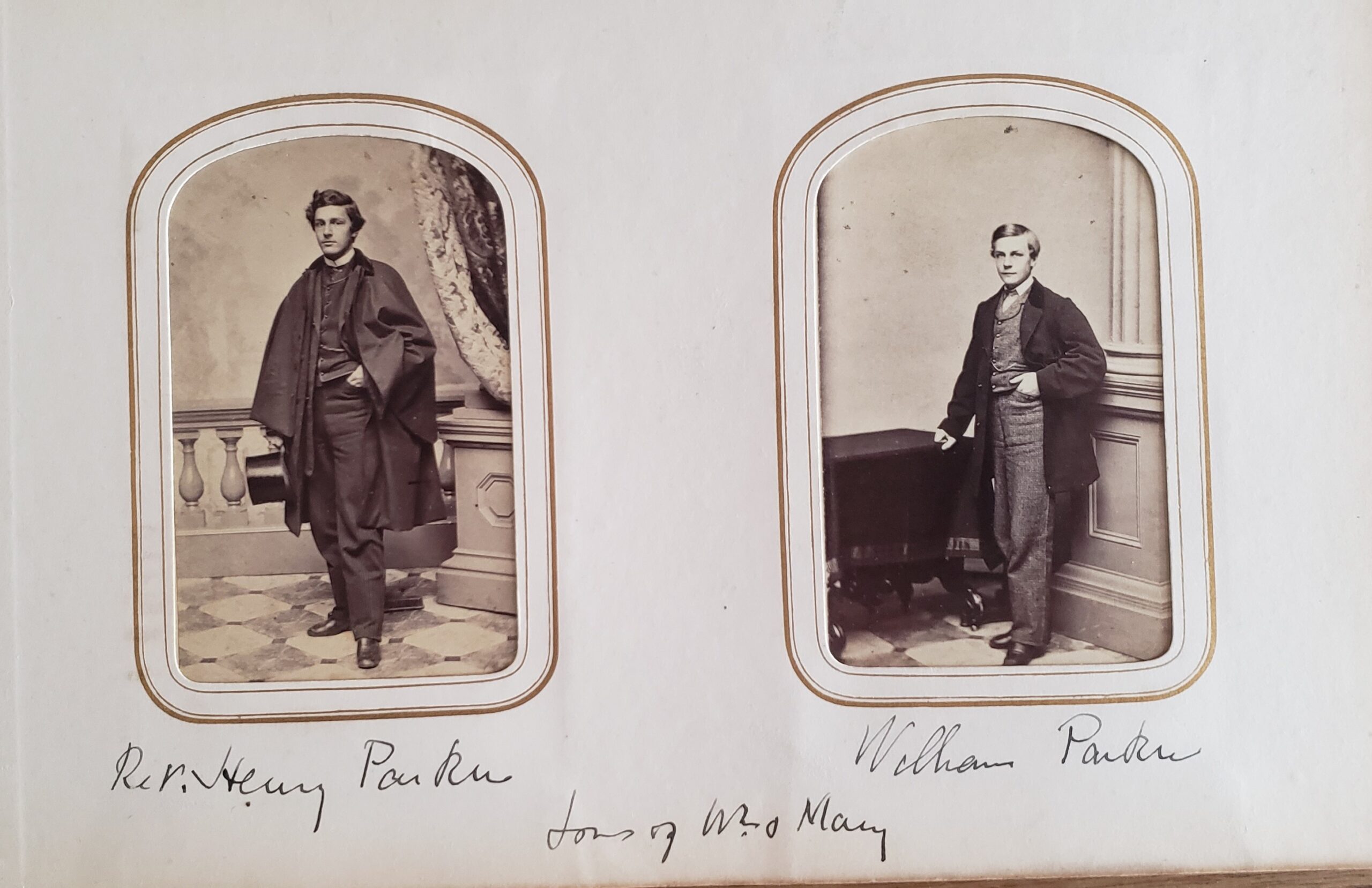
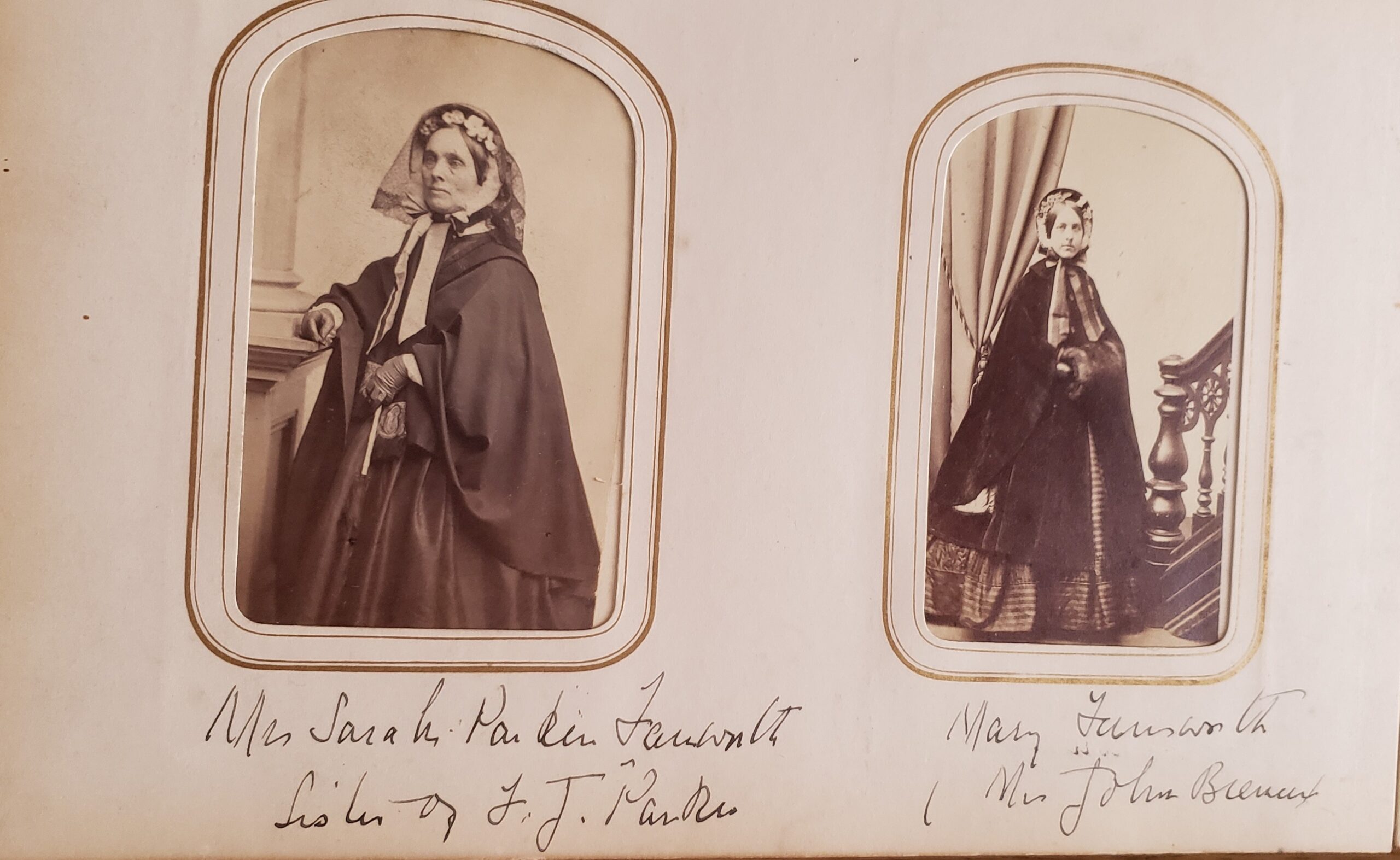
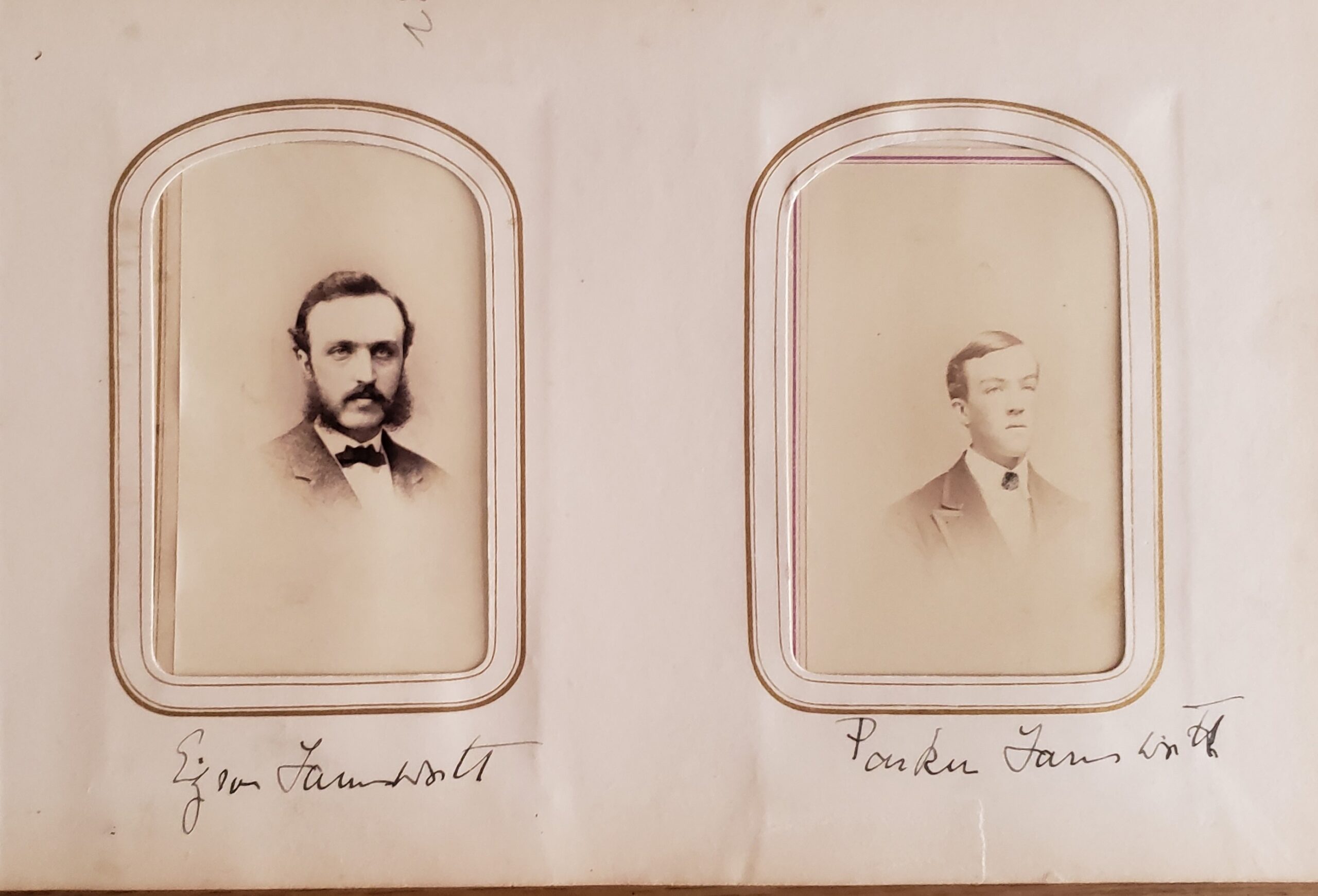
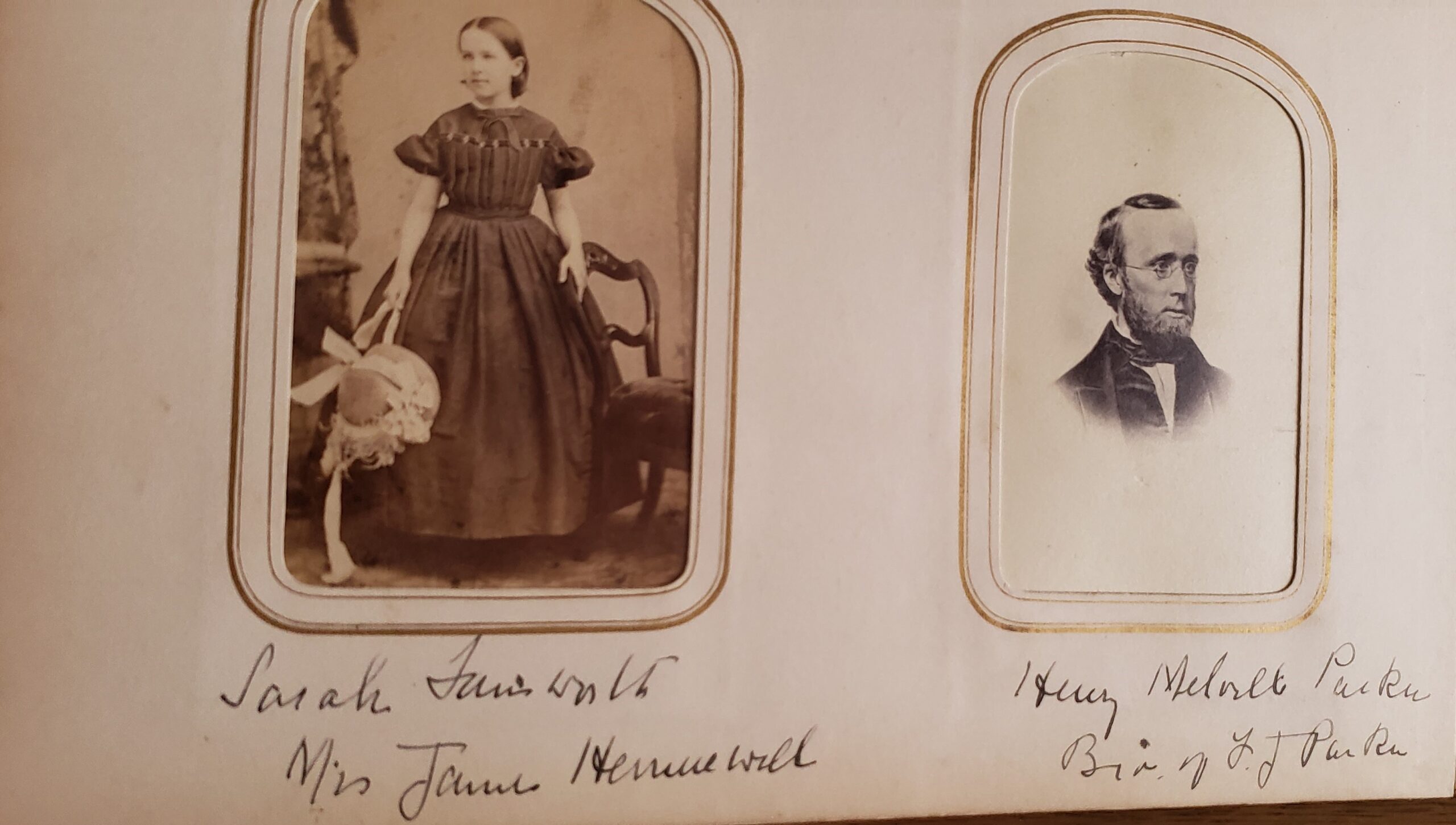
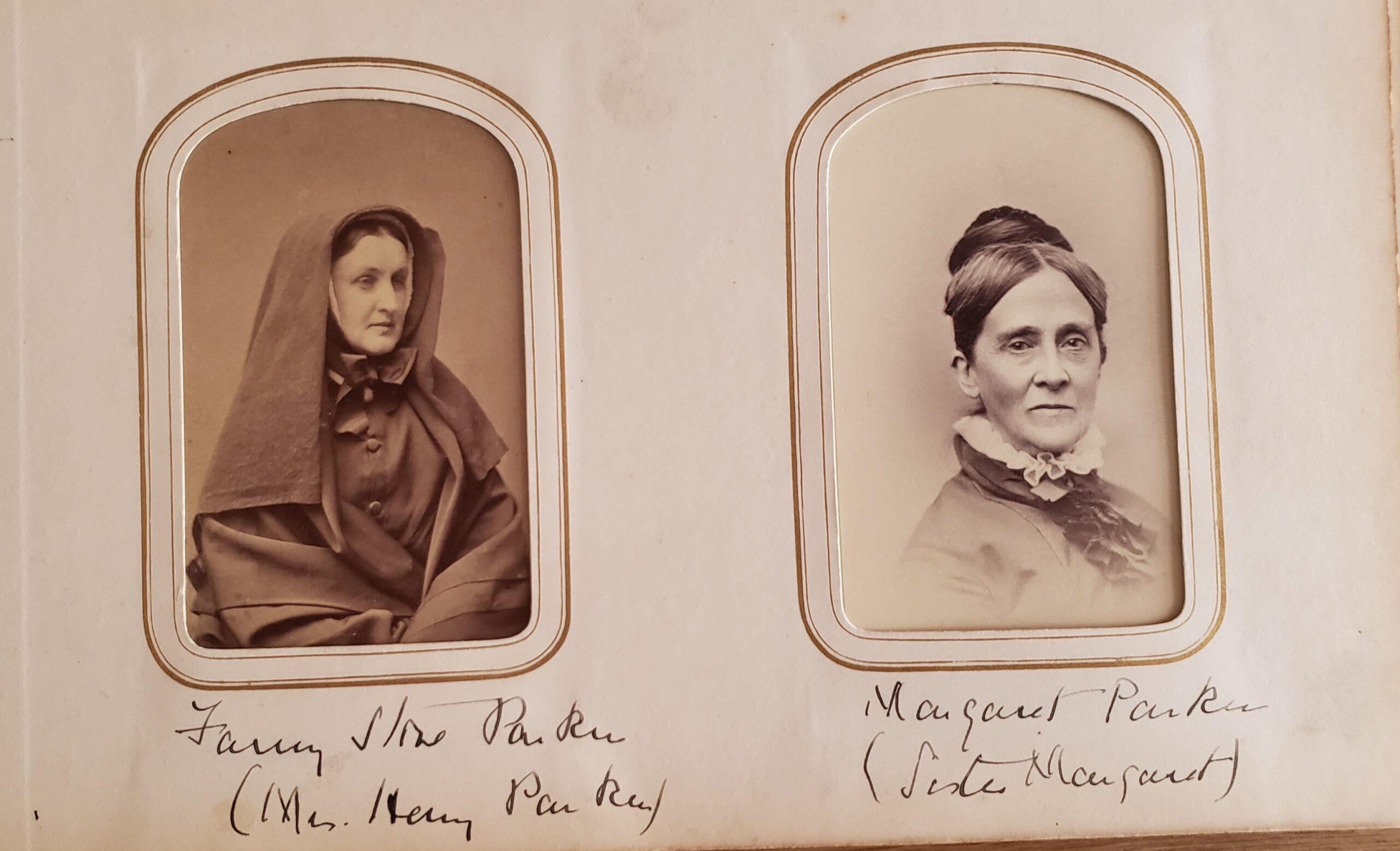
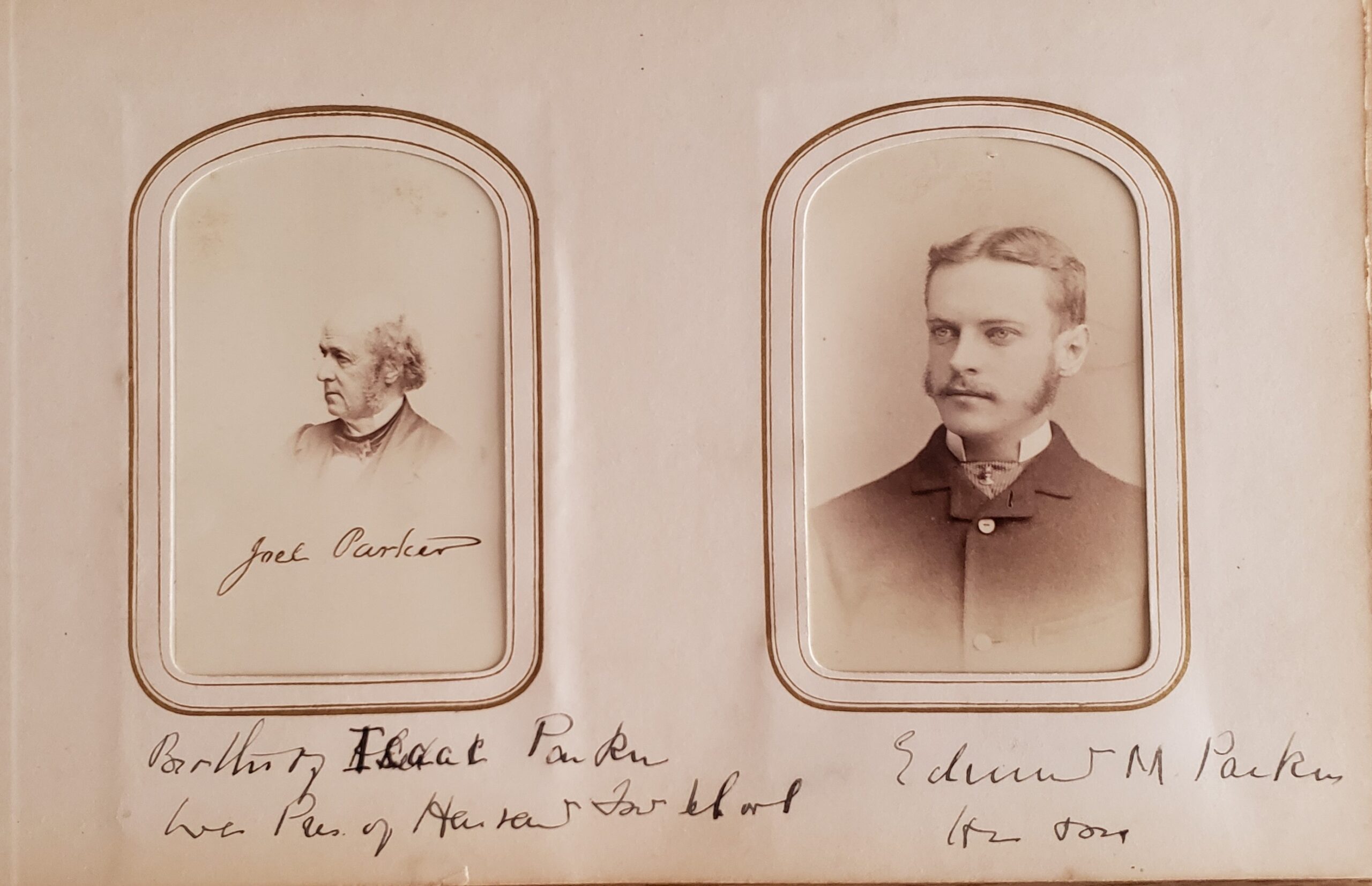
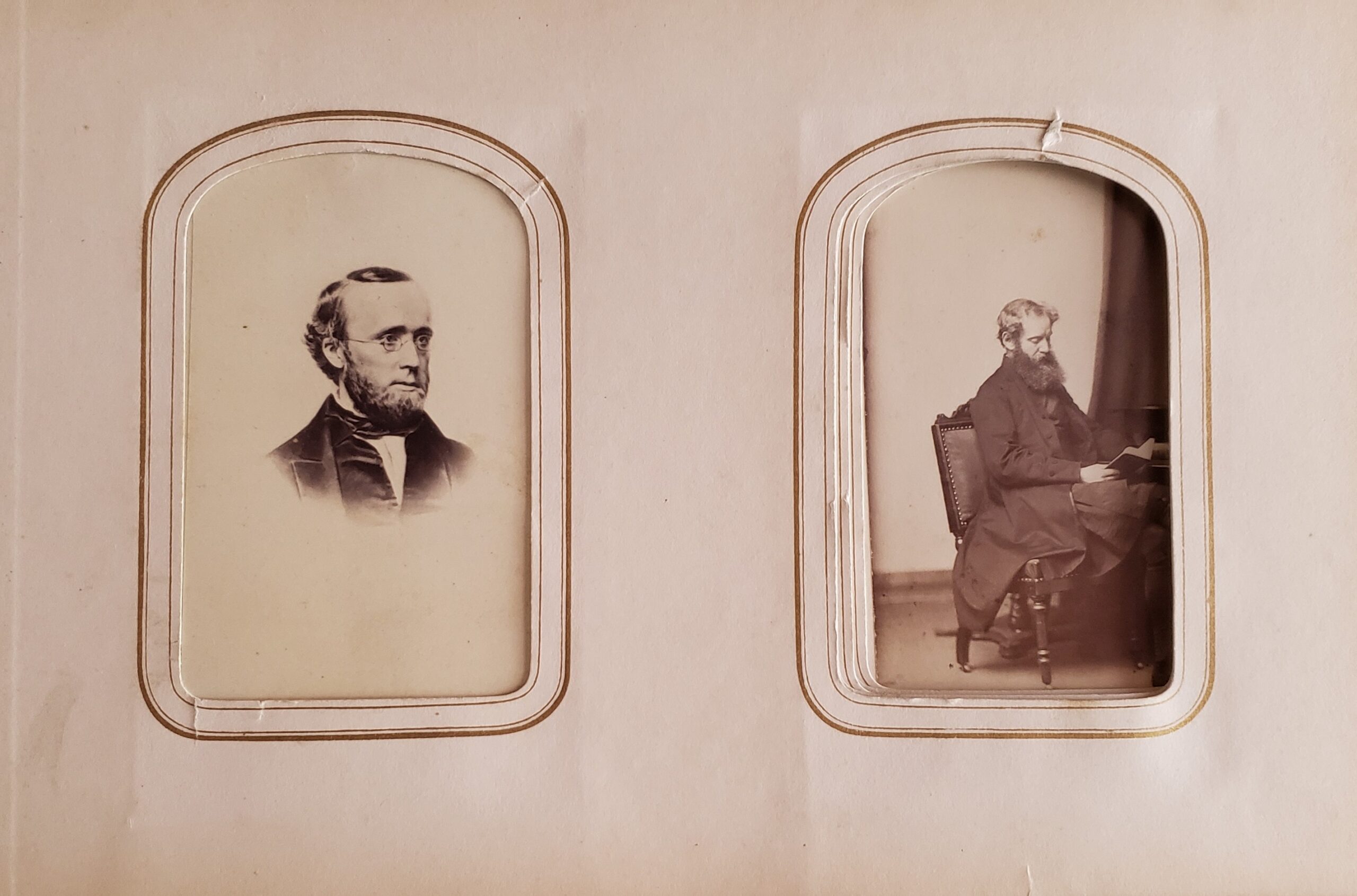
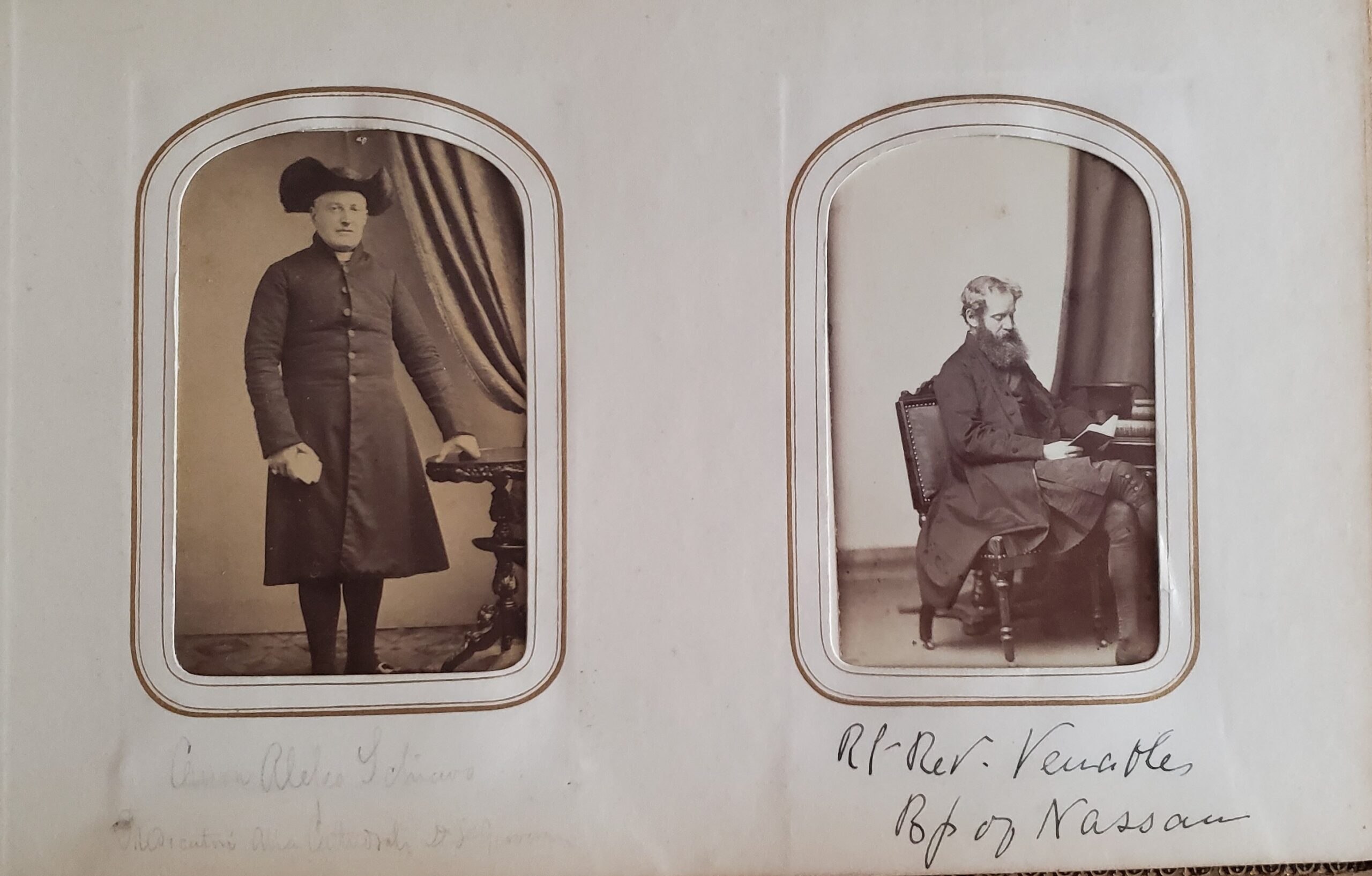
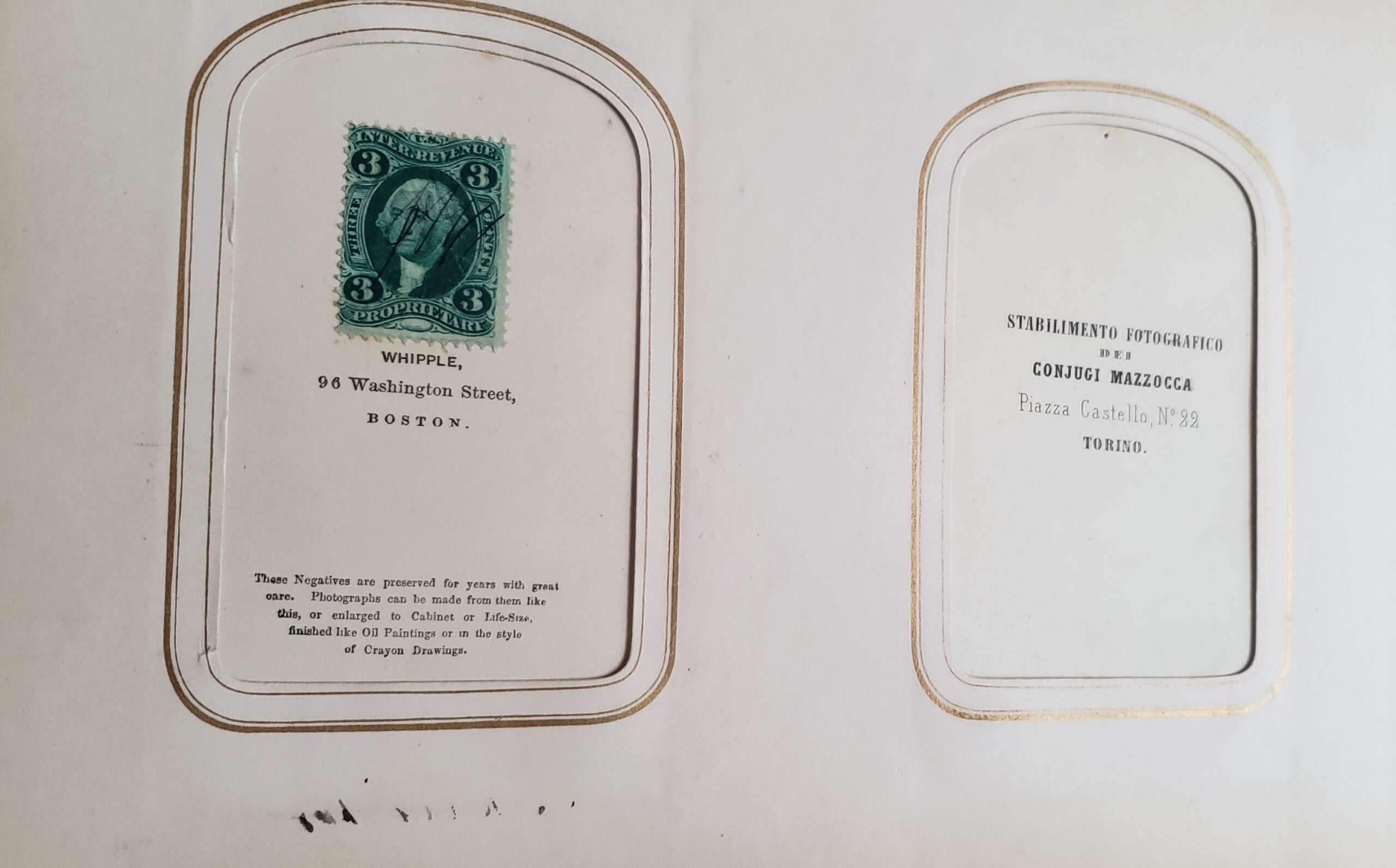
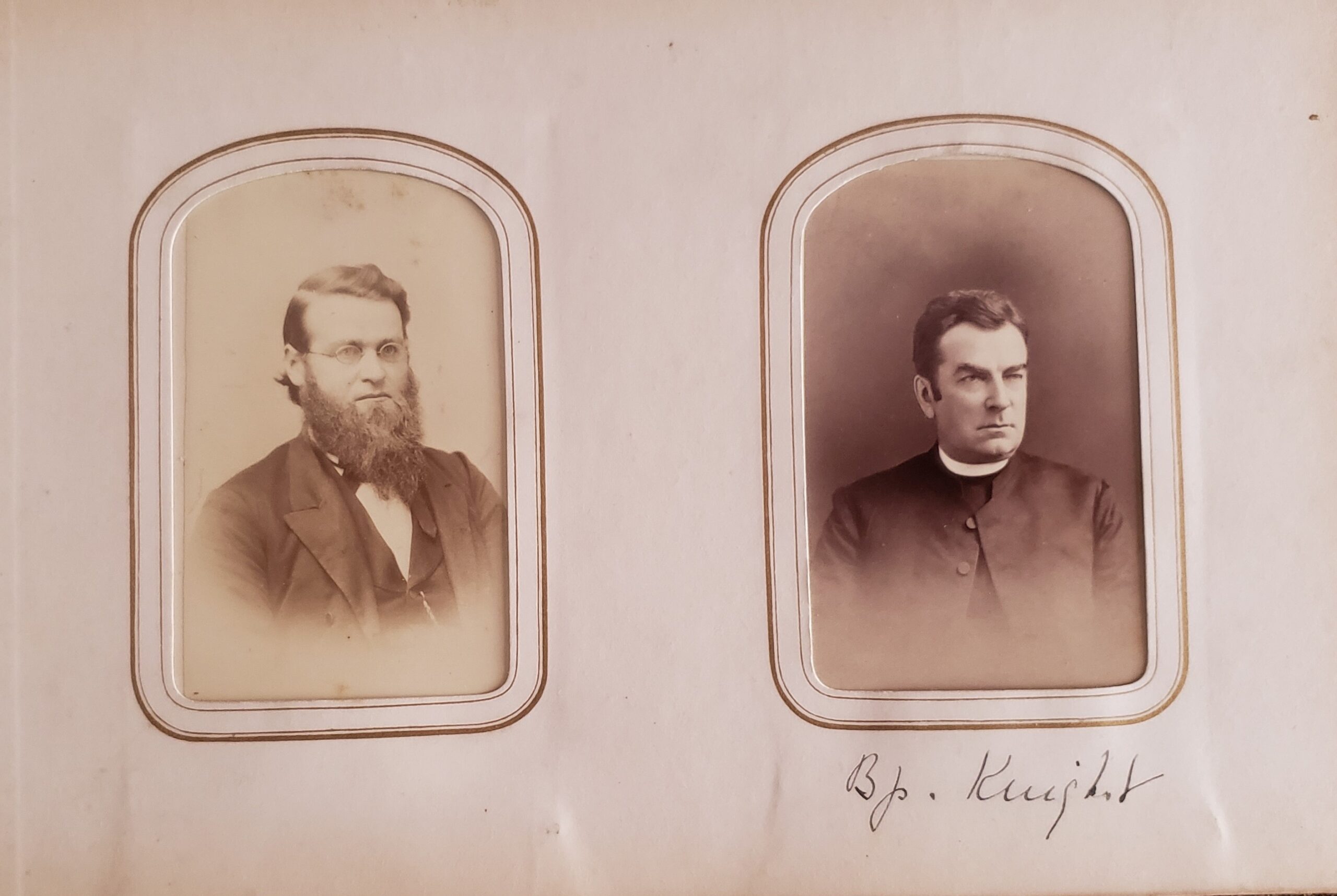
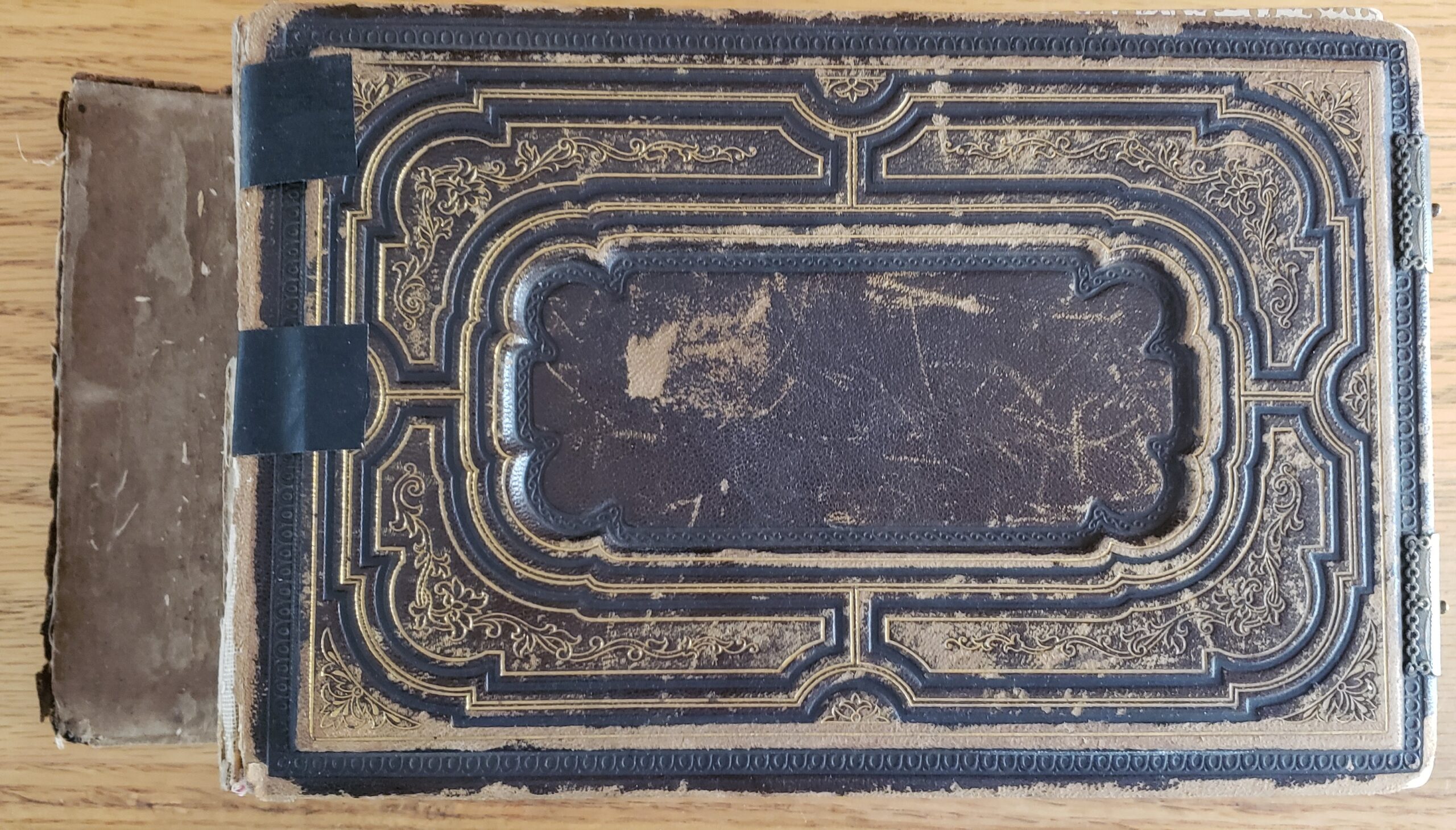
CWALBUM7. Colonel Francis J. Parker family album. Francis Jewett Parker was 36 years old and lived in Boston. He enlisted on 12/2/1861 as a Major. On 12/9/1861 he was commissioned into Field & Staff MA 32nd Infantry. He resigned on 12/27/1862. Promotions: Lt. Colonel 5/25/1862; Colonel 8/6/1862. He died on 1/20/1909 in Boston, MA. This album contains 65 CDVs, Parker’s being the first in the album. There are 2 other soldiers in the album. One is unidentified and the other is of Dr. Charles Ellery Stedman, Surgeon, US Navy. Stedman served on the USS Huron and the Circassian. He was also an artist and commentator and produced a book, available today, titled The Civil War Sketchbook of Charles Ellery Stedman, Surgeon, US Navy. A great many of the CDVs are named beneath the images and represent Parker’s extended family. Most of the backmarks are Boston photographers such as Black, Whipple, etc. The album itself has a separated cover and spine, pages intact. A fine Civil War era album in need of further genealogical research. Images are VG. $800
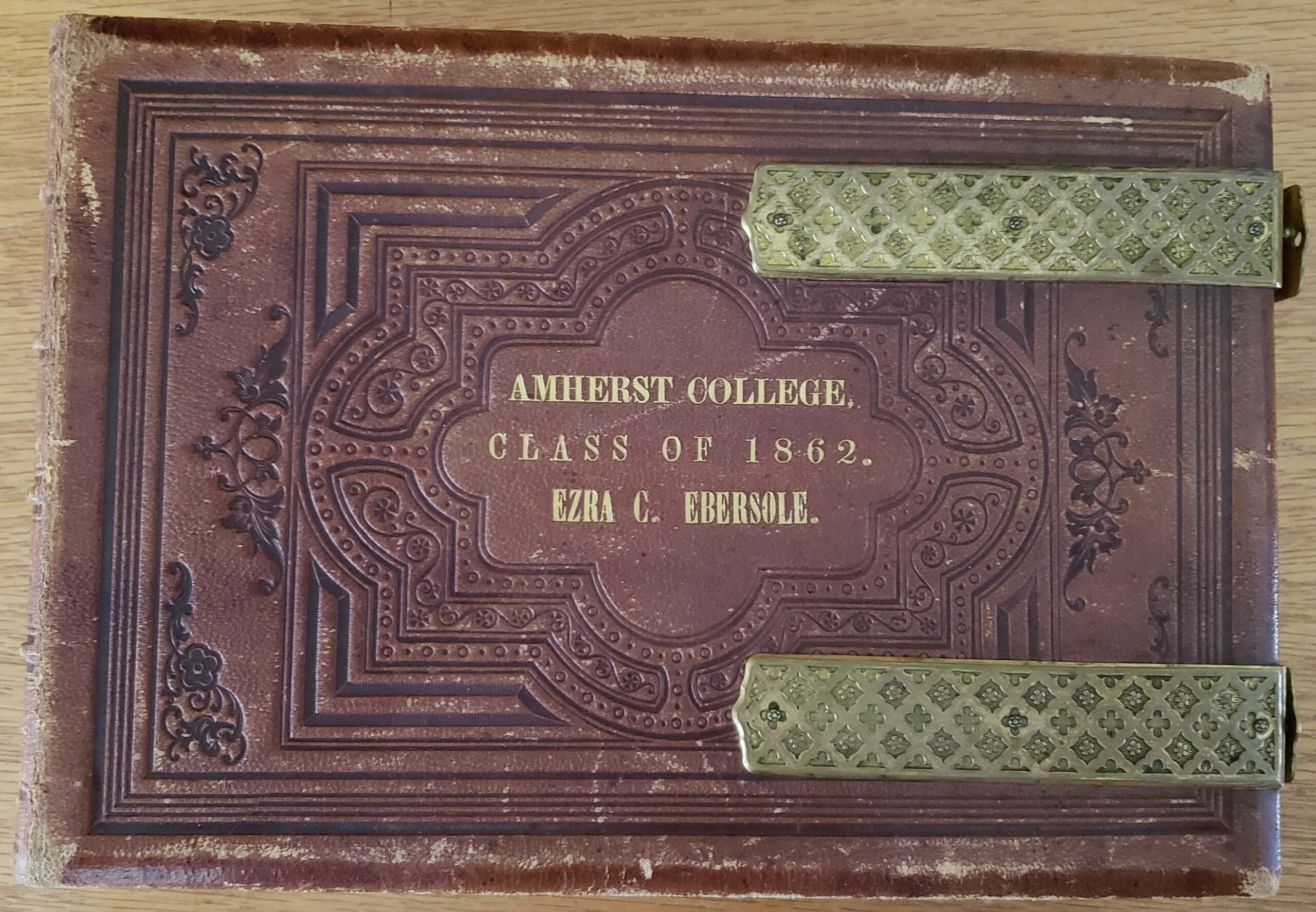
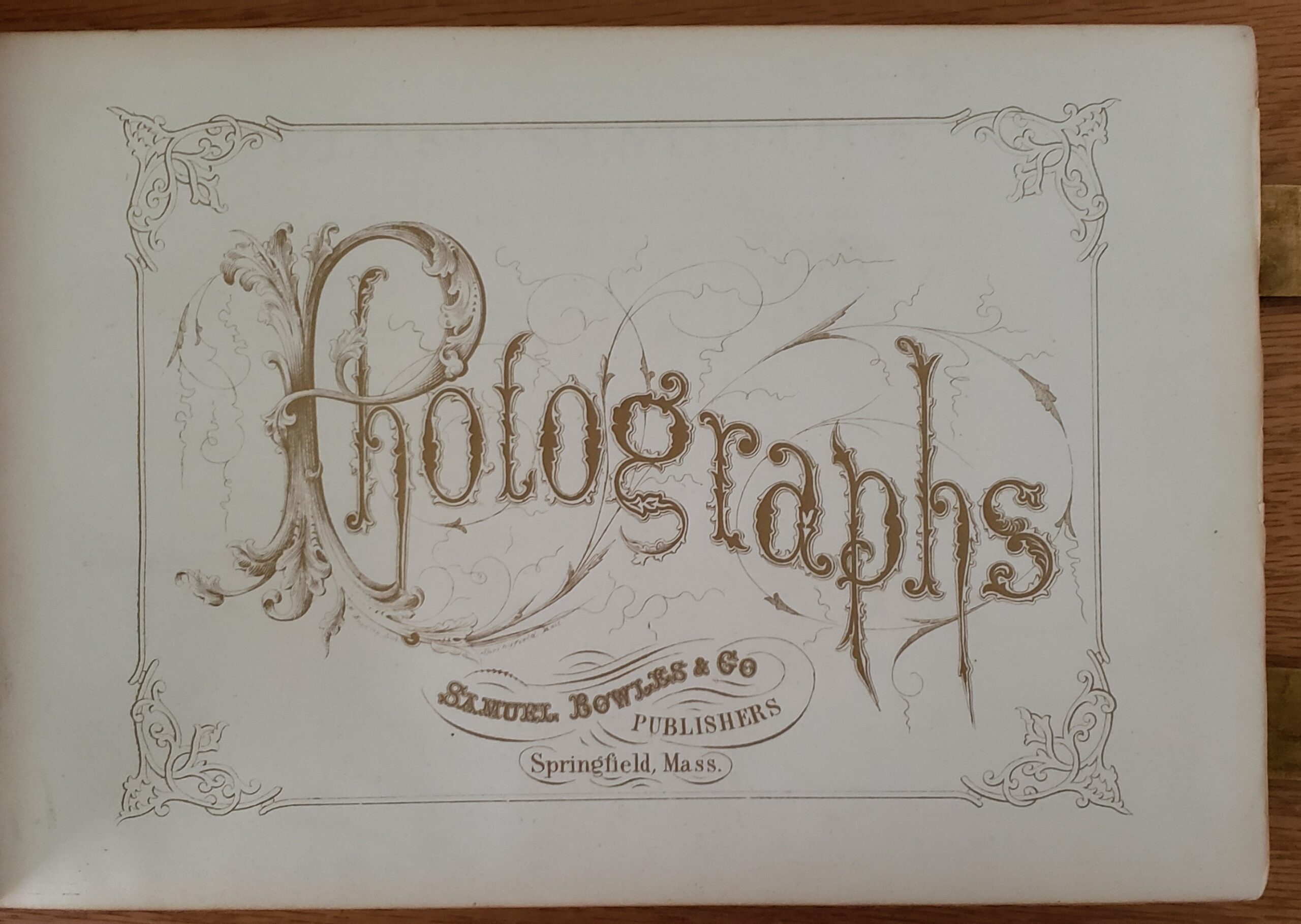
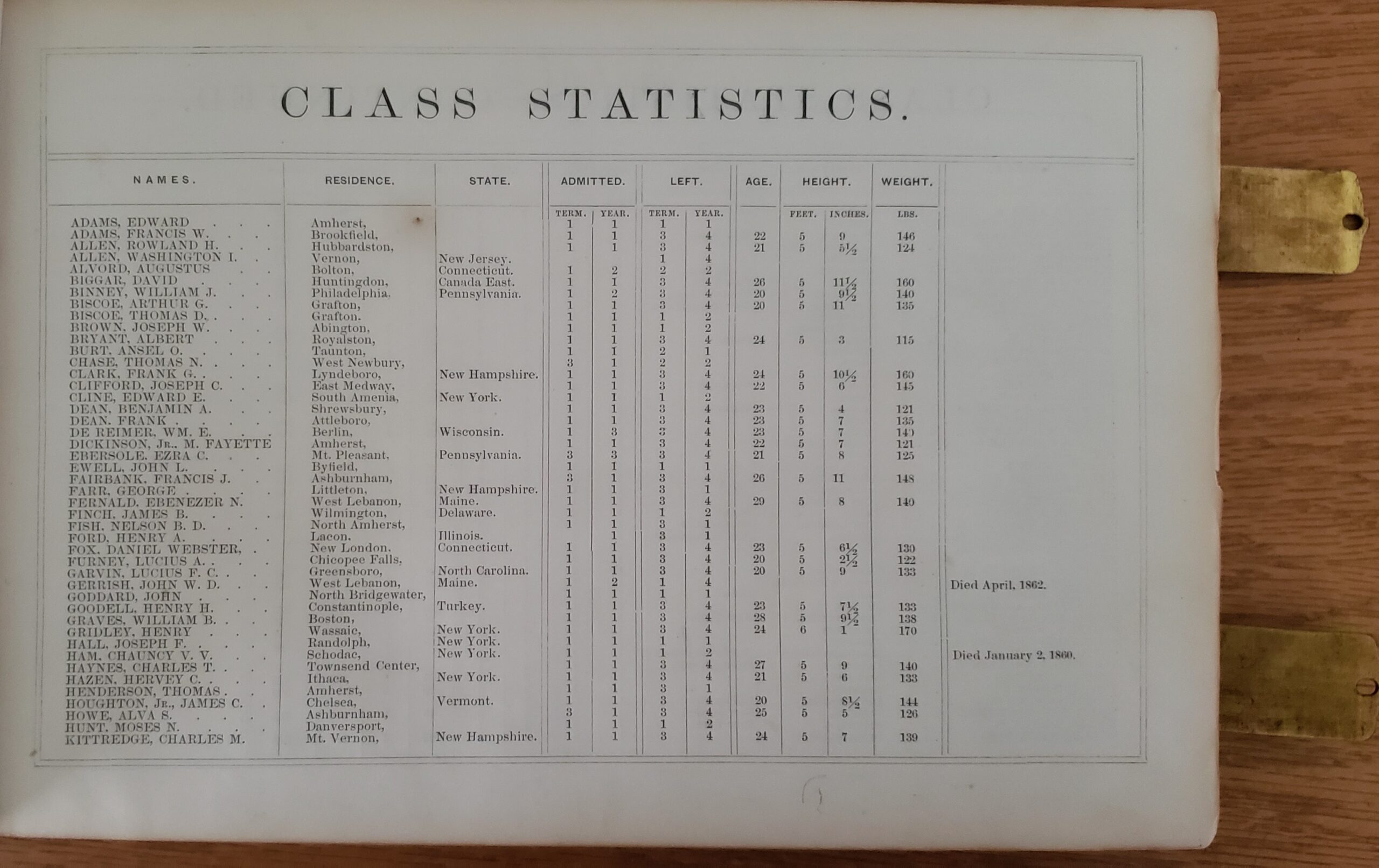
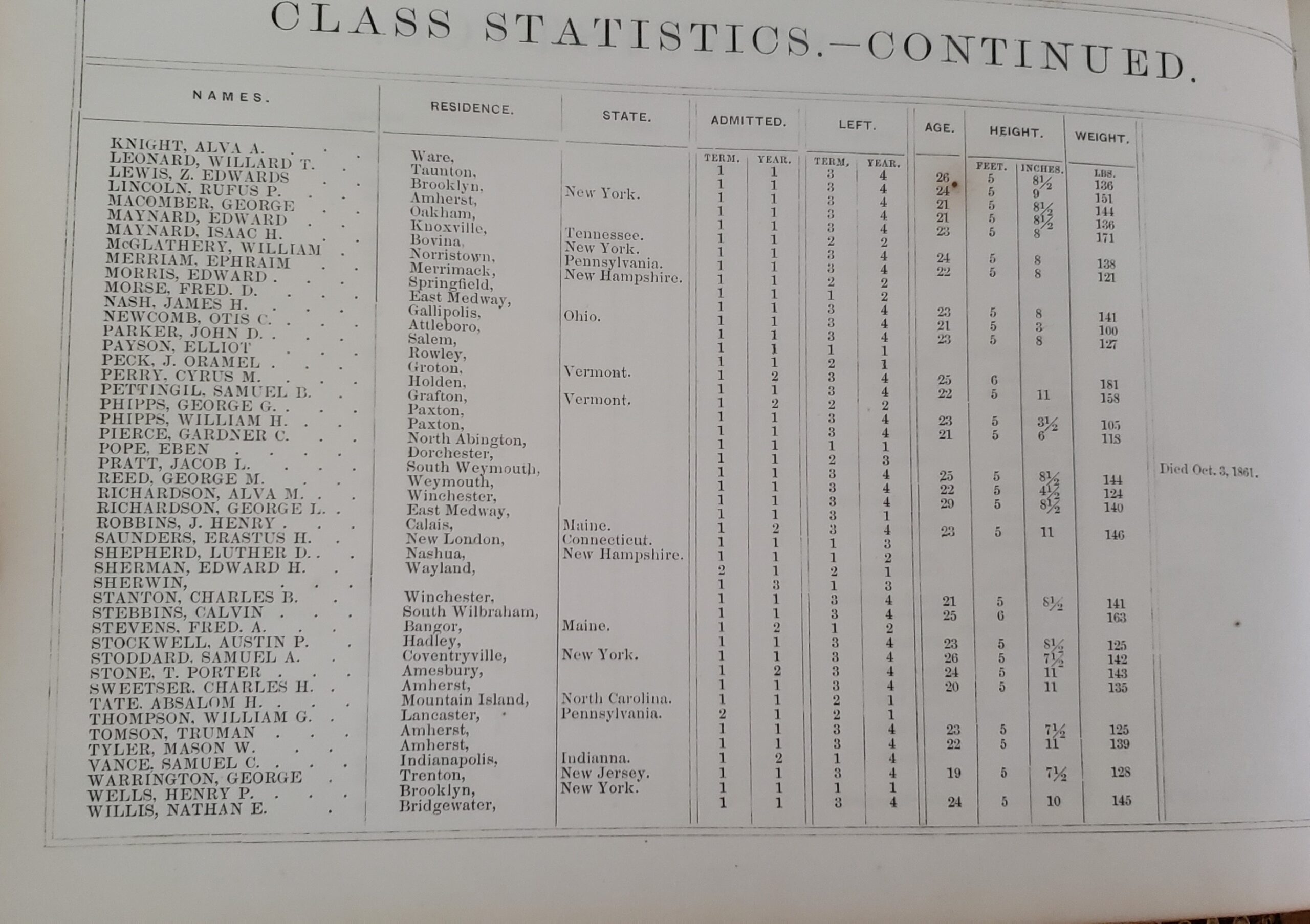
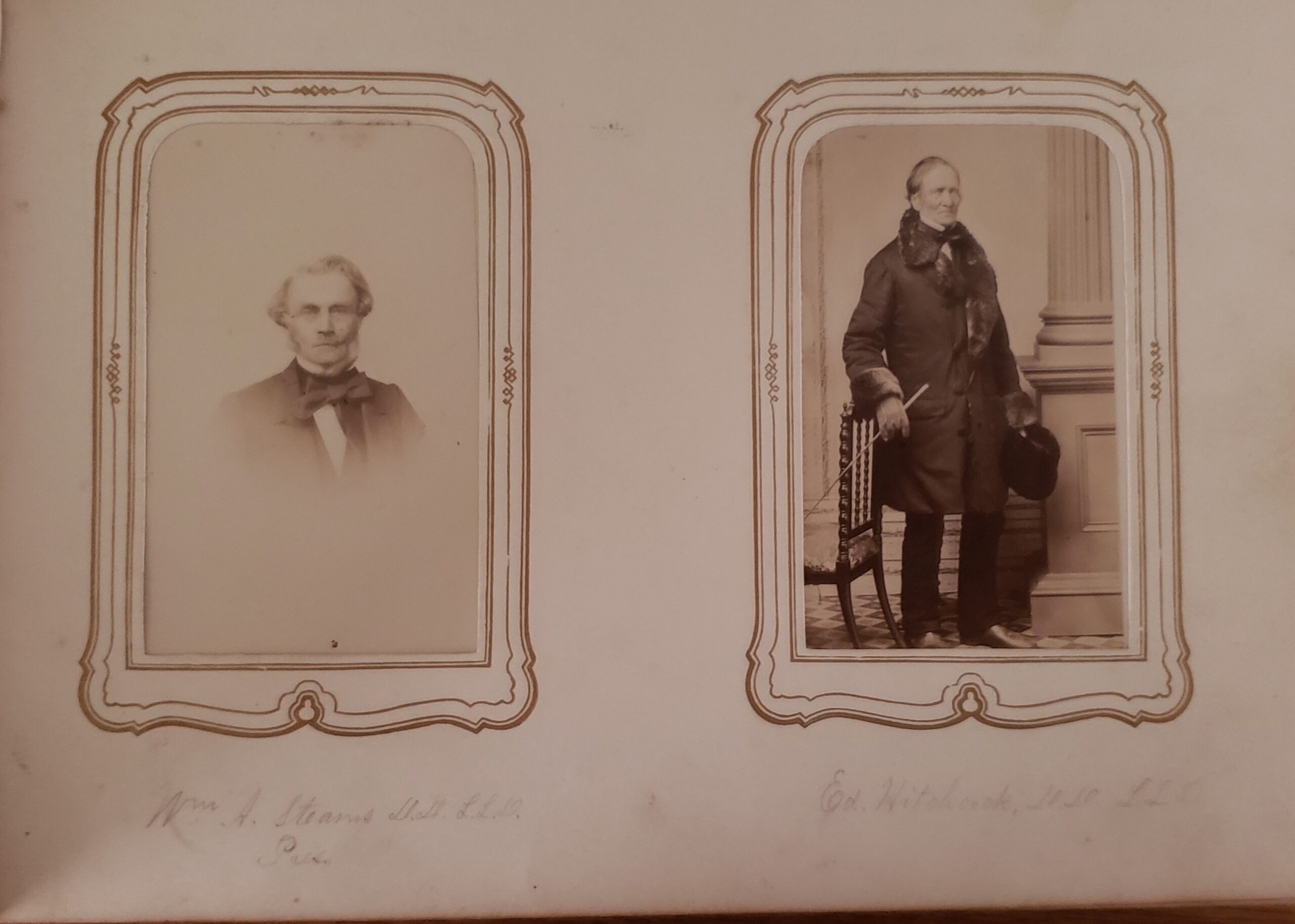
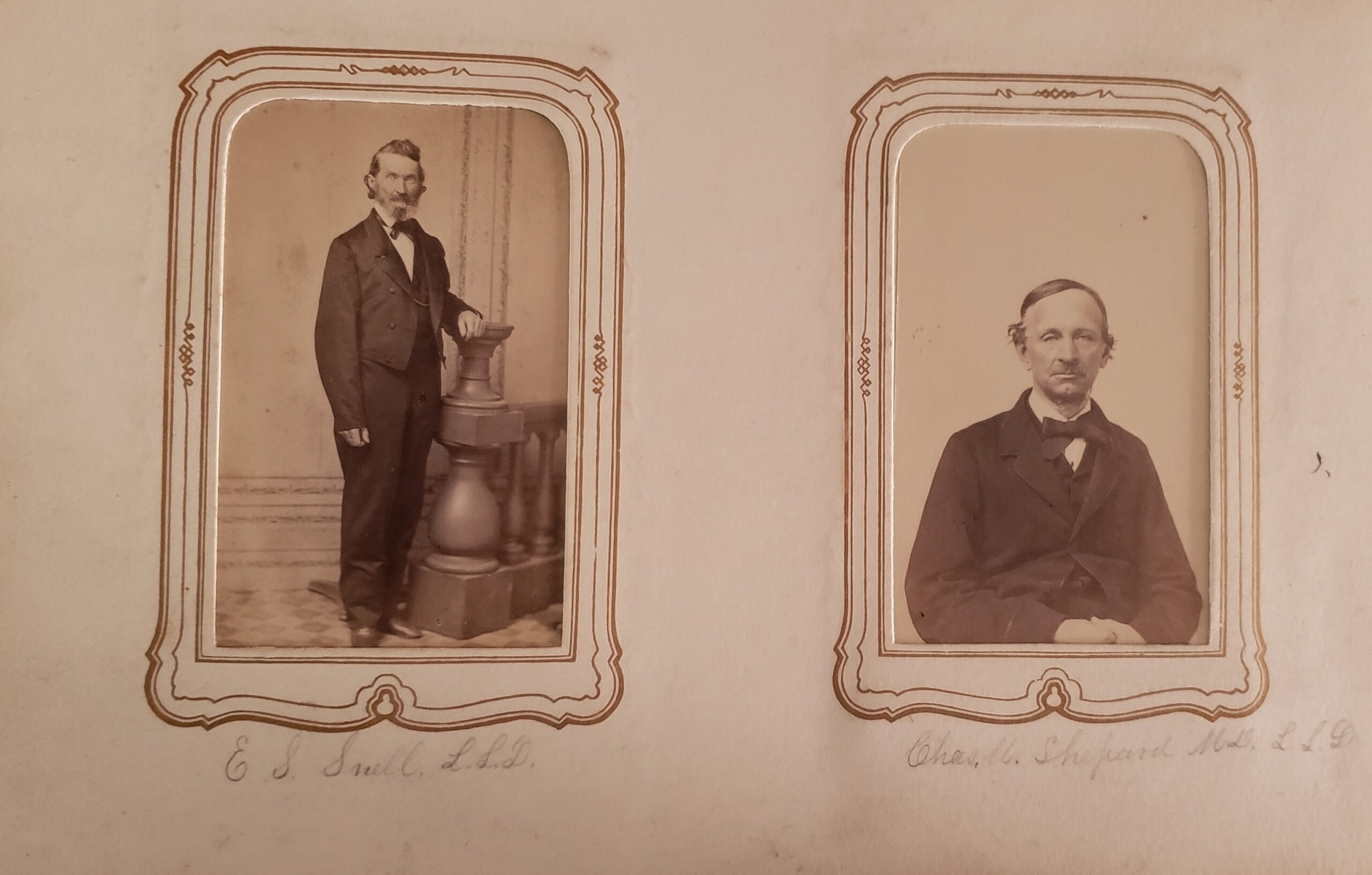
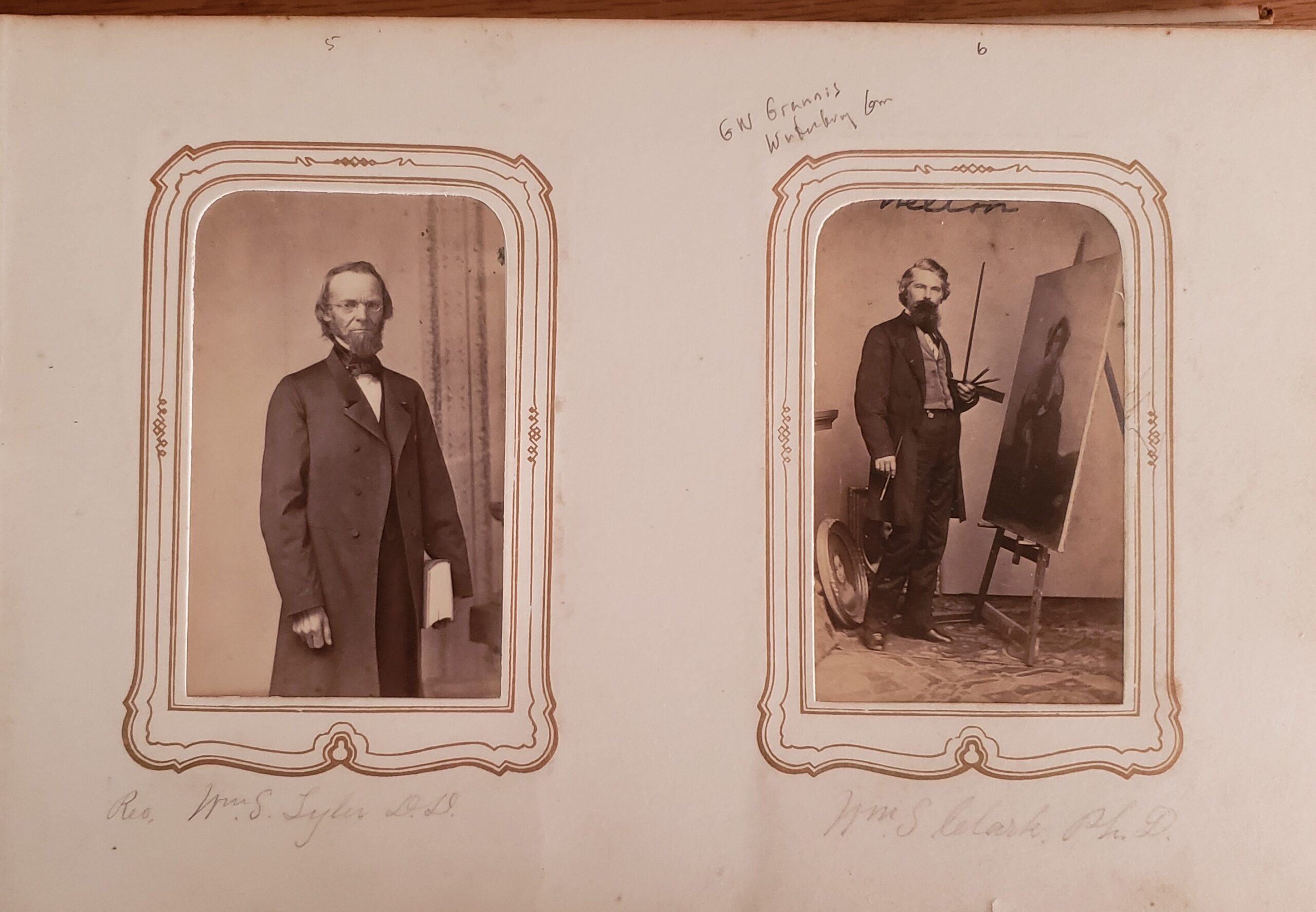
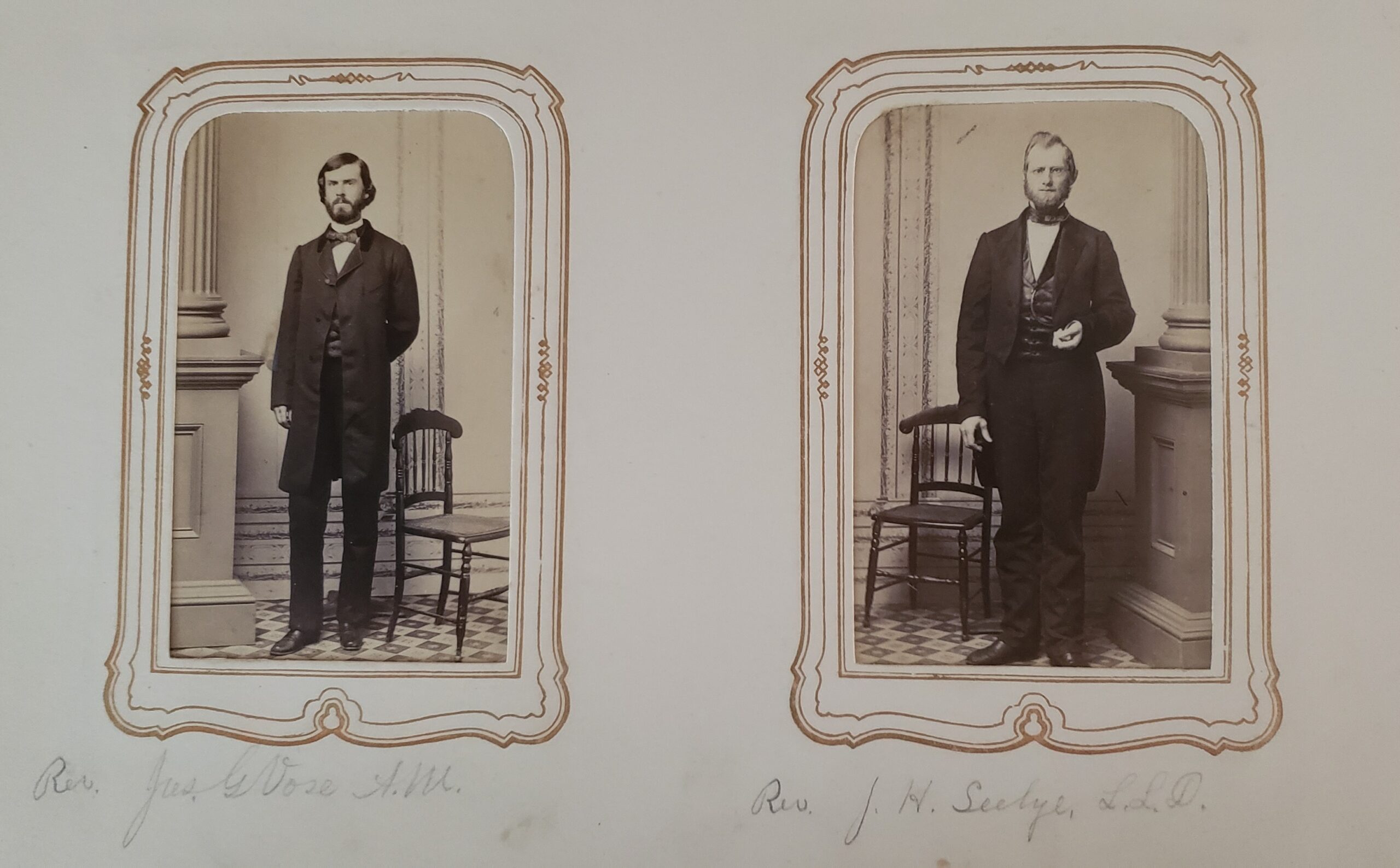
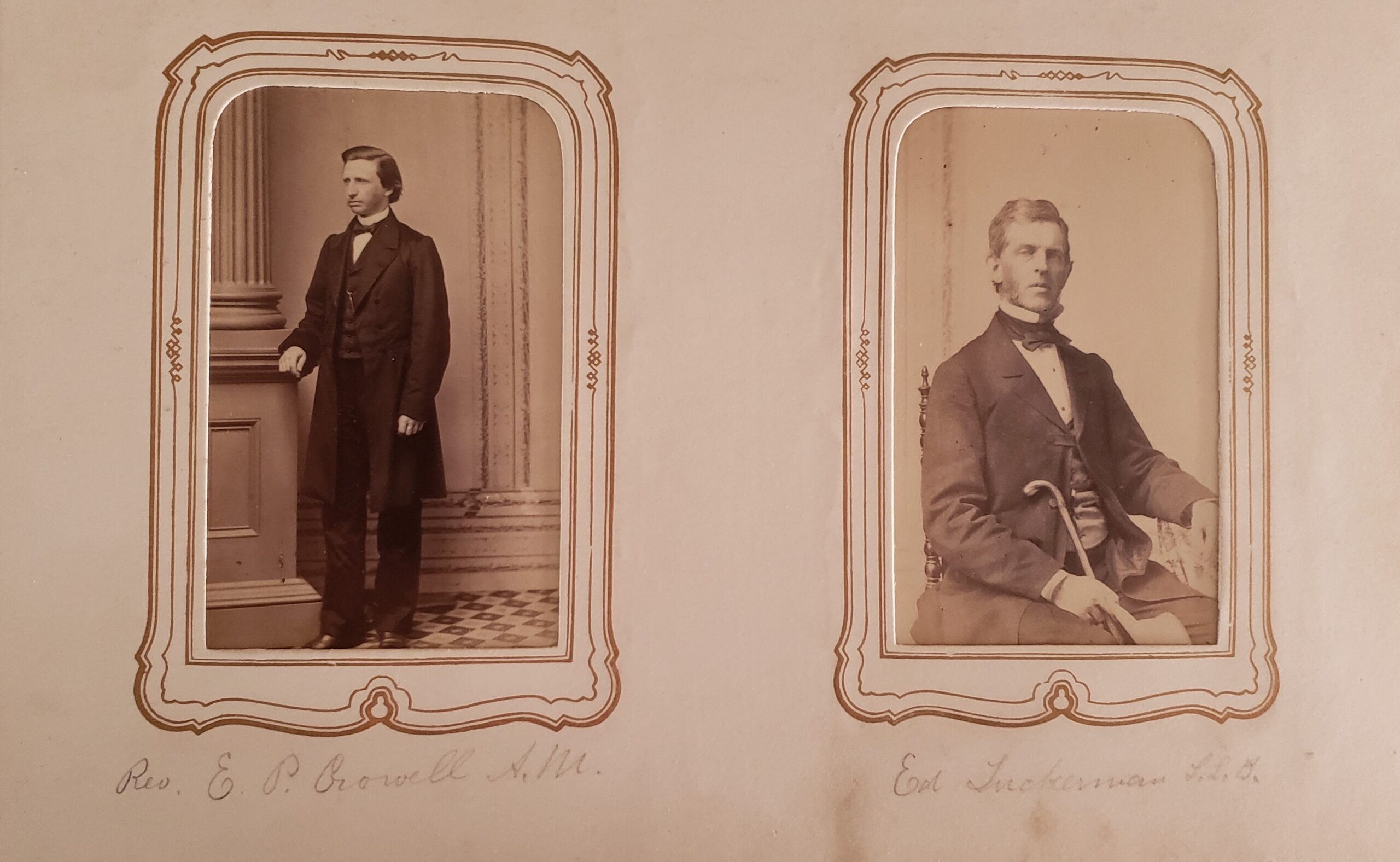
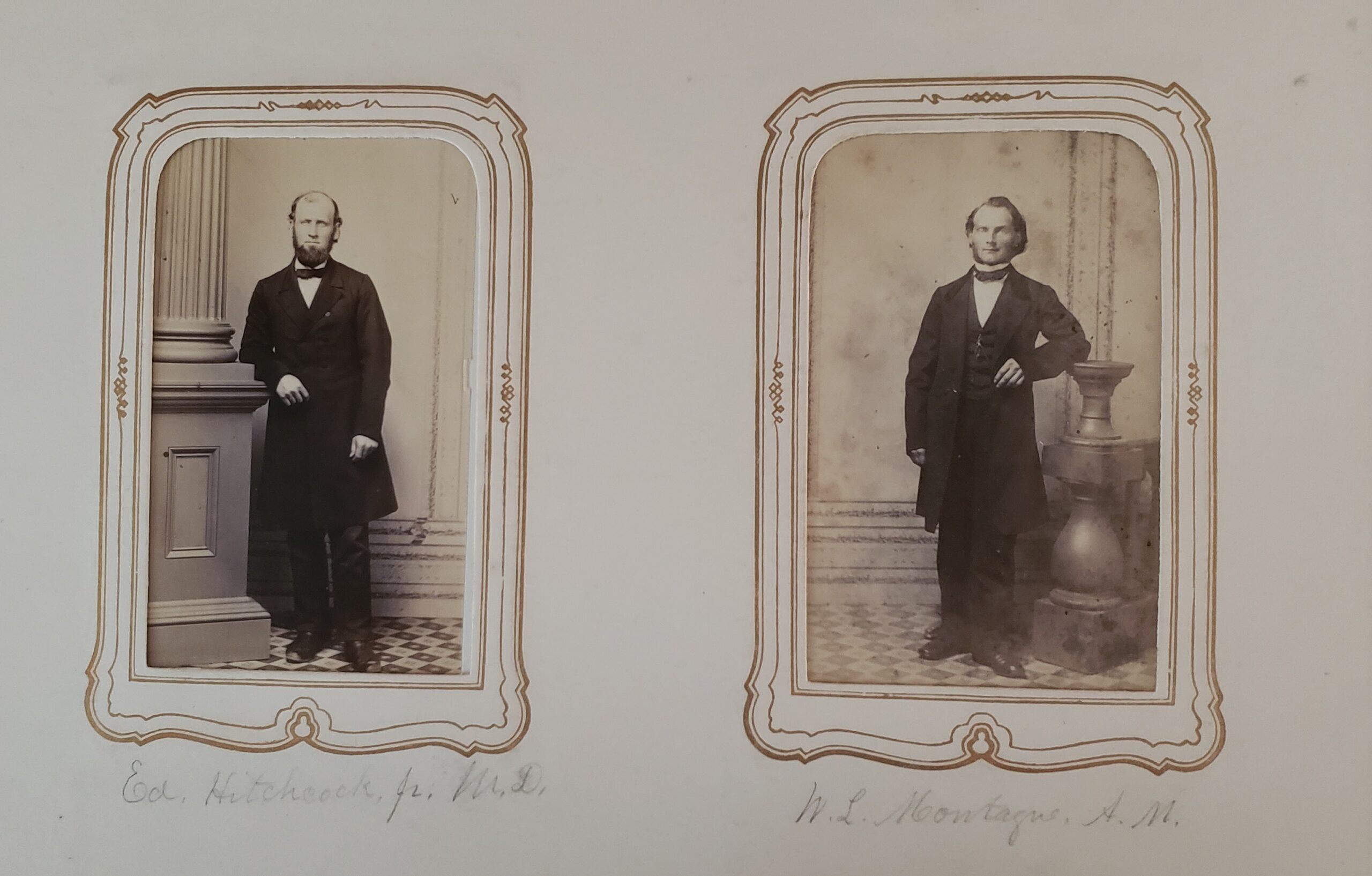
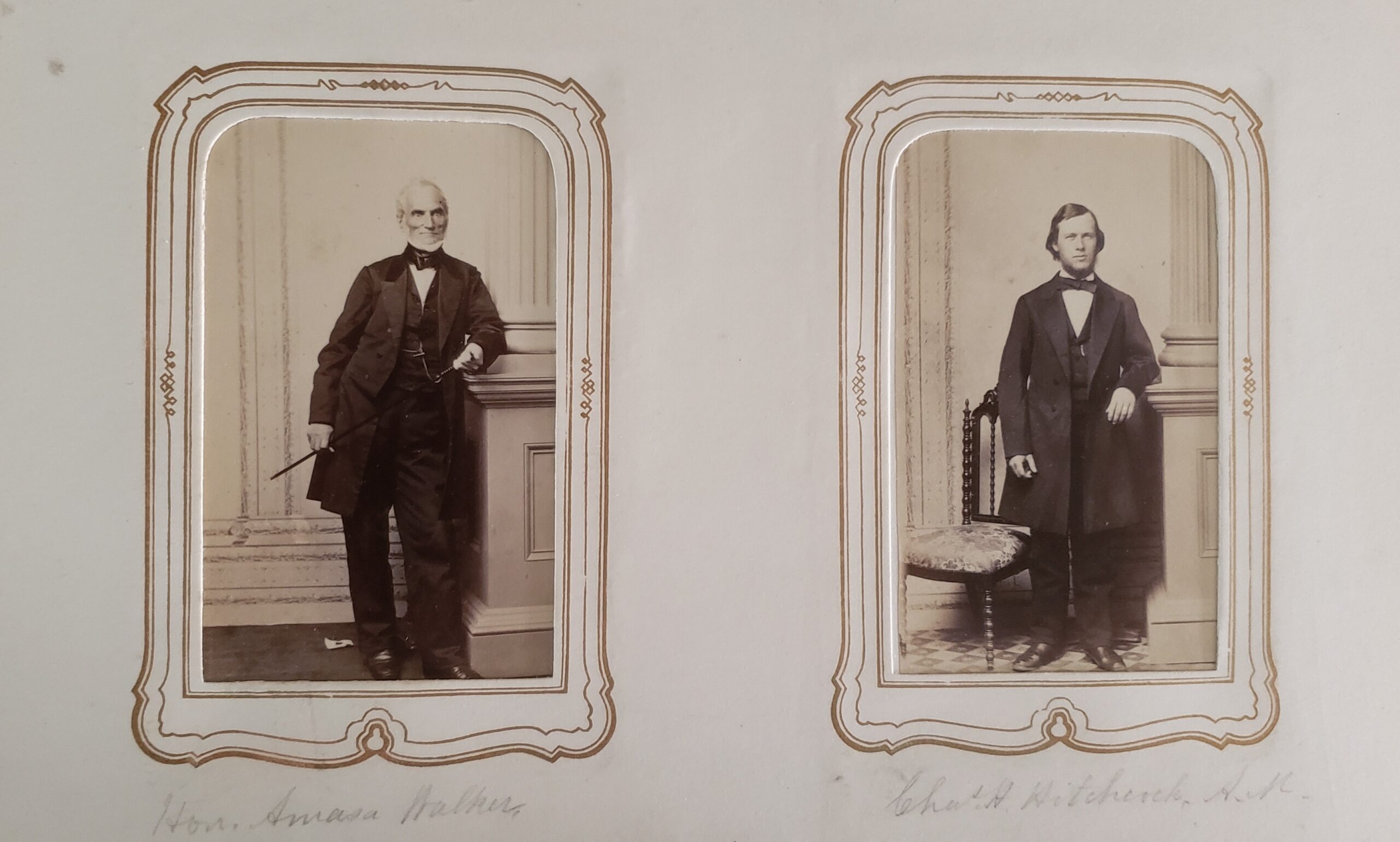
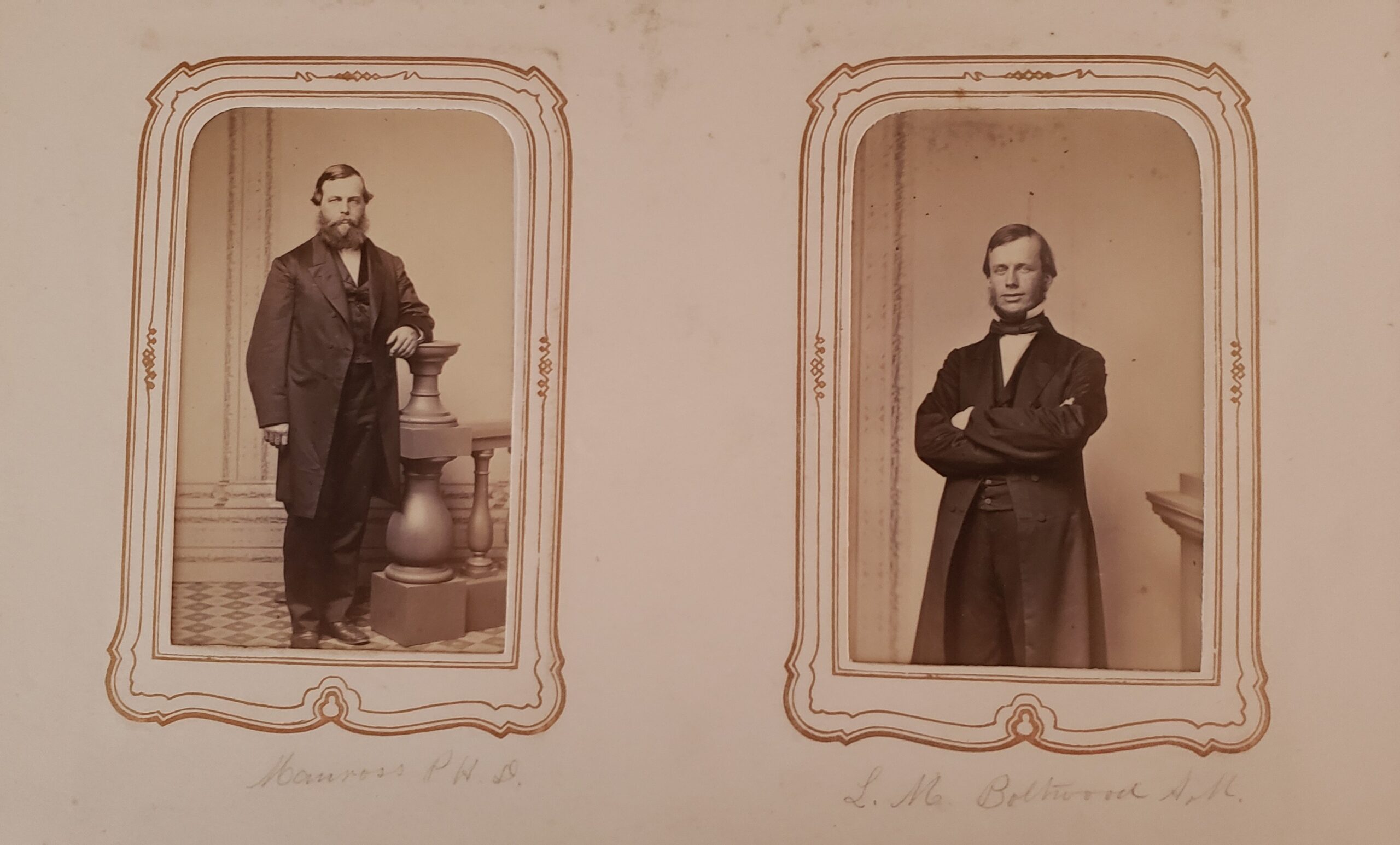
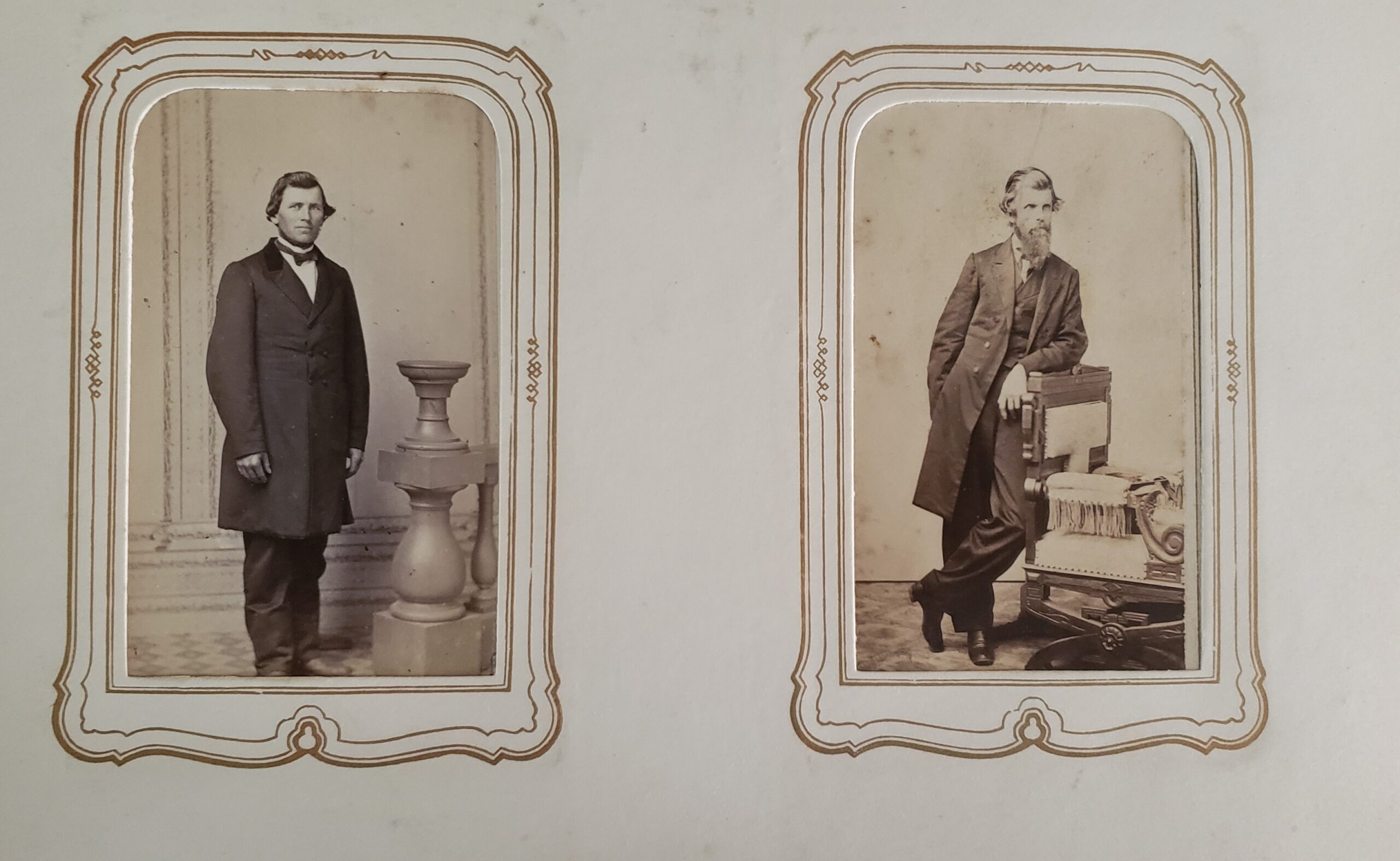
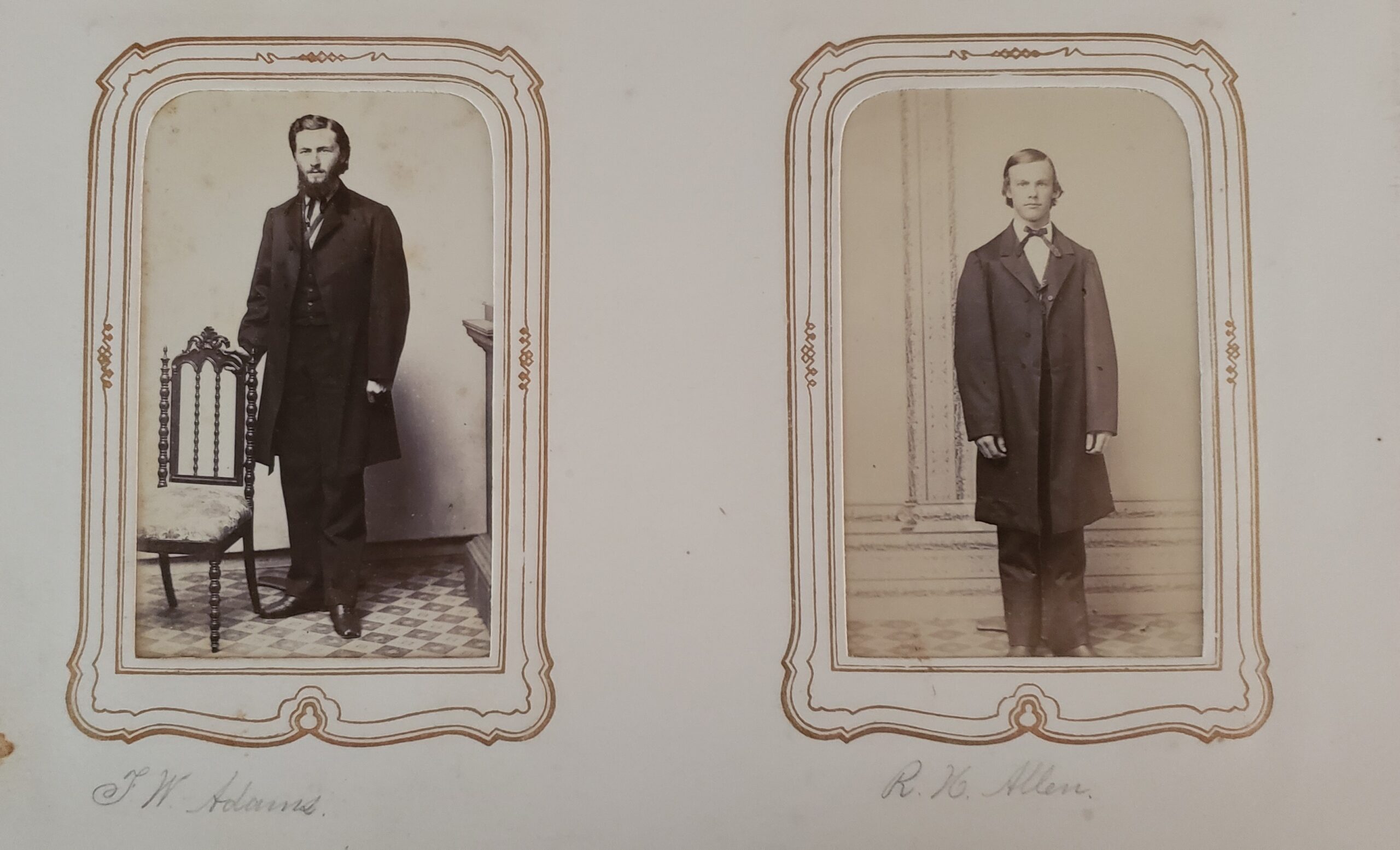
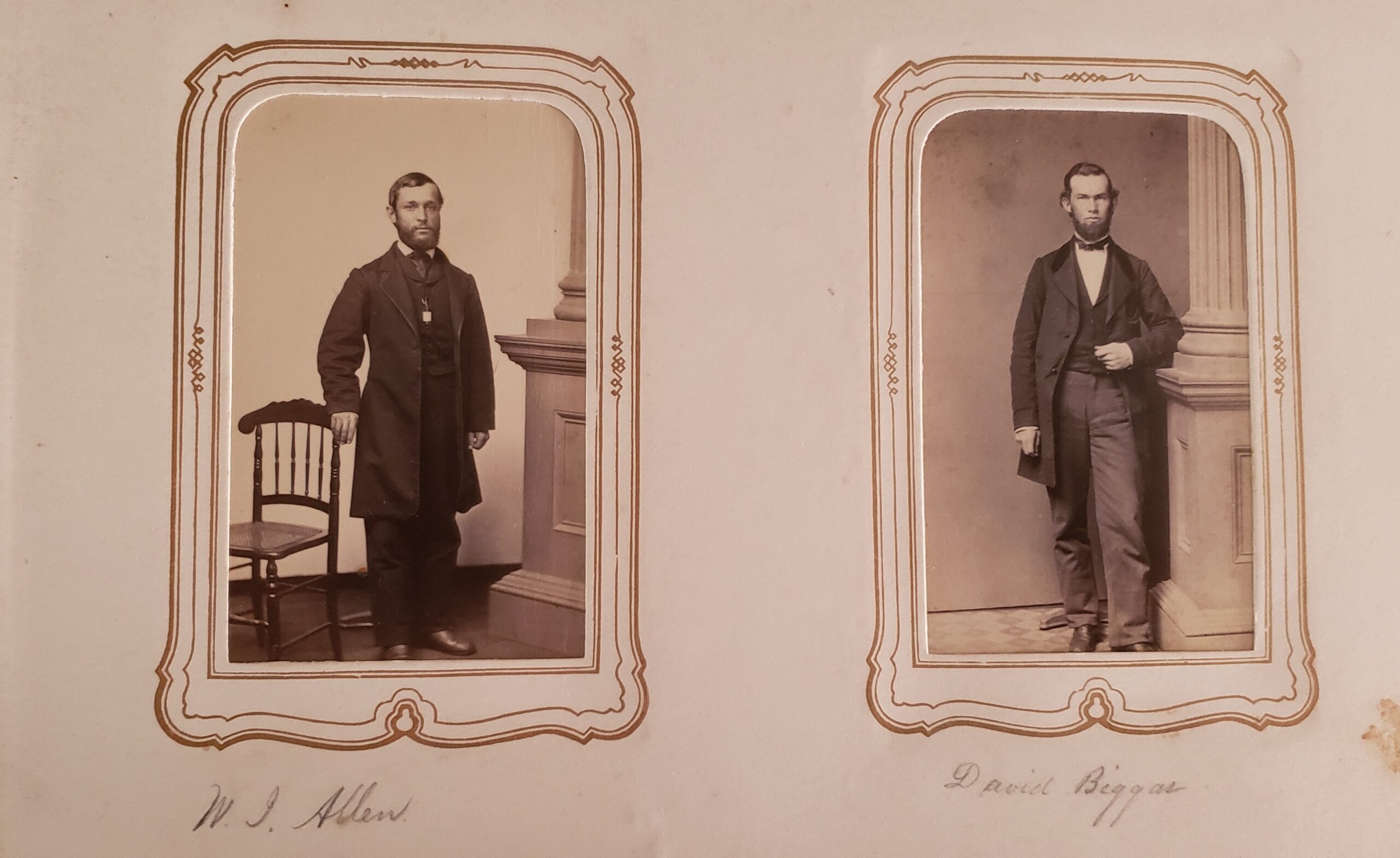
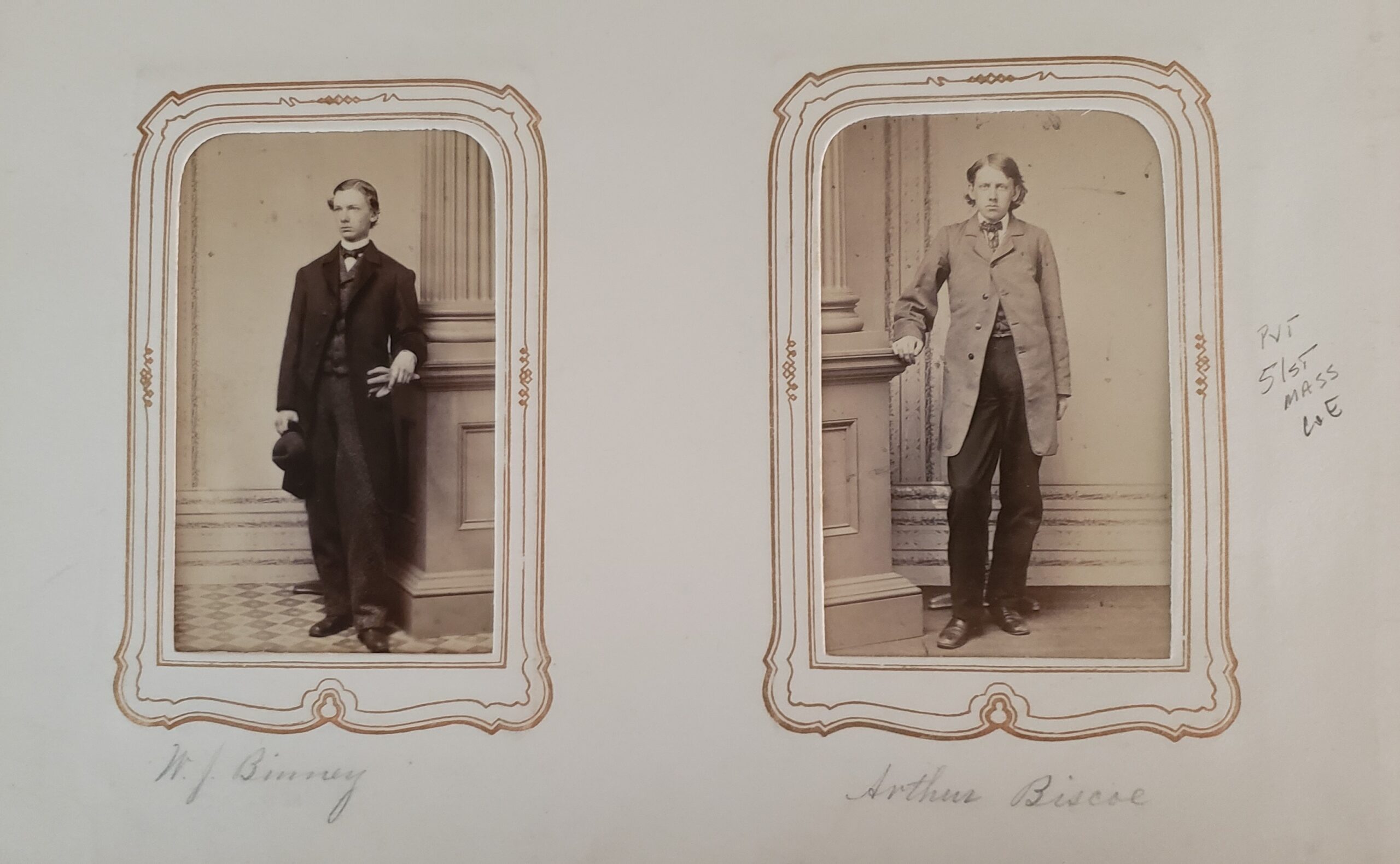
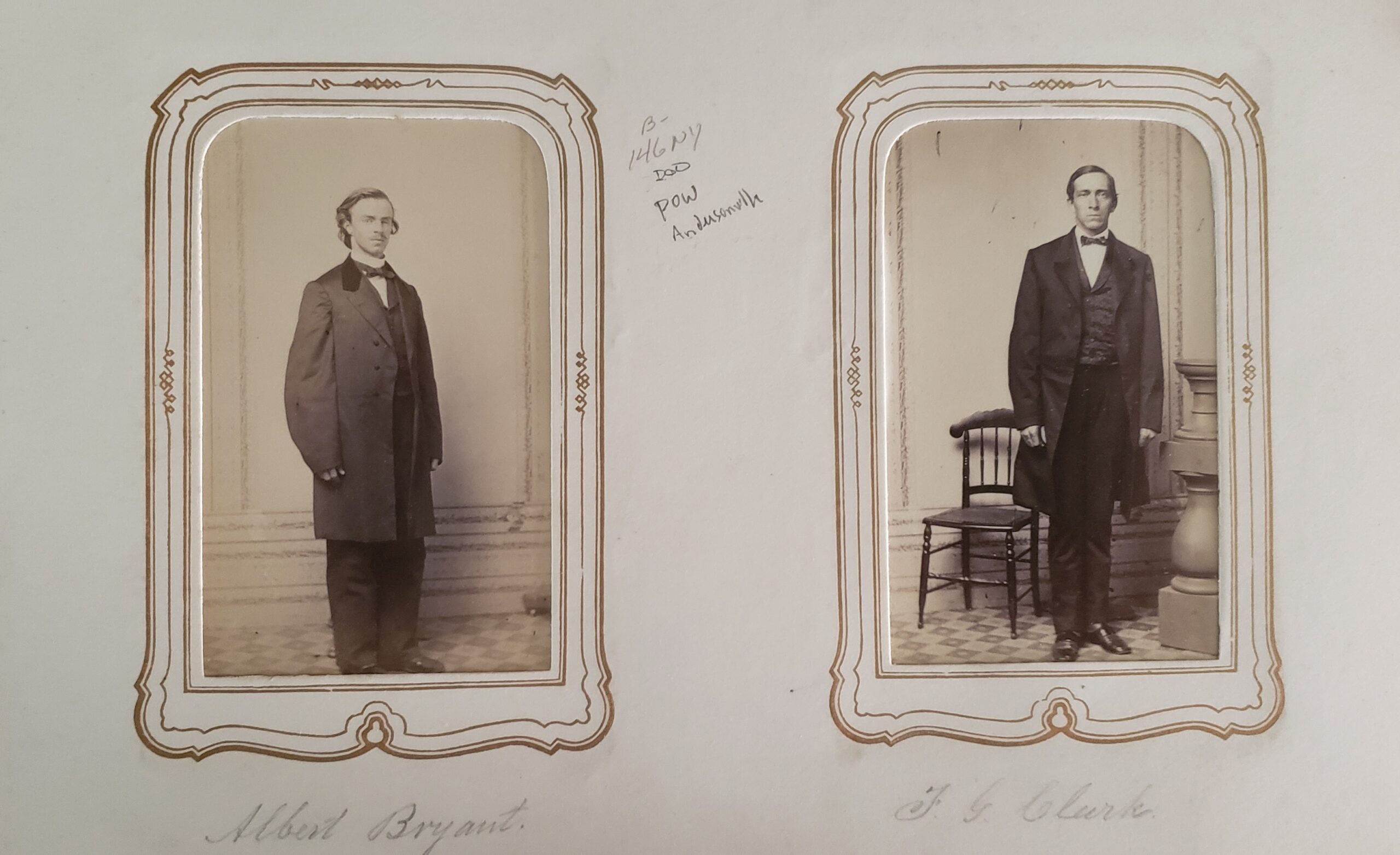
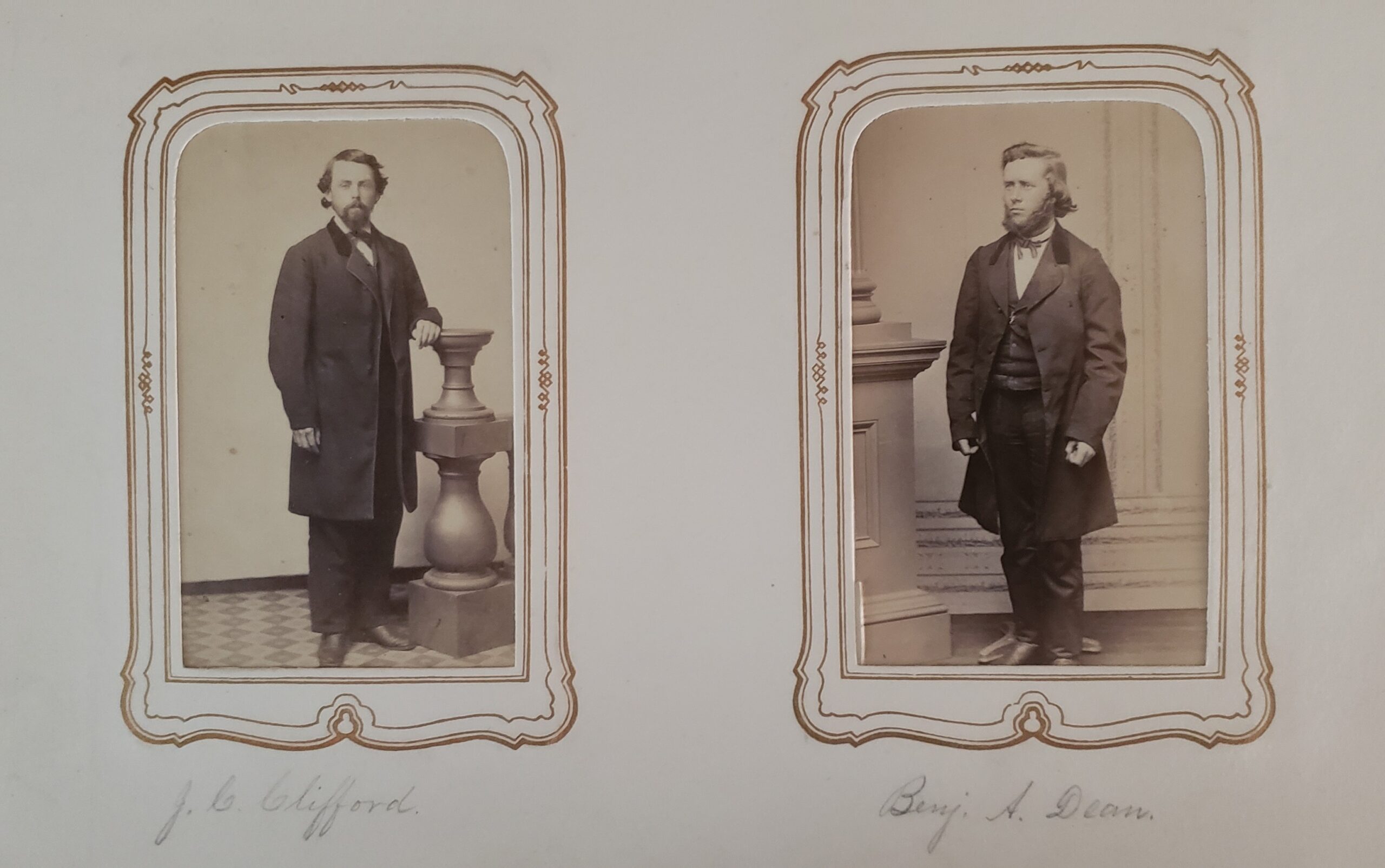
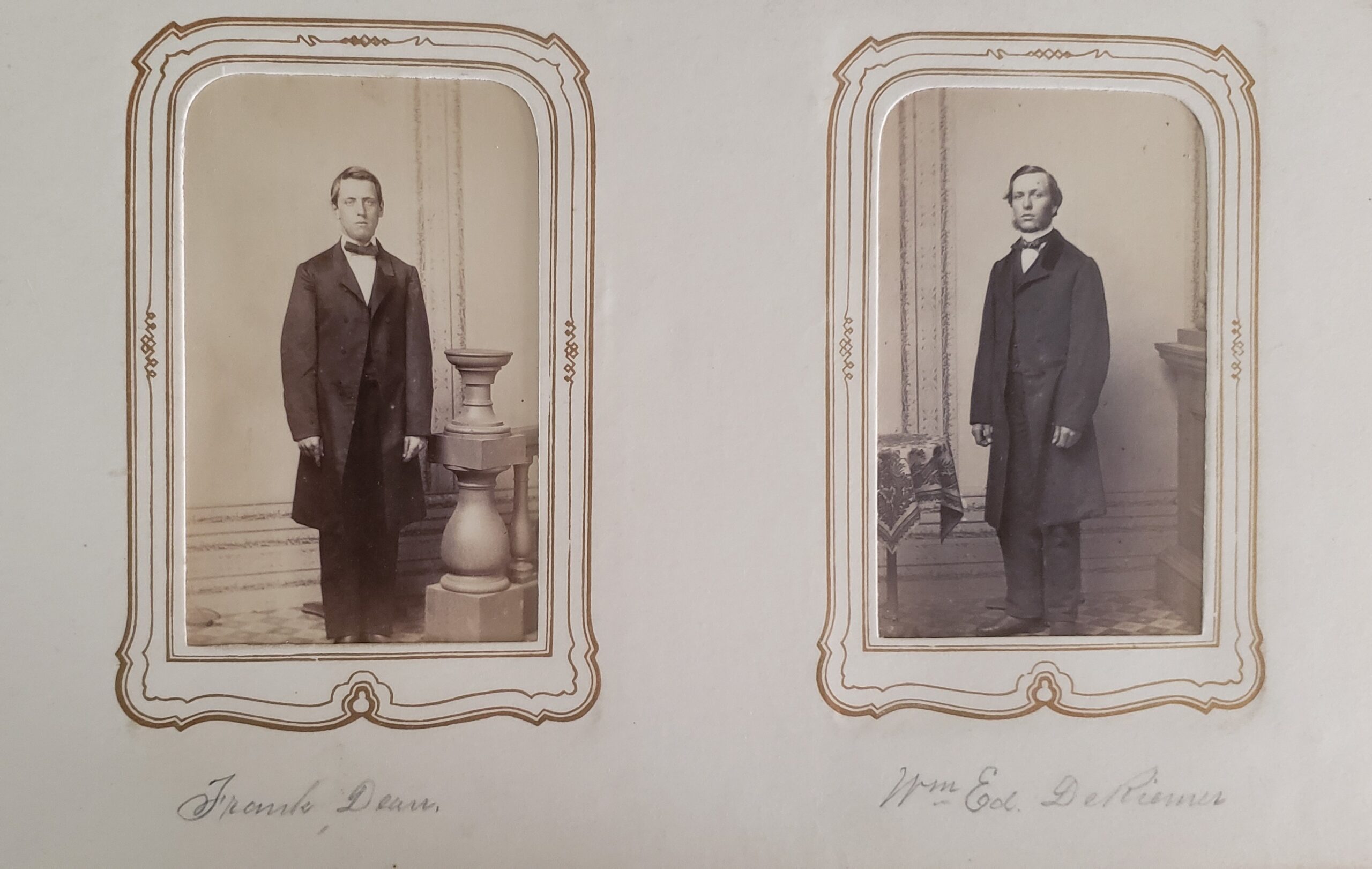
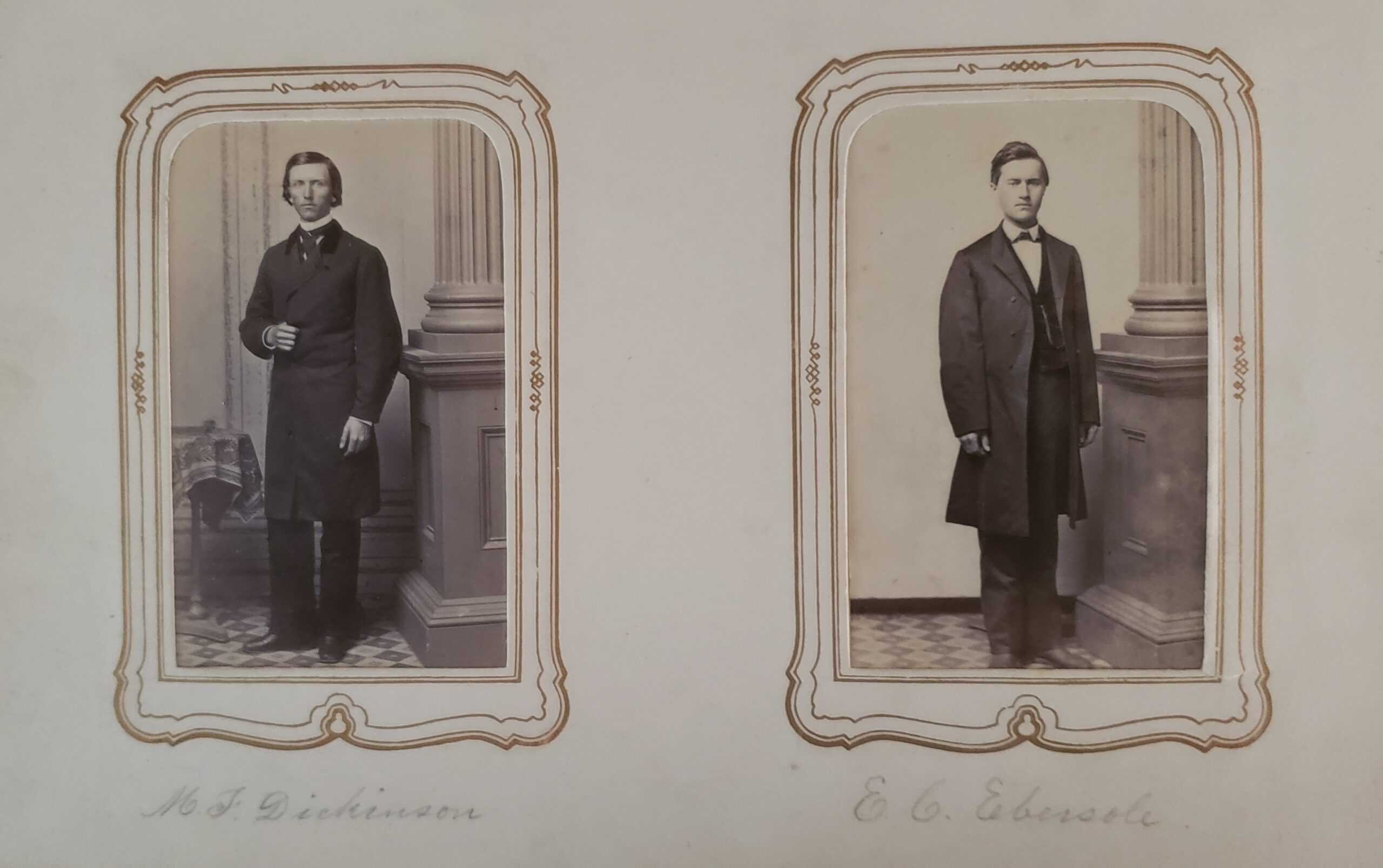
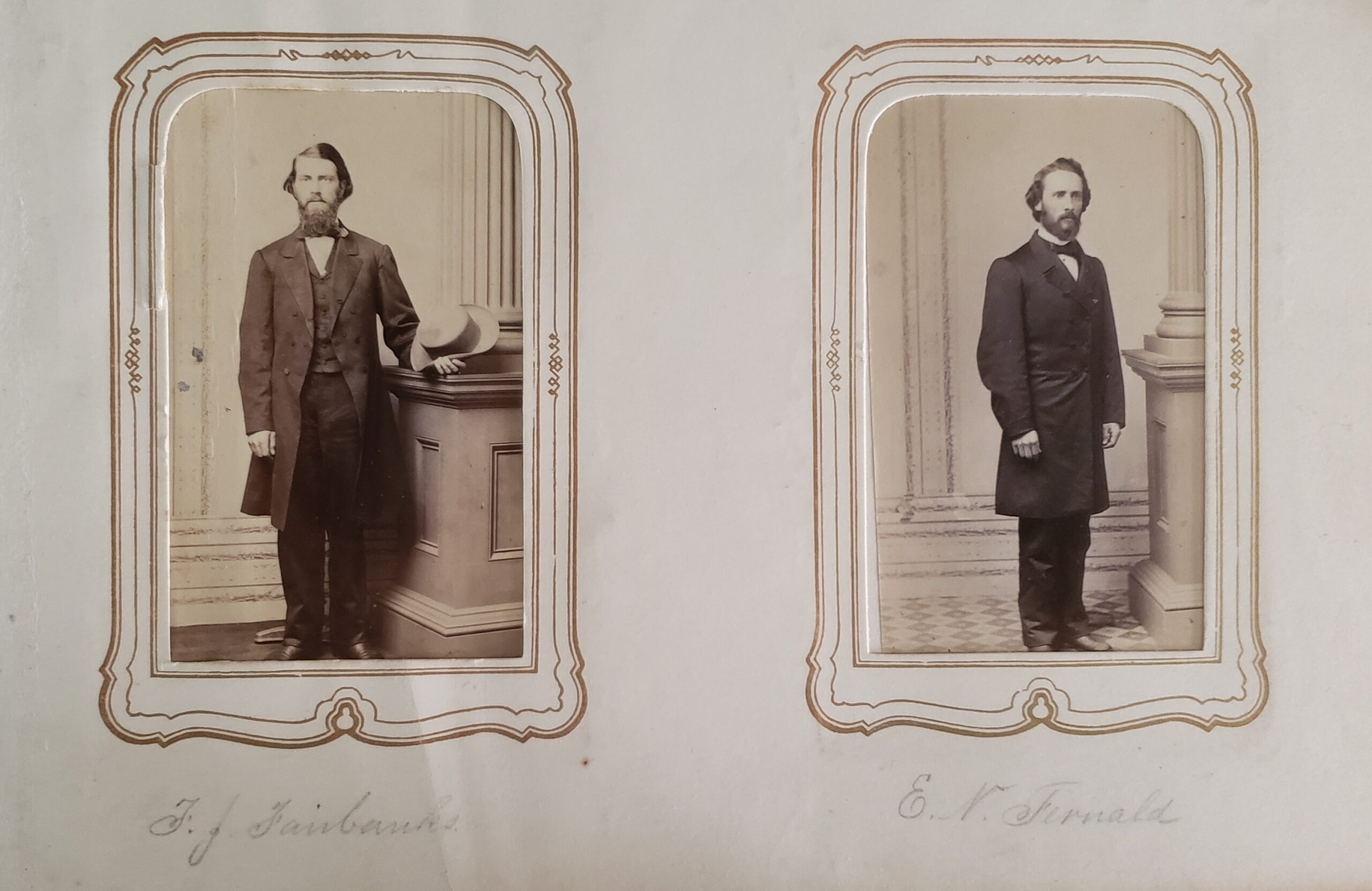
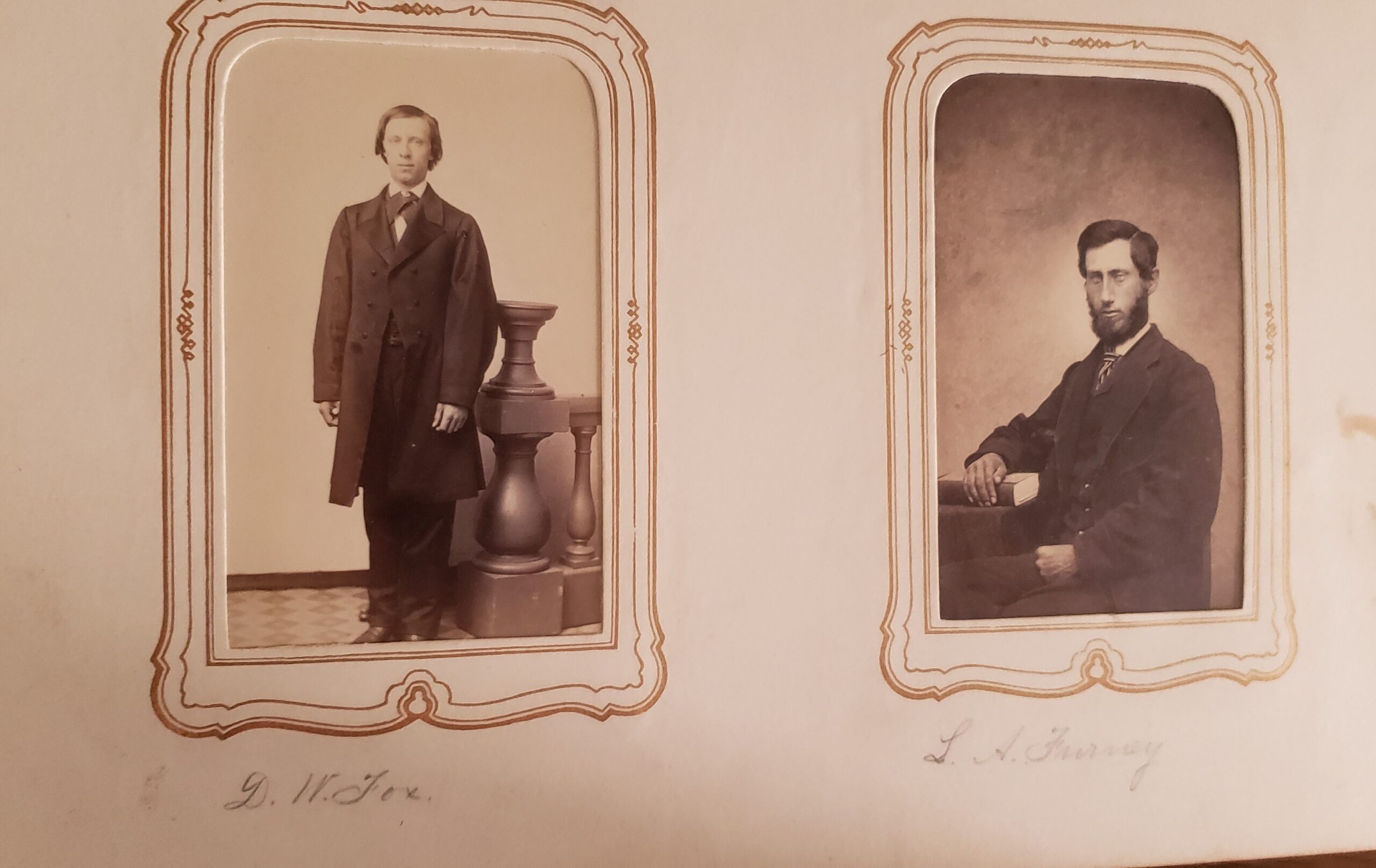
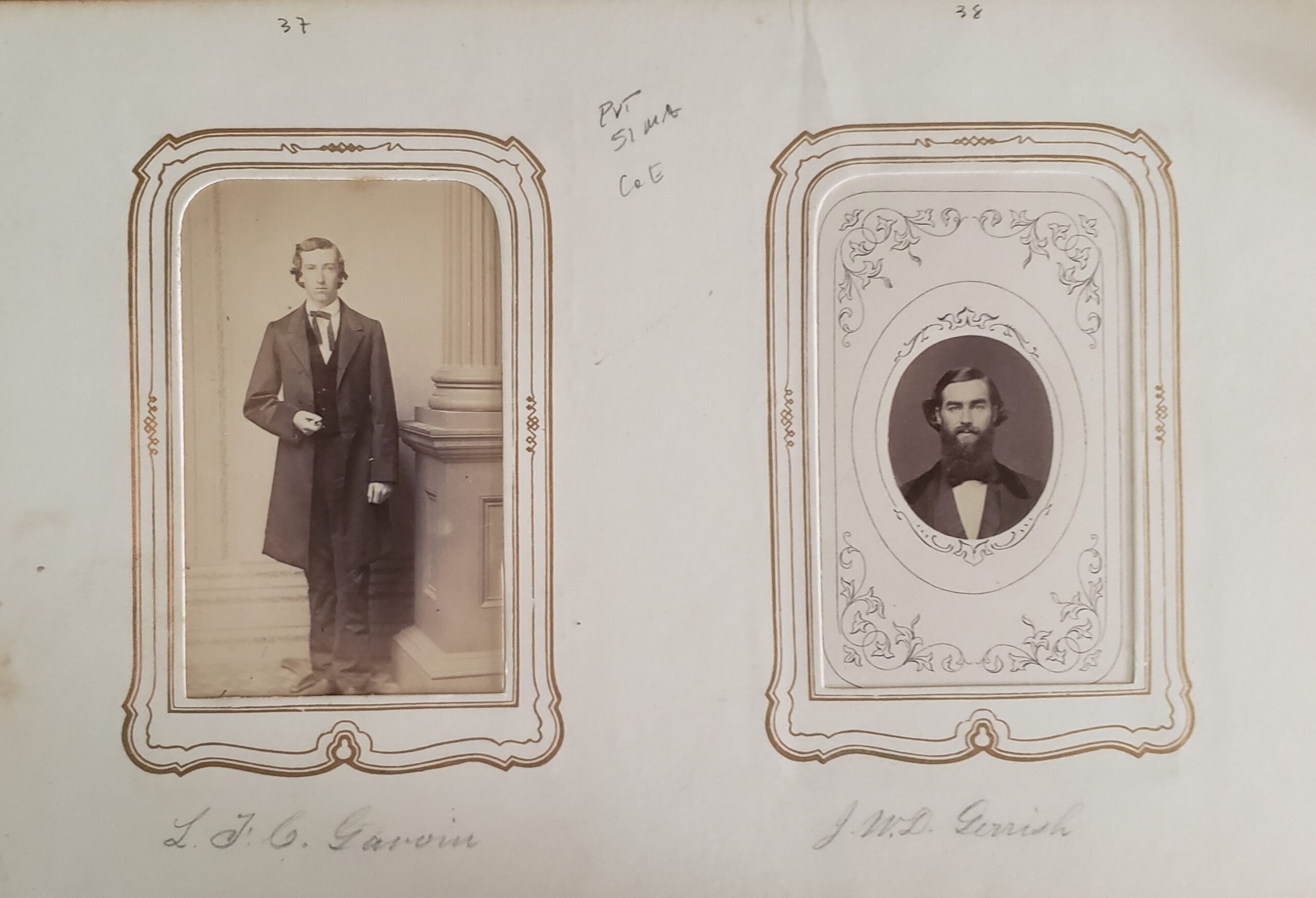
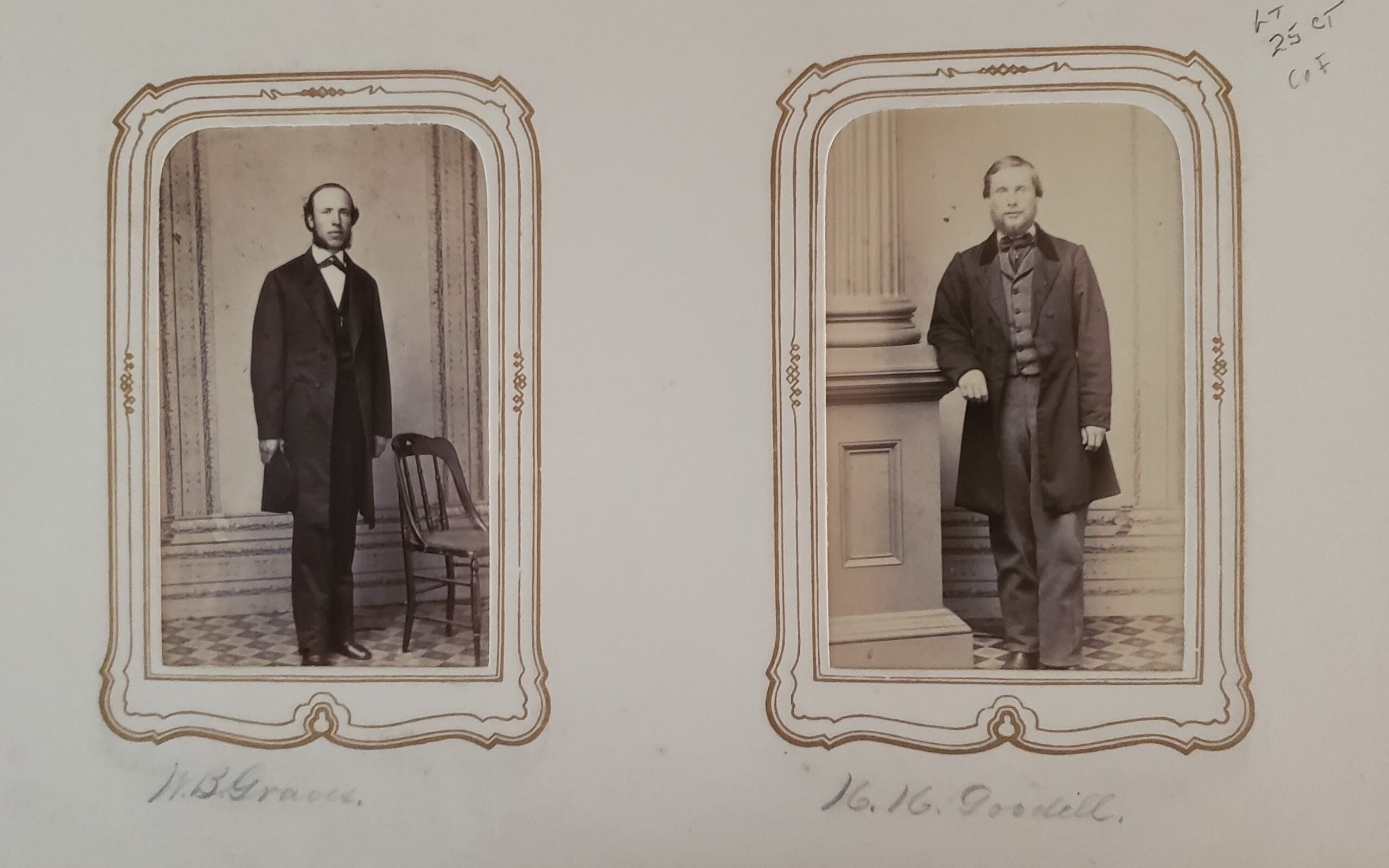
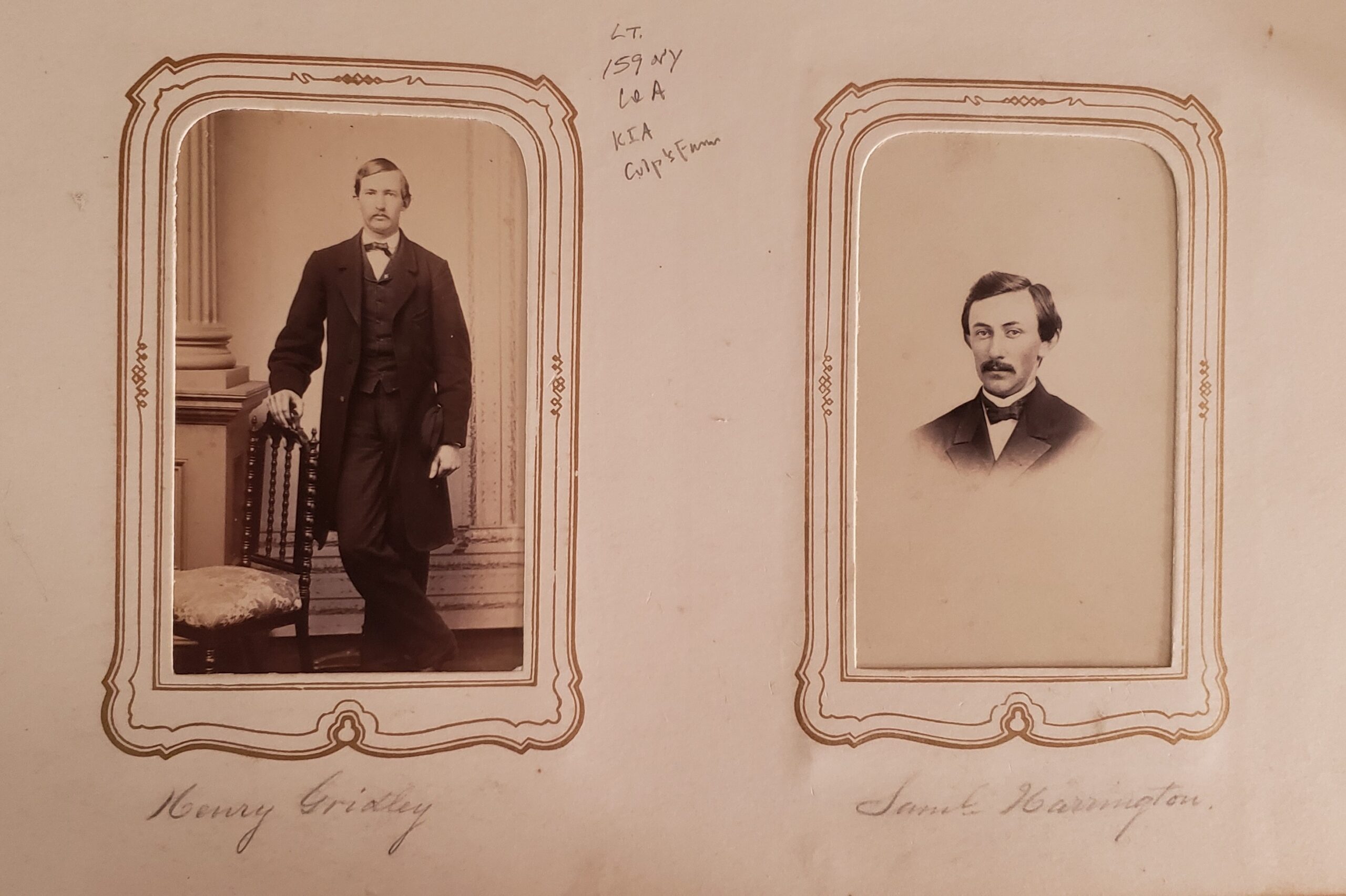
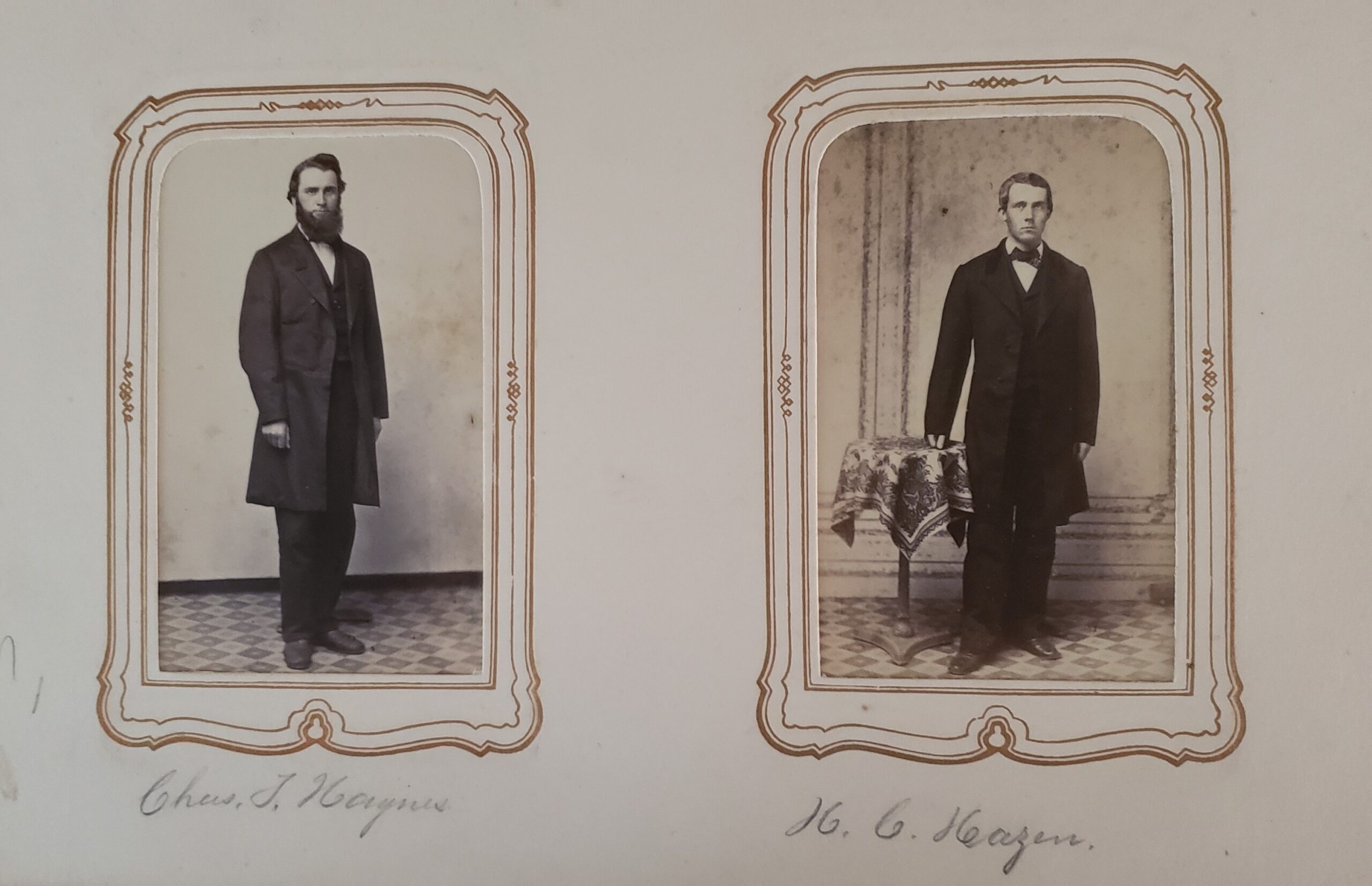
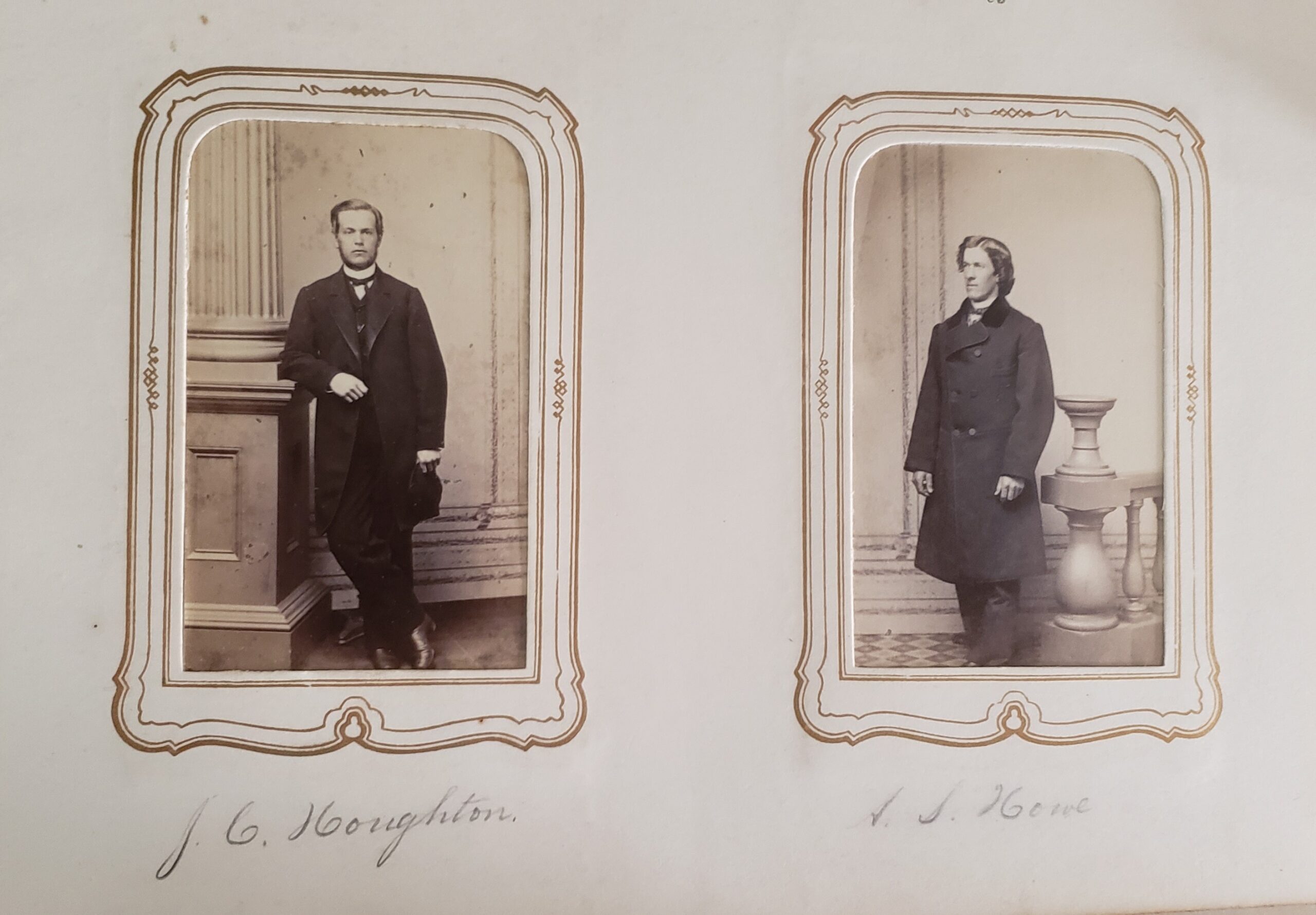
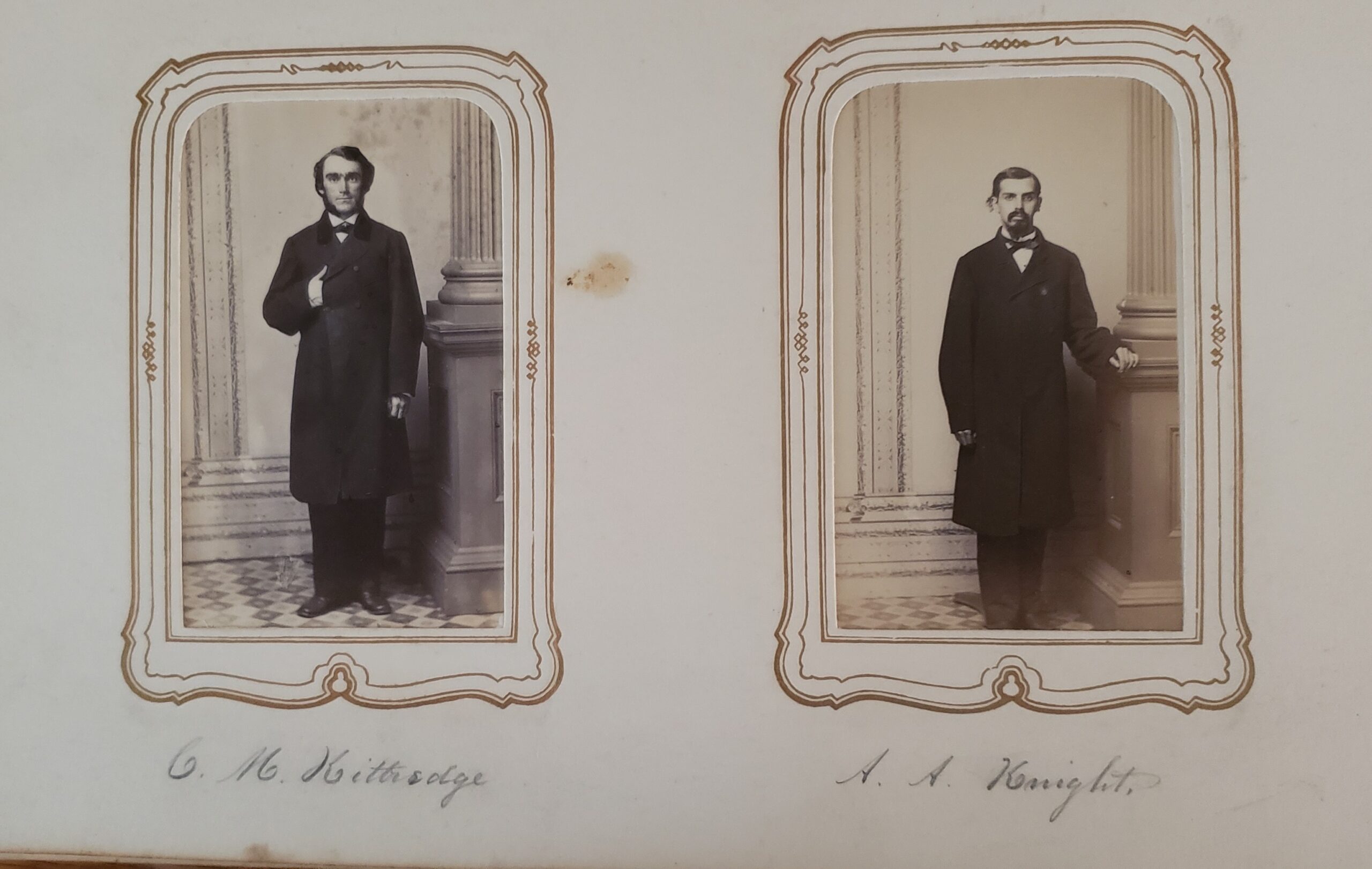
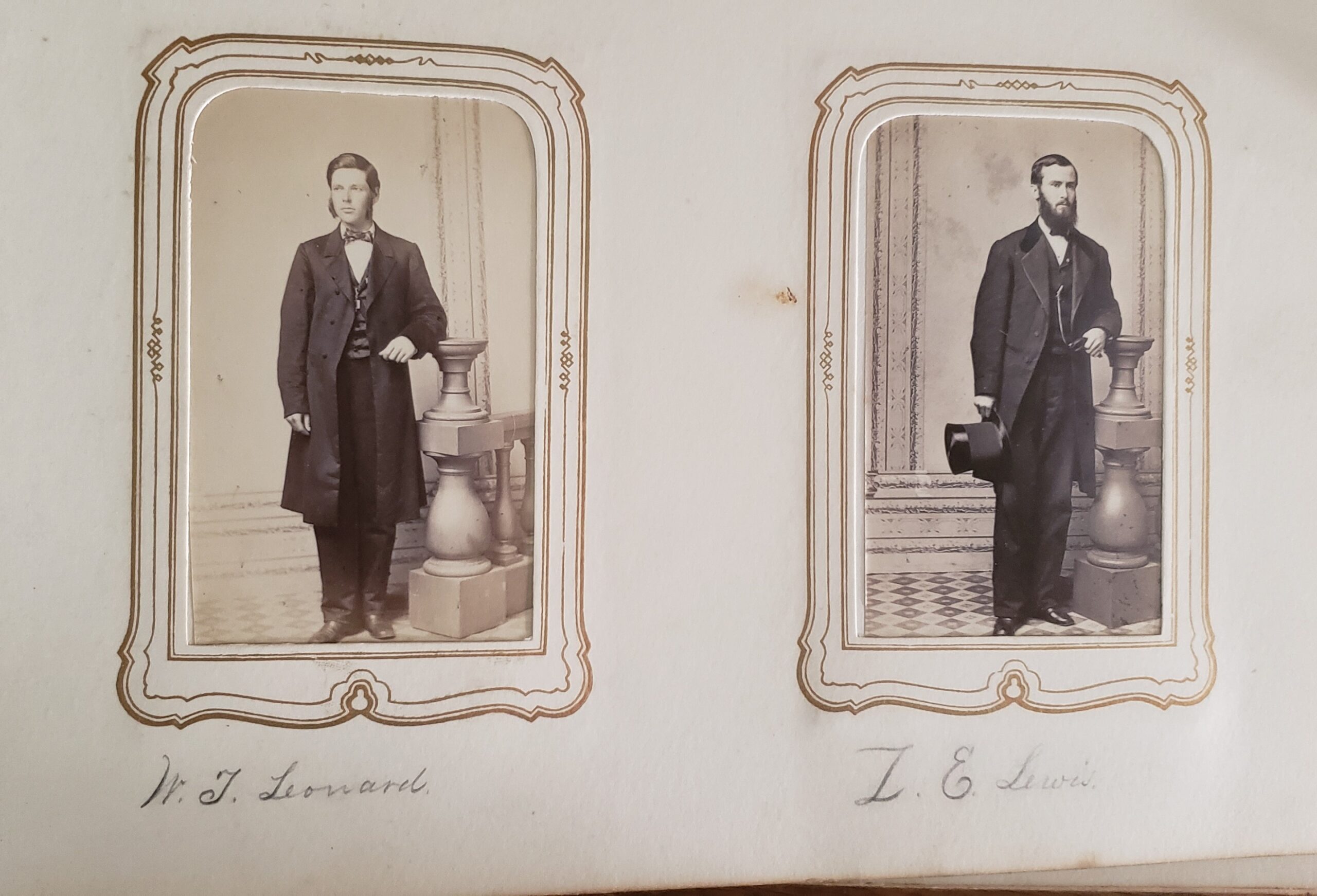
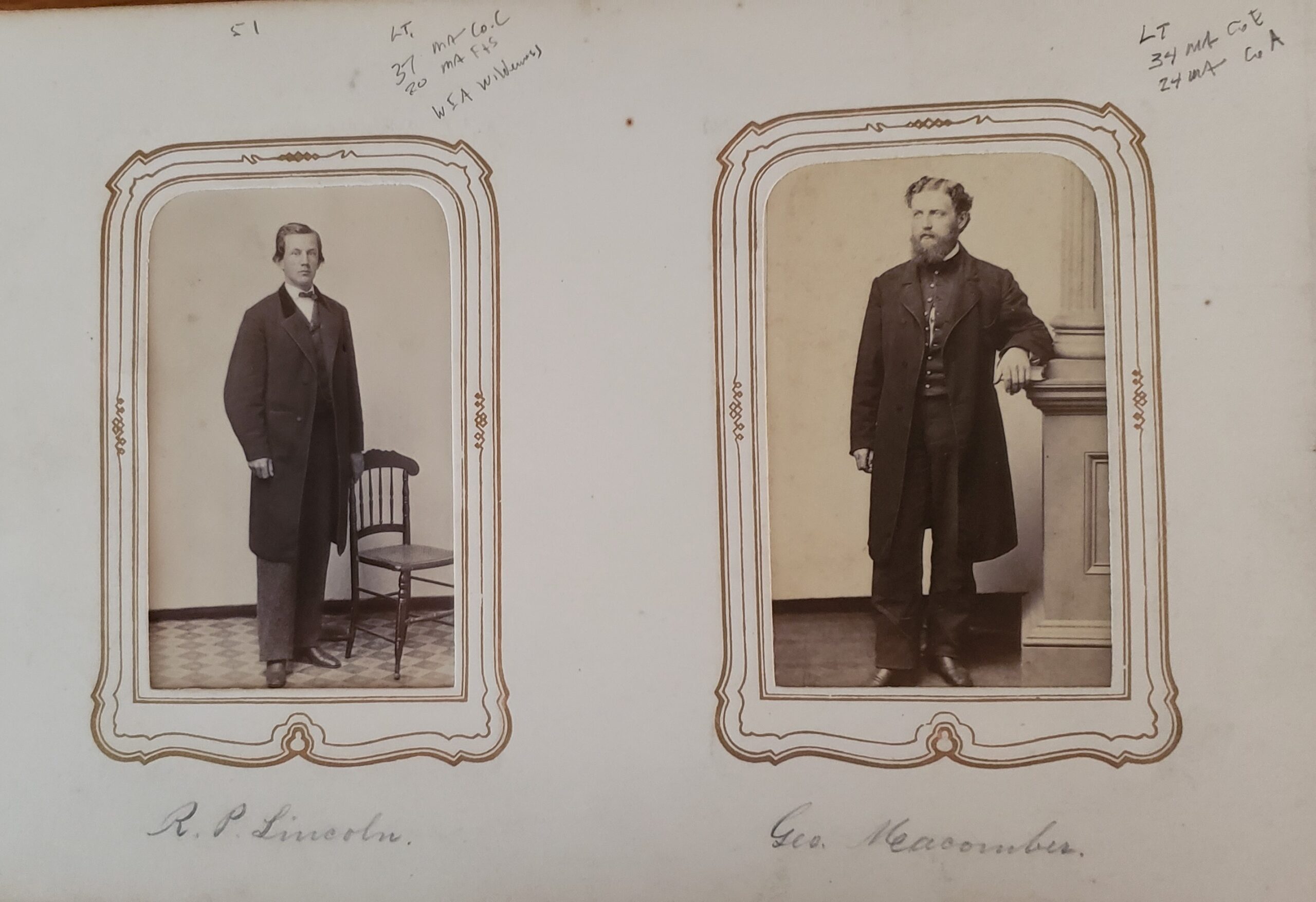
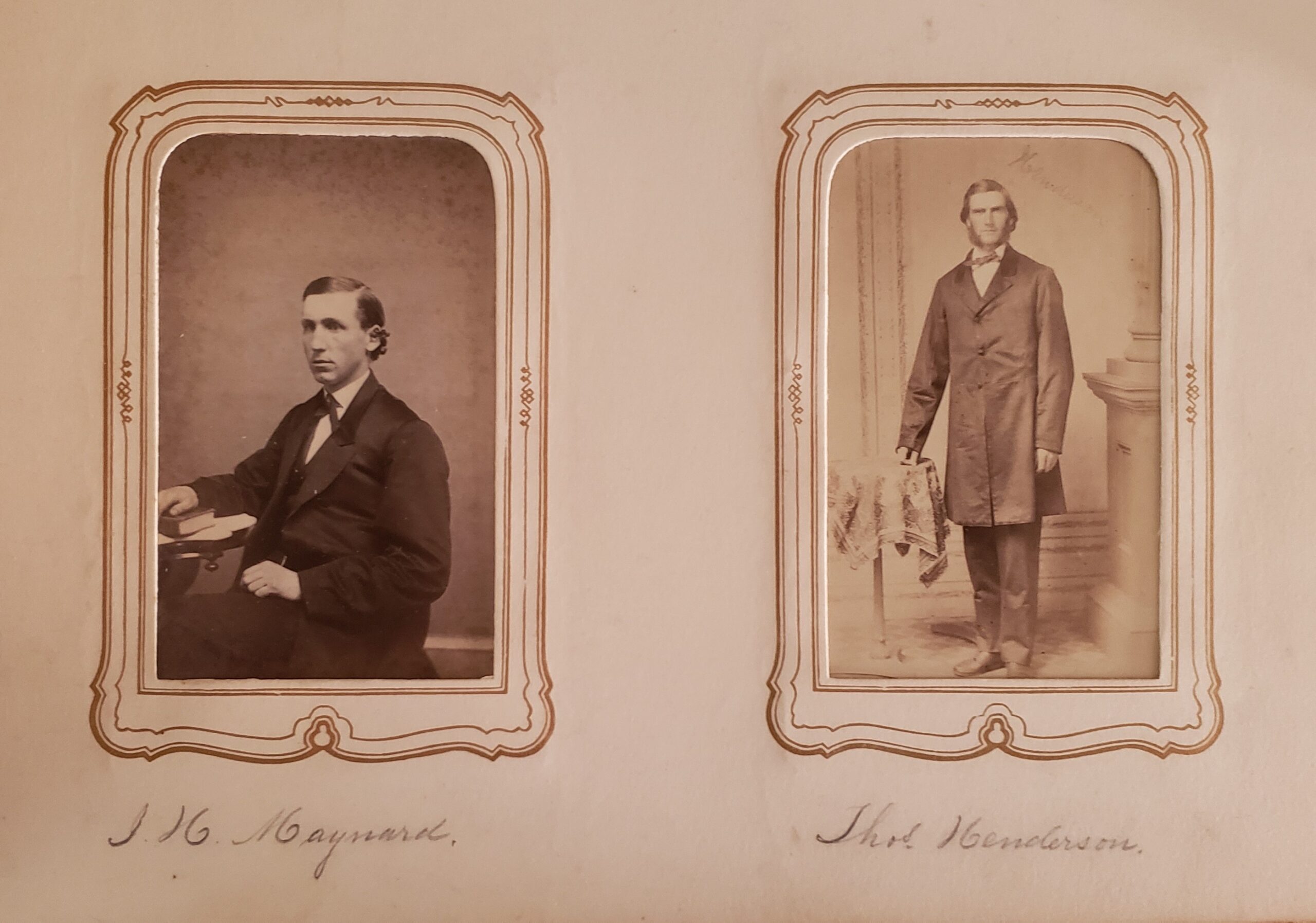
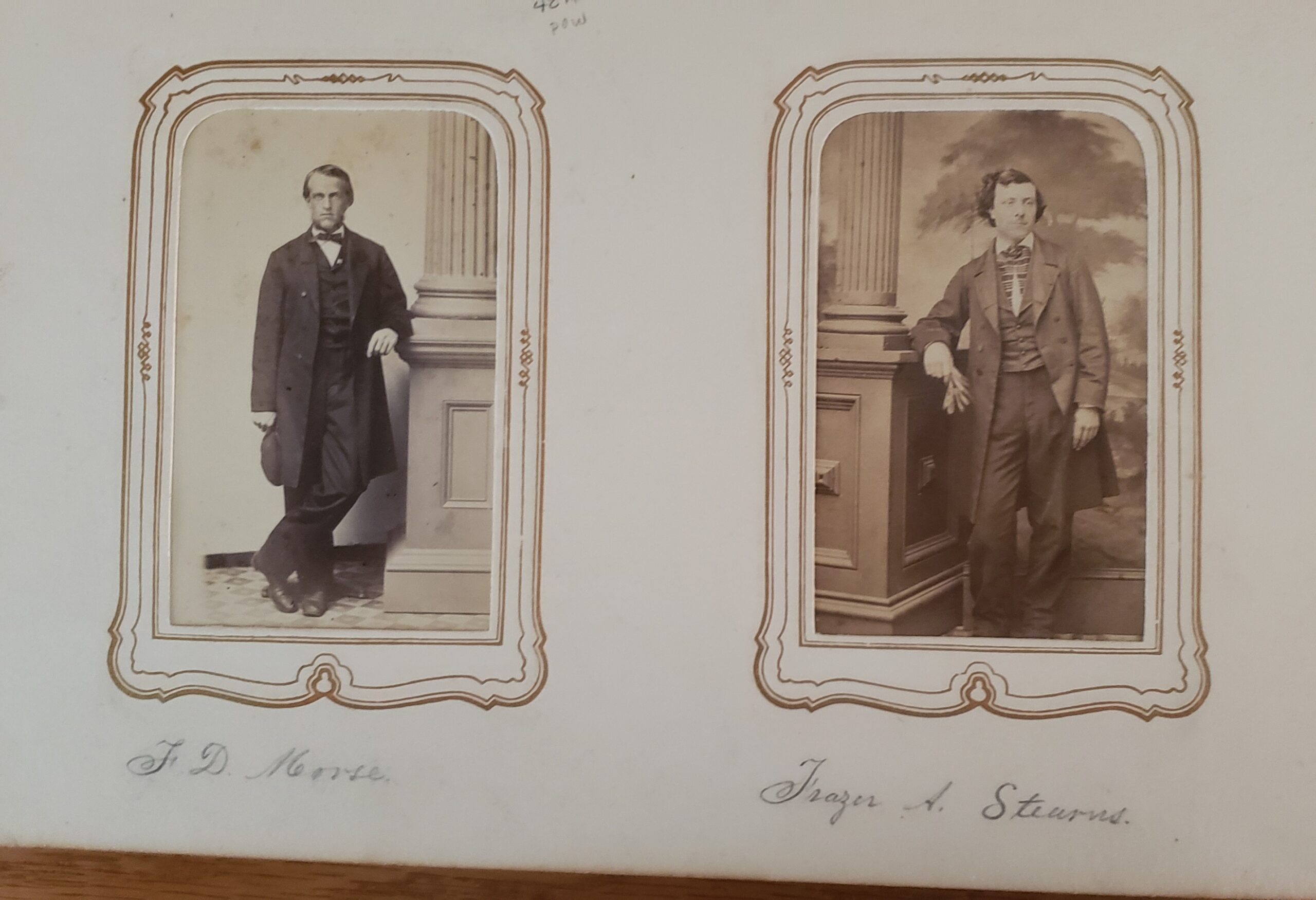
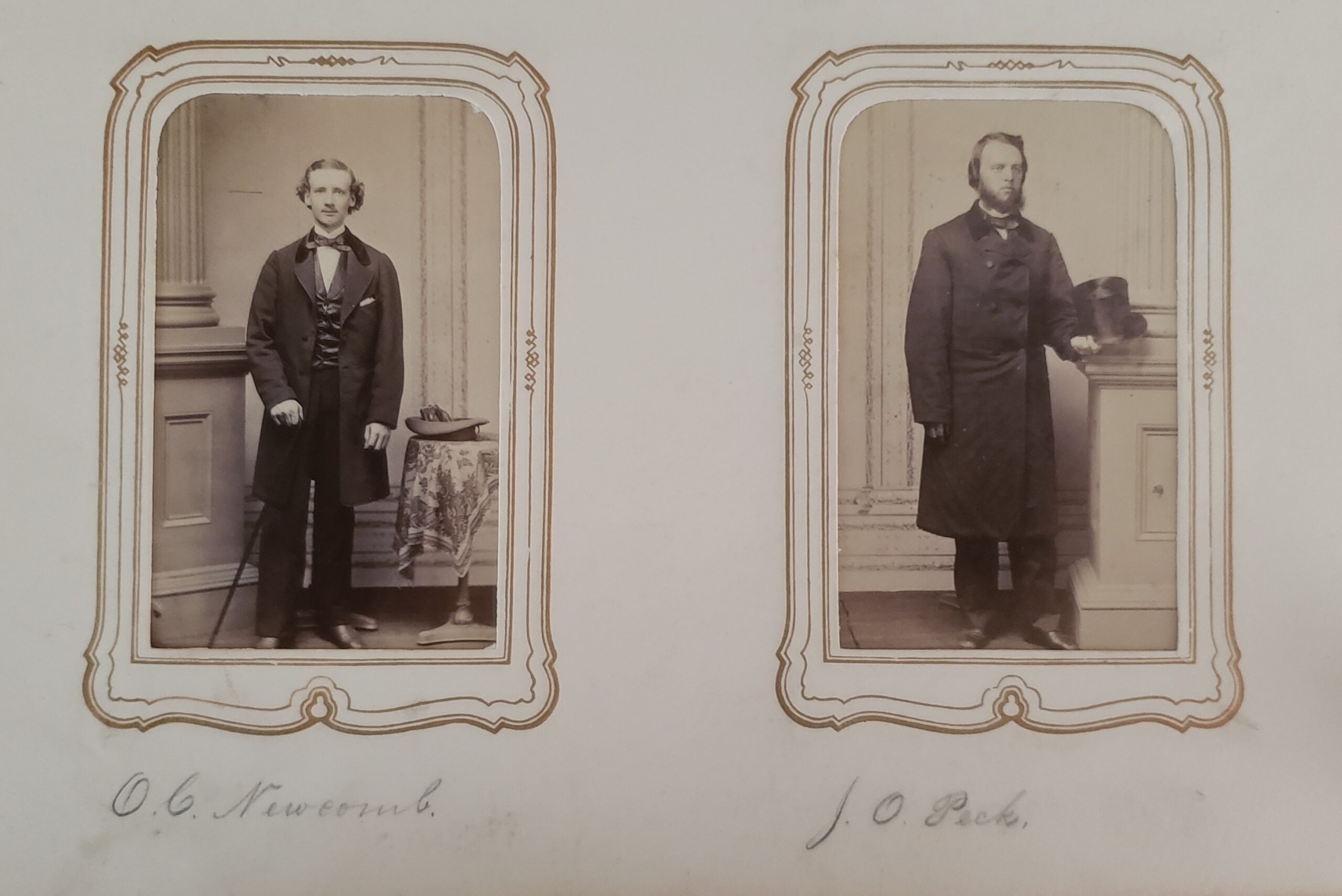
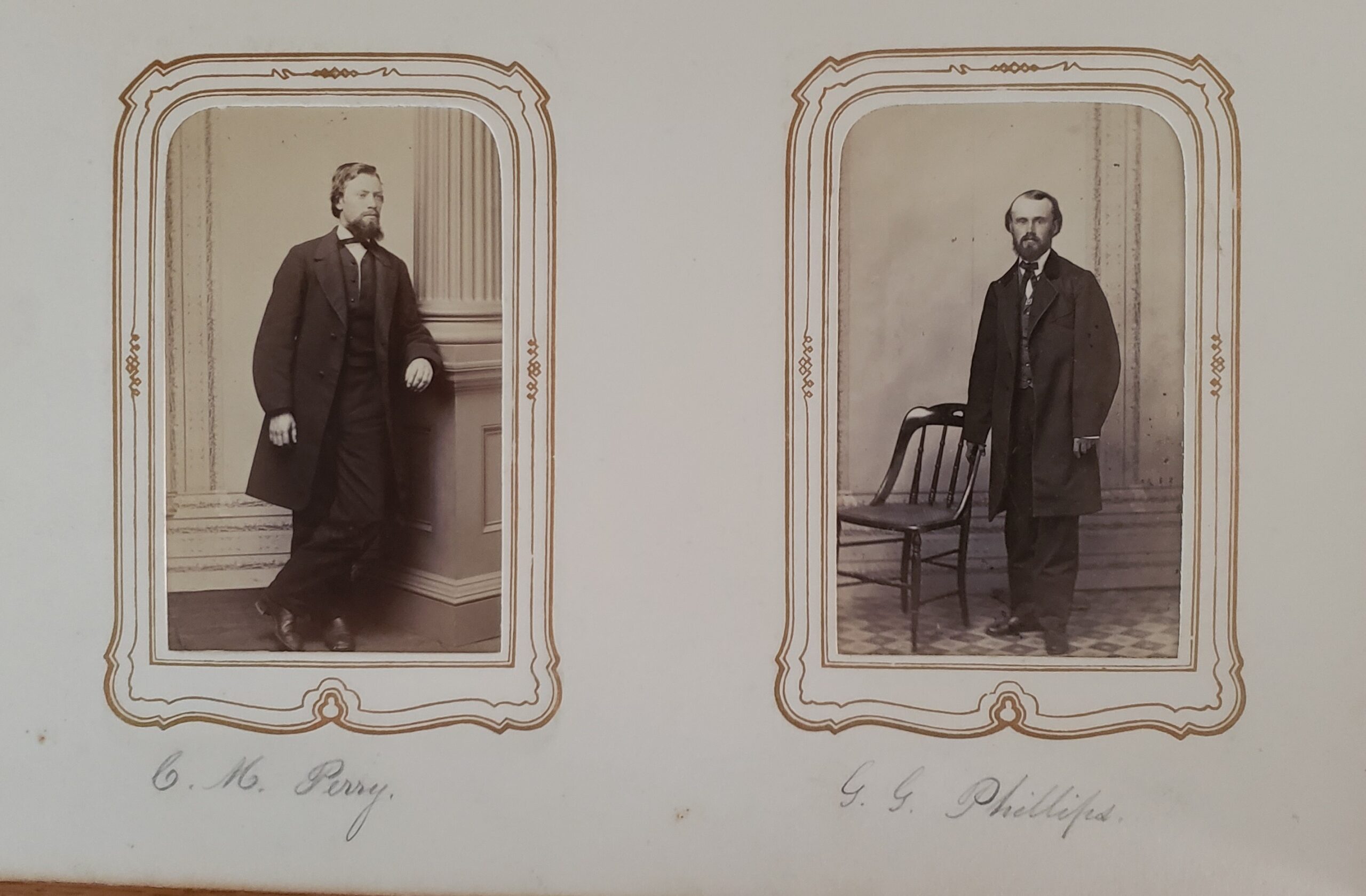
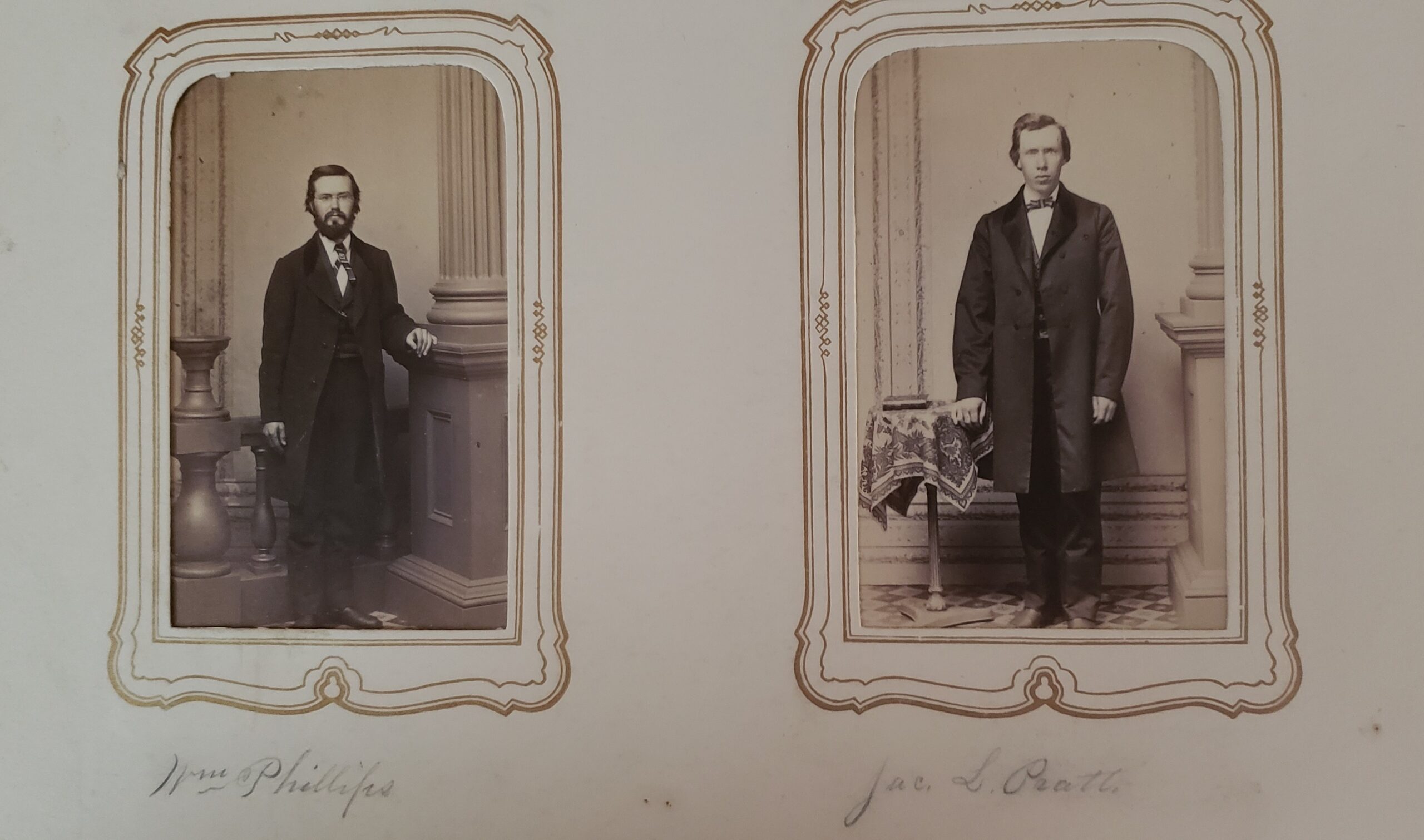
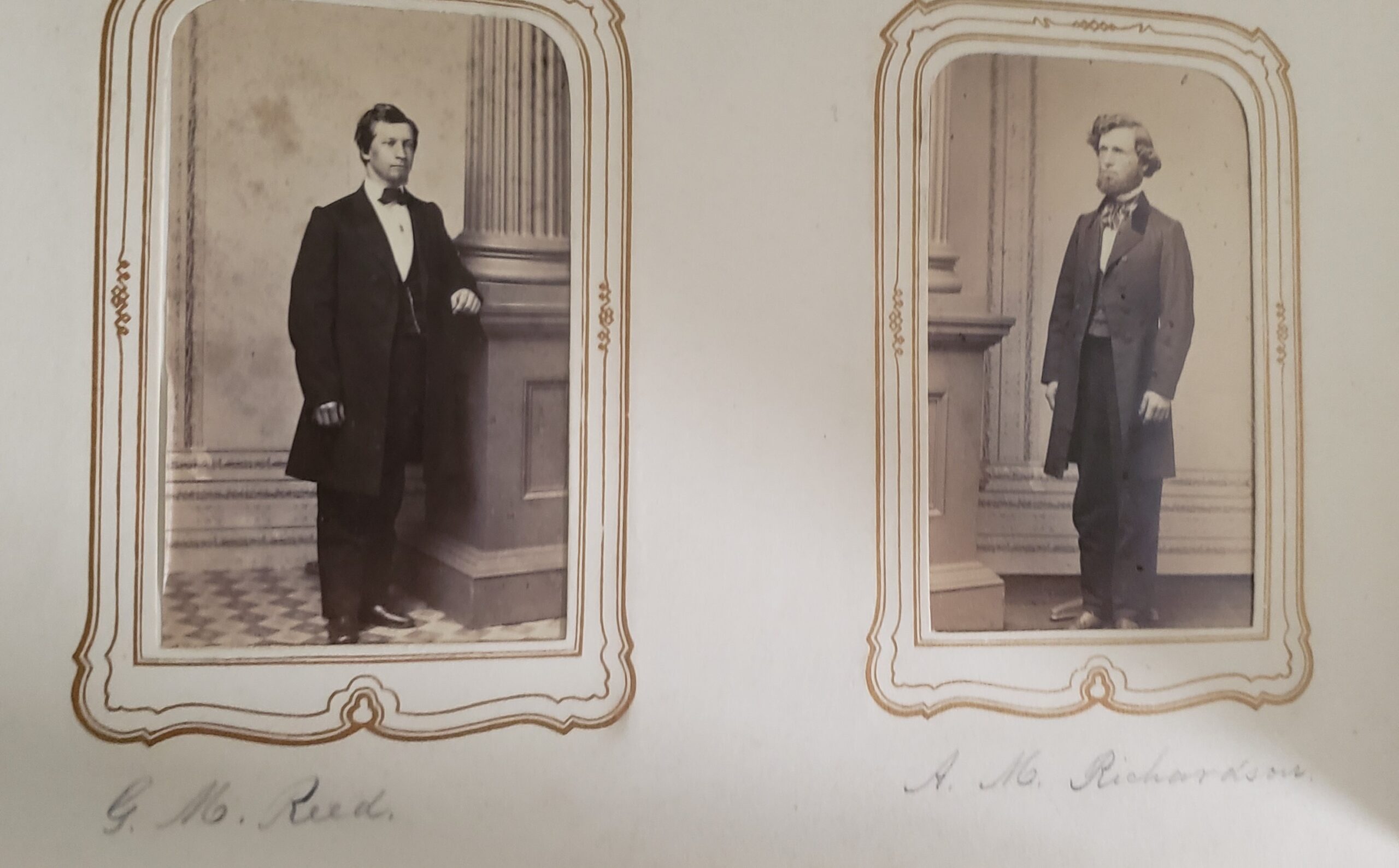
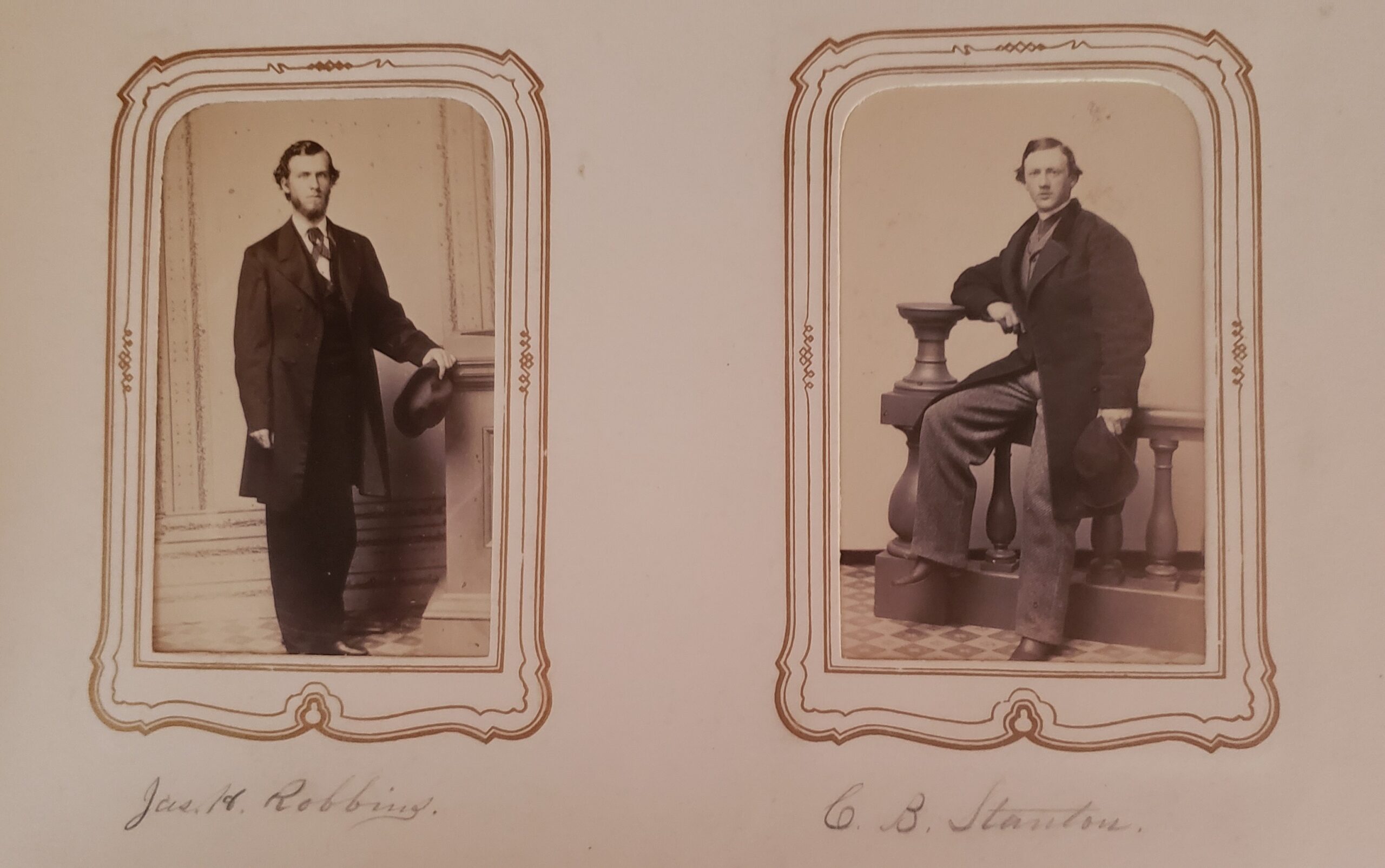
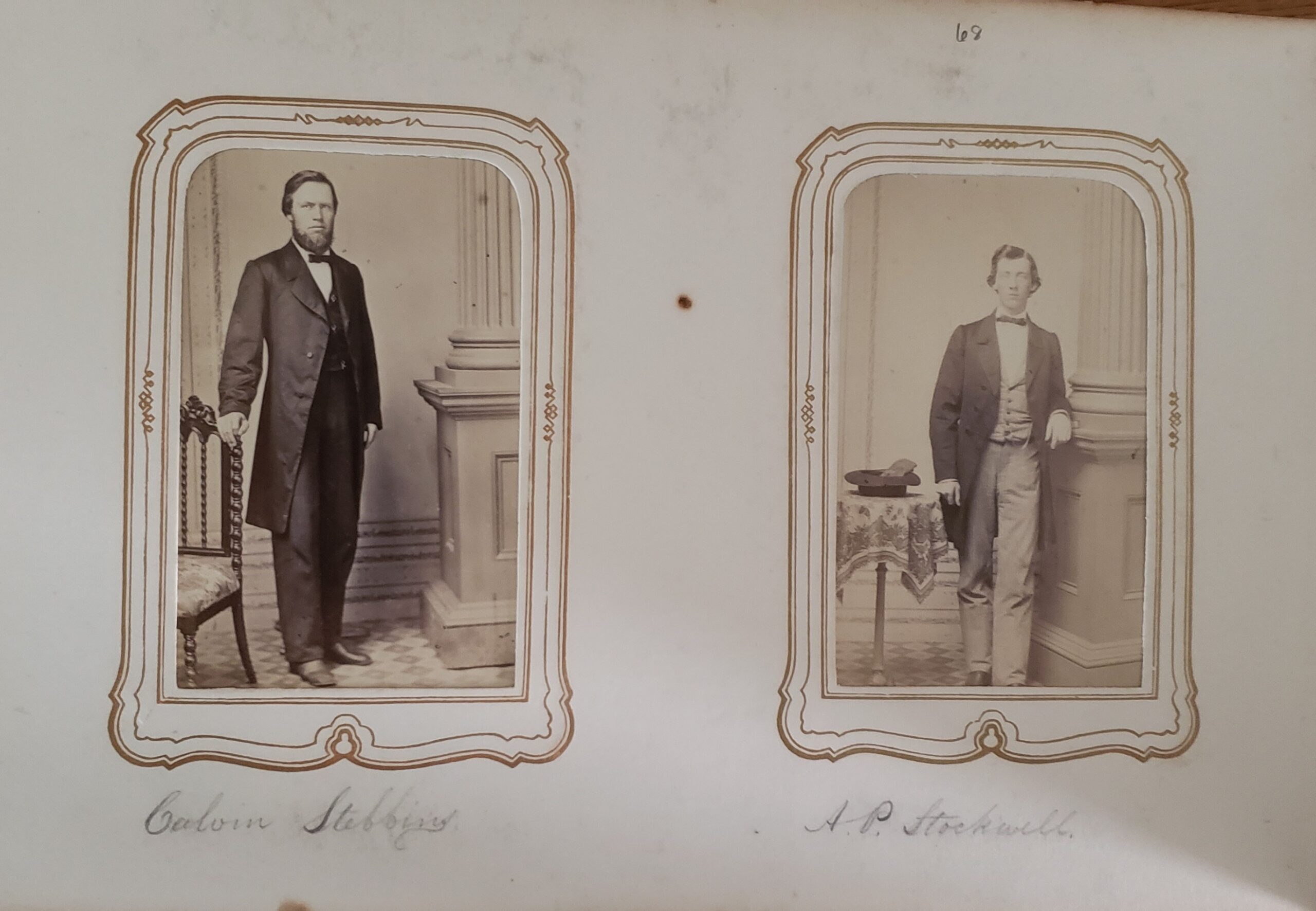
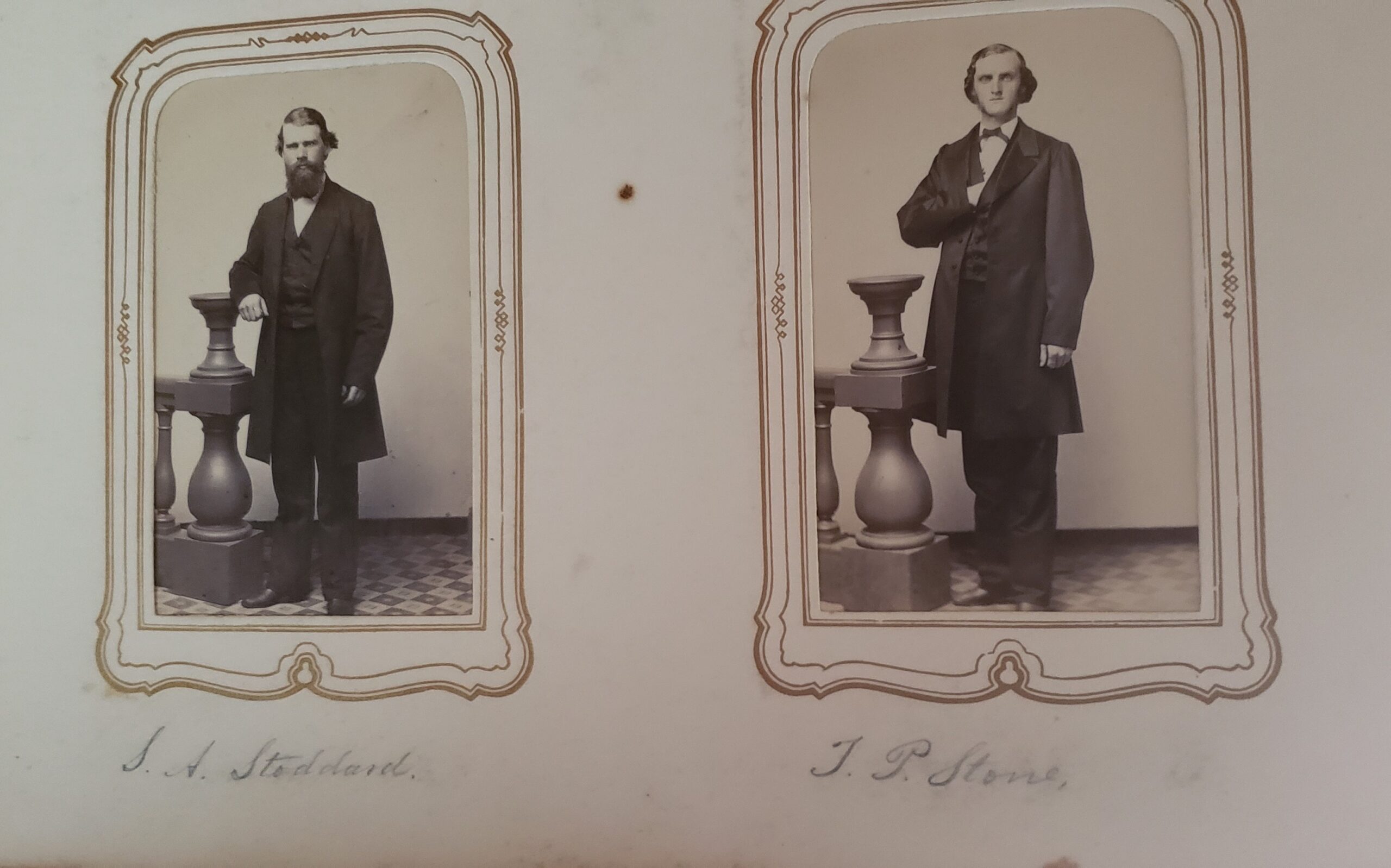
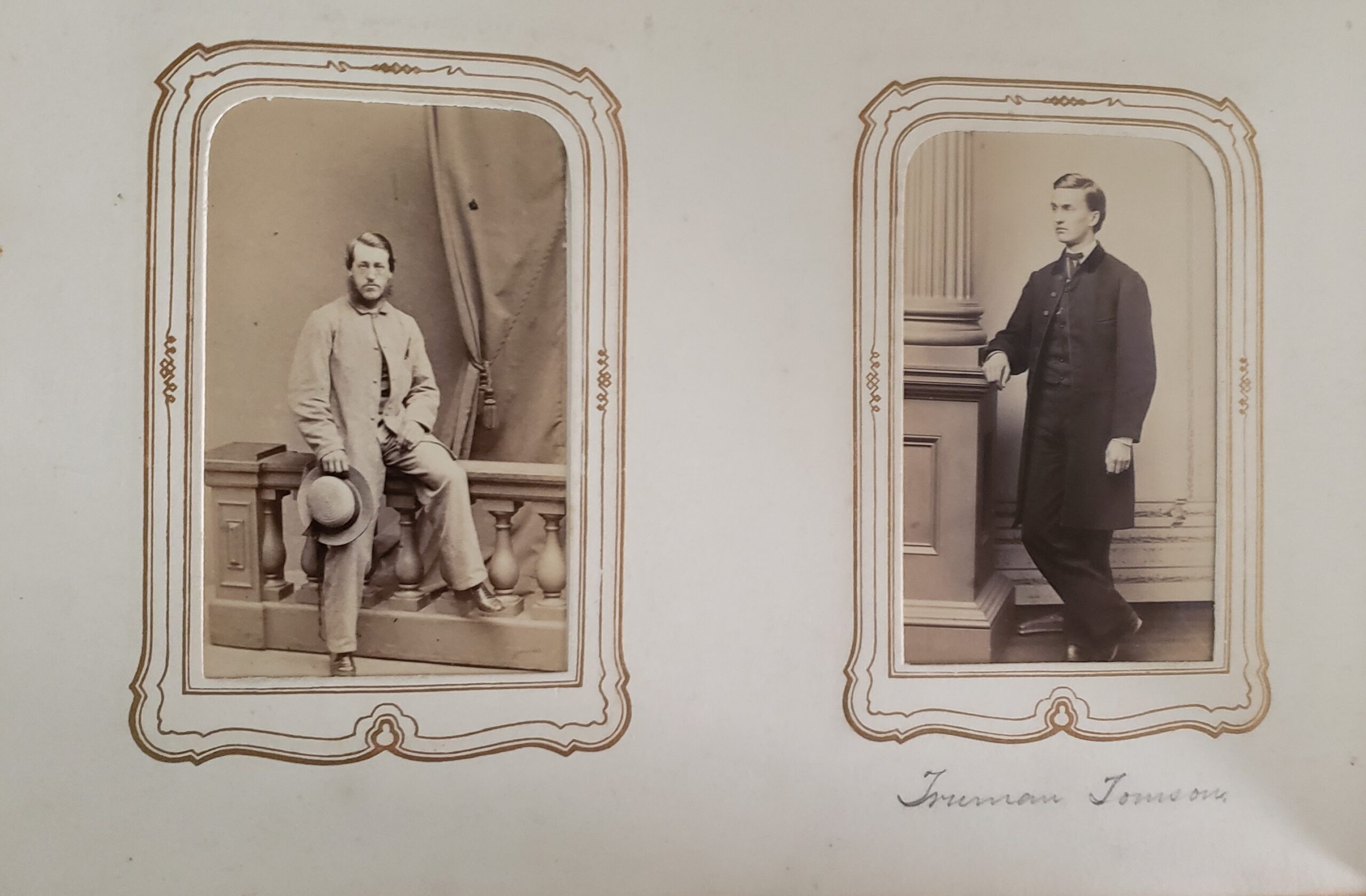
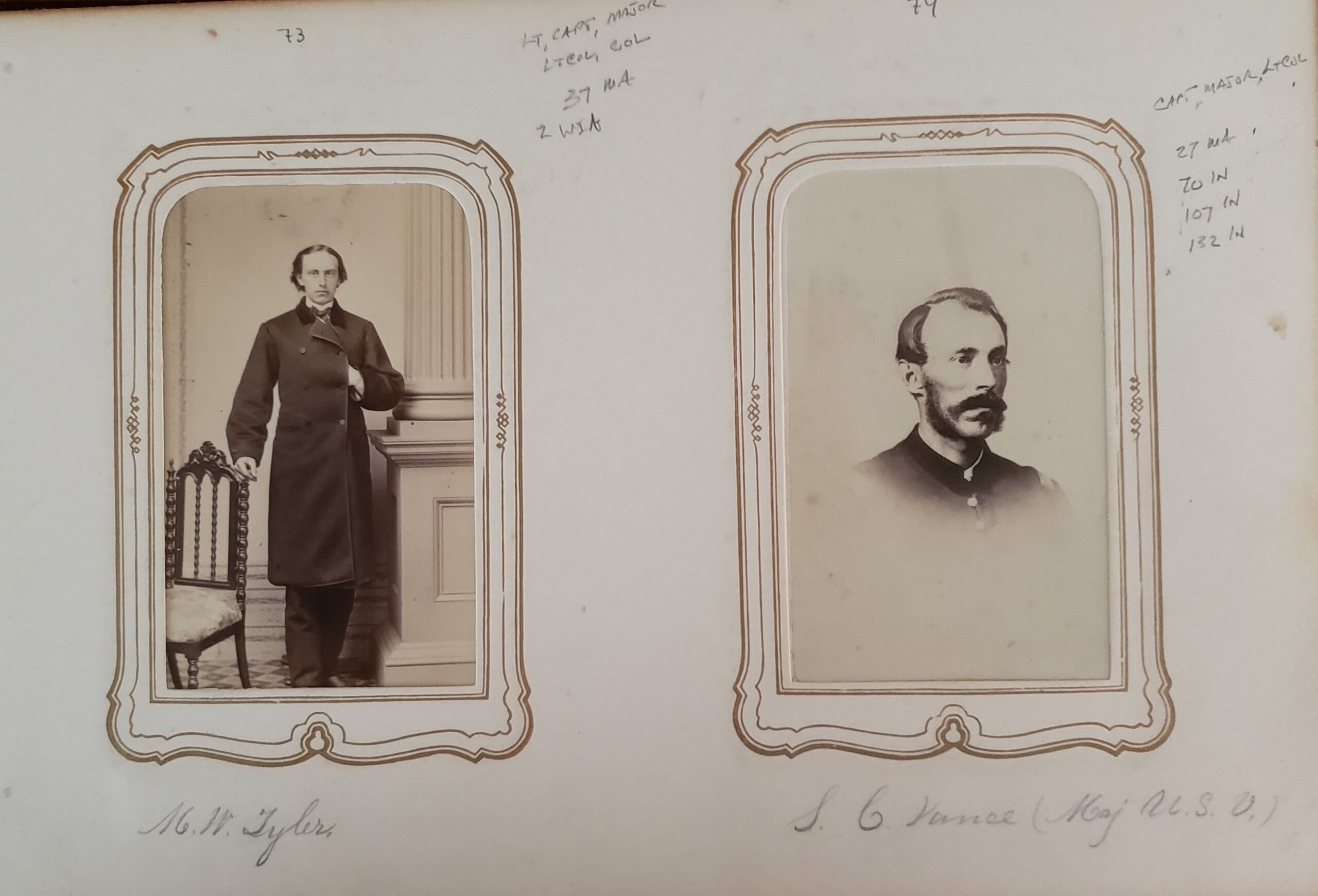
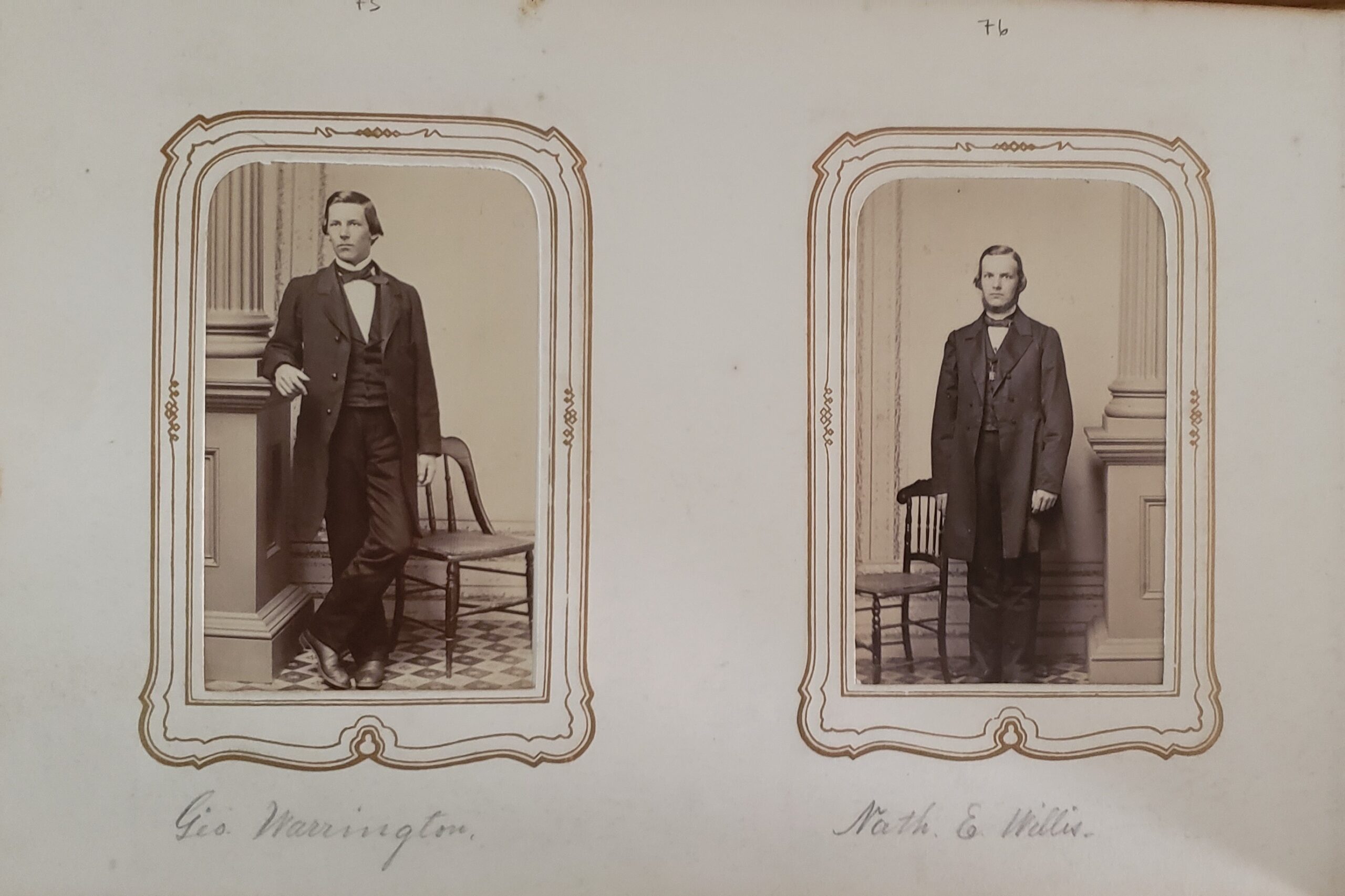
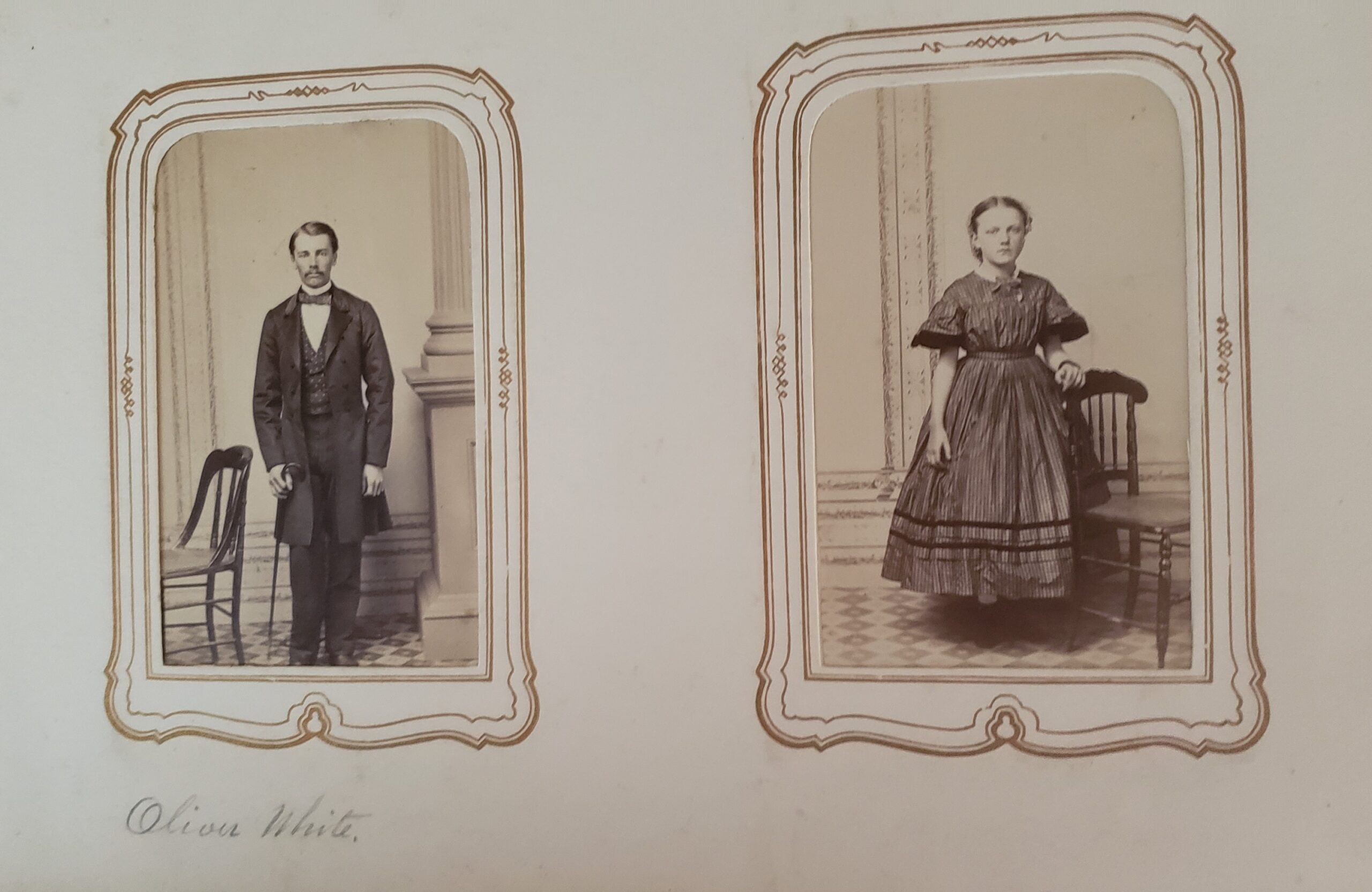
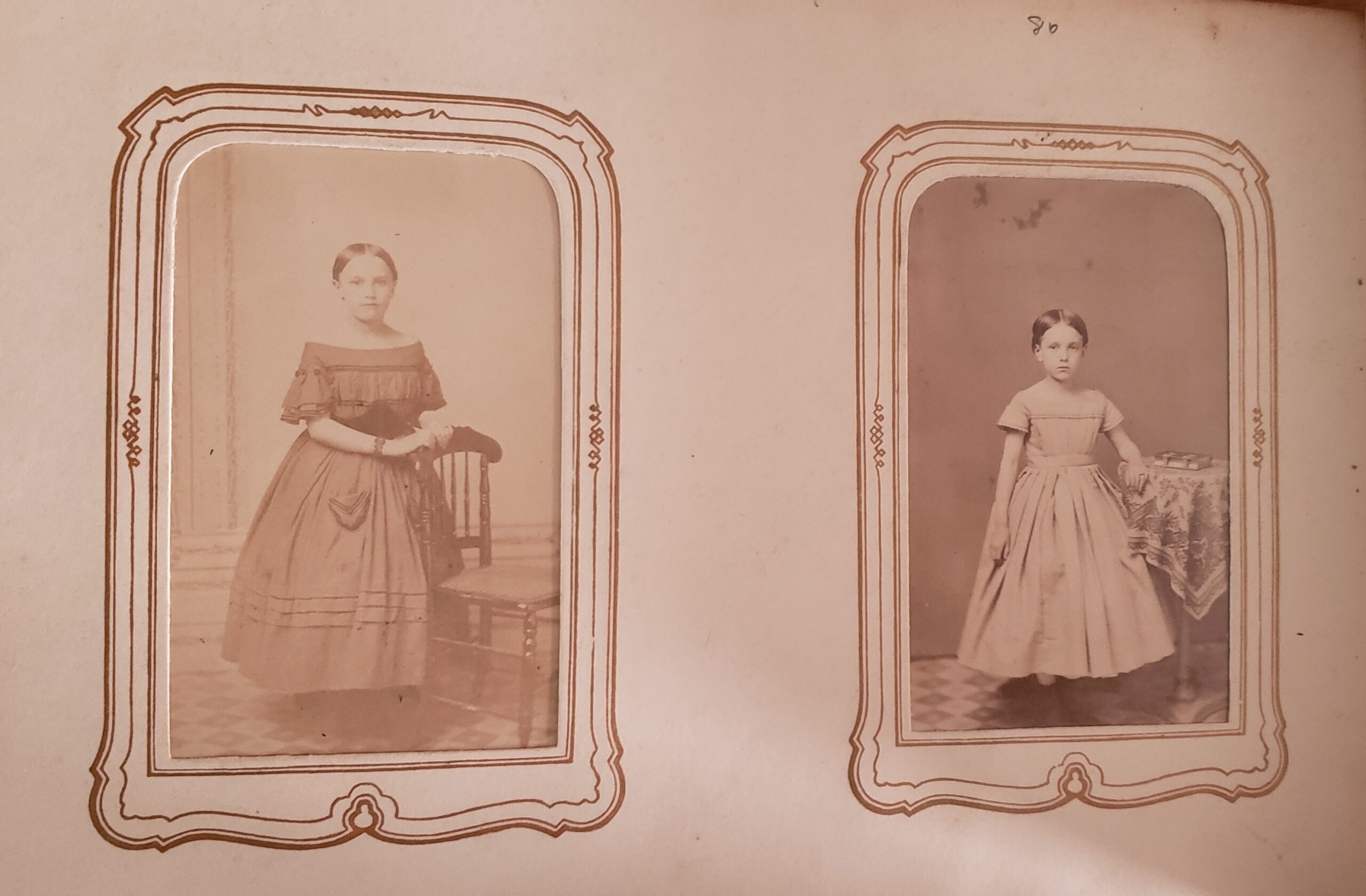
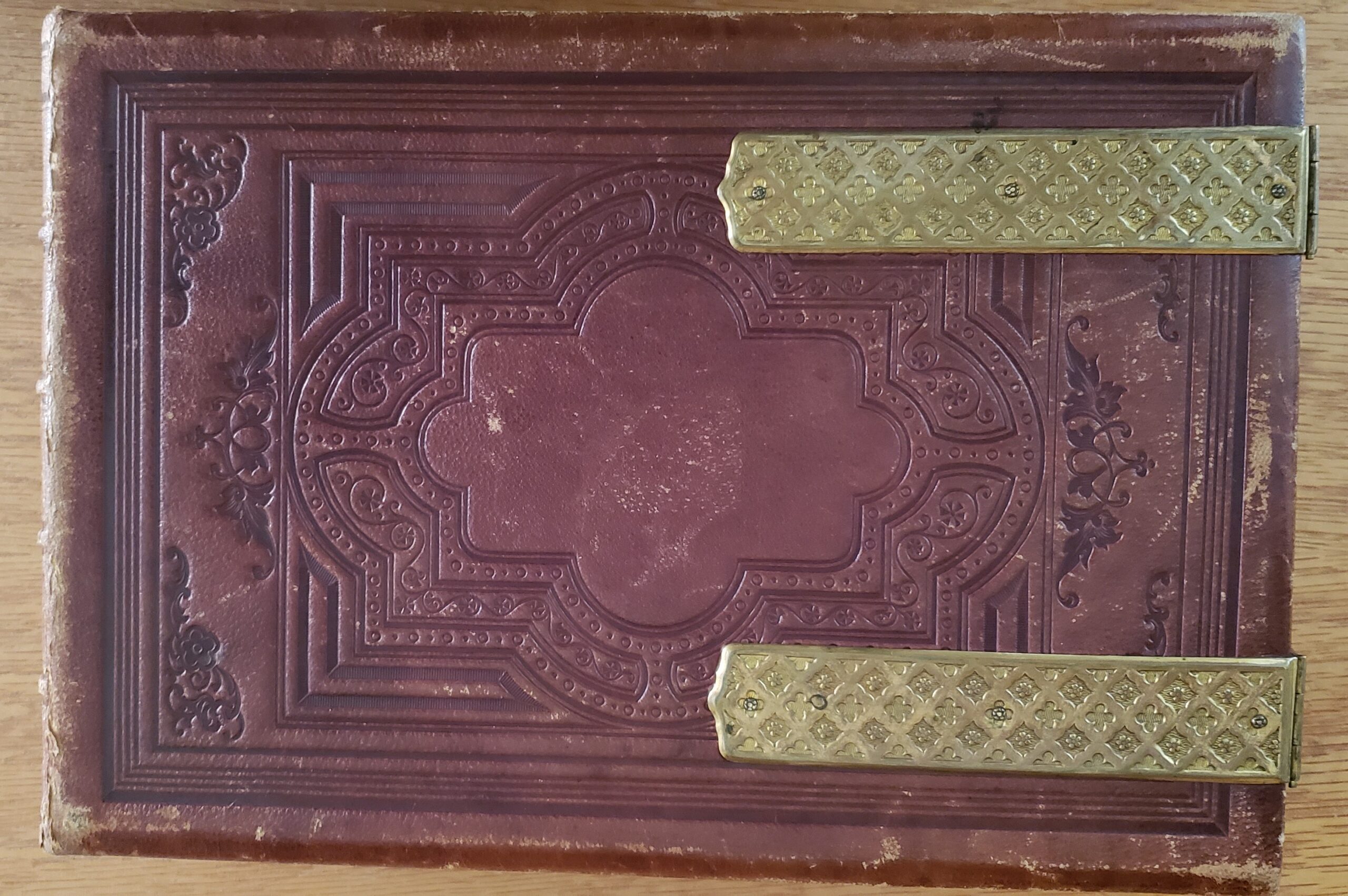
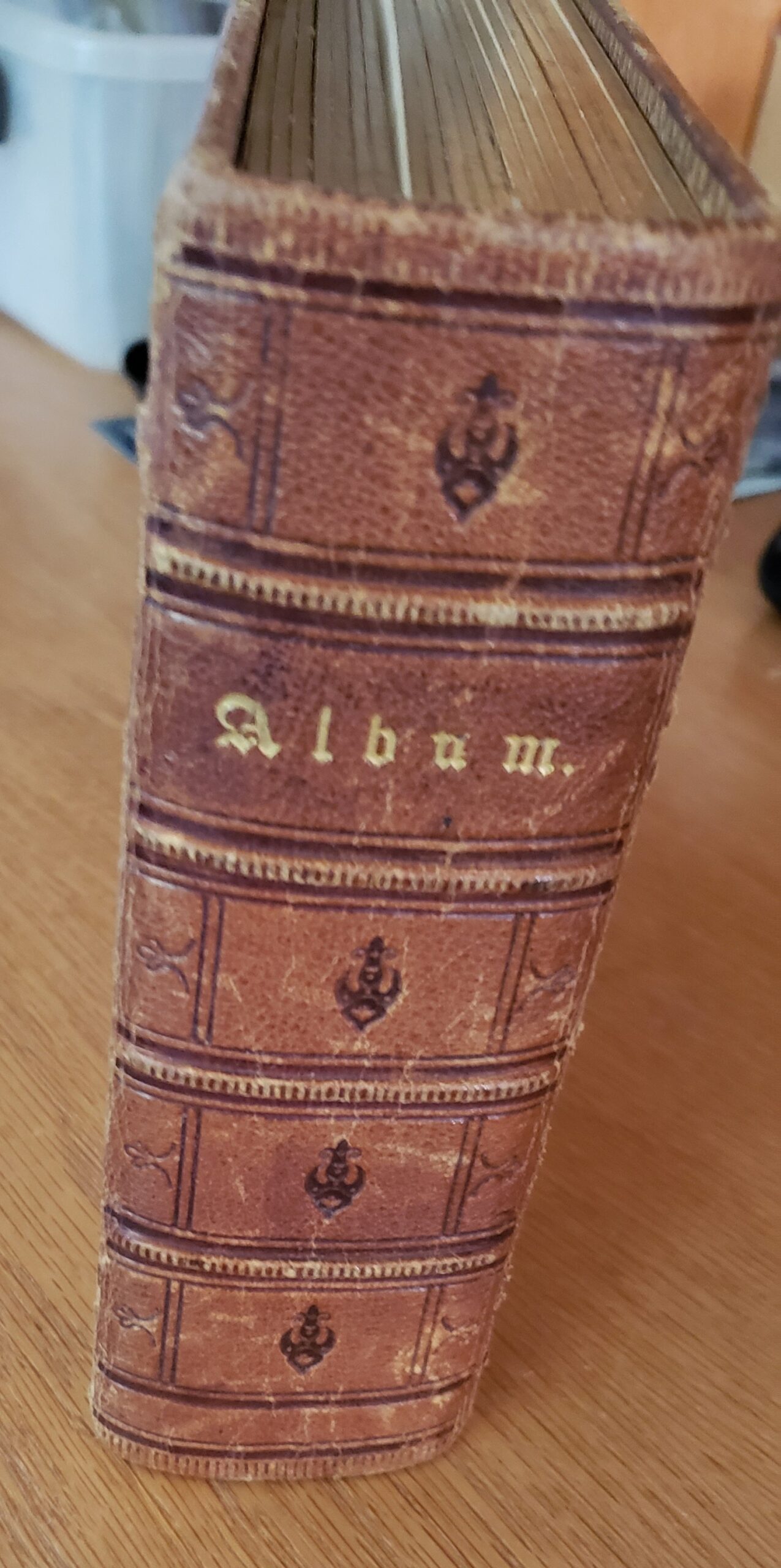
CWALBUM8. CDV Album—Amherst College. Class of 1862. Ezra C. Ebersole. There are 80 CDVs in the album. The names and statistics of the class members are on the front pages of the albums as well as beneath the images. They are by various MA and CT photographers. The first 18 images are faculty, all but two are named. The following 59 images are students, all but one has a name under the image. The final 3 CDVs are unidentified young girls. With a printed biographical document regarding the members of the class which has minor differences from the information at the front of the album. This lot comes with printouts on the soldiers from the CW database.
Ten of the students participated in the Civil War:
Arthur G. Biscoe, Private, Co. E, MA 51st Infantry.
Lucius F.C. Garvin, Private, Co. E, MA 51st Infantry.
Albert Bryant, Private, Co. B, NY 146th Infantry. POW, 5/5/1864 Wilderness, VA; confined at Andersonville, GA 5/7/1864; Died of disease 9/24/1864 at Andersonville, GA.
Henry Gridley, Co. A, NY 150th Infantry. Killed 6/22/1864 at Culp’s Farm, GA.
Henry Hill Goodell, 2nd Lt. Co. F, CT 25th Infantry.
Rufus P. Lincoln, 2nd Lt. Co. C, MA 37th Infantry; MA 20th Infantry. WIA 5/6/1864 Wilderness, VA.
George B. Macomber, 1st Lt Co. E, MA 34th Infantry; Co. A, MA 24th Infantry.
Frederic Daniels Morse, Sergeant Co. B, MA 42nd Infantry. POW 6/23/1863 Brashear City, LA.
Samuel C. Vance, Captain Co. A, MA 27th Infantry; IN 70th Infantry; IN 107th Infantry; IN 132nd Infantry.
Mason W. Tyler, 1st Lt. Co. F, MA 37th Infantry. WIA 9/19/1864 Winchester, VA; WIA 3/25/1865 Petersburg, VA.
The album itself is in good shape although there is one separation of the pages about two-thirds through the album.
VG. $1250


CWCDV1681. W.C. North, Cleveland, Ohio. The battle-torn national colors of the 23rd Ohio Volunteer Infantry. The 23rd Ohio Infantry Regiment was organized at Camp Chase (Columbus, Ohio) and mustered into duty on June 11, 1861, as a three-year regiment. Its 950 enlistees were originally led by Col. William Rosecrans. In July, after training and drilling, the regiment departed for western Virginia, where it served for several months, helping to restore that portion of Virginia to the Union. The 23rd was attached to Jacob D. Cox’s Kanawha Brigade and served throughout much of the war in what became the IX Corps. The unit saw heavy action during the Battle of South Mountain, where Colonel Hayes was wounded in an attack on the slopes near Fox’s Gap. Within a week, the regiment fought at Antietam in the fields southeast of Sharpsburg, Maryland, before returning to duty in West Virginia. It was again heavily engaged in Philip Sheridan’s 1864 Valley Campaign. The regiment mustered out in July 1865. Top of mount corners clipped. G. $750


CWCAB39. Brady’s Album Gallery. No. 407. St. Peter’s Church, Yorktown–Built 1717. Where George Washington was married. M.B. Brady’s 1862 copyright line bottom recto. Album cards measure 4.5″ x 6″ and were issued by Brady only in 1861 and 1862. VG. $300


CWCAB40. Brady’s Album Gallery. No. 489. Military Bridges across the Chickahominy, built by the 15th N.Y.V. Engineers, Col. Murphy. Gardner & Gibson’s 1862 copyright line bottom recto. Album cards measure 4.5″ x 6″ and were issued by Brady only in 1861 and 1862. VG. $275


CWCAB42. Brady’s Album Gallery. No. 502. Battle Field of Cedar Mountain. House in which General Winder was killed; family group. M.B. Brady’s 1862 copyright line bottom recto. Album cards measure 4.5″ x 6″ and were issued by Brady only in 1861 and 1862. VG. $300


CWCAB44. Brady’s Album Gallery. No. 501. Battle Field of Cedar Mountain. House riddled with cannon balls, in which Gen’l Winder was killed at the first fire from Capt. McGilvery’s battery. M.B. Brady’s 1862 copyright line bottom recto. Album cards measure 4.5″ x 6″ and were issued by Brady only in 1861 and 1862. VG. $300


CWCAB46. Brady’s Album Gallery. No. 542. Hotel at Warrenton Springs, Va. Street View, South. M.B. Brady’s 1862 copyright line bottom recto. Album cards measure 4.5″ x 6″ and were issued by Brady only in 1861 and 1862. VG. $300


CWCDV1682. T.M. Schleier’s Photograph Gallery, Nashville, Tenn. Signed verso “Sam. W. Fordyce Capt. Co. H. 1st OHC 1862.” This is Samuel W. Fordyce. Enlisted 8/17/61 as a 2nd Lieut. Co. B, Ohio 1st Cavalry. WIA 10/23/61 West Liberty, KY. Promotion: 1st Lieut. 6/10/62; Capt. 12/31/62 (as of Co. H). G. $200


CWCDV1683. G.T. Lape, NY. Written on verso: “Capt. James Walker 1st N.Y. Vol. Engns.” Label on verso reads “For Sale By E.D. Doolittle. Co. G. 1st N.Y. Vol. Engineer Corps. Port Royal. S.C.” Cancelled 2-cent tax stamp on verso. I cannot locate a “James Walker” in this regiment in the Civil War Database. VG. $150

CWCDV1685. Confederate Brigadier-General John Hunt Morgan (1825-1864), 2nd KY Cavalry. KIA Greenville TN. VG. $200


CWCDV1686. Black, Boston. George William Brown (October 13, 1812 – September 5, 1890) was an American politician, judge and academic. A graduate of Rutgers College in 1831, he was mayor of Baltimore from 1860 to 1861, professor in University of Maryland School of Law, and 2nd Chief Judge and Supreme Bench of Baltimore City. He was founder and president of the Bar Association of Baltimore City and the Library Company of the Baltimore Bar.
Brown played an important role in controlling the Pratt Street Riot, where the first bloodshed of the Civil War occurred, on April 19, 1861. During the riot, Brown accompanied a column of the Sixth Massachusetts regiment through the streets. When the column he was leading was assailed by the mob, “the mayor’s patience was soon exhausted, and he seized a musket from the hands of one of the men and killed a man therewith.” Immediately following the Riot, Baltimore saw much lawlessness, as citizens destroyed the offices of pro-Union German newspapers and looted shops in search of guns and other weapons. Mayor Brown and Maryland businessmen visited the White House to urge President Abraham Lincoln to reroute Union troops around Baltimore city to Annapolis to avoid further confrontations that they felt would result from additional troops passing through the city.
In the few days following the Pratt Street Riot, Governor Hicks likely assented to Mayor Brown’s decision to dispatch the Maryland militiamen to destroy the railroad bridges over the rivers north of the city, to prevent more troops from passing through Baltimore. This was an act both Hicks and Brown would later deny—though Isaac R. Trimble, commanding Baltimore militia companies immediately following the Riot—later claimed that Brown authorized destruction of the railroad bridges, which may explain Brown’s later arrest and imprisonment by federal authorities. Shortly thereafter, a Maryland militia captain and Baltimore County farmer, John Merryman, was arrested, held at Fort McHenry and later denied a writ of habeas corpus, on grounds that President Lincoln had suspended the writ (but only along rail lines in Maryland). This arrest sparked the case of Ex parte Merryman.
President Lincoln agreed to reroute Union troops around Baltimore to Annapolis, so they could then travel to Washington. Northern troops (state militia companies) were able to arrive in Washington, thus avoiding further bloodshed in Baltimore. On May 13, 1861, the Union army entered Baltimore, occupied the city, and declared martial law. Mayor Brown was arrested on September 12, 1861, at his home, with Habeas corpus suspended. He was imprisoned at Fort McHenry for one night, then transported to Fort Monroe in Hampton Roads, Virginia, and held for two weeks. Afterwards he was moved to Fort Warren in Boston Harbor and held for fourteen months. Brown was released on November 27, 1862. He returned to Baltimore and resumed his law practice. VG. $300

CWCDV1687. Unidentified infantry officer and his lady. G. $125


CWCDV1688. Alexander Gardner, Washington, DC. “J.L. Chamberlain” written bottom recto but this is Colonel James L. Selfridge (9/22/1824-5/19/1887), 46th Pennsylvania Infantry later a Brevet Brigadier General. After college, he studied law at Allentown, and was in his father’s Lehigh Transportation Company of Philadelphia, then began his own brokerage. In 1857 he moved to Bethlehem, where he was engaged in the coal and real estate businesses until the War. He mustered into service 20 April 1861 as Captain, Company A, First Pennsylvania Infantry (from Bethlehem, Northampton County) – the “Washington Grays”. After their three-months of service, they reenlisted as Company C, 46th Pennsylvania Infantry, and on 8 August 1861 Selfridge was appointed Lieutenant Colonel of the new 46th. He was in command of the Regiment after Colonel Knipe took command of the Brigade on 17 September. After Antietam, Knipe said of him “… I can cheerfully bear testimony to the bearing of Lieutenant-Colonel Selfridge. He displayed coolness and a bravery that distinguished the true soldier, and is worthy of promotion.” He was promoted to Colonel and command of the Regiment 10 May 1863. Also promoted after the Battle was Major Matthews of the 46th, who was made Colonel of the 128th Pennsylvania, which was assigned to Knipe’s Brigade. He led the Regiment up to the battle for Atlanta, where Colonel Selfridge took command of the brigade for the duration of the War. He was honorably mustered out 16 July 1865. He was cited by Brevet for gallant service on Sherman’s South Carolina and Georgia Campaign. In 1868, he was elected Chief Clerk of the House of Representatives of Pennsylvania, and was re-elected until 1873. In 1872, he returned to Philadelphia and became proprietor of the Lehigh Hydraulic Cement Company. He was also appointed by Governor Geary as Major-General of the Seventh Division of the National Guard of Pennsylvania. He is buried in Nisky Hill Cemetery, Bethlehem, PA. 2-cent tax stamp on verso. G. $250

CWCDV1689. Brady, Washington, DC. Gideon Welles, Lincoln’s Secretary of the Navy. G. $200


CWCDV1691. Photographic negative from Brady’s National Portrait Gallery, published by E&HT Anthony. James Samuel Wadsworth (October 30, 1807 – May 8, 1864) was a philanthropist, politician, and a Union general in the Civil War. He was mortally wounded at the Battle of the Wilderness in 1864. VG. $350


CWCDV1693. B. Carr, Concord, NH. Nathaniel Shackford. Enlisted 8/29/62 as a Captain. Co. E, NH 12th Inf. WIA 5/3/63 Chancellorsville, VA; WIA 7/2/63 Gettysburg, PA (3 bullets to wrist, groin, lung); WIA 6/3/64 Cold Harbor, VA (severe wound in elbow, and back). Promotions: Major 11/16/64; Lt. Col. 5/26/65. VG. $300


CWCDV1695. Landy, Cincinnati, Ohio. Signed “H.W. Rivers, Surg. to Head quarters Army of the Potomac.” This is Henry Wheaton Rivers. Enlisted 4/17/61 as an Asst. Surgeon. Field & Staff RI 1st Inf. On 10/30/61 commissioned into Field & Staff RI 4th Inf. He was listed as:
- Detached 4/15/1862 General Parke’s Staff (Estimated day)
- Returned 7/15/1862 (place not stated) (Estimated day)
- Detached 9/15/1862 3rd Div, 9th A.C. (Estimated day, as Medical Director)
- Detached 11/22/1862 Hqs, Army Of Potomac (As attending surgeon)
- Returned 1/15/1863 (place not stated) (Estimated day)
- Detached 1/16/1863 Hq Maj Gen Burnside (Estimated day, as attending surgeon)
- Returned 6/15/1863 (place not stated) (Estimated day)
- Detached 6/16/1863 2nd Div, 7th A.C. (Estimated day, as Medical Director)
- Returned 9/15/1863 (place not stated) (Estimated day)
- Detached 9/16/1863 Gettysburg Div, 18th A.C. (Estimated day, as Medical Director)
- Detached Service 10/15/1863 (place not stated) (Estimated day)
- Returned 2/15/1864 (place not stated) (Estimated day)
- Detached 2/16/1864 Gen Heckman’s Staff (Estimated day, as Medical director)
- Returned 4/15/1864 (place not stated) (Estimated day)
- Special Duty 4/16/1864 Board Of Examination (Estimated day)
- Detached 5/2/1864 Gen Kantz Staff (Estimated day)
- Returned 8/15/1864 (place not stated) (Estimated day)
Promotions:
- Surgeon 6/7/1861
- Surgeon 9/1/1861 (As of 4th RI Inf)
Died 12/3/1868. VG. $250


CWCDV1696. Bendann Bros., Baltimore, Md. Rufus H. Gilbert. Enlisted on 4/25/1861 at New York City, NY as a Surgeon. On 5/14/1861, he was commissioned into Field & Staff New York 5th Infantry. He was discharged for promotion on 9/3/1861. On 8/3/1861, he was commissioned into US Volunteers Medical Staff. He was Mustered Out on 7/20/1865. Promotions: Surgeon 8/3/1861 (As of Medical Staff); Lt. Colonel 6/1/1865 by Brevet. Died 7/10/1885. VG. $200


CWCDV1698. R.A. Lewis, NY. Lt. Col. John Hodges, Jr. Enlisted on 4/15/1861 as a Priv. On 4/30/1861, he mustered into “I” Co. Massachusetts 8th Infantry. He was Mustered Out on 8/1/1861 at Boston, MA. On 8/28/1861, he was commissioned into “B” Co. Massachusetts 19th Infantry. He resigned on 6/19/1862. On 11/11/1862, he was commissioned into Field & Staff Massachusetts 50th Infantry. He was Mustered Out on 8/24/1863 at Wenham, MA. On 2/3/1864, he was commissioned into Field & Staff Massachusetts 59th Infantry. He was Killed on 7/30/1864 at Petersburg, VA. Promotions: 1st Lieut 8/22/1861 (As of Co. B 19th MA Inf); Major 11/7/1862 (As of 50th MA Inf); Lt Colonel 2/2/1864 (As of 59th MA Inf). $275


CWCDV1700. Ambrose Powell Hill Jr. (November 9, 1825 – April 2, 1865) was a Confederate general who was killed in the Civil War. He is usually referred to as A. P. Hill to differentiate him from Confederate general Daniel Harvey Hill, who was unrelated. A native Virginian, Hill was a career United States Army officer who had fought in the Mexican–American War and Seminole Wars before joining the Confederate States Army. After the start of the Civil War, he gained early fame as the commander of the “Light Division” in the Seven Days Battles. He became one of Stonewall Jackson’s ablest subordinates, distinguishing himself in the 1862 battles of Cedar Mountain, Second Bull Run, Antietam, and Fredericksburg. Following Jackson’s death in May 1863 at the Battle of Chancellorsville, Hill was promoted to lieutenant general and commanded the Third Corps of Robert E. Lee’s Army of Northern Virginia, which he led in the summer Gettysburg Campaign and the fall campaigns of 1863. His command of the corps in 1864–65 was interrupted on multiple occasions by illness, from which he did not return until just before the end of the war. He was killed during the Union Army’s offensive at the Third Battle of Petersburg. This CDV is of Confederate origin and the poor contrast of the image is the result of the low quality chemicals available to southern photographers at the time. Such images are quite rare. G. $350


CWCDV1701. Richard Stoddert Ewell (February 8, 1817 – January 25, 1872) was an American military officer and a Confederate general during the Civil War. He achieved fame as a senior commander under Stonewall Jackson and Robert E. Lee and fought effectively through much of the war. Still, his legacy was clouded by controversies over his actions at the Battle of Gettysburg and the Battle of Spotsylvania Court House. This CDV is of Confederate origin and the poor contrast of the image is the result of the low quality chemicals available to southern photographers at the time. Such images are quite rare. G. $300


CWCDV1702. Photographic negative from Brady’s National Portrait Gallery, published by E. Anthony. Ambrose Everts Burnside (May 23, 1824 – September 13, 1881) was an American army officer and politician who became a senior Union general in the Civil War and three-time Governor of Rhode Island, as well as being a successful inventor and industrialist. He was responsible for some of the earliest victories in the Eastern theater, but was then promoted above his abilities, and is mainly remembered for two disastrous defeats, at Fredericksburg and the Battle of the Crater (Petersburg). Although an inquiry cleared him of blame in the latter case, he never regained credibility as an army commander. Burnside was a modest and unassuming individual, mindful of his limitations, who had been propelled to high command against his will. He could be described as a genuinely unlucky man, both in battle and in business, where he was robbed of the rights to a successful cavalry firearm that had been his own invention. His spectacular growth of whiskers became known as “sideburns”, deriving from the two parts of his surname. VG. $85


CWCDV1705. G.W. Armstead, Corinth, Miss. Grenville Mellen Dodge (April 12, 1831 – January 3, 1916) was a Union Army officer on the frontier and a pioneering figure in military intelligence during the Civil War, who served as Ulysses S. Grant’s intelligence chief in the Western Theater. He served in several notable assignments, including command of the XVI Corps during the Atlanta Campaign. He later commanded troops against Native Americans and served as a US Congressman, businessman, and railroad executive who helped direct the construction of the Transcontinental Railroad. Historian Stanley P. Hirshon suggested that Dodge, “by virtue of the range of his abilities and activities,” could be considered “more important in the national life after the Civil War than his more famous colleagues and friends, Grant, Sherman, and Sheridan.” At the beginning of the war, Dodge was sent by the Governor of Iowa to Washington, D.C., where he secured 6,000 muskets to supply Iowa volunteers. In July 1861, he was appointed Colonel of the 4th Iowa Volunteer Infantry Regiment. He was wounded in the left leg, near Rolla, Missouri, when a pistol in his coat pocket discharged accidentally. He commanded the 1st Brigade, 4th Division in the Army of the Southwest at the Battle of Pea Ridge, where he was wounded in the side and hand. For his services at the battle, he was appointed brigadier general of volunteers and placed in command of forces based in Corinth, where his intelligence operation was based. His commands were known variously as the Central District (Department of the Mississippi); 4th Division (District of West Tennessee); District of Mississippi (Department of Mississippi); 4th Division (District of Jackson, Army of the Tennessee); 4th Division (XIII Corps, Army of the Tennessee); District of Corinth (XVII Corps, Army of the Tennessee); District of Corinth (XVI Corps), Army of the Tennessee; and finally as the 2nd Division (XVI Corps). Following Confederate General Van Dorn’s repulse at the Second Battle of Corinth in October 1862, Dodge’s command fought successful engagements near the Hatchie River and then turned to West Tennessee where they captured a band of Confederate guerrillas near Dyersburg. On February 22, 1863, troops from Dodge’s command attacked Tuscumbia and the rear column of Van Dorn’s column, capturing a piece of artillery, 100 bales of cotton, 100 prisoners and Van Dorn’s supply train. He then served as Grant’s intelligence Chief through the Vicksburg campaign. Dodge was later appointed by General Grant as commander of a Division in the Army of the Tennessee, where his troops aided Grant and William T. Sherman by “rapidly repairing and rebuilding the railroads, bridges, and telegraph lines destroyed by the Confederates,” and defeating or capturing the Confederate guerrillas, who had been ripping up the track and destroying railroad bridges, by employing techniques such as building two-story blockhouses near the bridges. In 1863, he was summoned to Washington DC by President Abraham Lincoln, and although Dodge thought he was being called before a court of inquiry for his aggressive recruitment of black soldiers, the President was instead interested in Dodge’s railroad expertise, and asked him to divine a location along the Missouri River where the Union Pacific Railroad’s transcontinental railroad should have its initial point. The location provided by Dodge was later established by Executive Order as the starting point in 1864. Following the Vicksburg campaign, his own troops joined General Grant and Iowa Governor Samuel J. Kirkwood in petitioning for Dodge’s promotion. Dodge led an expedition to Northern Alabama from April 18, 1863, to May 8, 1863, that screened the advance of Streight’s Raid. While Dodge’s portion of the expedition was successful, Streight’s incursion was disastrous. His command performed various engagements thereafter in northwestern Mississippi and West Tennessee. In December, his forces engaged in a skirmish near Rawhide, twelve miles north of Florence, Alabama that resulted in the capture of 20 prisoners. He was promoted to major general in June 1864 and commanded the XVI Corps during William T. Sherman’s Atlanta campaign. At the Battle of Atlanta, the XVI Corps was held in reserve, but it happened to be placed in a position which directly intercepted John B. Hood’s flank attack. During the fighting Dodge rode to the front and personally led Thomas W. Sweeny’s division into battle. This action outraged the one-armed Sweeny so much that he got in a fistfight with Dodge and fellow division commander John W. Fuller. Sweeny received a court-martial for this action while Dodge continued to lead the corps at the Battle of Ezra Church. During the ensuing siege of Atlanta, while looking through an eyehole in the Union breastworks a Confederate sharpshooter spotted him and shot him in the head. After, he was to complete the war as commander of the Department of the Missouri. Also during the war, he provided information to Thomas Clark Durant who consequently made a fortune smuggling contraband cotton from the Confederate States to fund his intelligence efforts. He would later come into conflict with Durant. After the war, Dodge joined the Military Order of the Loyal Legion of the United States and was assigned insignia number 484. Image has a few crease lines but is not bent. G-. $225


CWCDV1707. Photographer’s imprint is overlaid by a label from McAllister & Brother, Philadelphia, the well-known optical establishment where the image was purchased. David Hunter (July 21, 1802 – February 2, 1886) was an American military officer. He served as a Union general during the Civil War. He achieved notability for his unauthorized 1862 order (immediately rescinded) emancipating slaves in three Southern states, for his leadership of United States troops during the Valley Campaigns of 1864, and as the president of the military commission trying the conspirators involved with the assassination of U.S. President Abraham Lincoln. VG. $200


CWCDV1708. E&HT Anthony. George Gordon Meade (December 31, 1815 – November 6, 1872) was an American military officer who served in the United States Army and the Union army as Major General in command of the Army of the Potomac during the Civil War from 1863 to 1865. He fought in many of the key battles of the Eastern theater and defeated the Confederate Army of Northern Virginia led by General Robert E. Lee at the Battle of Gettysburg. He was born in Cádiz, Spain, to a wealthy Philadelphia merchant family and graduated from the United States Military Academy in 1835. He fought in the Second Seminole War and the Mexican–American War. He served in the United States Army Corps of Topographical Engineers and directed construction of lighthouses in Florida and New Jersey from 1851 to 1856 and the United States Lake Survey from 1857 to 1861. His Civil War service began as brigadier general with the Pennsylvania Reserves, building defenses around Washington D.C. He fought in the Peninsula Campaign and the Seven Days Battles. He was severely wounded at the Battle of Glendale and returned to lead his brigade at the Second Battle of Bull Run. As a division commander, he won the Battle of South Mountain and assumed temporary command of the I Corps at the Battle of Antietam. Meade’s division broke through the lines at the Battle of Fredericksburg but were forced to retreat due to lack of support. Meade was promoted to major general and commander of the V Corps, which he led during the Battle of Chancellorsville. He was appointed to command the Army of the Potomac just three days before the Battle of Gettysburg and arrived on the battlefield after the first day’s action on July 1, 1863. He organized his forces on favorable ground to fight an effective defensive battle against Robert E. Lee’s Army of Northern Virginia and repelled a series of massive assaults throughout the next two days. While elated about the victory, President Abraham Lincoln was critical of Meade due to his perception of an ineffective pursuit during the retreat, which allowed Lee and his army to escape back to Virginia. That fall, Meade’s troops had a minor victory in the Bristoe Campaign but a stalemate at the Battle of Mine Run. Meade’s cautious approach prompted Lincoln to look for a new commander of the Army of the Potomac. In 1864–1865, Meade continued to command the Army of the Potomac through the Overland Campaign, the Richmond–Petersburg Campaign, and the Appomattox Campaign, but he was overshadowed by the direct supervision of the general-in-chief, Lt. Gen. Ulysses S. Grant, who accompanied him throughout these campaigns. Grant conducted most of the strategy during these campaigns, leaving Meade with significantly less influence than before. After the war, Meade commanded the Military Division of the Atlantic from 1865 to 1866 and again from 1869 to 1872. He oversaw the formation of the state governments and reentry into the United States for five southern states through his command of the Department of the South from 1866 to 1868 and the Third Military District in 1872. Meade was subjected to intense political rivalries within the Army, notably with Major Gen. Daniel Sickles, who tried to discredit Meade’s role in the victory at Gettysburg. He had a notoriously short temper which earned him the nickname of “Old Snapping Turtle”. G. $125


CWCDV1712. Henszey & Co., Philadelphia. John White Geary (December 30, 1819 – February 8, 1873) was an American lawyer, politician, Freemason, and a Union general in the Civil War. He was the final alcalde and first mayor of San Francisco, a governor of the Kansas Territory, and the 16th governor of Pennsylvania. At the start of the Civil War, Geary raised the 147th and 28th Pennsylvania Infantry regiments and became colonel of the latter. Commanding the district of the upper Potomac River, he was wounded and captured near Leesburg, Virginia, on March 8, 1862, but was immediately exchanged and returned to duty. On April 25, 1862, he was promoted to Brigadier General, U.S. Volunteers and the command of a brigade in Maj. Gen. Nathaniel Banks’s corps, which he led in the Shenandoah Valley against Thomas J. “Stonewall” Jackson. His brigade joined Maj. Gen. John Pope’s Army of Virginia in late June. He led it at the Battle of Cedar Mountain on August 9, 1862, where he was seriously wounded in the arm and leg. He returned to duty on October 15 as the division commander; the corps was now part of the Army of the Potomac, designated the XII Corps, under the command of Maj. Gen. Henry W. Slocum. Geary’s division was heavily engaged at Chancellorsville, where he was knocked unconscious as a cannonball shot past his head on May 3, 1863. (Some accounts state that he was hit in the chest with a cannonball.) At the Battle of Gettysburg, Slocum’s corps arrived after the first day’s (July 1, 1863) fighting subsided and took up a defensive position on Culp’s Hill, the extreme right of the Union line. On the second day, heavy fighting on the Union left demanded reinforcements and Geary was ordered to leave a single brigade, under Brig. Gen. George S. Greene, on Culp’s Hill and follow another division, which was just departing. Geary lost track of the division he was supposed to follow south on the Baltimore Pike and inexplicably marched completely off the battlefield, eventually reaching Rock Creek. His two brigades finally returned to Culp’s Hill by 9:00 pm that night, arriving in the midst of a fierce fire fight between a Confederate division and Greene’s lone brigade. This embarrassing incident might have damaged his reputation except for two factors: the part of the battle he was supposed to march to join had ended, so he wasn’t really needed; and, because of a dispute between army commander Maj. Gen. George G. Meade and Slocum over the filing of their official reports, little public notice ensued. The XII Corps was transferred west to join the besieged Union army at Chattanooga. Geary’s son Edward died in his arms at the Battle of Wauhatchie, enraging him sufficiently to prevail in a battle in which his division was greatly outnumbered. He distinguished himself in command during the Battle of Lookout Mountain, the entire Atlanta Campaign, Sherman’s March to the Sea, and the Carolinas Campaign. He oversaw the surrender of Savannah, Georgia, and briefly served as the city’s military governor, where he was breveted to major general. VG. $200


CWCDV1713. C. Cole, Roxbury, Mass. Ansel D. Wass. Enlisted on 4/22/1861 at Boston, MA as a 1st Lieut. On 4/22/1861, he was commissioned into “K” Co. Massachusetts 6th Infantry. He was Mustered Out on 8/2/1861 at Boston, MA (Commissioned January 22, 1861). On 8/28/1861, he was commissioned into “K” Co. Massachusetts 19th Infantry. He was discharged for promotion on 10/1/1862. On 10/10/1862, he was commissioned into Field & Staff Massachusetts 3rd Cavalry. He resigned & Disch disability on 1/31/1863. On 5/25/1863, he was commissioned into Field & Staff Massachusetts 19th Infantry. He was disch on 7/27/1864. On 8/6/1864, he was commissioned into Field & Staff Massachusetts 60th Infantry. He was Mustered Out on 12/29/1864 (MO by SO War Dept. #473). On 3/2/1865, he was commissioned into Field & Staff Massachusetts 62nd Infantry. (Date and method of discharge not given.) (Never mustered). He was listed as: Wounded 4/7/1862 Yorktown, VA; Wounded 6/30/1862 Glendale, VA; Wounded 7/3/1863 Gettysburg, PA; Wounded 10/14/1863 Bristoe Station, VA. Promotions: Capt 8/28/1861 (As of Co. K 19th MA Inf); Major 7/1/1862; Lt Colonel 5/25/1863; Colonel 7/30/1864 (As of 60th MA Inf); Colonel 3/2/1865 (As of 62nd MA Inf (not mustered)); Brig-General 3/13/1865 by Brevet; Lt Colonel 9/6/1862 (As of 3rd MA Cav). Born 11/12/1832 in Addison, Washington Co., ME. Died 1/24/1889 in Boston, MA. Buried: Evergreen Cemetery, Portland, ME. 2-cent tax stamp on verso. $250


CWCDV1714. Photographic negative from Brady’s National Portrait Gallery, published by E&HT Anthony. David Glasgow Farragut (July 5, 1801 – August 14, 1870) was a flag officer of the United States Navy during the Civil War. He was the first rear admiral, vice admiral, and admiral in the United States Navy. He is remembered in U.S. Navy tradition for his bold order at the Battle of Mobile Bay, usually abbreviated to “Damn the torpedoes … full speed ahead.” Born near Knoxville, Tennessee, Farragut was fostered by naval officer David Porter after the death of his mother. When he was 11 years old, Farragut served in the War of 1812 under the command of his adoptive father. He received his first command in 1823, at the age of 22, and went on to participate in anti-piracy operations in the Caribbean Sea. He then served in the Mexican–American War under the command of Matthew C. Perry, participating in the blockade of Tuxpan. After the war, he oversaw the construction of the Mare Island Navy Yard (now Mare Island Naval Shipyard), which was the first U.S. Navy base established on the Pacific Ocean. Though Farragut resided in Norfolk, Virginia, prior to the Civil War, he was a Southern Unionist who strongly opposed Southern secession and remained loyal to the Union after the outbreak of the Civil War. Despite some doubts about Farragut’s loyalty, Farragut was assigned command of an attack on the important Confederate port city of New Orleans. After defeating the Confederates at the Battle of Forts Jackson and St. Philip, Farragut captured New Orleans in April 1862. He was promoted to rear admiral after the battle and helped extend Union control up along the Mississippi River, participating in the siege of Port Hudson. With the Union in control of the Mississippi, Farragut led a successful attack on Mobile Bay, home to the last major Confederate port on the Gulf of Mexico. Farragut was promoted to admiral following the end of the Civil War and remained on active duty until his death in 1870. G. $150


CWCDV1715. Signed on verso “Wm. L. Bayley.” Possibly “Rayley.” Experts tell me this is a 3rd Asst. Engineer in the Navy and the uniform particulars are from 7/1/62-1/28/64 (cap insignia and lack of sleeve lace). I can’t locate him in any of the record searches. VG. $100


CWCDV1717. E&HT Anthony. Confederate Brigadier-General John Hunt Morgan (1825-1864), 2nd KY Cavalry. KIA Greenville TN. VG. $200


CWCDV1718. This is a letter, not a CDV. It is from Sergeant Joseph E. Bruff. Enlisted 8/12/62 and mustered into Co. I, MD 6th Inf. He was killed on 5/5/64 at Wilderness, VA. The letter is to his sister Lydia and it was written in Harpers Ferry on Jan. 28th. The full transcription of the letter is shown above. VG. $200


CWCDV1719. A. Weilepp, Baltimore, Md. Unidentified corporal. 2-cent cancelled tax stamp on verso. This CDV came with the above letter and written on the verso is “Poss. 6th Md. Came w/Jos. Bruff letter, Co. I 6th MD.” Since Bruff was a Sergeant and this soldier is a corporal, they are being offered separately. G. $125


CWCDV1720. J.A. Scholten, St. Louis, Mo. Richard Dominicus Cutts (1817-1883). Civil War Union Brevet Brigadier General. A nephew of Presidential First Lady Dolly Madison and an 1835 graduate of Georgetown University in Washington, DC, he rose to prominence as a member of the United States Coast and Geodetic Survey. When the Civil War began he offered his services to the Union, and was commissioned as a Colonel and Aide-de-Camp, US Volunteers on November 29, 1861. Assigned to the staff of Major General Henry Wager Halleck, he served with him through the balance of the war as General Halleck served as Commander-in-Chief of the Union Army, then as Chief-of-Staff under Lieutenant General Ulysses S. Grant. Colonel Cutts was brevetted Brigadier General, US Volunteers on March 13, 1865 for “meritorious services during the war”, and was honorably mustered out on June 1, 1865. Corners clipped. VG. $125


CWCDV1721. Gideon Smith, Geisboro,’ D.C. Unidentified soldier. He appears to be holding a CDV album as it has clasps. G. $100


CWCDV1722. John Holyland, Washington, DC. Private Benjamin F. Townsend. Enlisted 8/2/62 at Wilna, NY. Mustered into Co. D, NY 10 HA. Mo 6/14/65, Phila. PA. VG. $125


CWCDV1723. Jno. Holyland, Washington, DC. Corporal Hugh Ormiston. Enlisted 8/20/62 at Champion, NY as a Private. Mustered into Co. D, NY 10 HA 9/11/62. MO 6/23/65, Petersburg, VA. Promotions: Corpl 8/8/64. VG. $125


CWCDV1724. Jno. Holyland, Washington, DC. Private Benjamin F. Fox. Enlisted 8/21/62 at Champion, NY. Mustered into D Co. NY 10 HA. Mustered out 6/23/65, Petersburg, VA. VG. $125


CWCDV1725. Jno. Holyland, Washington, DC. Private Eugene Brassard. Enlisted 8/19/62 at Champion, NY. Mustered into Co. D NY 10 HA 9/11/62. Mustered out 6/23/65, Petersburg, VA. VG. $125


CWCDV1726. Corp. Charles P. Covey. Enlisted 7/28/62 at Wilna, NY as a Private. Mustered into D Co. NY 10 HA 8/15/62. Promotions: Corpl. 9/11/62. Died of disease on 5/9/64 at Fort Lyon, VA. VG. $125


CWCDV1727. Brady’s Album Gallery. No. 1. Capitol, from near Trinity Church. The Capitol dome under construction in the background. Barnard & Gibson’s 1862 copyright line on label and bottom recto. G. $450


CWCDV1730. Pair of CDVs of George Richmond Fearing, Esq. (1839-1920). Residence was not listed; 22 years old. Enlisted on 11/22/1861 as a 1st Lieut. On 11/22/1861, he was commissioned into US Volunteers Aide-De-Camp. He resigned on 2/1/1864. Promotions: Capt 4/4/1862; Major 3/13/1865 by Brevet. Born 6/2/1839 in New York City, NY. Died 1/24/1920 in New York City, NY. (Parents: Daniel Butler & Harriet (Richmond) Fearing. Wife: Harriet Travers). In the first CDV, he holds a U.S. Model 1860 Staff and Field sword, gauntlets, and high boots. He wears staff buttons on his coat, but is missing the common wreath insignia on his hat. The second CDV is of Fearing in Paris taken by Levitsky. George Richmond Fearing (1839-1920) was a son of Daniel B. Fearing (1804-1870), a New York merchant banker from Massachusetts who was one of the earliest summer residents at Newport. George himself was a well-known society figure and President of the Knickerbocker Club. In Newport, he co-founded the Casino and was the uncle of Mayor Daniel B. Fearing II (1859-1918). He grew up between New York and Newport. He became Colonel of the Newport Artillery Company and during the Civil War served on the staff of General Ambrose E. Burnside. He lived at 998 Fifth Avenue in Manhattan. In 1871, Colonel Fearing commissioned a French architect to deliver a set of drawings of a French chateau for his Summer home at 180 Narragansett Ave in Newport. The drawings were based on an 18th century country house on the outskirts of Geneva, Switzerland. The esteemed Newport architectural firm of George Champlin Mason & Son took the drawings and adapted them to create The Orchard, a grand mansion built of yellow Milwaukee brick and Ohio limestone. It has been a landmark in Newport since 1873. VG. $125
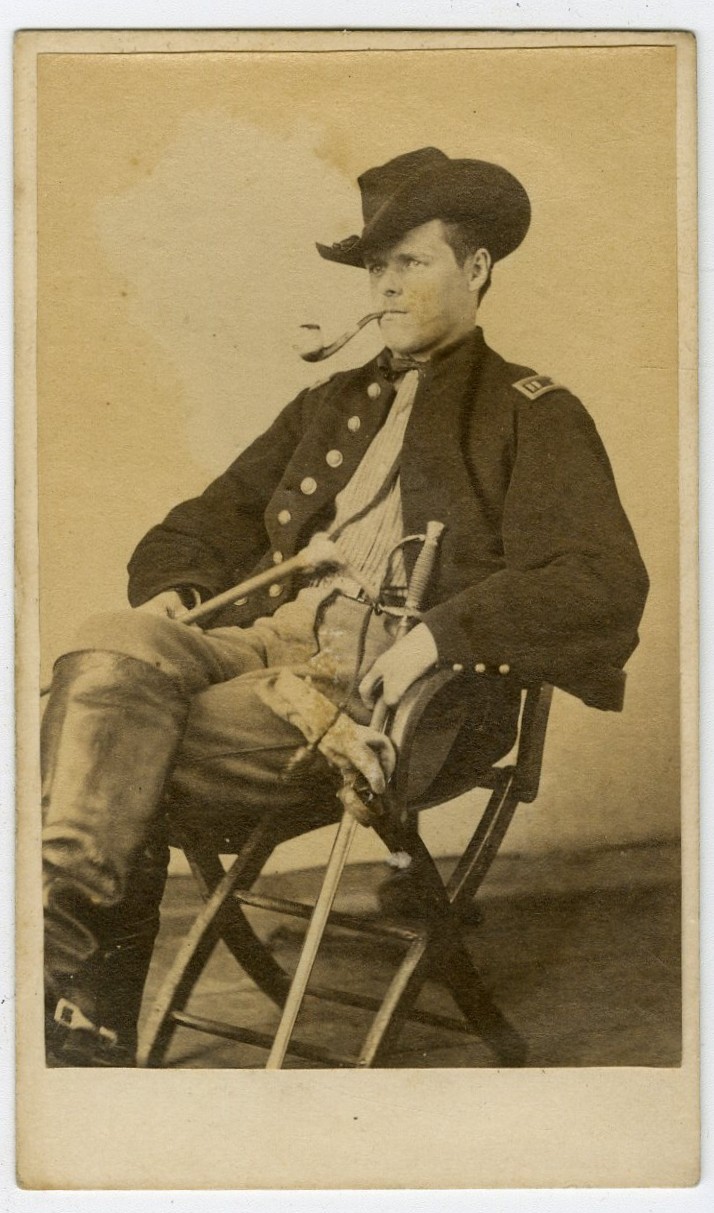
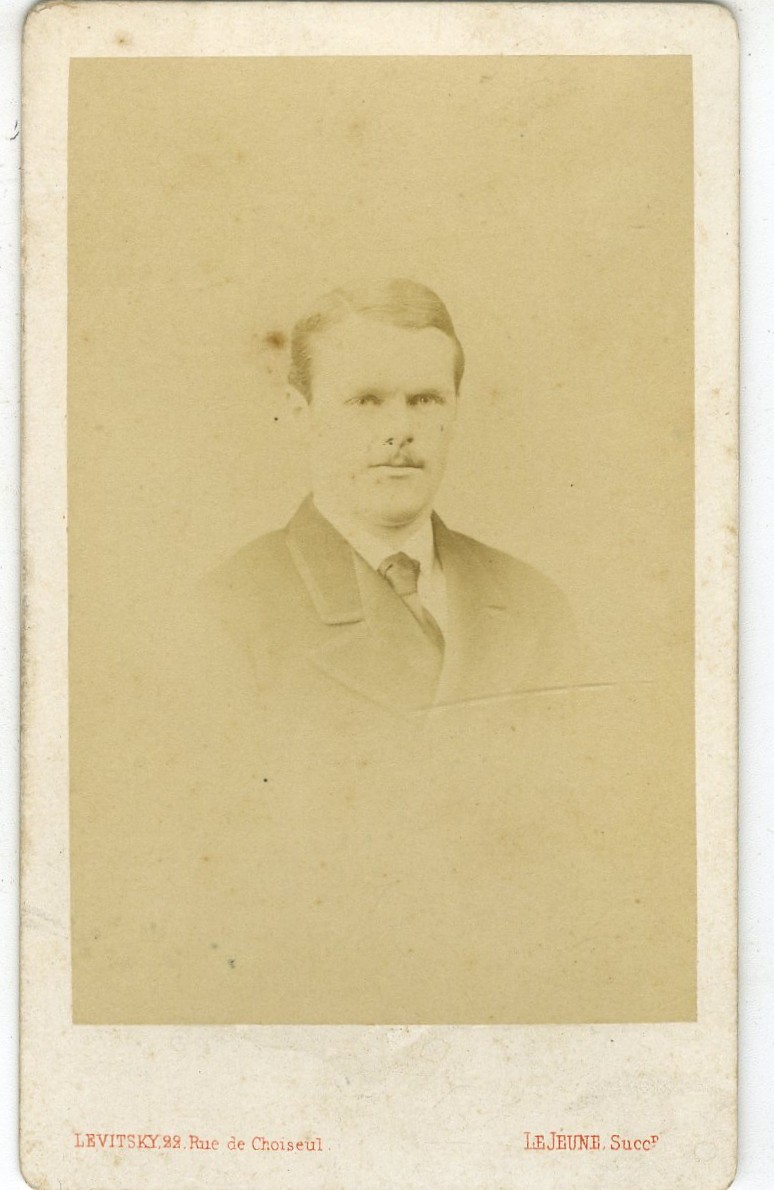
CWCDV1730a. Pair of CDVs of George Richmond Fearing, Esq. (1839-1920). Residence was not listed; 22 years old. Enlisted on 11/22/1861 as a 1st Lieut. On 11/22/1861, he was commissioned into US Volunteers Aide-De-Camp. He resigned on 2/1/1864. Promotions: Capt 4/4/1862; Major 3/13/1865 by Brevet. Born 6/2/1839 in New York City, NY. Died 1/24/1920 in New York City, NY. (Parents: Daniel Butler & Harriet (Richmond) Fearing. Wife: Harriet Travers). In the first CDV, he holds a U.S. Model 1860 Staff and Field sword, gauntlets, and high boots and is smoking a pipe. He wears staff buttons on his coat, but is missing the common wreath insignia on his hat. The second CDV of Fearing is by Levitsky, Paris. George Richmond Fearing (1839-1920) was a son of Daniel B. Fearing (1804-1870), a New York merchant banker from Massachusetts who was one of the earliest summer residents at Newport. George himself was a well-known society figure and President of the Knickerbocker Club. In Newport, he co-founded the Casino and was the uncle of Mayor Daniel B. Fearing II (1859-1918). He grew up between New York and Newport. He became Colonel of the Newport Artillery Company and during the Civil War served on the staff of General Ambrose E. Burnside. He lived at 998 Fifth Avenue in Manhattan. In 1871, Colonel Fearing commissioned a French architect to deliver a set of drawings of a French chateau for his Summer home at 180 Narragansett Ave in Newport. The drawings were based on an 18th century country house on the outskirts of Geneva, Switzerland. The esteemed Newport architectural firm of George Champlin Mason & Son took the drawings and adapted them to create The Orchard, a grand mansion built of yellow Milwaukee brick and Ohio limestone. It has been a landmark in Newport since 1873. VG. $125

CWCDV1733. Brady, Washington, DC. Louis Blenker (July 31, 1812 – October 31, 1863) was a German revolutionary and American soldier. He was born at Worms, Germany. After being trained as a goldsmith by an uncle in Kreuznach, he was sent to a polytechnical school in Munich. Against his family’s wishes, he enlisted in an Uhlan regiment which accompanied Otto, soon to be King of Greece to Greece in 1832. Due to his gallantry, he soon became an officer. A revolt in Greece obligated him to leave, with an honorable discharge, in 1837. He studied medicine in Munich and then, at the wish of his parents, opened a wine trading business in Worms. In 1843, he married Elise Blenker. In 1848, he became a colonel in the Worms militia. A large majority of the citizens also preferred him for mayor of Worms, but the otherwise liberal Jaup ministry failed to confirm him due to intrigues by the opposition party. This drove him into the hands of the German Revolutionary party of 1848, and when the revolution broke out in Baden, he led an insurgent corps in spite of the poor prospects. He was noted on both sides for his fearlessness. His wife, Elise, accompanied him on his campaigns. As commander of the Freischaren (Free Corps), he took Ludwigshafen (May 10, 1849), occupied the city of Worms, and made an unsuccessful attack on Landau. When the Prussian troops entered the Electorate of the Palatinate, he fought in several of the engagements in Baden, but after the suppression of the revolution was compelled to flee with other leading revolutionaries like Germain Metternich, Ludwig Bamberger, and Franz Zitz to Switzerland, whence he emigrated to the United States. On his arrival in the United States, he settled on a farm in New York, and ran a small business. Upon the outbreak of the Civil War he organized the 8th New York Volunteer Infantry Regiment, of which he became colonel. He was noted for his coverage of the retreat at Bull Run and for his performance in western Virginia at the Battle of Cross Keys. For his gallantry at Bull Run he was raised to the rank of brigadier general of volunteers. But after Cross Keys a series of deficiencies plagued his command, the main accusation being carelessness with respect to supplies. There were also allegations of financial irregularities. In a letter to the Illinois Staatszeitung, Gustav Struve defended Blenker on this score, i.e. with regard to a charge that he got $100 a month from each of the sutlers he had licensed to service his troops. But the charges persisted. Stories appeared in the German-language press and the New York Tribune accusing Blenker’s troops of looting the countryside of edibles and theft of items of no military worth. Blenker was defended by the New Yorker Criminal Zeitung und Belletristisches Journal, and some editors suggested that Carl Schurz was planning to supersede Blenker. Blenker had a love of pomp. When McClellan became general of the Army of the Potomac, Blenker led a procession to his headquarters. Yet there were credible testimonials to his organizational ability, and no one questioned his courage. However, his command became notable for the quantities of foreign nobility in its ranks, the climax coming when Prince Felix Salm-Salm joined his ranks, an affront to republicans like Karl Heinzen and Struve. Struve, also a member of Blenker’s corps, resigned, and Heinzen broadcast protests in his newspaper, the Pionier. The allegations reached the War Department, and when his appointment as a general reached the Senate for confirmation several senators repeated them: questionable finances, command hierarchies and distinctions more appropriate to Europe than to the United States, exploitation of his troops through the sutlers. Alexander Schimmelfennig, a fellow officer, referred to him as a “bum,” and there was much controversy between supporters of Schurz, Blenker and Franz Sigel. Blenker was ultimately confirmed as a general, but his career was ruined. Soon he was superseded by Sigel. He was mustered out of service March 31, 1863, and died in October of injuries sustained while with his command at Warrenton, Virginia, leaving behind his wife, son and three daughters in dire circumstances. Blenker died in poverty and there was no proof he profited from the sutlers’ trade. Some members of his staff were convicted for financial irregularities however. McClellan continued to esteem him as an officer. G. $125

CWCDV1734. Unidentified Captain. G. $75

CWCDV1735. Unidentified Cavalry 1st Lieutenant. G. $75


CWCDV1736. Unidentified Navy Officer with woman on verso. My guess is they are husband and wife. G. $100


CWCDV1737. Unidentified Navy Officer with woman on verso. My guess is they are husband and wife. G. $100


CWCDV1738. C.L. Lochman, Carlisle, Pa. Unidentified 1st Lieutenant. G. $75


CWCDV1740. Photographic negative from Brady’s National Portrait Gallery, published by E&HT Anthony. James Samuel Wadsworth (October 30, 1807 – May 8, 1864) was a philanthropist, politician, and a Union general in the Civil War. He was mortally wounded at the Battle of the Wilderness in 1864. VG. $250


CWCDV1747. J. Gurney & Son, NY. Unidentified soldier. G. $50


CWCDV1749. Brady, New York. 7th NYS Militia at Camp Cameron, Washington, DC, April-June, 1861. Trimmed at sides o/w VG. $325


CWCDV1750. Brady, Washington. 7th NYS Militia at Camp Cameron, Washington, DC, April-June, 1861. Trimmed at sides o/w VG. $300


CWCDV1751. Brady, Washington. 7th NYS Militia at Camp Cameron, Washington, DC, April-June, 1861. G. $325


CWCDV1754. [Brady]. 7th NYS Militia at Camp Cameron, Washington, DC, April-June, 1861. VG. $325


CWCDV1755. [Brady]. 7th NYS Militia at Camp Cameron, Washington, DC, April-June, 1861. VG. $350


CWCDV1756. [Brady]. 7th NYS Militia at Camp Cameron, Washington, DC, April-June, 1861. VG. $350
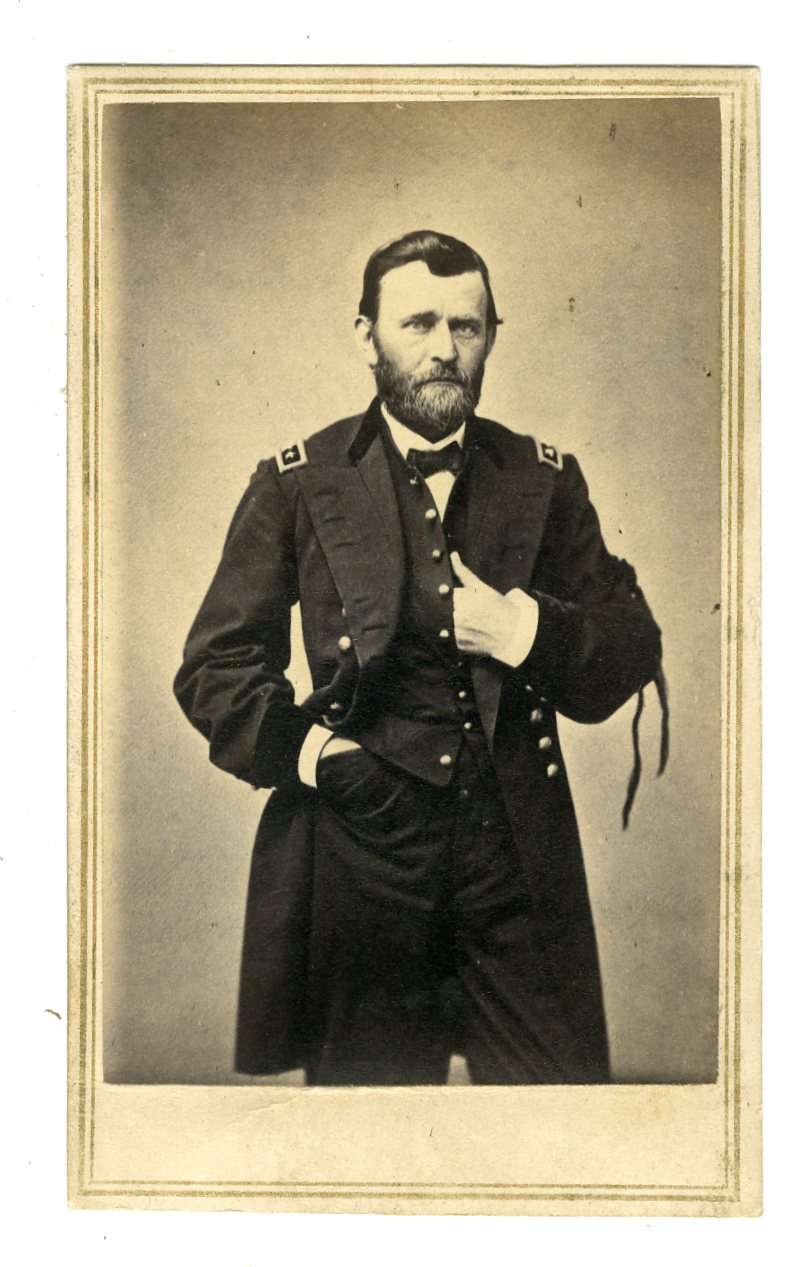
CWCDV1762. General US Grant. Wearing mourning ribbons on sleeve for Lincoln. E. $200
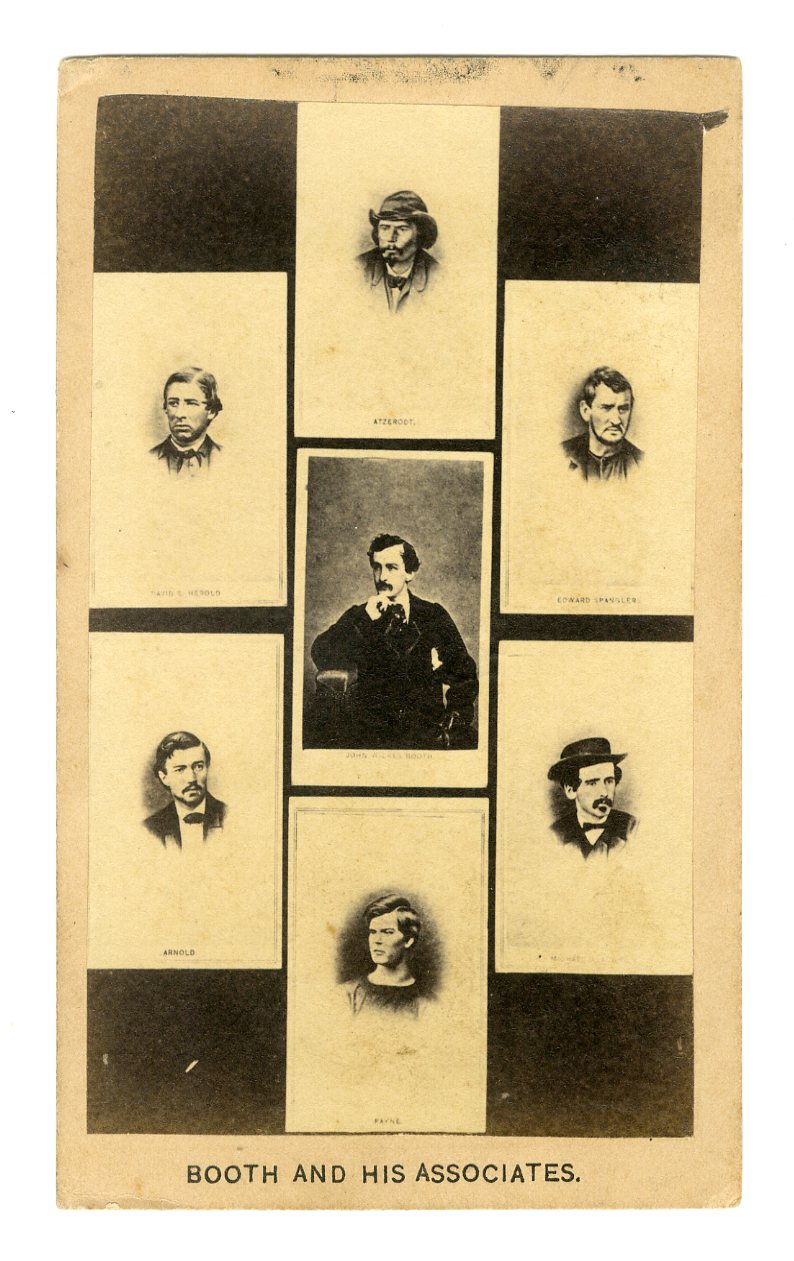
CWCDV1765. Booth and His Associates. Composite image of Booth, Atzerodt, Payne, Herold, Spangler, Arnold, & McLaughlin. 2-cent tax stamp on verso. VG. $350
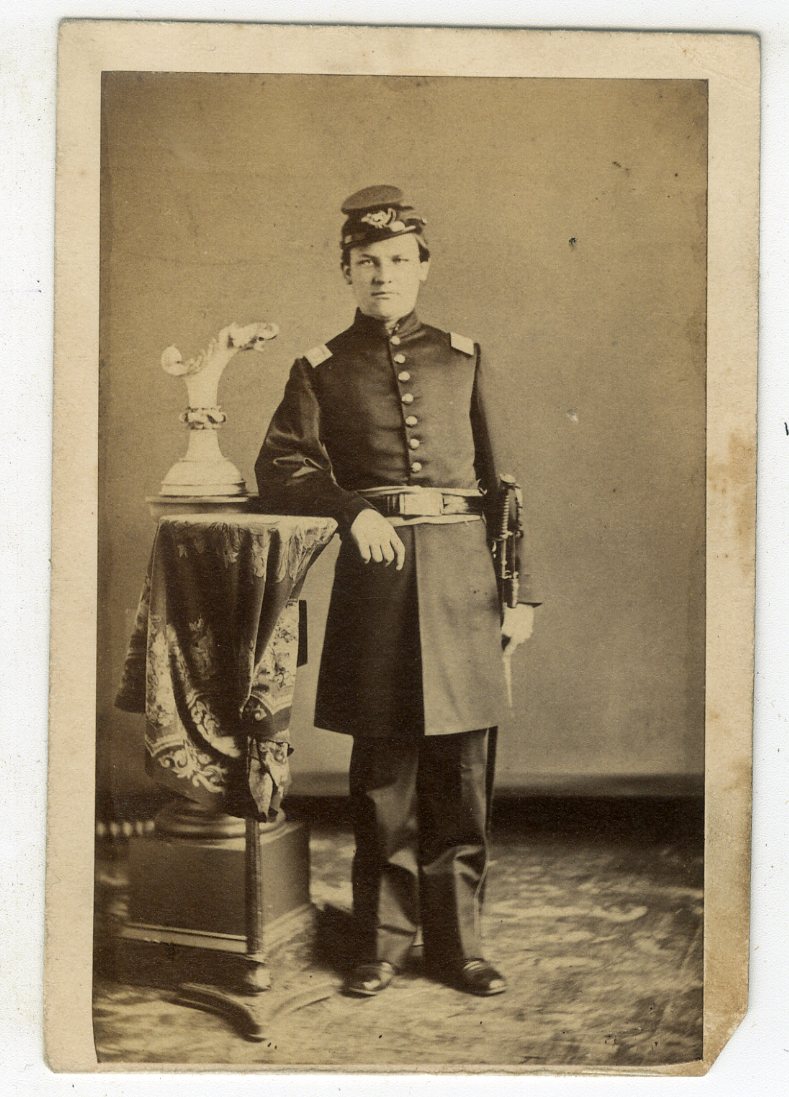
CWCDV1767. Ball & Thomas, Cincinnati, Ohio. Unidentified artillery officer. Slight trim at bottom o/w VG. $275
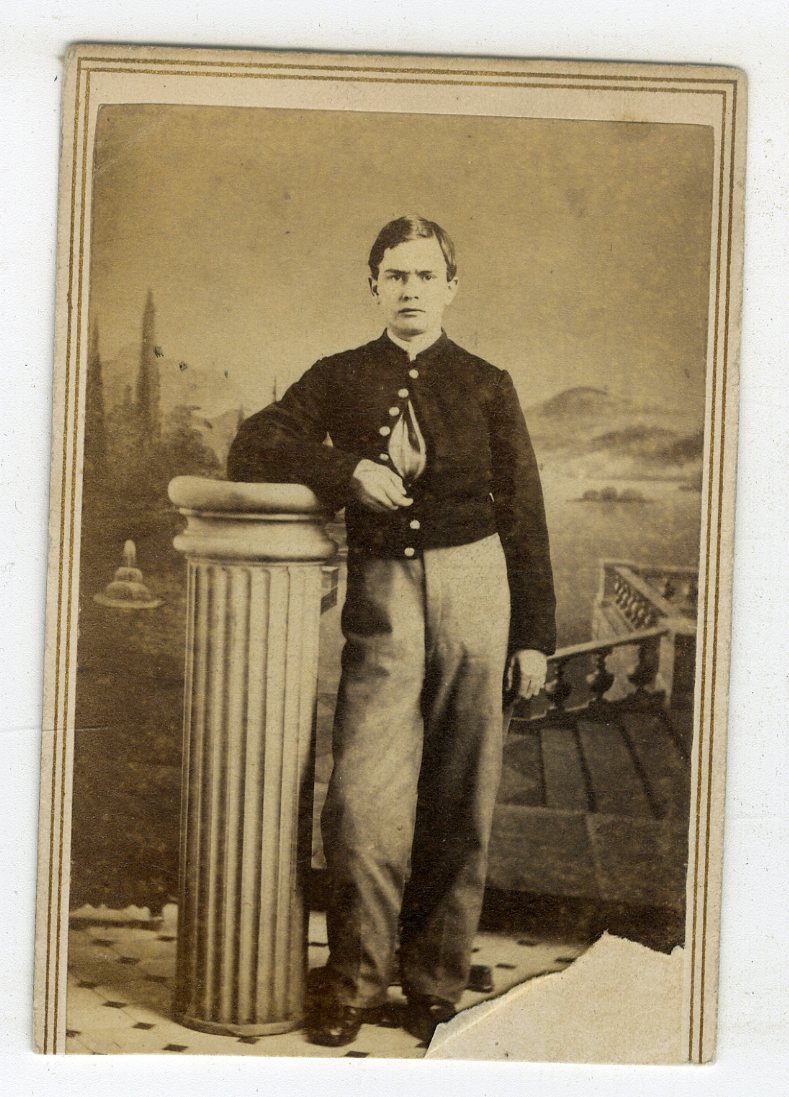
CWCDV1768. Ball & Thomas, Cincinnati, Ohio. Unidentified soldier. Note bottom right corner piece of image is missing. Trimmed at bottom. G. $150
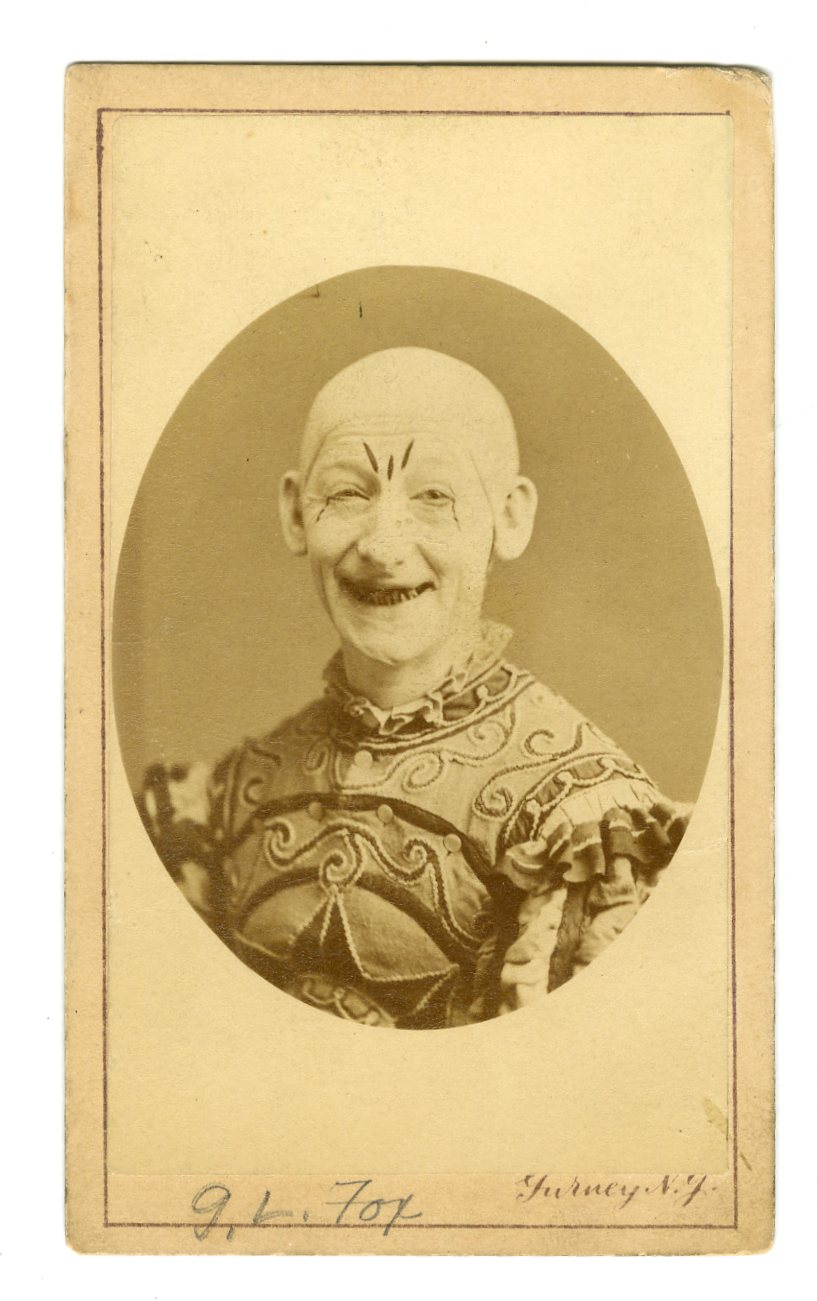
Per120. CDV by Gurney, NY of George Washington Lafayette Fox (July 3, 1825 – October 24, 1877). In the Civil War, Fox enlisted as a lieutenant in the Eighth New York Infantry. He rose to the rank of major and saw action at the First Battle of Bull Run before mustering out in August 1861.
Here is the rest of his story:
George Washington Lafayette Fox (July 3, 1825 – October 24, 1877) was an American actor and dancer who became known for his pantomime Clown roles, and who based the characterizations for these roles on his inspiration Joseph Grimaldi.
Fox was born George Washington Lafayette Fox, the first child of George Howe and Emily (née Watt) Fox of Cambridge, Massachusetts. His parents were stock players at Boston’s Tremont Street Theatre, where Laff (his childhood nickname) and his five siblings were often called upon to play juvenile roles. Fox made his debut at the Tremont Street Theatre at the age of five, though in later years his younger brothers, Charles and James, and his sister Caroline were considered the more talented. James and Caroline became popular in the Boston area as a child act and flourished for a number of years. Fox’s parents decided his future would be better served if he learned a trade and they enrolled him in an apprenticeship with a local merchant.
Fox’s brother James continued acting for several years, even while attending Harvard Law School and would later become a successful lawyer and four-term mayor of Cambridge. His sister Caroline married actor George C. Howard, a union that would leave an important mark on the history of American theater. In 1852 Howard commissioned his wife’s cousin George L. Aiken to write a dramatization of Harriet Beecher Stowe’s famous anti-slavery novel Uncle Tom’s Cabin. The original production at Peal’s Museum in Troy, New York spawned a sequel and then was merged into a six-act play that ran until the 1930s. The play had probably a greater impact than the novel by visually depicting the cruelties of slavery and was a boost to the abolitionist movement.
By the time Fox had reached the age of twenty his apprenticeship had failed, leaving him to return to the family business. He toured for a while with Howard and his sister as L. Fox, playing minor dramatic and comedic roles. He left their company in 1850 to try his hand as a low comedian at the Bowery’s National Theatre on Chatham Street. There he finally found his niche, becoming a popular headliner over the following seven years. For the remainder of his career Fox would play at venues that catered primarily to working-class audiences.
In 1853, Fox directed and performed in his cousin’s dramatization of Uncle Tom’s Cabin at the National, starring Fox as Phineas Fletcher; his brother Charles as Gumption Cute; brother-in-law George C. Howard as Augustine St. Clair; sister Caroline as Eva St. Clair; William J. Le Moyne as Deacon Perry; and Greene C. Germon as Uncle Tom.
Inspired by the French Commedia dell’arte artists, the Ravel Brothers, to undertake the British musical genre of pantomime, he created a distinct place for that kind of entertainment in New York City, first at the National Theatre and later at the New Bowery Theatre, of which he was for a time both lessee and manager in partnership with James R. Lingard. Fox continued to surround himself with an increasingly competent group of comedians and acrobats that included his brother Charles, who had become popular as an actor and a pantomime Clown performer. Though often overlooked by the theater critics of the day, Fox’s popularity in vaudeville houses at the time can be compared to that of Edwin Booth’s playing Hamlet, a role that Fox played in a much lighter vein.
When Fox returned from the war, he resumed playing pantomime roles to Lower East Side audiences. Fire forced him out of the New Bowery Theatre, one of many that would curse the building over the years. Poor business had caused a schism with Lingard that would later spill over into the court dockets. In 1866, Fox became stage manager at the Olympic Theatre on the East side of Broadway near Houston Street. There he played Bottom in A Midsummer Night’s Dream and, starting in 1868, his signature role as Clown in a pantomime version that he co-wrote of Humpty Dumpty, the first American pantomime to be performed in two acts, which some feel has never been equaled since.
Over the last decade of his life, Fox would encounter artistic success coupled with financial setbacks. As a manager he often ignored the bottom line when planning a new show and as a result several of his productions that were popular with the public saw little return. This problem was compounded by competition from younger artists who were performing in ever more spectacular productions each year and by an unscrupulous partner who made promises he could not honor.
Fox’s health began to fail in 1875 after an accident on stage that broke his nose and damaged an optic nerve. Erratic behavior over the next few months that caused some concern over his sanity was soon followed by a series of strokes that eventually led to his death, aged 52. At the time of his death he was under the care of his sister and brother-in-law at their residence in Cambridge. Fox’s daughter, Louisa A. Fox, later married Daniel Sully, a stage actor who was a circus performer in youth. VG. $150
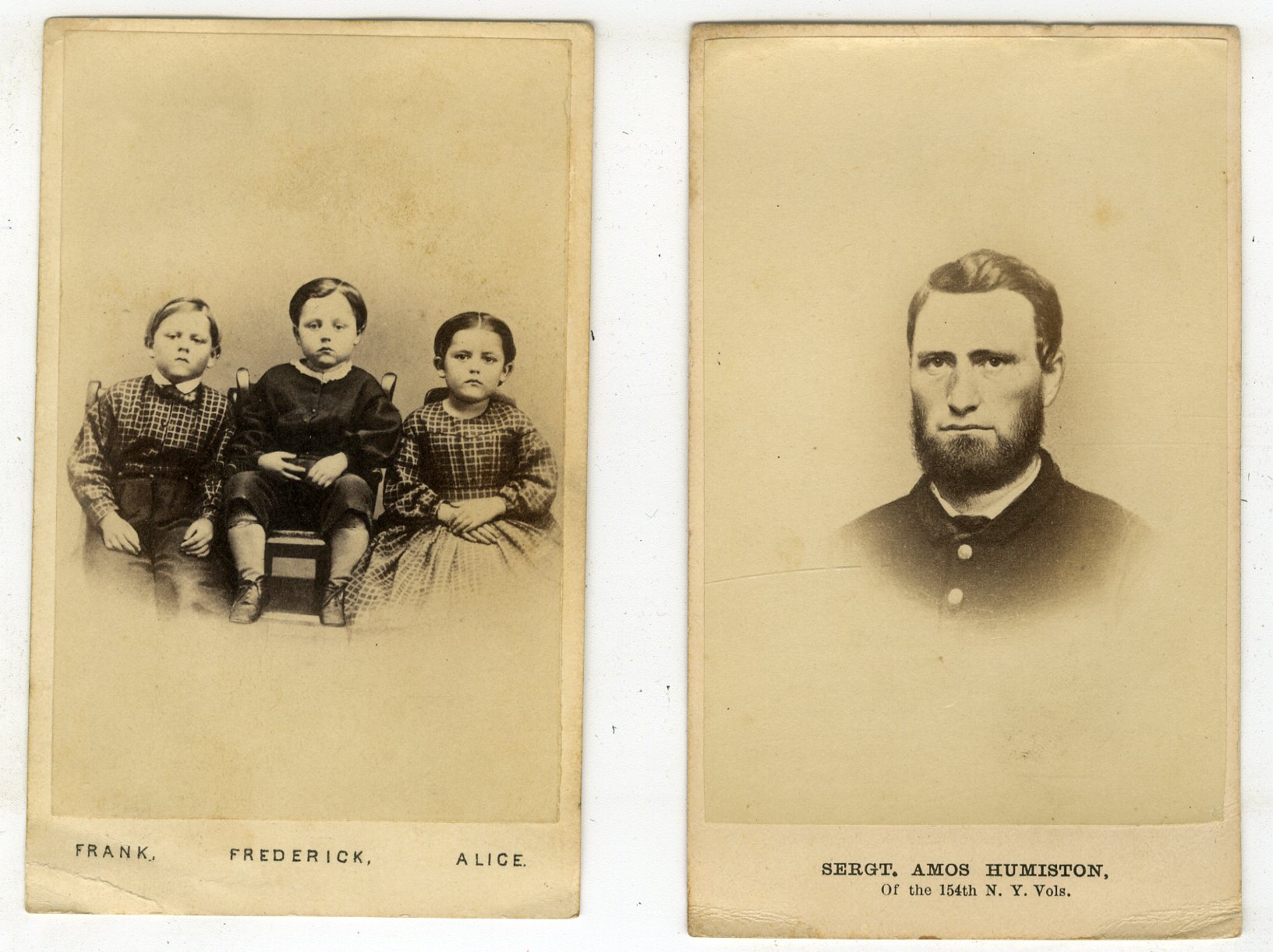
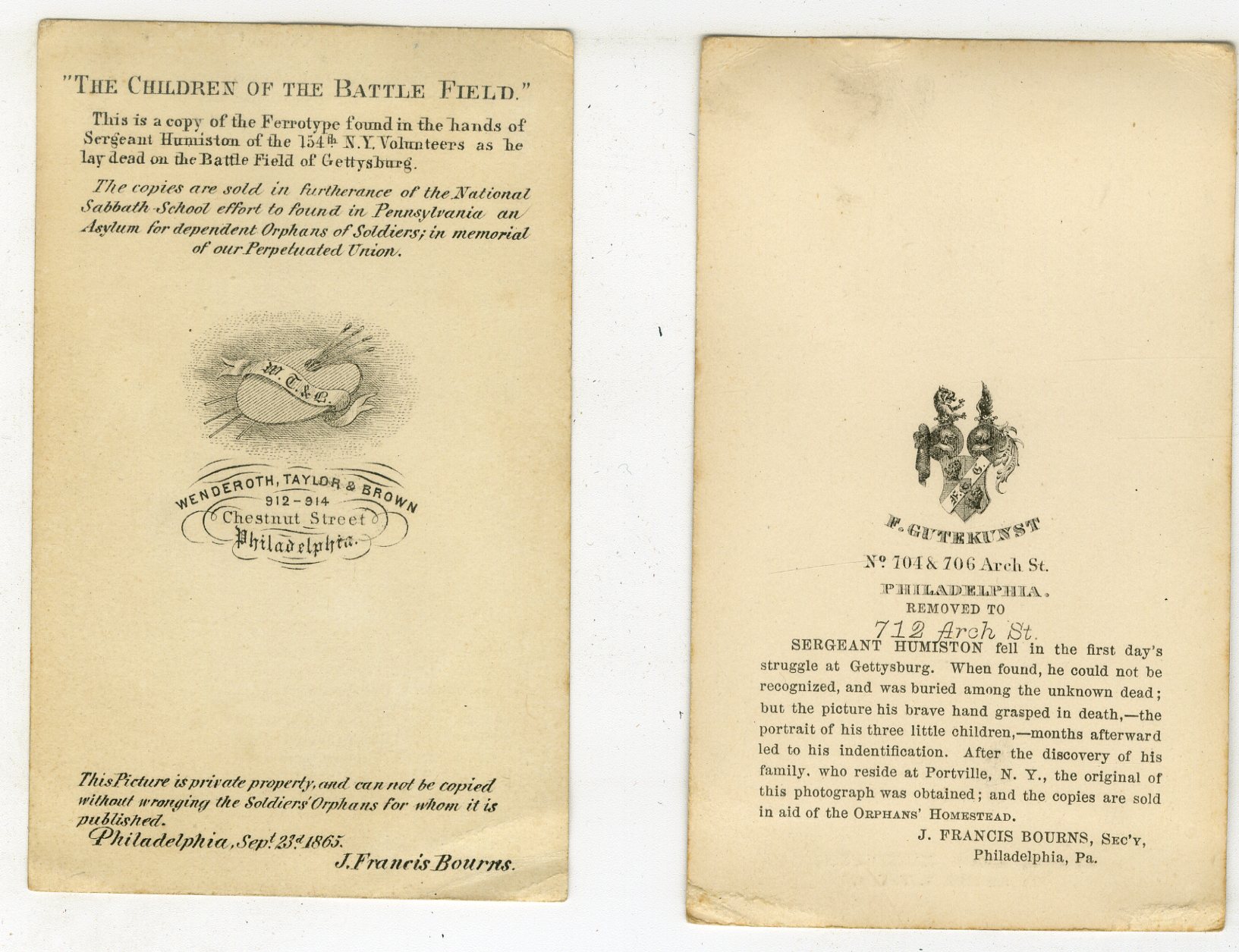
CWCDV1769. Pair of CDVs of The Children of the Battle Field and Sergt. Amos Humiston of the 154th N.Y. Vols. Vignetted albumen CDV group studio portrait. Philadelphia: Wenderoth & Taylor, n.d. Photographers’ imprint to mount verso. The iconic portrait of Frank, Frederick, and Alice, the children of Amos Humiston of the 154th New York Infantry. Humiston was killed at the Battle of Gettysburg, but his identity was at first unknown. An original ambrotype of his three children – eventually copied to produce this CDV – was found clutched in his hand. The ambrotype came into the possession of Dr. J. Francis Bournes of Philadelphia, who traveled to Gettysburg to help tend to the wounded after the battle. Bournes vowed to identify the soldier and return his image to the family. Newspapers soon printed a description of the subjects in the hopes that someone could connect them to the fallen soldier. It worked. Bourne would later collaborate with local photographers in Philadelphia to produce copies of the Humiston ambrotype for the benefit of a home for orphaned children of the battlefield in Gettysburg. Plus a CDV of Sergt. Humiston by F. Gutekunst, Philadelphia. VG. $500
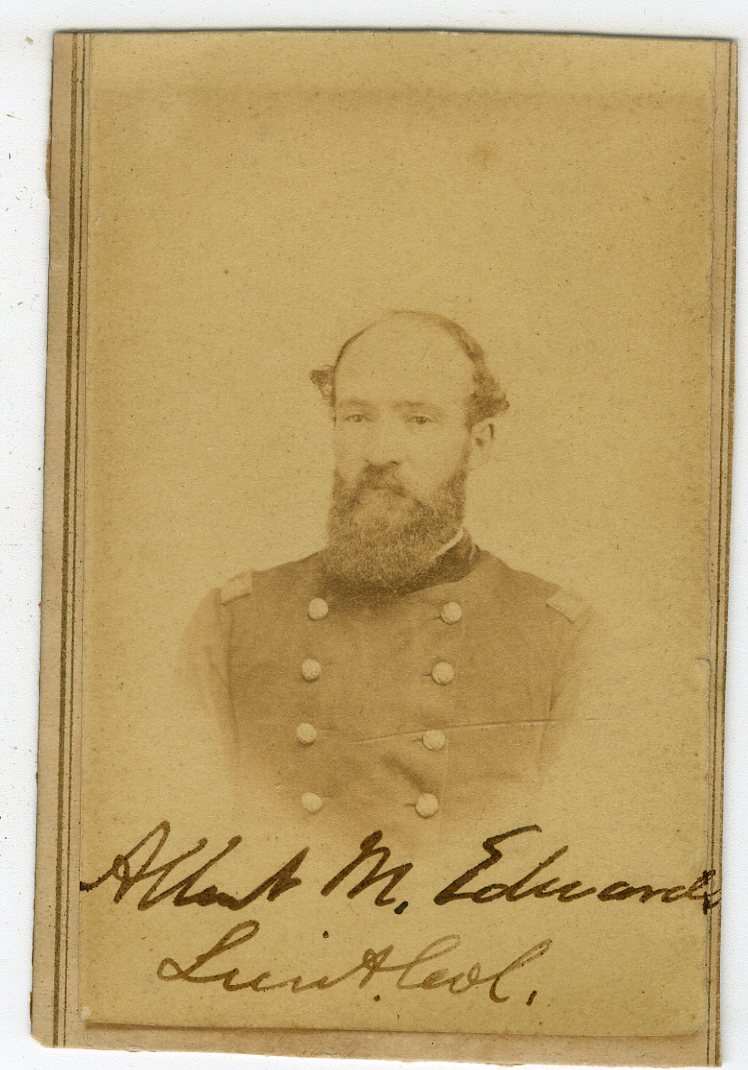
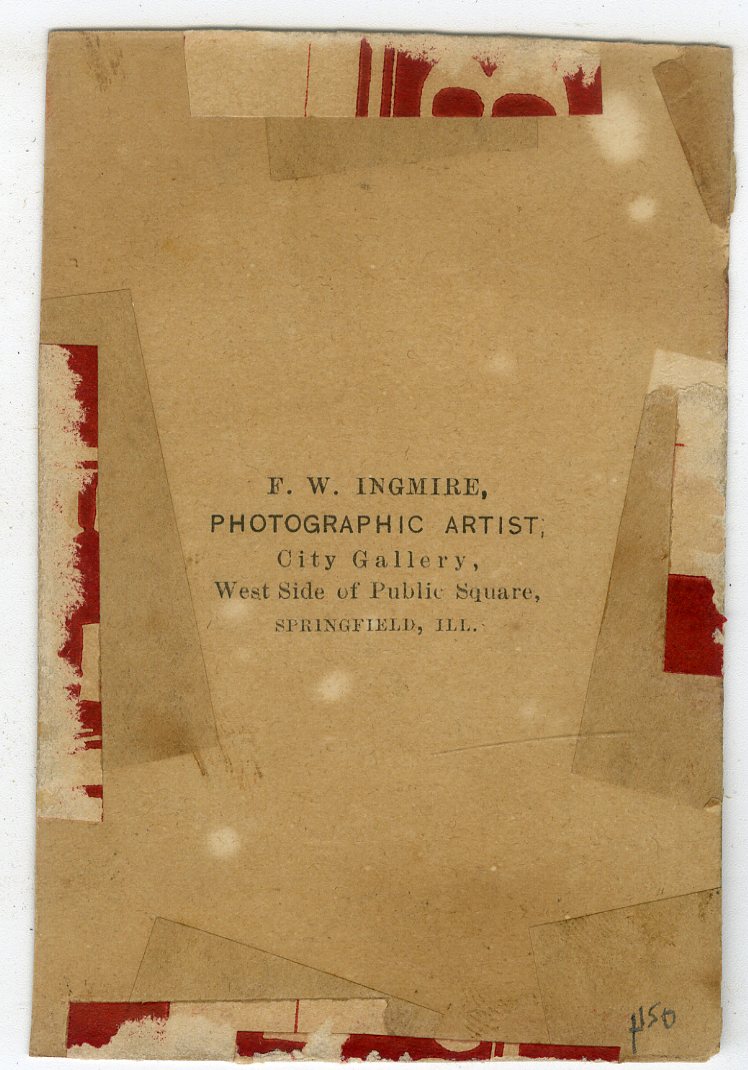
CWCDV1770. F.W. Ingmire, City Gallery, Springfield, Ill. Signed “Albert M. Edwards, Lieut. Col.” (Feb. 25, 1836-July 15, 1909). Edwards married Ingmire’s sister. Enlisted on 4/16/1861 at Adrian, Lenawee Co., MI as a Captain. On 5/1/1861, he was commissioned into “K” Co. Michigan 1st Infantry. He was Mustered Out on 5/20/1862. On 8/15/1862, he was commissioned into “F” Co. Michigan 24th Infantry. He was Mustered Out on 6/30/1865 at Detroit, MI. (Commanding Regmt: July, 1863 to Feb, 1864; Jan 25, 1865 to March, 1865). He was listed as: POW 7/21/1861 Bull Run, VA; Exchanged 5/20/1862 (place not stated). Promotions: Colonel 3/13/1865 by Brevet; Major 11/22/1863; Lt Colonel 6/9/1864. Intra-regimental company transfers: 2/1/1864 From company F to Field & Staff. Born 2/25/1836 in Otisfield, ME. Member of GAR Post # 17 (Fairbanks) in Detroit, MI. Died 7/15/1909 in Detroit, MI. Buried: Woodmere Cemetery, Detroit, MI. After the war, he lived in Detroit, MI.
The following information cites these two publications: Smith, Donald L. The Twenty-Fourth Michigan of the Iron Brigade, 1862. (1987 Reprint, Old Soldier Books, Gaithersburg MD.); & Curtis, O.B. History of the Twenty-Fourth Michigan of the Iron Brigade, known as the Detroit and Wayne County Regiment, 1891. (1988 Reprint, Old Soldier Books, Gaithersburg, MD).
Born in Maine, at the time the Regiment was formed, Albert M. Edwards was a 26 year old journalist from Detroit. Smith (p. 9) says that he left college in his second year to enlist as a sergeant in the first Michigan Infantry. He was captured at first Bull Run and was later exchanged. Smith also states that he was by profession a “comer”. Whatever the case, Albert M. Edwards was instrumental in raising the new regiment, Captain Edwards recruited his company, the last to be organized, in only 2 days. In recognition of his efforts, he was appointed captain of Company F, to rank from July 26. Before leaving Detroit, the men of his company presented him with a sword. This sword may still exist in the hands of a private collector. He was Acting Assistant Inspector General from June 11 to June 13, 1863. On June 25, Captain Edwards was sent to Alexandria, Virginia to bring back convalescents for the First Corps. He returned on June 29, with 1219 men who would be desperately needed in the coming fight. On July first the 24th Michigan played a key role at the battle of Gettysburg. In this action, the Regiment suffered horrible casualties, the largest number sustain by any of the 400 Union regiments that participated in the three day battle. By 4:30 in the afternoon of July 1st, Albert Edwards was ranking officer still on his feet, and took over the Regiment. He led them during their “last and hopeless stand” and during the chaotic retreat back to Cemetery Hill. “Soon after assuming command, Captain A. M. Edwards saw the flag lying on the ground in the hand of a dead or dying soldier boy, who was reclining on his right side, his gun being near him. Captain Edwards took the flag from the young soldier’s hands which were grasping it with a deathlike grip, and after rallying the men to it amid a shower of bullets, bore it through town to the Cemetery where he planted it near a battery , and sat down on a gravestone while the remnants of the regiment rallied about its bullet-riddled folds.” (Curtis, p. 165). In the aftermath of the fighting on July 1, the only officers left unwounded were Captain Edwards, and Lieutenants George Hutton and John Witherspoon. Colonel Morrow who had been both wounded and captured was left behind by the retreating Confederates, and briefly returned to take command of the regiment. Morrow’s condition was not good, however and Edwards commanded the Regiment from July 14 to August 9 and from August 21 to 23. He was again in command from October 10 to December 6, 1863. During the Mine Run campaign, the Regiment was involved in heavy skirmishing. Captain Edwards took the opportunity to “liberate” a fine pistol from a captured Confederate officer. Edwards was promoted to Major on February. 1, 1864 to rank from November 22, 1863. Along with his promotion, he received a leave of absence from February 10 to 25, 1864. During the fighting on in the Wilderness on May 5, 1864. “The Iron Brigade with its old-time yell, charged the enemy… capturing 300 prisoners, the Twenty-Fourth Michigan securing the battle flag of the Forty-Eighth Virginia of Jones’ Brigade. This flag was taken from a Confederate color-bearer by Major Albert M. Edwards… Major Edwards carried the flag to the rear. When Colonel Morrow was brought to the regiment on a stretcher after he was wounded, he made a brief good-bye speech to the boys. Major Edwards tore the flag from its staff and put it in Colonel Morrow’s haversack. The latter took it to the hospital in Washington with him, and then to Detroit where it was put on exhibition. It was later placed in the archives of the War Department at Washington.” (Curtis p. 231). By the criteria commonly used in the Civil War, capturing a confederate battle flag could have entitled Edwards to a medal of honor. After the fighting during the Battle of Laurel Hill (Usually included as part of the Battle of Spottsylvania), on May 12, 1864 Major Edwards, virtually dead on his feet, though that he saw a log in the darkness and decided to rest himself. After resting for a moment, he discovered that it was not a log, but was actually a corpse. The next day Frederick Chavey, of Company F was struck by a solid shot. Major Edwards, who happened to be with his old company at the time, was “bespattered” with his blood, but was not himself wounded. Later, near Bethesda Church, Edwards had another brush with death: “As Sergeant Eaton was getting some requisitions signed by Major Edwards, a solid shot buried itself in the tree at the foot of which they were sitting.” (Curtis p. 257) During the siege of Petersburg “… Major Hutchinson was wounded within fifteen minutes after his return from hospital, while drinking a cup of coffee with Lieutenant-Colonel Edwards.” (Curtis p. 263) Albert Edwards was promoted to Lieutenant Colonel on July 17, 1864 to rank from June 9, 1864. During the fight at Dabney’s Mill, Lt. Colonel Edwards had another close brush with death. According to Smith (p. 240). “Lieutenant Colonel Edward’s horse was shot out from under him early in the contest by a Minie ball which passed through Edwards’ boot and trousers, before killing his steed. He also received a shot through his coat but was unwounded…” Smith (p. 241) also notes “That battle had not dulled the sensibilities of the men was proven by Lieutenant Colonel Edwards. Noticing that the soldiers on the right flank of the Regiment had stopped firing, he went over to seek the cause. There he found them helping their comrades from the Seventh Wisconsin, who were engaged in burying their pet dog which had just been killed by a Minie ball in the midst of a hail of shot and shell. The dog, a mongrel, was known throughout the Brigade for his courage under fire, and despite the bullets whizzing past, the men paused long enough to give their small friend a hasty but honorable burial.” Albert received a leave of absence from December 22, 1864 to January 16, 1865, and spent Christmas at home with his family in 1864. He was sent to New York with recruits from April 5 to April 12, 1865, and was in command of Camp Butler Illinois, from April 14 to 25, 1865. He served a term as President of the General Court Martial at Springfield, Illinois from April 24, to June 17, 1865. He was given the great honor of standing Guard of Honor over the body of President Lincoln at the Illinois statehouse on May 3, 1865. In 1865 he was in command of the Regiment from January 17 to 20; January 24 to March 31, and from April 14 to 22. May 4, and from June 17 to 30, 1865. He was given the rank of “Brevet Colonel” on March 13, 1865 “for Gallant and meritorious services during the war.” When the Regiment returned to Detroit to be mustered out, Colonel Edwards was in command. After the war, Colonel Edwards was very active in the 24th Regimental Association, and was responsible for having this now missing state flag released into his care for use at reunions and veterans events. He attended Michigan Day at Gettysburg. Albert M. Edwards was never wounded in action, and was present in every battle and march of the regiment. He was in command of the regiment during the following actions:
Gettysburg (from 4:30 p.m., after all senior officers became casualties).
Locust Grove
Laurel Hill (from May 9 to 12th, 1864)
the Salient at Spottsylvania|
Cold Harbor
Assault and Siege of Petersburg
Weldon Railroad
Hatcher’s Run
Dabney’s Mill
He led the Regiment during:
The Campaign of Maneuvers
Mine Run Campaign
The Reconnaissance to Yellow Tavern
The Reconnaissance to Vaughn Road
The Raid the Meherrin River
Here is information on the 24th Michigan Infantry Regiment:
The 24th Michigan Infantry Regiment was an infantry regiment that served in the Union Army during the Civil War. It was part of the Union Iron Brigade. It was chosen to be the honor guard for the Funeral of Abraham Lincoln. The 24th Michigan Infantry was organized at Detroit, Michigan and mustered into Federal service on August 15, 1862. It was assigned to the famous Iron Brigade in the Army of the Potomac. The brigade’s commander General John Gibbon had requested a new regiment be added to his command because its four original regiments (the 2nd, 6th, and 7th Wisconsin and the 19th Indiana) had been severely depleted by combat action and numbered less than 1000 men total by October 1862. He said that ideally it should be a Western regiment since the others were from that part of the country. Gibbon’s request granted, the 24th Michigan joined the brigade and saw its first action at Fredericksburg taking on a nuisance battery of Confederate horse artillery south of the town. The regiment would follow up its actions at Fredericksburg with a raid on Port Royal, Virginia and fighting at Fitzhugh Crossing. It would earn the Model 1858 Hardee Hat of the Iron Brigade in May, 1863. The 24th saw no major action during the Chancellorsville campaign, but at Gettysburg it “Went into action with 496 officers and men. Killed & mortally wounded: 89; Otherwise wounded: 218; Captured: 56; Total casualties: 363. Nine color bearers were killed or mortally wounded and two wounded, of 13 men to hold onto the flag during the first day of the battle, and all the color guard killed or wounded, a net loss of 80%. The 24th Michigan alongside the 1st Minnesota Infantry Regiment suffered the highest casualties of any Union forces that fought at Gettysburg.” Colonel Morrow was wounded while holding the regimental flag. “Just before reaching the fence, Col. Morrow was wounded in the head while bearing the colors. He was stunned by the wound and fell down. He was then helped from the field by Lt. Charles Hutton of Company G, with the last alive and non-wounded officer, then Captain Albert M. Edwards, assuming command of the regiment.” Thereafter, the 24th participated in the rest of the Army of the Potomac’s campaigns and battles, participating in the Overland Campaign, being heavily engaged at both the Battle of the Wilderness and the Battle of Spotsylvania Court House, with Colonel Morrow being wounded in the Wilderness and Lieutenant Colonel William Wight would take command through the rest of the Overland Campaign except for the latter portion of the Battle of Spotsylvania Court House when he was sick and led by Albert M. Edwards, by then a major, until he was forced to resign to his wounds he sustained at Gettysburg, with command of the Regiment once again falling on Albert M. Edwards, who was promoted to Lieutenant Colonel with Captain William Hutchinson being promoted to Major and Edwards would be the commander of the regiment until December, 1864 when Colonel Morrow would return and then would become commander once again when Morrow was promoted to Brevet Brigadier General. The 24th after the Overland Campaign would participate in the Petersburg Campaign, participating in various battles during the siege such as the Battle of Globe Tavern, Battle of Boydton Plank Road, and the Battle of Peebles’ Farm in a supporting capacity but was not present at Appomattox because it had been reassigned to Camp Butler (Illinois) in Illinois two months earlier after participating in the Battle of Hatcher’s Run. The regiment was selected as an escort at the funeral of President Abraham Lincoln. The regiment was mustered out on June 30, 1865. G. [binder] $2500
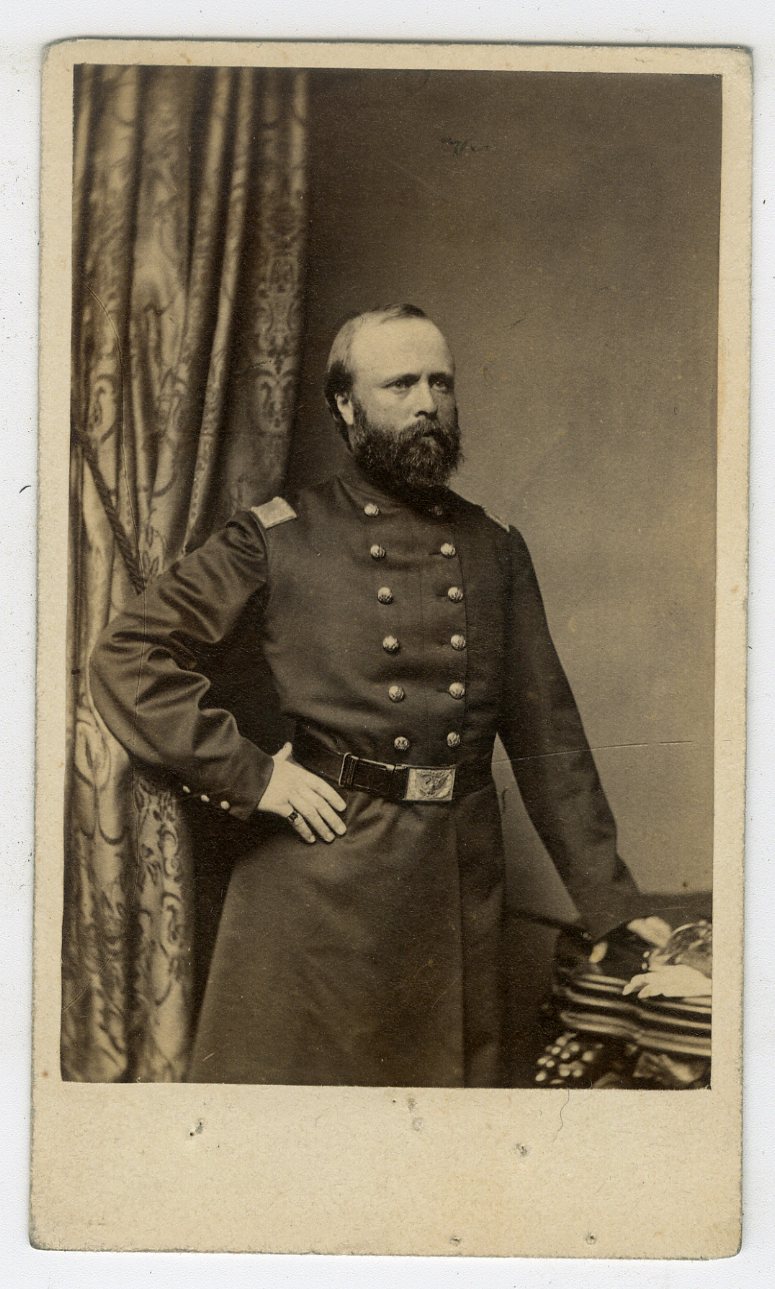
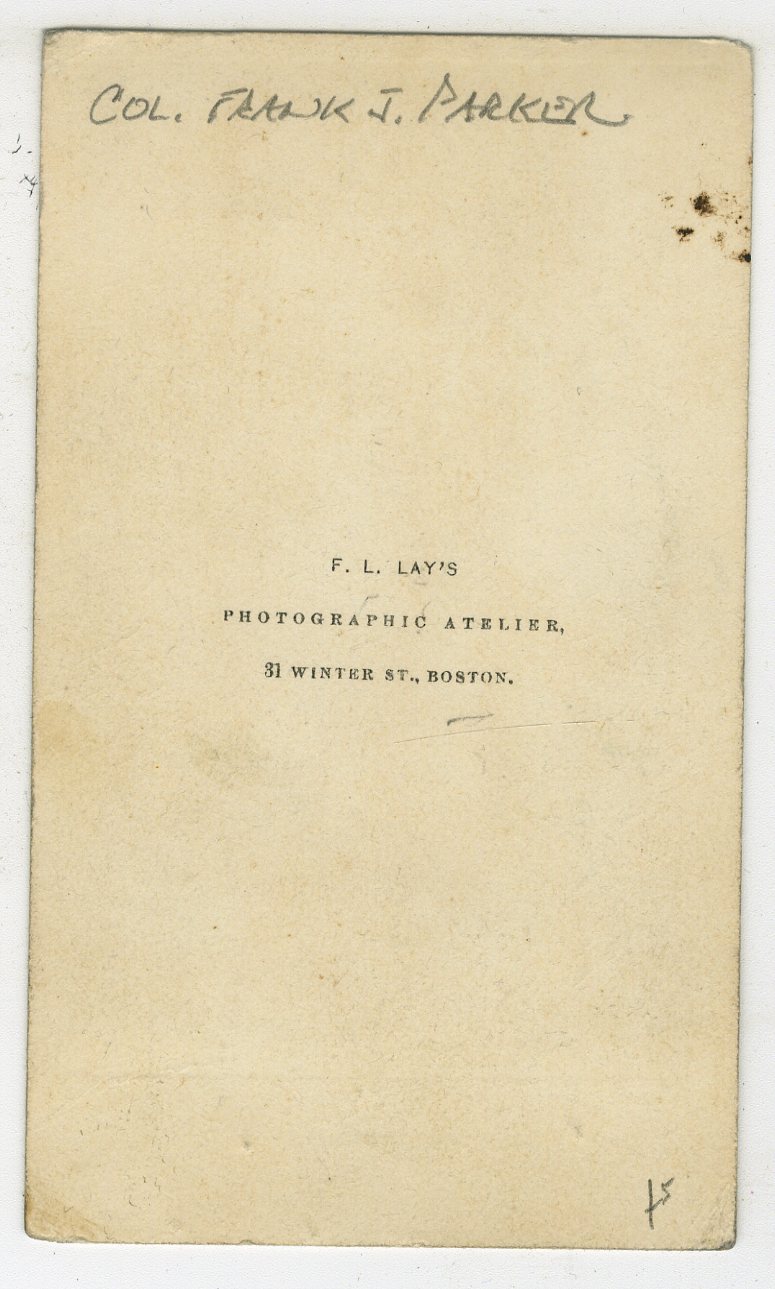
CWCDV1771. F.L. Lay’s Photographic Atelier, 31 Winter St., Boston. Francis Jewett Parker. Enlisted 12/2/61 as a Major. On 12/9/61, he was commissioned into Field & Staff Massachusetts 32nd Infantry. He resigned on 12/27/62. Promotions: Lt. Col. 5/25/62; Col. 8/6/62. Died 1/20/1909 in Boston. The 32nd Massachusetts Infantry Regiment was present at the Battle of Antietam on September 16–17, 1862, as part of the Army of the Potomac’s Fifth Corps. Commanded by Colonel Francis Jewett Parker, the regiment served in the 2nd Brigade, 1st Division, and was held in reserve, resulting in no casualties. Key Details of the 32nd MA at Antietam: Role: The regiment, often held in reserve, supported the artillery near the Boonsboro Pike. Command: The unit was part of Morell’s Division of the Fifth Army Corps. Campaign Context: After spending the summer of 1862 in the Defenses of Washington and during the aftermath of the Peninsula Campaign, the unit was assigned to the Army of the Potomac just in time for the Maryland Campaign. Following Action: After Antietam, the 32nd was engaged in the autumn campaign along the Rappahannock. The regiment later gained a reputation as a hard-fighting unit, suffering high casualties (54%) later in the war at the Battle of Spotsylvania Court House. [binder] VG. $175
CWCDV1772. Brady, Washington, DC. Signed “I Smith Brown,” bottom recto. On verso signed “I Smith Brown Adjutant, Berdan’s U.S.S.S. Washington Feb. 1862.” Ira Smith Brown. Enlisted 3/1/62 at Washington, DC as a 2nd Lieutenant. On 3/1/62 he was commissioned into “A” Co. US Volunteers 1st Sharpshooters. He was discharged for promotion on 9/2/62. On 9/2/62 he was commissioned into Field & Staff NY 126th Infantry. He was Mustered Out on 6/3/65 at Alexandria, Va. Promotions: 1st Lieut & Adj 9/2/62 (not mustered); Major 11/13/63; Lt Col 4/18/64; Col 6/17/64 (not mustered). Here is an excerpt from Dan Master’s Civil War blog: “While my research and blog is generally focused on Ohio soldiers and their contributions to the Civil War, I occasionally come across items from soldiers of other states that pique my interest and inevitably lead to a research project. Such is the case with the letters of Adjutant Ira Smith Brown of the 1st United States Sharpshooters. I came across Brown’s series of letters in the Yates County Chronicle, and an impressive set of correspondence he left behind. Brown wrote frequent, almost weekly, letters to his hometown newspaper and provide a detailed view of soldiers life during the Peninsula campaign. That Brown was serving with Berdan’s Sharpshooters makes his perspective somewhat unique and a pleasure to read.” Trimmed. [binder] $375
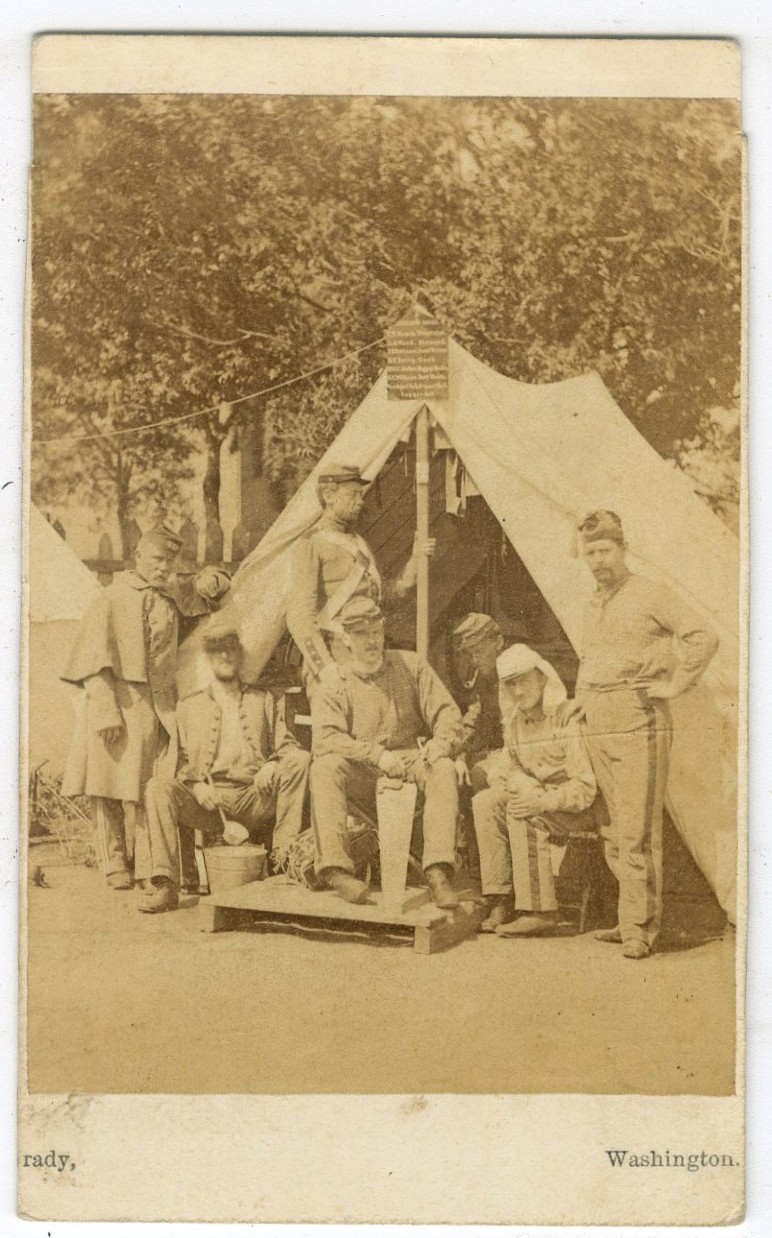
CWCDV1773. Brady, Washington, DC. Camp scene, 7th NYSM. Mount trimmed at sides. G. $325
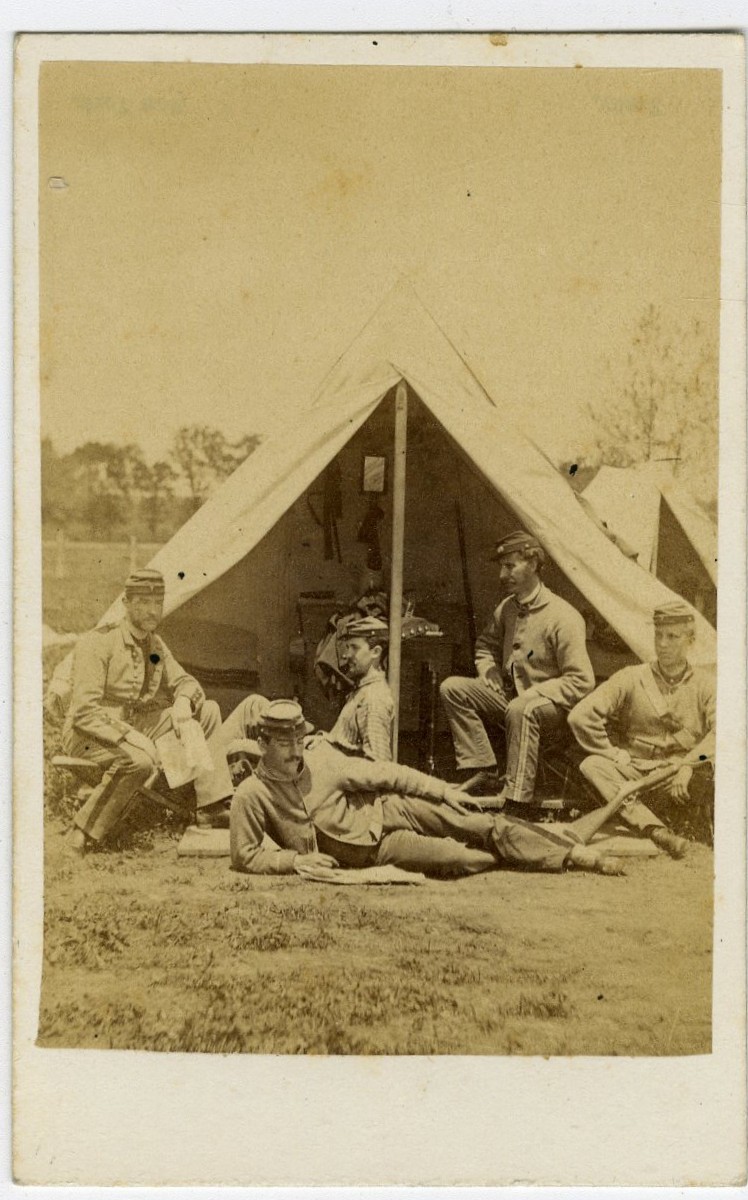
CWCDV1774. [Brady, Washington, DC]. Camp scene, 7th NYSM. VG. $350
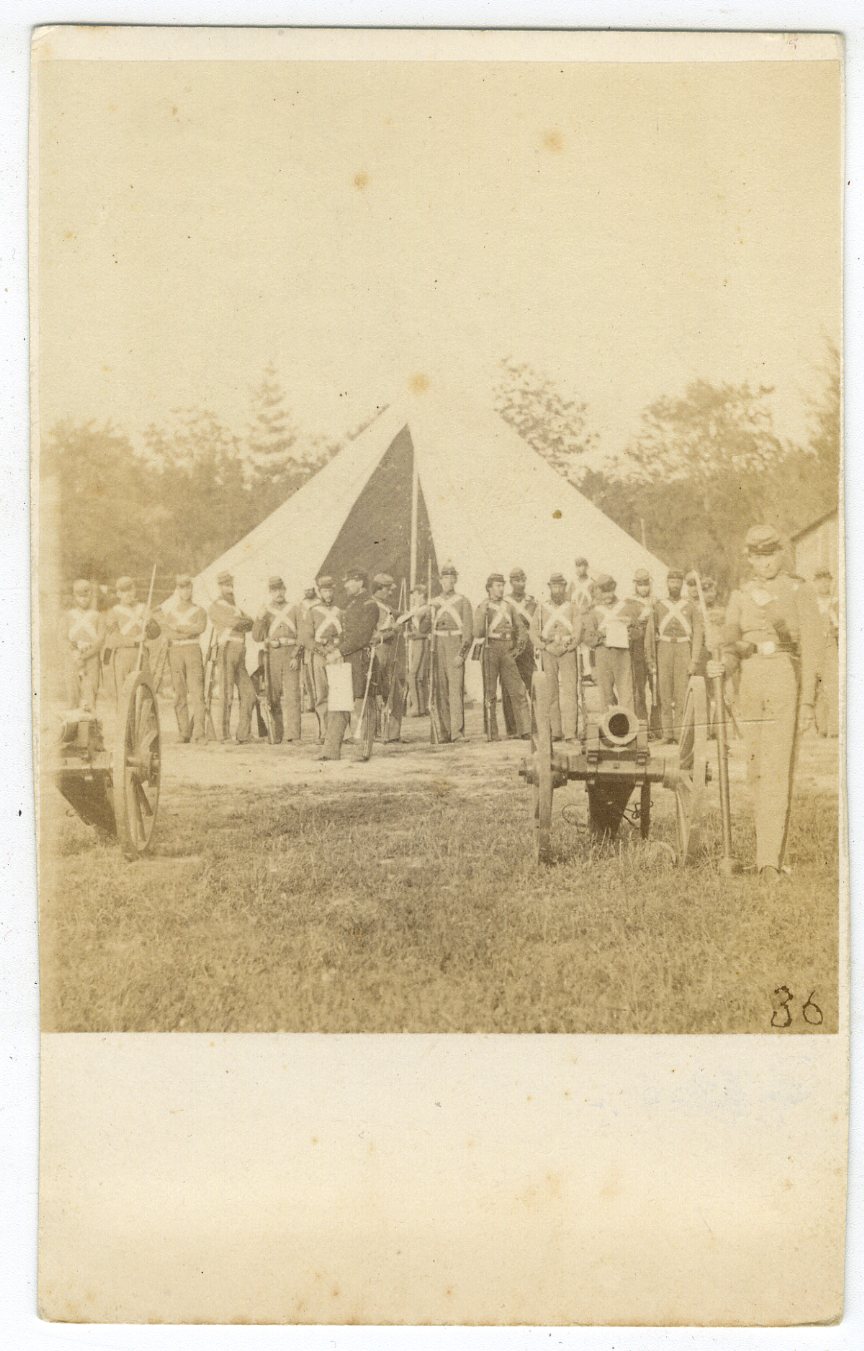
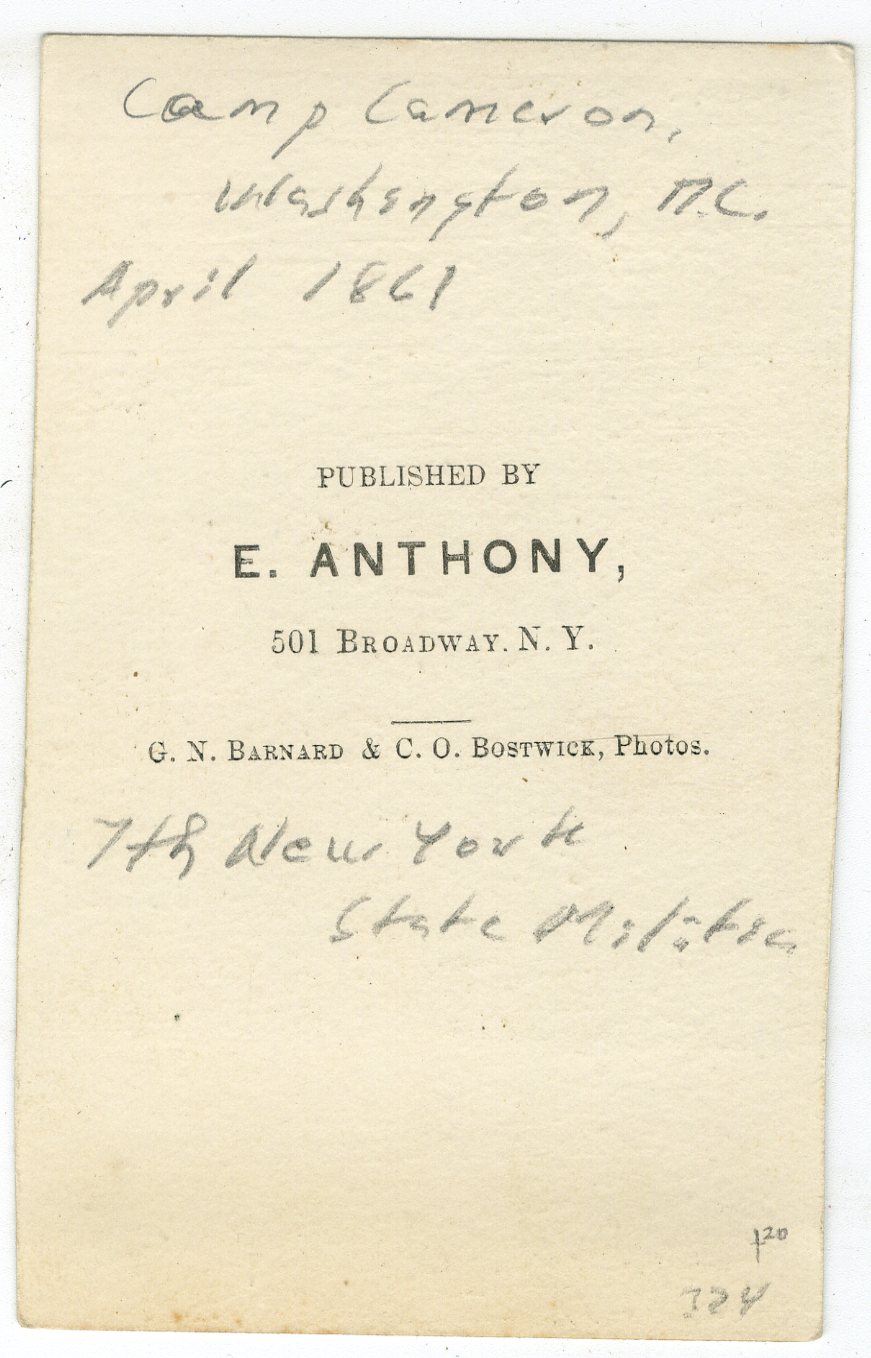
CWCDV1775. G.N. Barnard & C.O. Bostwick, Photos. Published by E. Anthony. Camp Cameron, Washington, DC. April, 1861. 7th New York State Militia. G. $400
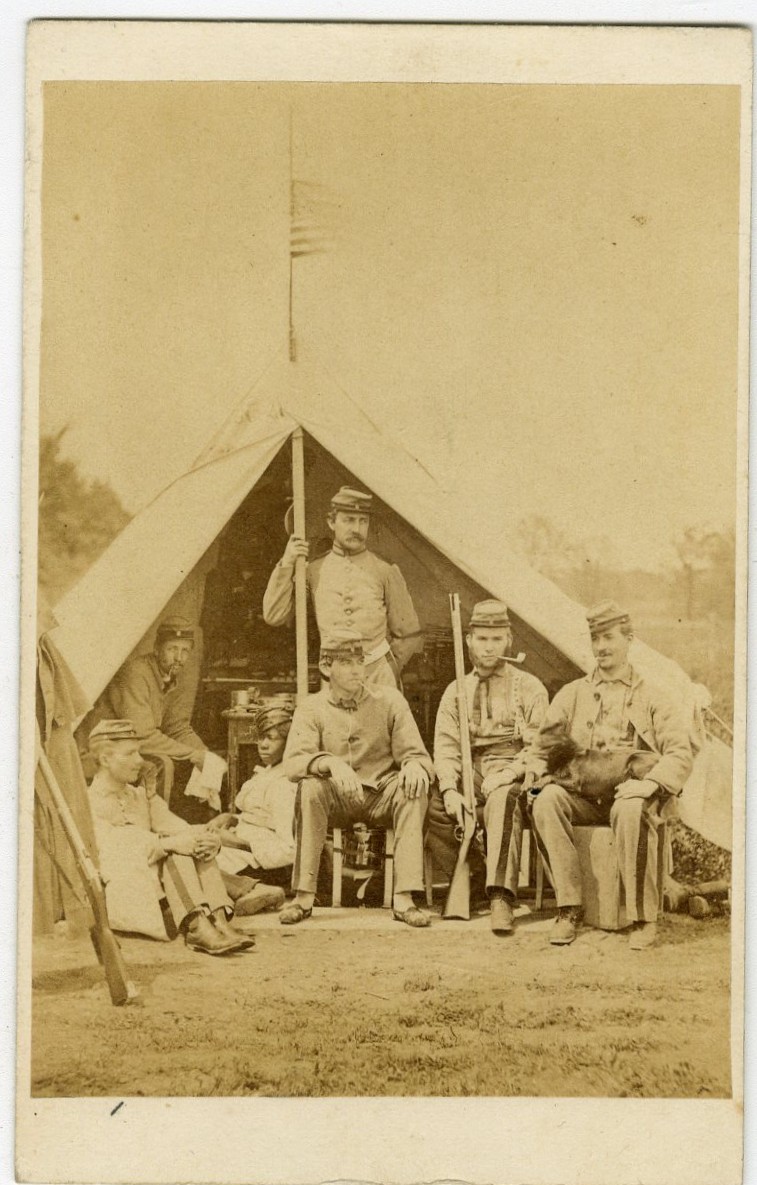
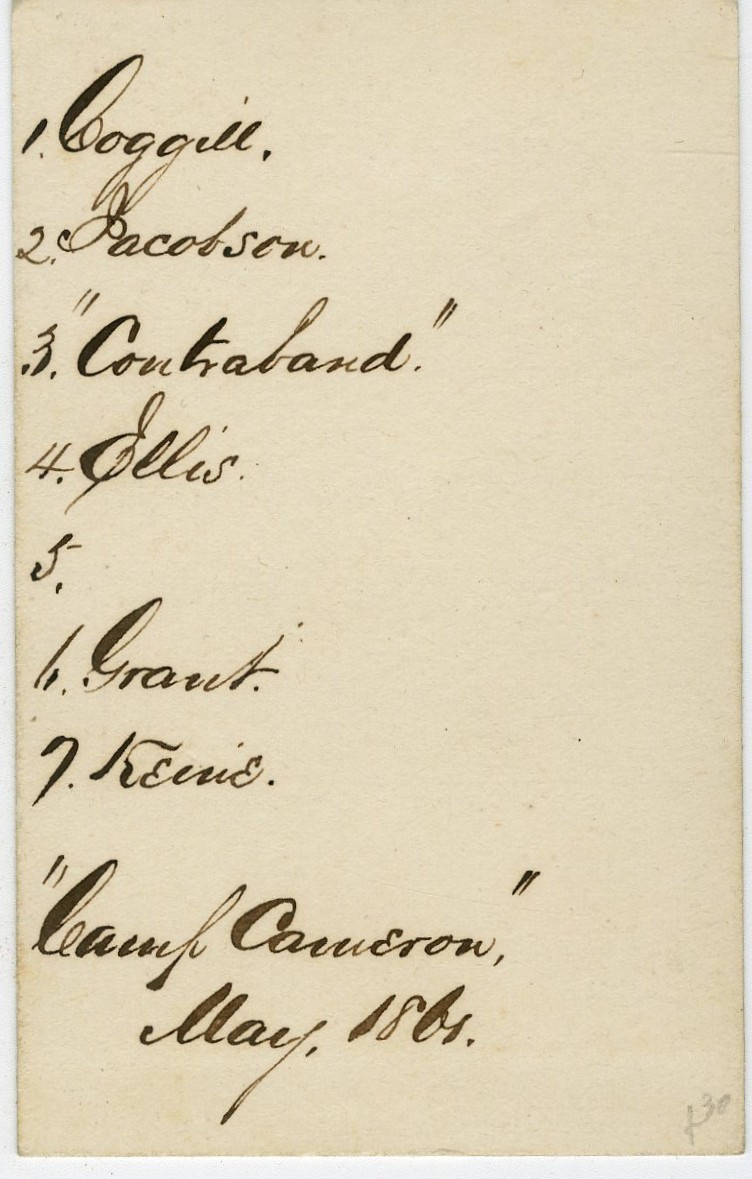
CWCDV1776. [Brady, Washington, DC]. Camp scene 7th New York State Militia. Identified on verso: “1. Coggill. 2. Jacobson. 3. “Contraband.” 4. Ellis. 5. 6. Grant. 7. Keene. Camp Cameron, May 1861.”VG. $450
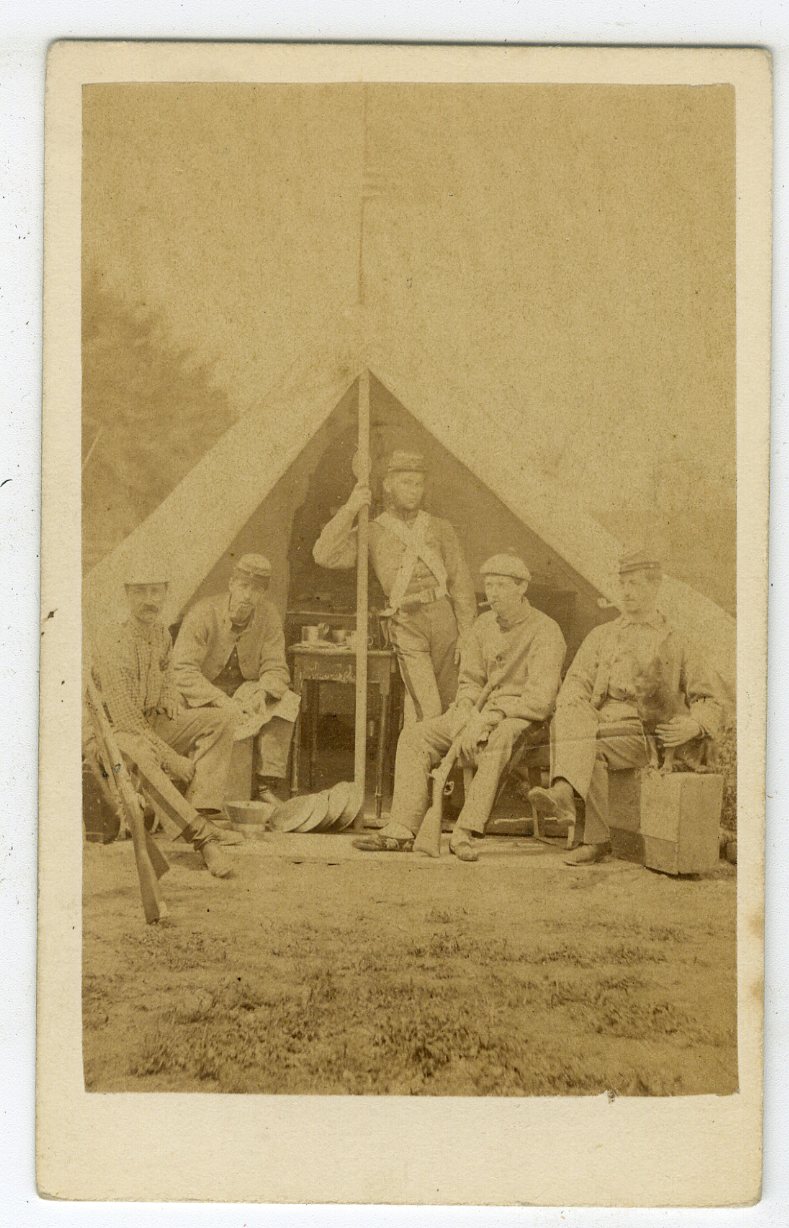
CWCDV1777. [Brady, Washington, DC]. Camp scene. Paper with image reads: “7th New York State Militia. Co. H 8th company. Frank Cargill, Asst. Paymaster; Wm C. Jacobson, 2nd lt, 5th NY HA, Wm. I Ellis, Capt. 2nd RI Vols., T.C. grant, John P. Keene.” G. $350
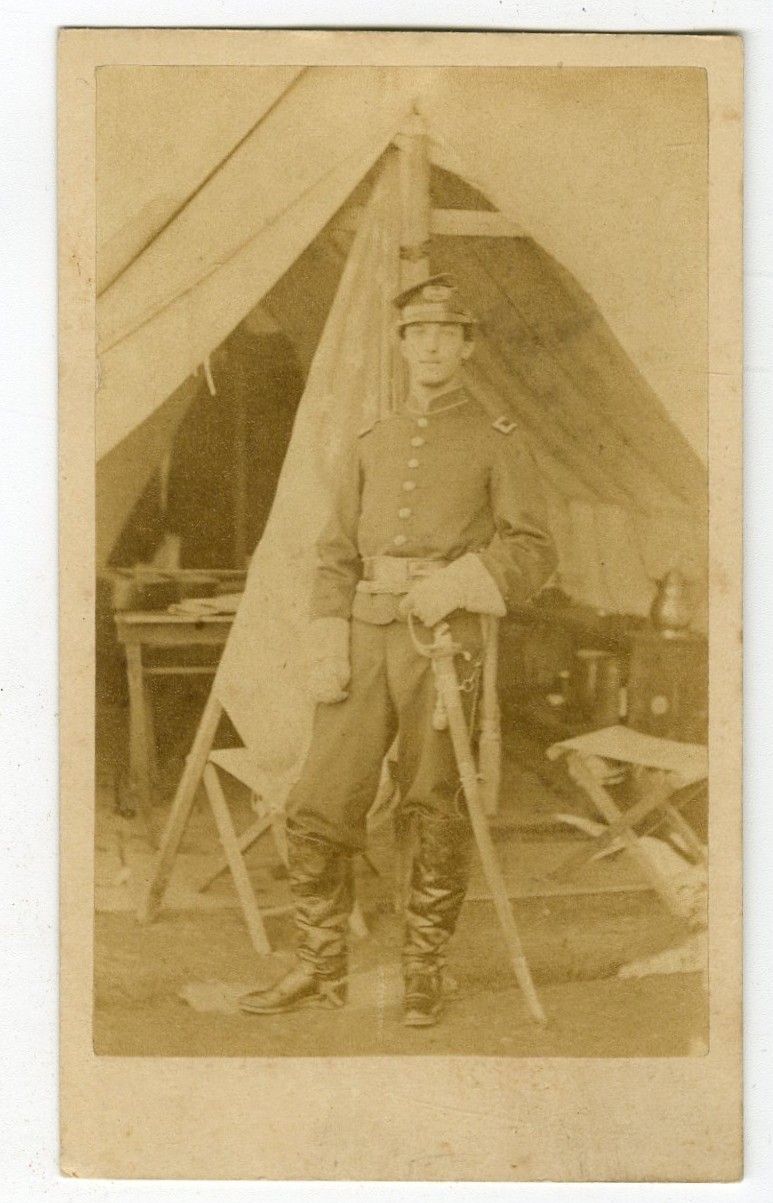

CWCDV1778. Bierstadt Brothers, New Bedford, Mass. Officer before Officer’s tent, Camp Griffin, No. 1861. Flag draped at left. Probably 43rd NY Inf. G. $350
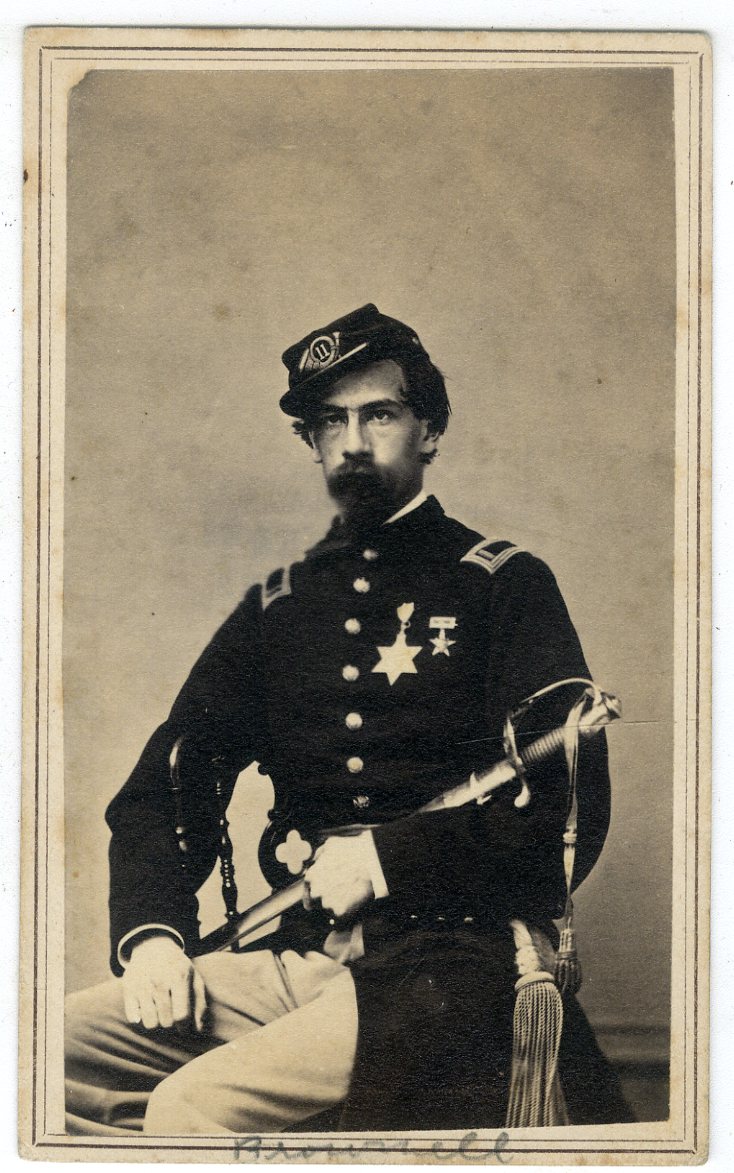
CWCDV1779. D. Woodworth, Albany, NY. Francis Edwin Brownell. Residence was not listed; 25 years old. Enlisted on 4/20/1861 at New York City, NY as a Priv. On 5/7/1861, he mustered into “A” Co. New York 11th Infantry. He was Mustered Out on 7/4/1861. On 7/4/1861, he was commissioned into US Regular Army 11th Infantry. He resigned on 11/4/1863. Promotions: Sergt 5/26/1861; 1st Lieut 10/24/1861; 2nd Lieut 5/14/1861 (As of 11th RA Infantry). Born in 1840 in Troy, Rensselaer Co., NY. Died 3/15/1894 in Washington, DC. Buried: Bellefontaine Cemetery, St Louis, MO. Medal of Honor Information: He was awarded the Medal of Honor for action on 5/24/1861 at Alexander, VA. (Killed the murderer of Colonel Ellsworth at the Marshall House). On May 24, 1861, Union troops in Alexandria, Virginia took exception to a Confederate flag that flew on the roof of the Marshall House hotel, which was visible to President Lincoln from the White House. Colonel Elmer E. Ellsworth, leading a squad of his 11th New York Fire Zouaves, decided to pull the flag down. Having removed it, Ellsworth was shot dead as he started down the stairs from the roof by the hotel’s owner James T. Jackson. He was the first martyr of the Civil War. Brownell avenged the death of Colonel Ellsworth by shooting and killing James T. Jackson on the spot at the Marshall House hotel. Brownell was awarded the Congressional Medal of Honor for this action. Superb seated view in uniform with rank of 1st lieutenant, clad in a kepi with infantry insignia and the regimental numerals “11” clearly visible, and two medals pinned to his frock coat. His sash is also clearly seen as he poses cradling his sword. VG. [binder]. $500
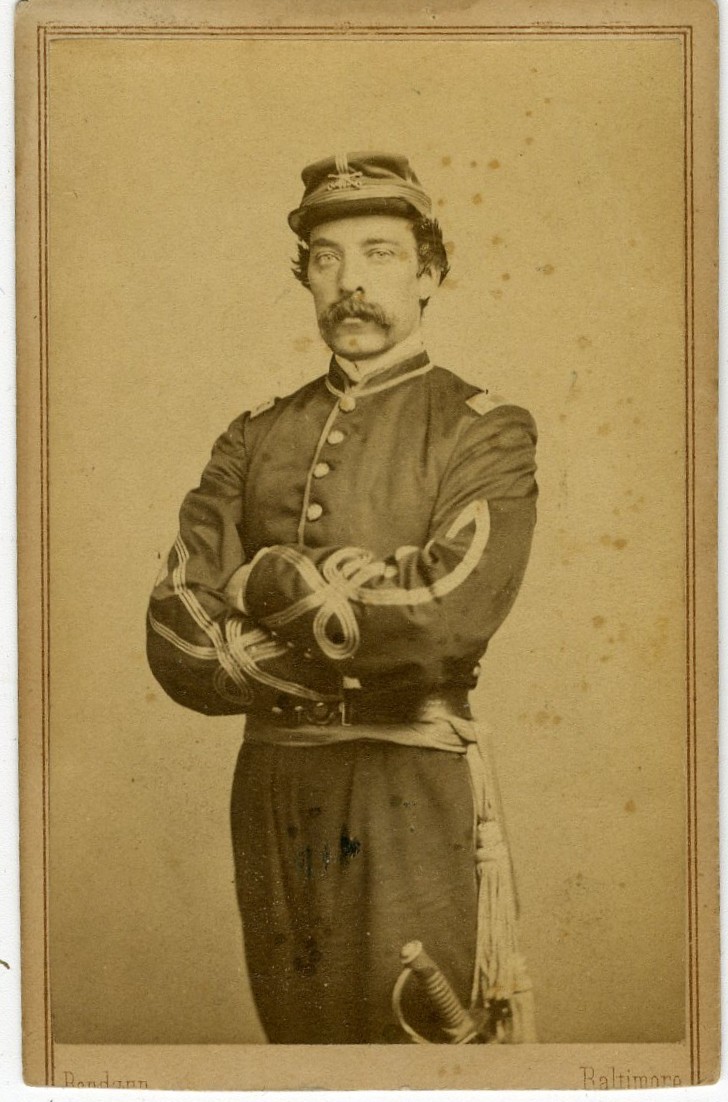
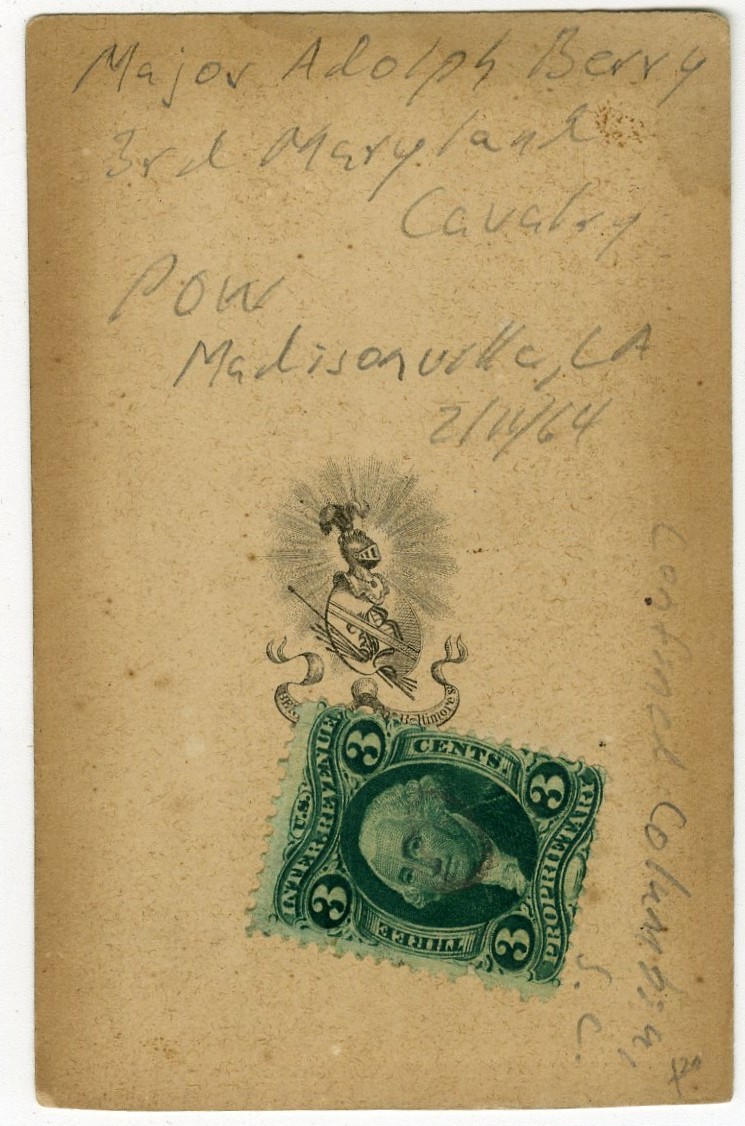
CWCDV1781. Major Adolph Berry, 3rd Maryland Cavalry. Residence was not listed. Enlisted on 7/23/1863 as a 1st Lieut. On 7/23/1863, he was commissioned into “C” Co. Maryland 3rd Cavalry. He was Mustered Out on 8/11/1865. He was listed as: POW 2/11/1864 Madisonville, LA (Confined at Columbia, SC). Promotions: Capt 8/11/1863; Major 5/30/1865. Intra-regimental company transfers: 5/30/1865 From company K to Field & Staff; From company C to company K. 3-cent tax stamp on verso. VG. $300
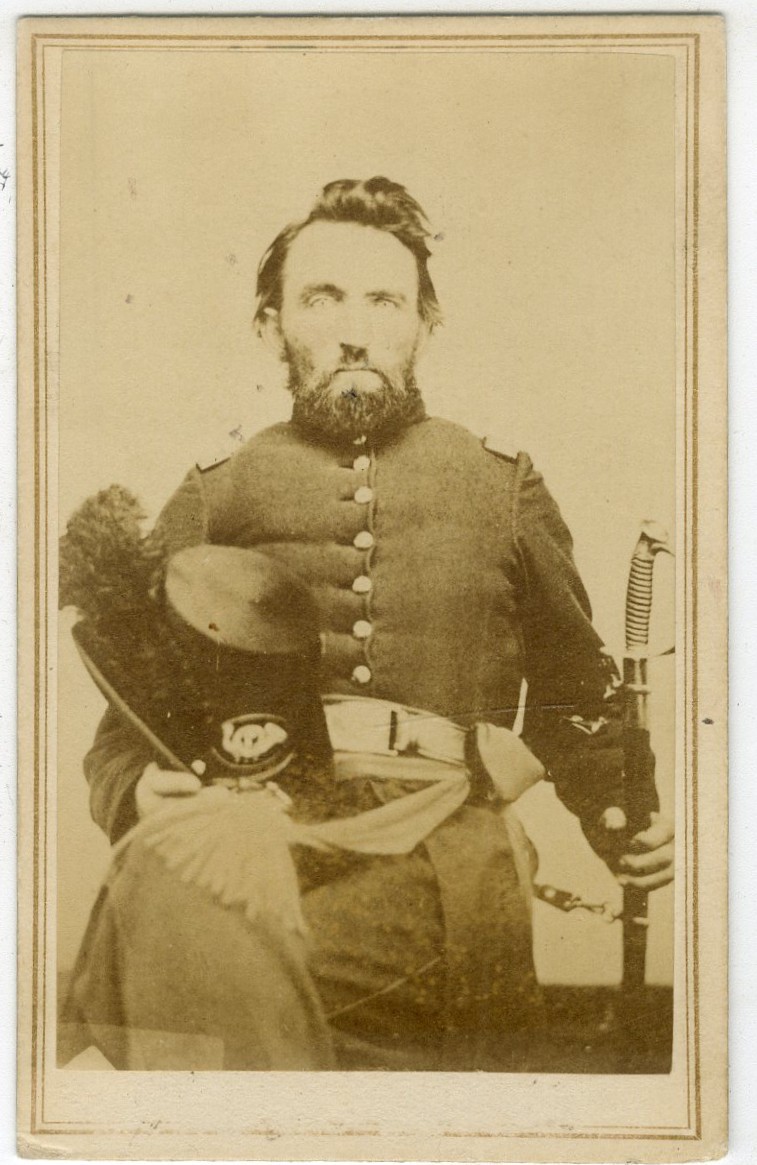

CWCDV1782. S.C. Hamilton & Co., Nashua, NH. Capt. Warren E. F. Brown, 7th N.H. Residence Manchester, NH; 30 years old. Enlisted on 12/11/1861 as a Captain. On 12/11/1861, he was commissioned into “K” Co. New Hampshire 7th Infantry. He was Killed on 7/18/1863 at Fort Wagner, SC. VG. $350
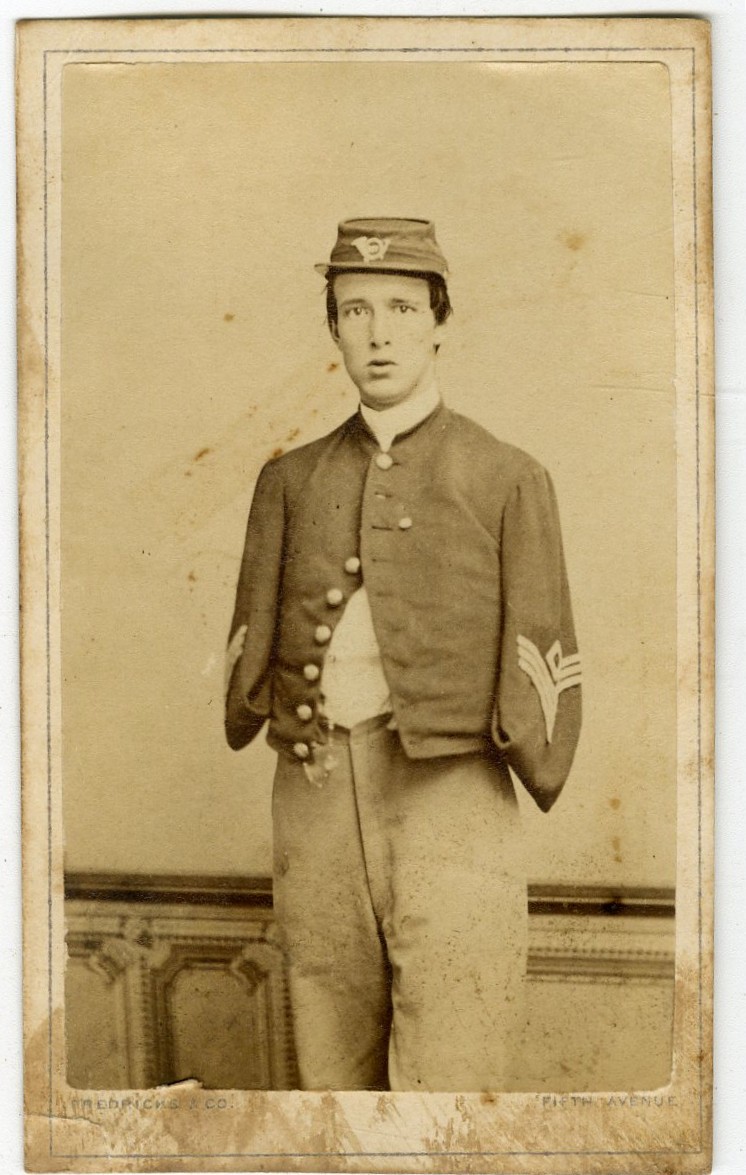
CWCDV1783. Fredricks & Co., NY. Alfred A. Stratton. Residence was not listed; 17 years old. Enlisted on 8/19/1863 at Ellicott, NY as a Priv. On 8/19/1863, he mustered into “G” Co. New York 147th Infantry. He was disch wounds on 9/27/1864. He was listed as: Wounded 6/18/1864 Petersburg, VA (Both arms amputated). Promotions: Sergt. Died 6/13/1874. G. $325
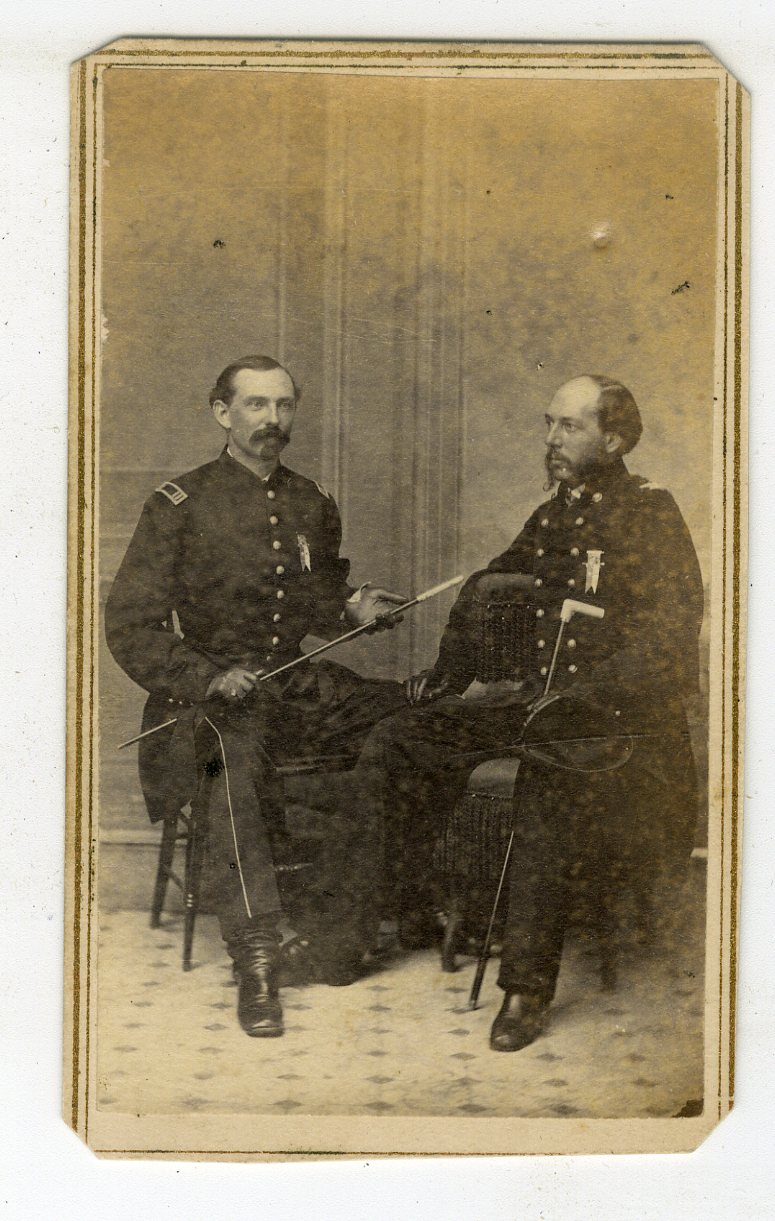
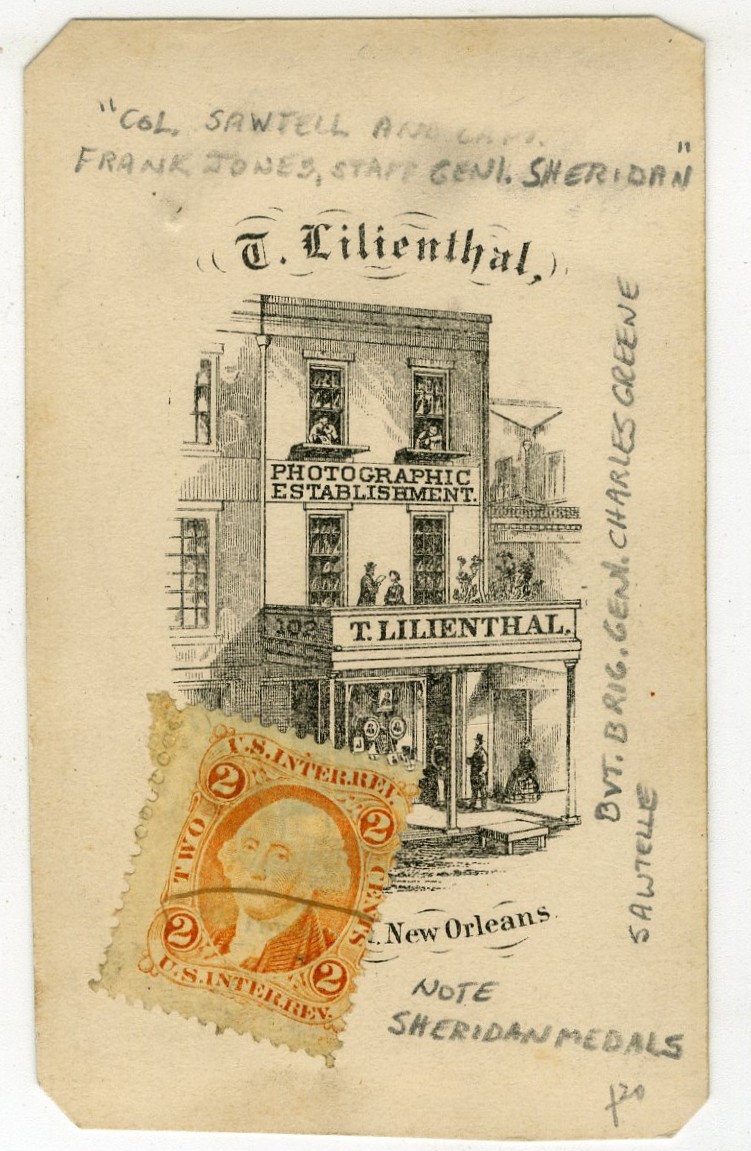
CWCDV1784. T. Lilienthal, New Orleans, La. Charles Greene Sawtelle. Residence was not listed. Enlisted on 7/1/1854 as a 2nd Lieut. On 7/1/1854, he was commissioned into US Regular Army 2nd Infantry. He transferred out on 3/3/1855. On 3/3/1855, he transferred into US Regular Army 6th Infantry. He was discharged for promotion on 5/17/1861. On 5/17/1861, he was commissioned into US Regular Army Quartermaster’s Dept. (Date and method of discharge not given.) (Subsequent service in US army until retiring 02/16/1897). Promotions: Qtr Master 2/15/1857; 1st Lieut 6/5/1860; Capt 5/17/1861 (Captain & Asst Quartermaster); Lt Colonel 8/20/1862 (Lieut Colonel & Quartermaster); Major 3/13/1865 by Brevet; Lt Colonel 3/13/1865 by Brevet; Colonel 3/13/1865 by Brevet; Brig-General 3/13/1865 by Brevet; Colonel 5/25/1865 (Colonel & Quartermaster). (Graduate USMA 07/01/1854). On the verso is written: “Col. Sawtell and Capt. Frank Jones, Staff Genl. Sheridan,” and “Bvt. Brig. Genl. Charles Greene Sawtelle,” and “Note Sheridan Medals.” Both men wear medals or ribbons but I don’t know what “Sheridan Medals” refer to. There is a 2-cent, cancelled tax stamp on verso. Fine backmark showing the “Photographic Establishment of T. Lilienthal.” G. $300
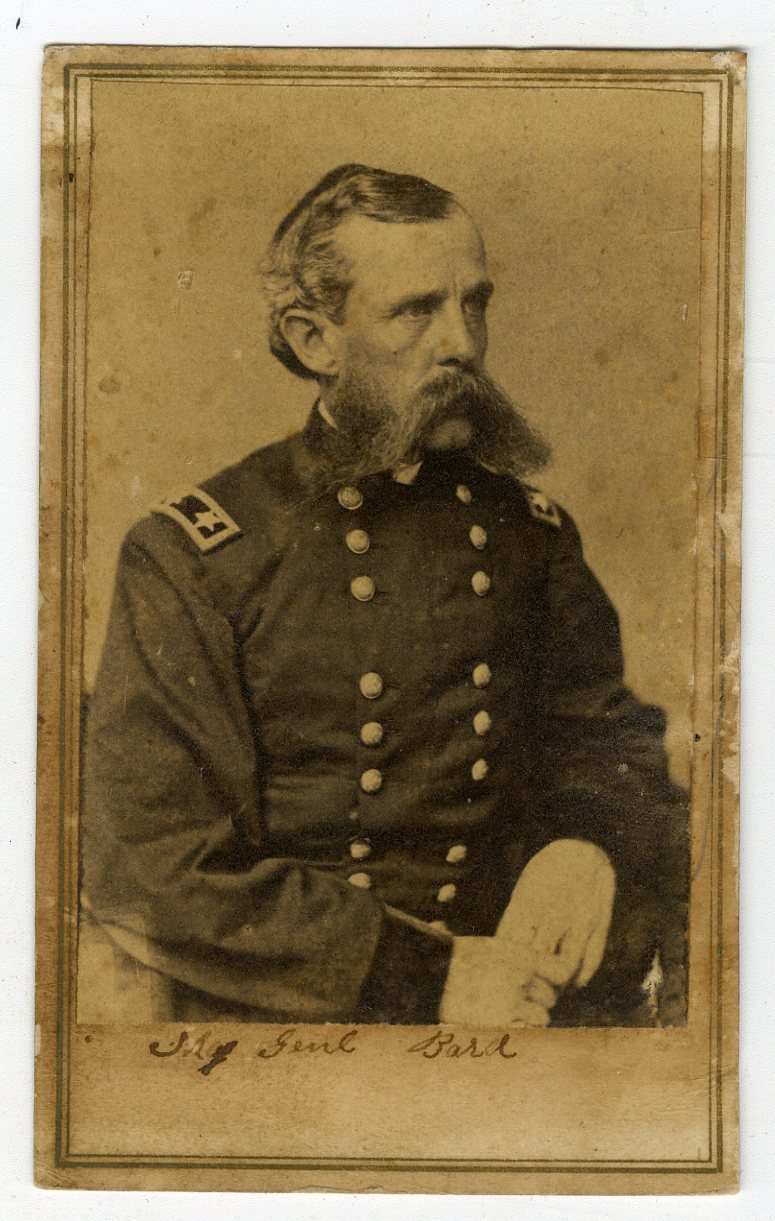
CWCDV1785. Webster & Bro., Louisville, Ky. Maj. Genl. Absalom Baird. Residence was not listed; 36 years old. Enlisted on 5/11/1861 as a Captain. On 5/11/1861, he was commissioned into US Volunteers Adjutant Genl Dept. He was discharged for promotion on 11/12/1861. On 11/12/1861, he was commissioned into US Volunteers Inspector Genl Dept. He was discharged for promotion on 4/28/1862. On 4/28/1862, he was commissioned into US Volunteers General Staff. He was Mustered Out on 9/1/1866. (Subsequent service in US Army until retiring 08/20/1888). Promotions: Capt 5/11/1861 (Captain & Asst Adjutant General); Major 11/12/1861 (Major & Asst Inspector General); Brig-General 4/28/1862. Born 8/20/1824 in Washington County, PA. Died 6/14/1905 in Relay, MD. Buried: Arlington National Cemetery, Arlington, VA, Gravesite: 1-55. (Graduate USMA 1849). Medal of Honor Information: He was awarded the Medal of Honor for action on 9/1/1864 at Jonesboro, GA. (Led detached brigade in assault on enemy’s works). 2-cent cancelled tax stamp on verso. G. $325
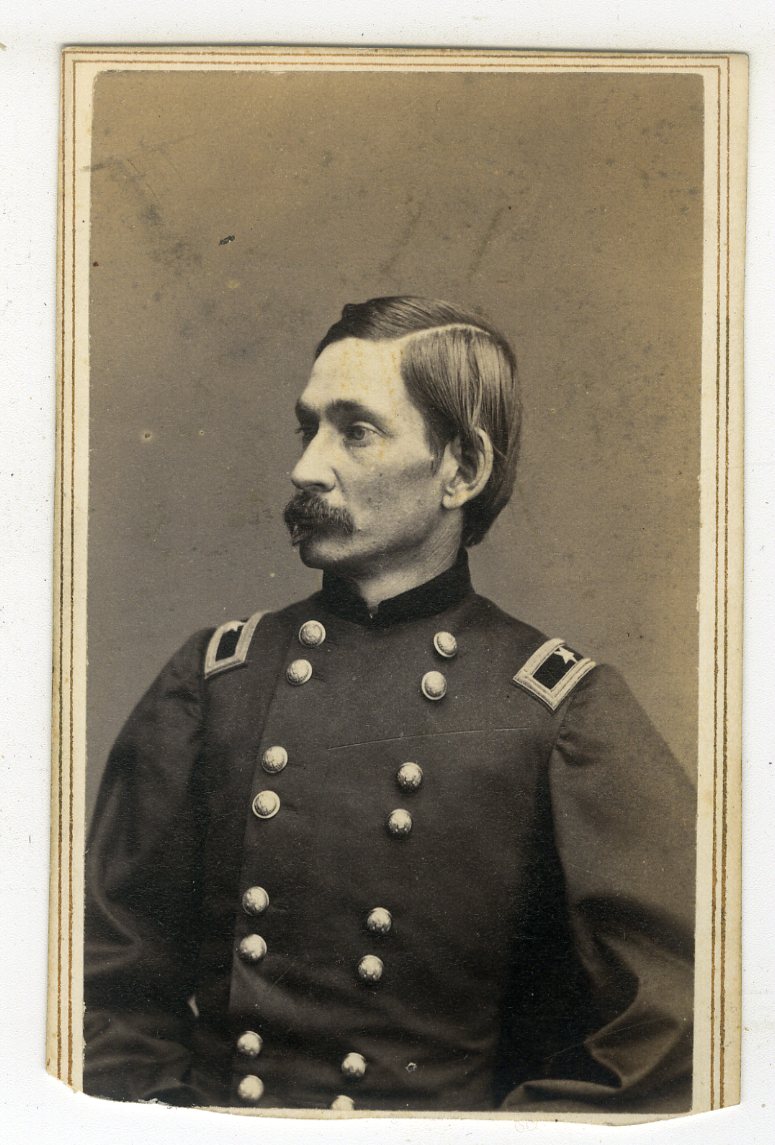
CWCDV1786. C.D. Fredricks & Co., NY. Henry Moses Judah. Residence was not listed; 40 years old. Enlisted on 9/6/1861 at Placerville, CA as a Colonel. On 9/6/1861, he was commissioned into Field & Staff California 4th Infantry. He resigned on 11/9/1861. On 5/21/1862, he was commissioned into US Volunteers General Staff. He was Mustered Out on 8/24/1865. Promotions: Brig-General 5/21/1862. Born 6/12/1821 in Snow Hill, MD. Died 1/14/1866 in Plattsburg Barracks, NY.
Henry Moses Judah (June 12, 1821 – February 14, 1866) was a career officer in the United States Army, serving during the Mexican–American War, Indian Wars, and Civil War. He is most remembered for his role in helping thwart Morgan’s Raid in 1863 and for leading a disastrous attack during the Battle of Resaca.
Judah was born at Snow Hill on the Eastern Shore of Maryland to Henry Raymond Judah and Mary Jane (Reece) Judah. His father, a native of Connecticut, was serving as a parish minister in an Episcopal church. One of his brothers, Theodore Judah, later was chief engineer of the Central Pacific Railroad and was instrumental in constructing the first transcontinental railroad. Another brother became a prominent attorney.
Judah received an appointment to the United States Military Academy, graduating 35th of 39 students in the Class of 1843. He was a classmate of Ulysses S. Grant. Commissioned as a second lieutenant in the U.S. 8th Infantry Regiment, he served on the frontier. He served with distinction during the Mexican–American War and was promoted to first lieutenant on September 26, 1847. He was commended for bravery during the storming of Monterrey, and again at the Battle of Molino del Rey and the Battle for Mexico City.
He was promoted to captain in the U.S. 4th Infantry Regiment and served in a variety of posts in the Pacific Northwest in the Washington Territory before being assigned to duty in California. His Company E was stationed at Fort Jones in Siskiyou County, where he joined the Freemasons, becoming a member of the North Star Lodge No. 91.
In 1854, Judah participated in an expedition against local Native Americans, but was too inebriated to lead his company in an attack on a group of Indians who were hiding in a cave. Instead, he stayed with the pack train and straggled far behind the column. The commissary officer, Lt. George Crook (a future Civil War general) later wrote, “It seemed that the rear guard had gotten some whiskey, and were all drunk, and scattered for at least 10 miles back. Judah was so drunk that he had to be lifted from his horse when the rear guard straggled into camp. The next day he was sick all day with the delirium tremens.” Crook and other officers discussed pressing charges against Judah, but the matter was dropped when Judah promised to arrange a transfer to a new post. He then served in Placerville, California, in El Dorado County. However, Judah’s reputation for bouts with alcohol would carry over into the Civil War.
With the outbreak of the Civil War in 1861, Judah was colonel of the 4th California Volunteers at Fort Yuma, a post on the Colorado River opposite the Arizona Territory. He commanded troops at Camp McClellan near Auburn, California, until November, when he resigned his command and returned to the East. He served in the defenses of Washington, D.C. for several months. He was appointed a brigadier general of volunteers on March 22, 1862 (confirmed March 24, 1862), to rank from March 21, 1862, and served as Grant’s inspector general during the Battle of Shiloh.
Given field command of a division under Henry W. Halleck, Judah participated in the siege of Corinth. He received a promotion in the Regular Army in June 1862 to Major (United States) of the 4th Infantry. By autumn, he was performing administrative duties in Cincinnati, Ohio before being ordered in October to join the Army of Kentucky under Maj. Gen. Gordon Granger at Covington, Kentucky. Judah returned to a staff position during the winter of 1862-63, when he served as acting inspector general of the Army of the Ohio.
In June 1863, Judah was assigned to command the 3rd Division of the XXIII Corps, stationed in Cincinnati, Ohio. During Morgan’s Raid, Maj. Gen. Ambrose Burnside ordered Judah to pursue the Confederate raider John Hunt Morgan. Judah’s Indiana and Illinois cavalry under Edward H. Hobson defeated Morgan at the Battle of Buffington Island, but failed to capture the general (who finally surrendered to other Federal troops on July 26). Judah was criticized for missing an opportunity earlier in the week to snare Morgan near Pomeroy, Ohio, where his slowness in flanking Morgan allowed the Confederates to escape. He then led his command back to Tennessee to rejoin the army of William S. Rosecrans.
In 1864, Judah led an infantry division under Maj. Gen. John M. Schofield during the Atlanta campaign. Having been previously disciplined for poor performance and alcoholism by Schofield, Judah was given one last chance to redeem himself at the Battle of Resaca. In his haste to seize victory, he did not properly reconnoiter the battlefield terrain beforehand or use his artillery in the fight. It would be his last field command, as Schofield soon removed him from duty.
Judah was placed on routine administrative duty in the Department of the Cumberland until the end of the war, stationed in Marietta, Georgia. He was appointed a brevet lieutenant colonel and colonel in the Regular Army on March 13, 1865. On May 12, he received the surrender of Brig. Gen. William T. Wofford’s estimated 3,000 to 4,000 Confederate soldiers. Since no crops had been grown here on the battlefields in 1864 and, as the surrender had paralyzed the local economy and government, the citizens and former soldiers lacked food, funds and employment. Judah, seeing that aid was needed to prevent suffering, issued corn and bacon to the needy until a crop could be harvested. The rations helped put the Georgians and their economy back on a sound basis, and served as a humanitarian gesture.
After the war, Judah mustered out of the volunteer army on August 24, 1865 and reverted to his Regular Army rank of major. He served on garrison duty in Plattsburgh, New York, where he died a year later. He was entombed at Kings Highway Cemetery in Westport, Connecticut. Trimmed at bottom. G. $300 ON HOLD
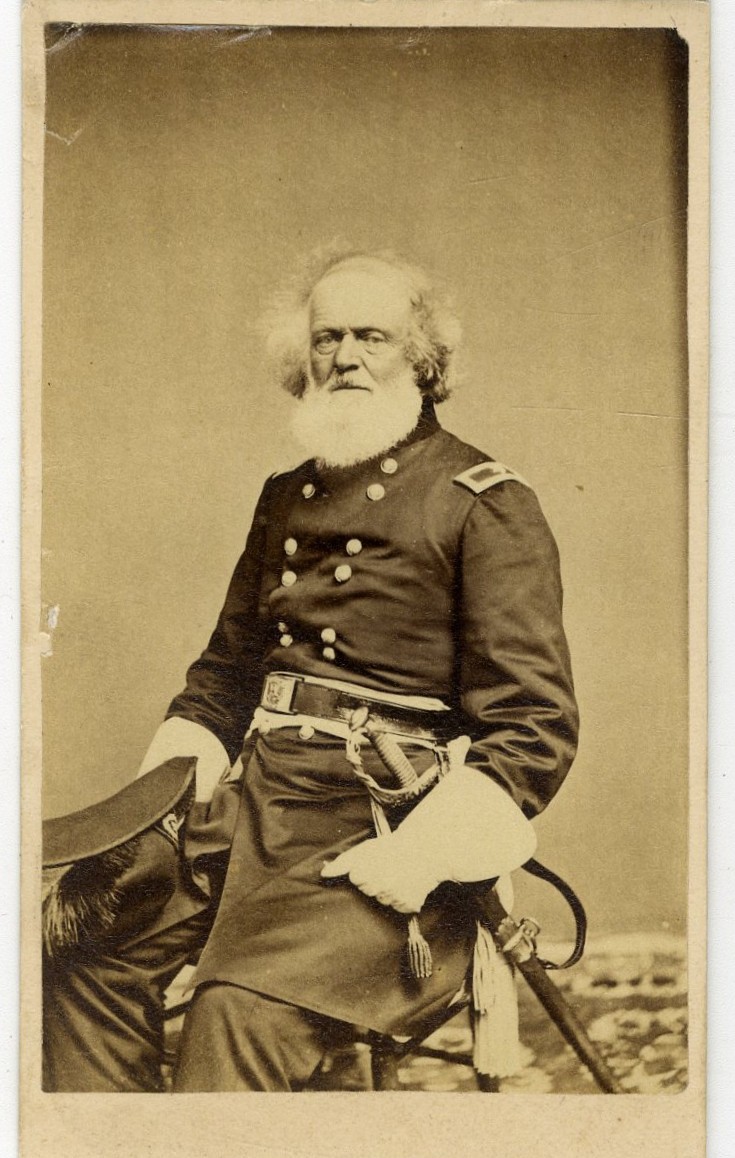
CWCDV1787. Moore Bros., Springfield, Mass. Major Genl Joseph King Fenno Mansfield. Residence was not listed; a 49-year-old US Army Officer. Enlisted on 5/28/1853 as a Colonel. On 5/28/1853, he was commissioned into US Regular Army Inspector Genl Dept. (Date and method of discharge not given.) (Prior service in US Army since 07/01/1822; subsequent service until his death). On 5/14/1861, he was commissioned into US Volunteers General Staff. He died of wounds on 9/18/1862. He was listed as: Wounded 9/17/1862 Antietam, MD. Promotions: Colonel 5/28/1853 (Colonel & Inspector General); Brig-General 5/14/1861; Major-Gen 7/18/1862. Born 12/22/1803 in New Haven, CT. Buried: Indian Hills Cemetery, Middletown, CT. (Graduate USMA 07/01/1822). VG. $275
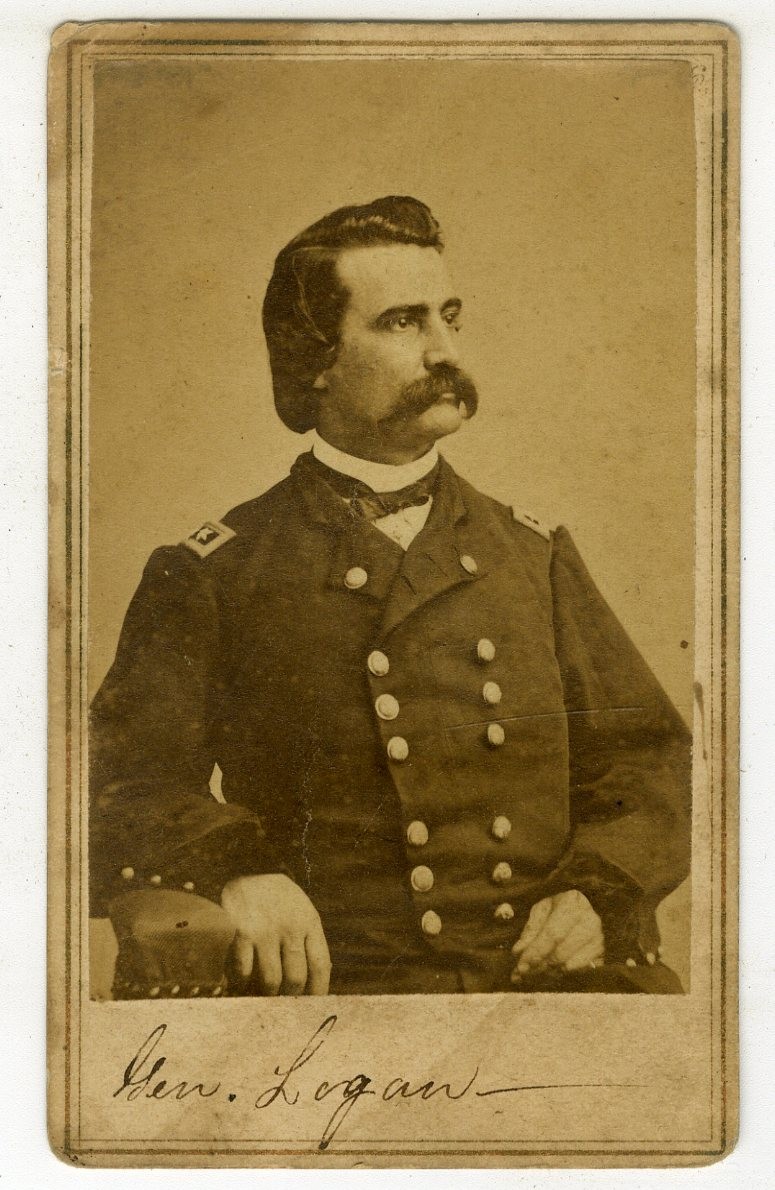
CWCDV1788. Brady’s National Photographic Portrait Gallery, NY & Washington, DC. John Alexander Logan. Residence Carbondale, IL; 35 years old. Enlisted on 8/10/1861 as a Colonel. On 9/18/1861, he was commissioned into Field & Staff Illinois 31st Infantry. He was discharged for promotion on 3/21/1862. (Prior enlistment in Mexican War). On 3/21/1862, he was commissioned into US Volunteers General Staff. He resigned on 8/17/1865. Promotions: Brig-General 3/21/1862; Major-Gen 11/29/1862. Born 2/9/1826 in Jackson County, IL. Died 12/26/1886 in Washington, DC. (Graduate of law from Louisville University. Member of State Legislature in 1852 . Member of US Congress, candidate for Vice Pres).
John Alexander Logan (February 9, 1826 – December 26, 1886) was an American soldier and politician. He served in the Mexican–American War and was a general in the Union Army in the Civil War. He served the state of Illinois as a state representative, a U.S. representative, and a U.S. senator and was an unsuccessful candidate for Vice President of the United States as James G. Blaine’s running mate in the election of 1884. As the 3rd Commander-in-Chief of the Grand Army of the Republic, he is regarded as the most important figure in the movement to recognize Memorial Day (originally known as Decoration Day) as an official holiday.
His likeness appears on a statue at the center of Logan Circle, Washington, D.C. He is also honored with a statue in Grant Park in Chicago, Illinois. Memorial Park in Houston, Texas was formerly Camp Logan named after him. He is the namesake of Logan County, Illinois; Logan County, Kansas; Logan County, Nebraska; Logan County, Oklahoma; Logan County, Colorado; Logan County, North Dakota; and Logan Square, Chicago, which is the neighborhood chosen to mark Illinois’ centennial. Logan is one of only three people mentioned by name in the Illinois state song. Upon his death, he lay in state in the United States Capitol rotunda. He is the father of U.S. Army officer and Medal of Honor recipient John Alexander Logan Jr. (1865–1899).
John A. Logan was born near what is now Murphysboro, Illinois, the son of Dr. John Logan and Dr. Logan’s second wife, Elizabeth (Jenkins) Logan. He studied with his father and with a private tutor, then studied for three years at Shiloh College. He enlisted in the 1st Illinois Infantry for the Mexican–American War, and received a commission as a second lieutenant and assignment as the regimental quartermaster.
After the war Logan studied law in the office of his uncle, Alexander M. Jenkins, graduated from the Law Department of the University of Louisville in 1851, and practiced law with success.
John A. Logan entered politics as a Douglas Democrat, was elected county clerk in 1849, served in the Illinois House of Representatives from 1853 to 1854 and in 1857; and for a time, during the interval, was prosecuting attorney of the Third Judicial District of Illinois. In 1858 and 1860, he was elected as a Democrat to the U.S. House of Representatives. In 1853, John A. Logan helped pass a law which prohibited all African Americans, including freedmen, from settling in the state.
U.S. Representative Logan fought at Bull Run as an unattached volunteer in a Michigan regiment, and then returned to Washington where, before he resigned his congressional seat on April 2, 1862, he entered the Union Army as Colonel of the 31st Illinois Volunteer Infantry Regiment, which he organized. He was known by his soldiers as “Black Jack” because of his black eyes and hair and swarthy complexion, and was regarded as one of the most able officers to enter the army from civilian life. In a time when political generals usually performed poorly in battle, Logan was an exception.
Before resigning his seat, Union Army Colonel Logan served in the army of Ulysses S. Grant in the Western Theater and was present at the Battle of Belmont on November 7, 1861, where his horse was killed, and at Fort Donelson, where he was wounded on February 15, 1862. Soon after the victory at Donelson, he resigned his seat on April 2, 1862, and was promoted to brigadier general in the volunteers, as of March 21, 1862. Major John Hotaling served as his chief of staff. To confuse matters, the 32nd Illinois was commanded at Shiloh by a different Colonel John Logan. During the Siege of Corinth, John A. Logan commanded first a brigade and then the 1st Division of the Army of the Tennessee. In the spring of 1863, he was promoted to major general to rank from November 29, 1862.
In Grant’s Vicksburg Campaign, Logan commanded the 3rd Division of James B. McPherson’s XVII Corps, which was the first to enter the city of Vicksburg in July 1863 after its capture. Logan then served as the city’s military governor. In November 1863 he succeeded William Tecumseh Sherman in command of the XV Corps; and at the Battle of Atlanta (July 22, 1864), after the death of James B. McPherson during the day, he assumed command of the Army of the Tennessee. He was relieved a short time afterward by Oliver O. Howard. He returned to Illinois for the 1864 elections but rejoined the army afterward and commanded his XV corps in Sherman’s Carolinas campaign.
In December 1864, Grant became impatient with George H. Thomas’s apparent unwillingness to attack immediately at Nashville and sent Logan to relieve him. Logan was stopped in Louisville when news came that Thomas had completely smashed John Bell Hood’s Confederate army in the Battle of Nashville.
Logan had been disappointed when Howard was given permanent command of the Army of the Tennessee after McPherson’s death, and Sherman arranged for Logan to lead the army during the May 1865 Grand Review in Washington.
After the war, Logan resumed his political career, now as a Republican, and was a member of the United States House of Representatives from 1867 to 1871, and of the United States Senate from 1871 until 1877 and again from 1879 until his death in 1886. After the war, Logan, who had always been a staunch partisan, was identified with the radical wing of the Republican Party. His forceful, passionate speaking, popular on the platform, was less effective in the halls of legislation. In 1868, he was one of the House managers in the impeachment trial of U.S. President Andrew Johnson. One of Logan’s issues in the Senate was his efforts to stop any action taken to overturn the conviction in the court-martial of Maj. Gen. Fitz John Porter.
He was the second Commander-in-Chief of the Grand Army of the Republic from 1868 to 1871 and helped lead the call for creation of Memorial Day, originally called Decoration Day, as a national public holiday. His war record and his great personal following, especially among members of the Grand Army of the Republic, contributed to his nomination for Vice President in 1884 on the Republican ticket with James G. Blaine. However, they were defeated by the Democratic ticket of Grover Cleveland and Thomas A. Hendricks.
Logan was deeply embittered by the loss. He believed that President Chester A. Arthur’s supporters were disloyal after Arthur lost the Republican nomination. Logan obstructed Arthur’s nomination of journalist William Eleroy Curtis to be Secretary of the Latin American Trade Commission, claiming that Curtis made “damaging disclosures… to the Democratic National Committee.” Curtis threatened to mobilize his press resources against Logan’s re-election bid. The controversy eventually dissipated. The 1885 US Senate election in Illinois was contentious, and Logan only won after a Democratic representative died and was replaced with a Republican.
In September 1872, the New York newspaper The Sun reported that many major politicians were bribed by Union Pacific Railroad, and Credit Mobilier. In response to this Congress created the Poland Committee to investigate these accusations. The committee found out that many senators including Logan were involved. In February 1873, the House was convinced that it should share this information with the Senate. The House said to the Senate that these politicians including Logan were possibly involved with the scandal.
Logan explained that he rejected The Credit Mobilier official Oakes Ames first offer, but a few months later Logan accepted Ames offer of 325 dollars. Logan was exonerated by the committee report.
Logan showed signs of illness when the 49th United States Congress opened its first official session on December 7, 1886. By mid-December, Logan’s arms swelled and his lower limbs were in pain. After several days of intense discomfort, the ailment subsided. He relapsed a few days later and eventually struggled to maintain consciousness. On December 24, Logan’s doctors conceded that the condition might be fatal. Around three o’clock in the afternoon on December 26, Logan died at his home in Columbia Heights, Washington, D.C. After his death, Logan’s body lay in state in the United States Capitol. He was temporarily interred in a vault at Rock Creek Cemetery on December 31, 1886 until he could be reburied in a newly constructed mortuary chapel at the United States Soldiers’ and Airmen’s Home National Cemetery in Washington on December 26, 1888, the second anniversary of his death.
Logan was the author of two books on the Civil War. In The Great Conspiracy: Its Origin and History (1886), he sought to demonstrate that secession and the Civil War were the result of a long-contemplated “conspiracy” to which various Southern politicians had been party since the Nullification Crisis; he also vindicated the pre-war political positions of Stephen A. Douglas and himself. He also wrote The Volunteer Soldier of America (1887). His son, John Alexander Logan Jr., was also an army officer and posthumously received the Medal of Honor for actions during the Philippine–American War. His brother-in-law, Cyrus Thomas, participated in the Hayden Geological Survey of 1871.
Logan was also a member of the Military Order of the Loyal Legion of the United States – a military society which was composed of officers who had served in the Union armed forces during the American Civil War.
The State of Illinois commissioned an equestrian statue of the general that now stands in Chicago’s Grant Park. Another equestrian statue stands in Logan Circle in Washington, D.C., which gives its name to the surrounding neighborhood. At #4 Logan Circle, a former Logan residence, now called John Logan House, displays a variety of exterior and interior plaques to celebrate Logan’s achievements as soldier and statesman.
Logan Square, Chicago and Logan Boulevard in Chicago are named after him, as well as Logan Avenue and the neighborhood of Logan Heights (aka Barrio Logan) in San Diego, and the community of Logan Township, New Jersey. His hometown, Murphysboro, Illinois, is home to the General John A. Logan Museum, as well as the General John A. Logan Elementary School; and, in nearby Carterville, Illinois, there is the John A. Logan College, a community college. Camp Logan, Illinois, an Illinois National Guard base and rifle range from 1892 to the early 1970s, was also named for him. John A. Logan Elementary School in Washington, DC is also named in his honor.
The United States Army Transport Logan was named after him.
Logan is one of only three individuals mentioned by name in the Illinois state song:
On the record of thy years,
Abraham Lincoln’s name appears,
Grant and Logan, and our tears,
Illinois, Illinois,
Grant and Logan, and our tears,
Illinois.
2-cent tax stamp on verso. G. $250
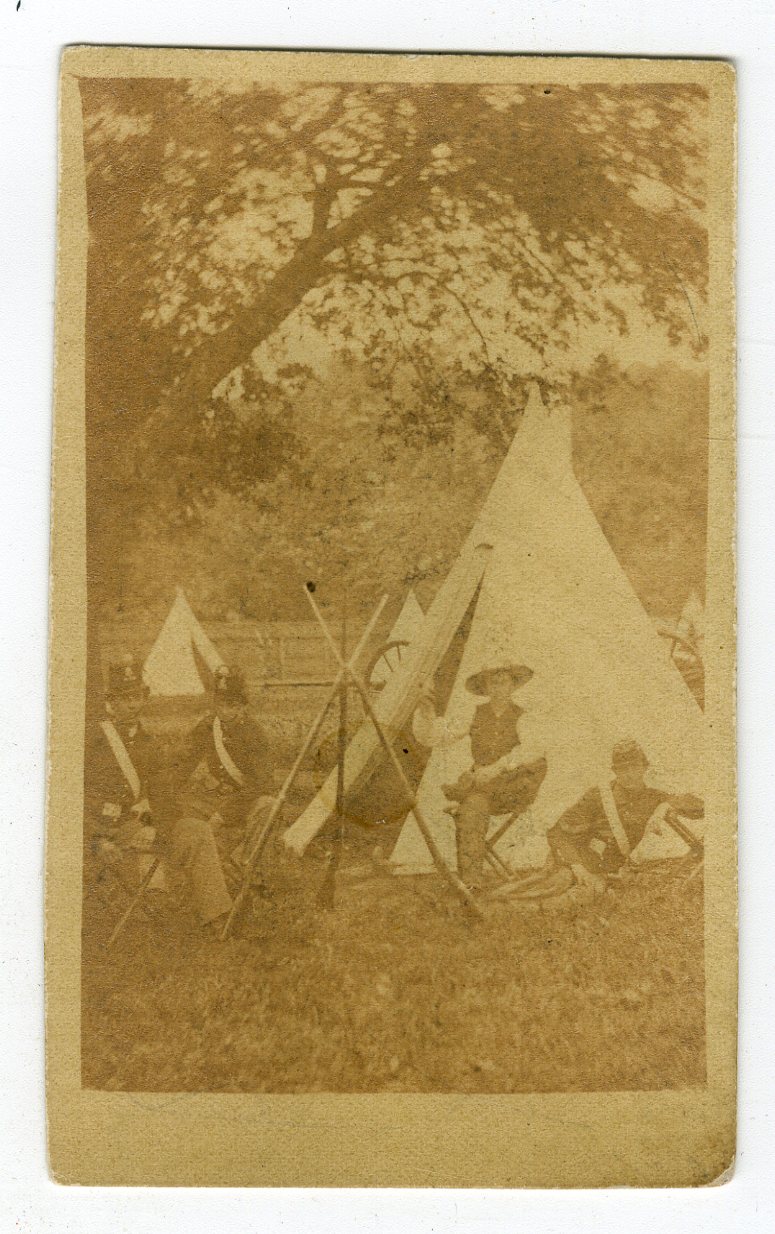
CWCDV1789. O. Pierre Havens, Sing Sing, NY. Tent encampment, several soldiers in scene. G. $200
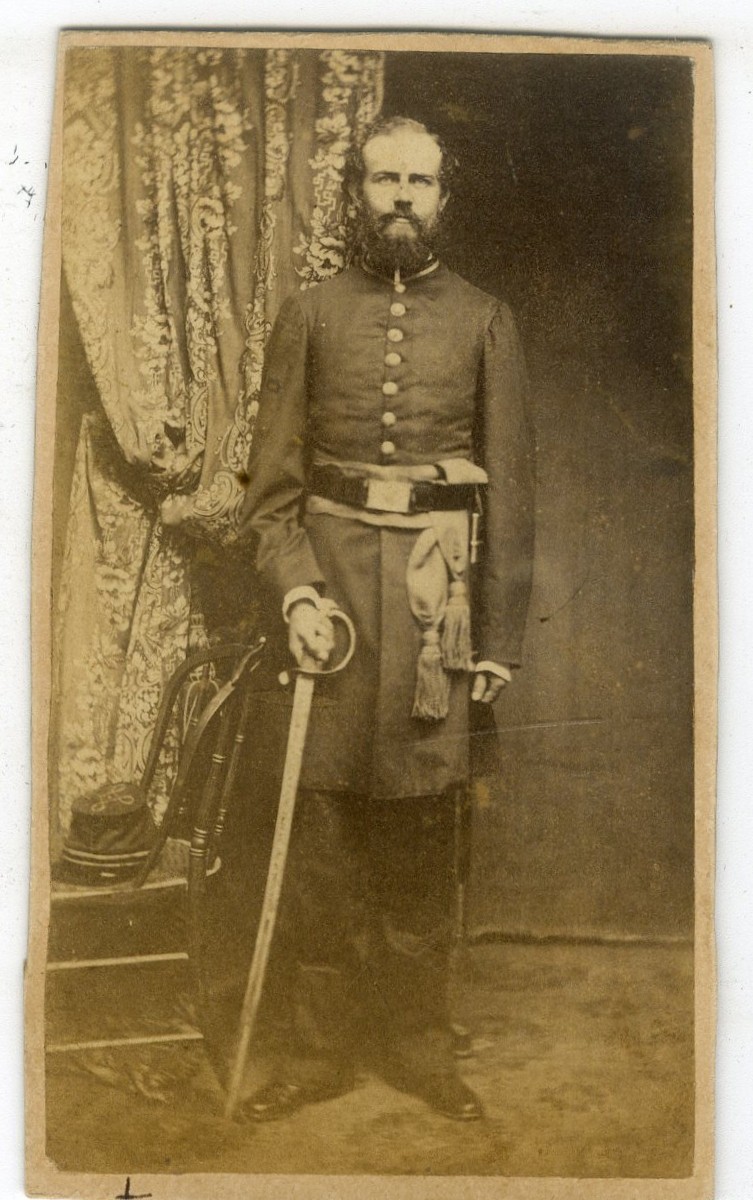

CWCDV1790. CDV of Confederate line officer from North Carolina, full standing with sword with kepi on chair identified on verso as “George 1861.” On a heavy cardboard mount common to Southern-made CDVs. VG. $275
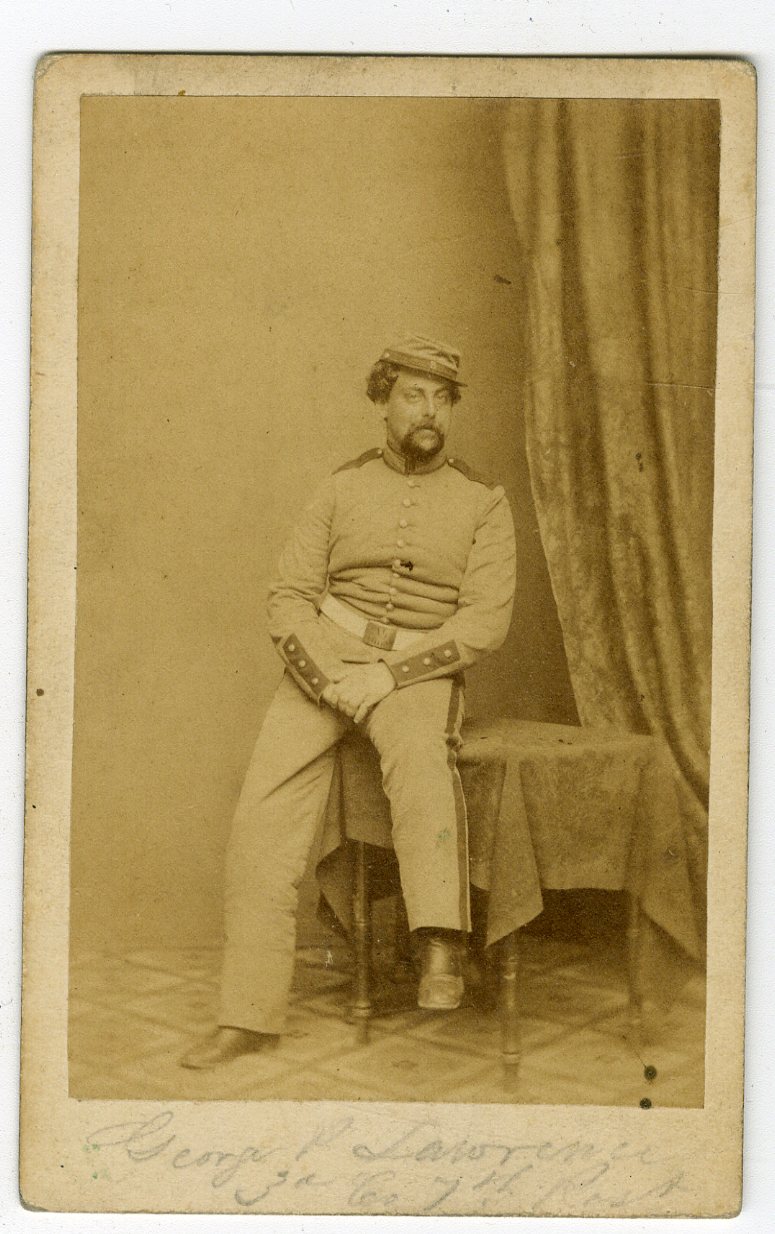
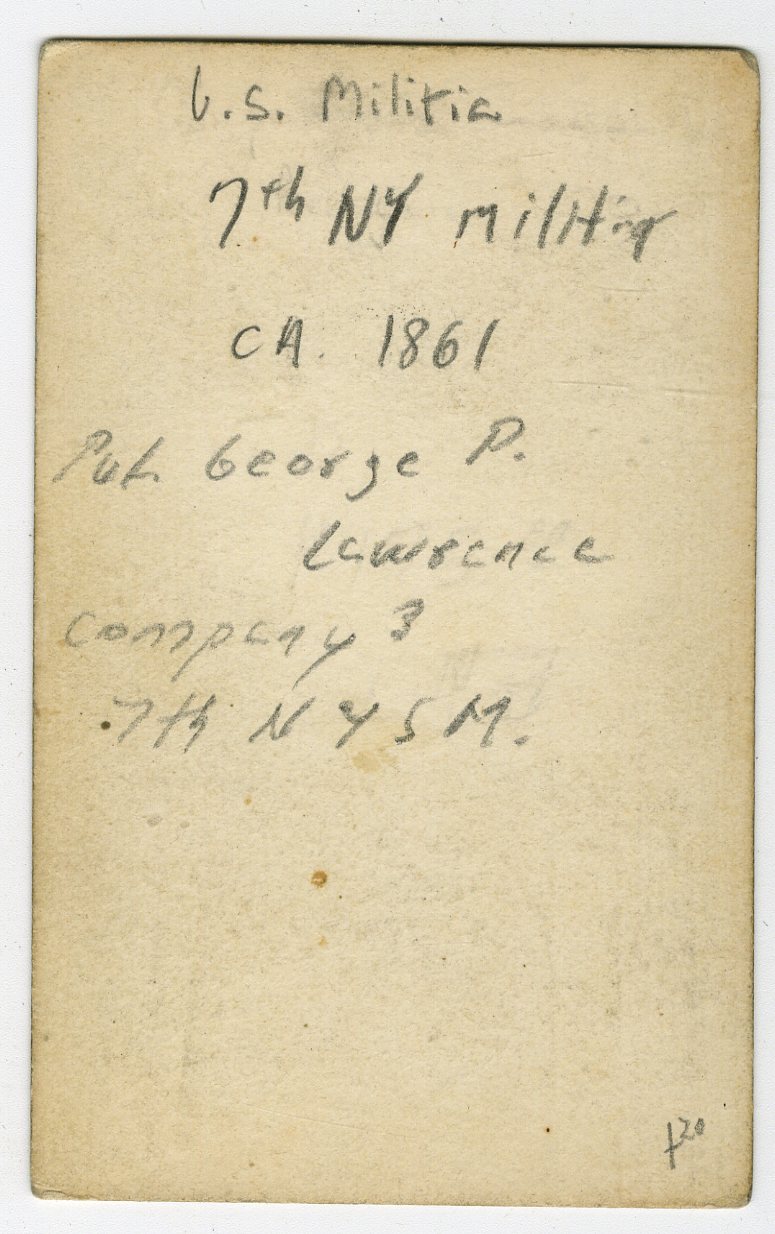
CWCDV1791. George P. Lawrence, 7th NY State Militia, ca. 1861. VG. $275
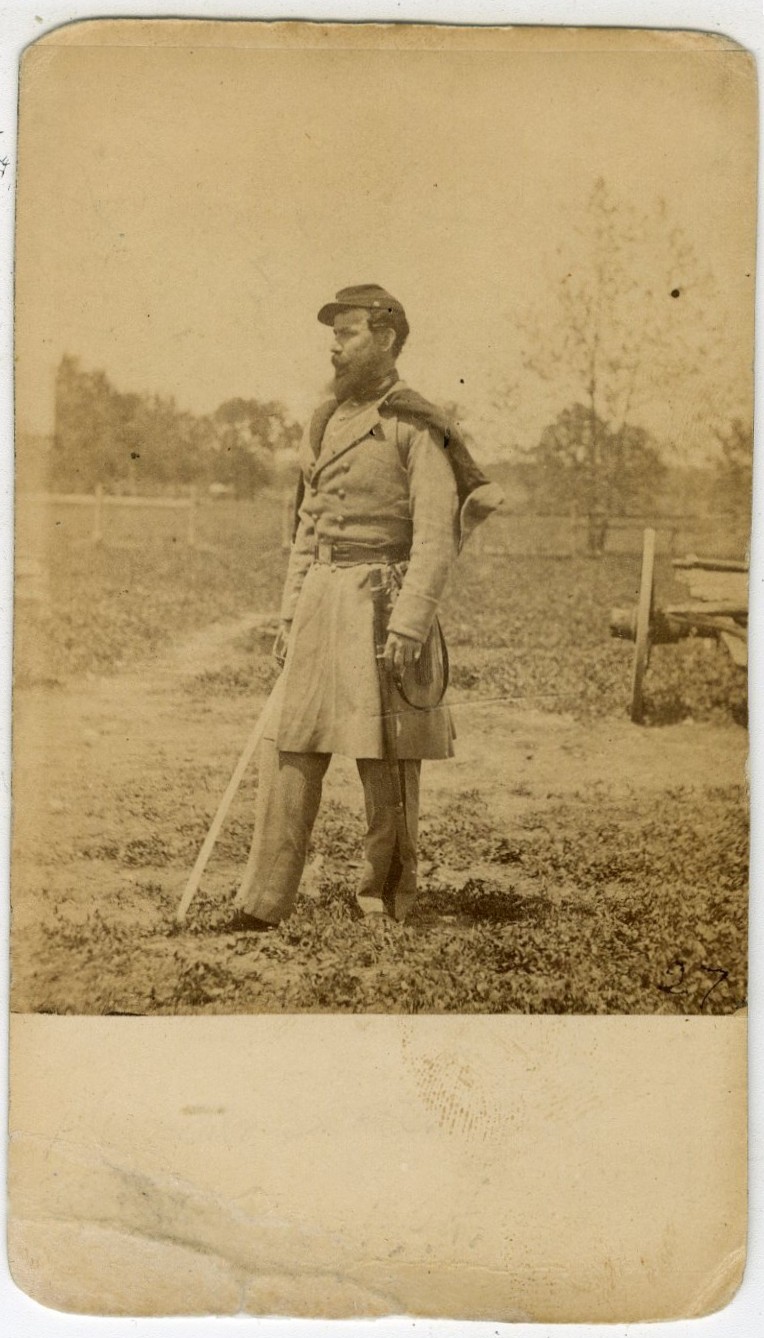
CWCDV1792. G.N. Barnard & C.O. Bostwick, Photo. Published by E. Anthony. Unidentified 7th NY State Militia soldier, Camp Cameron, Wash. DC, 1861. VG. $350

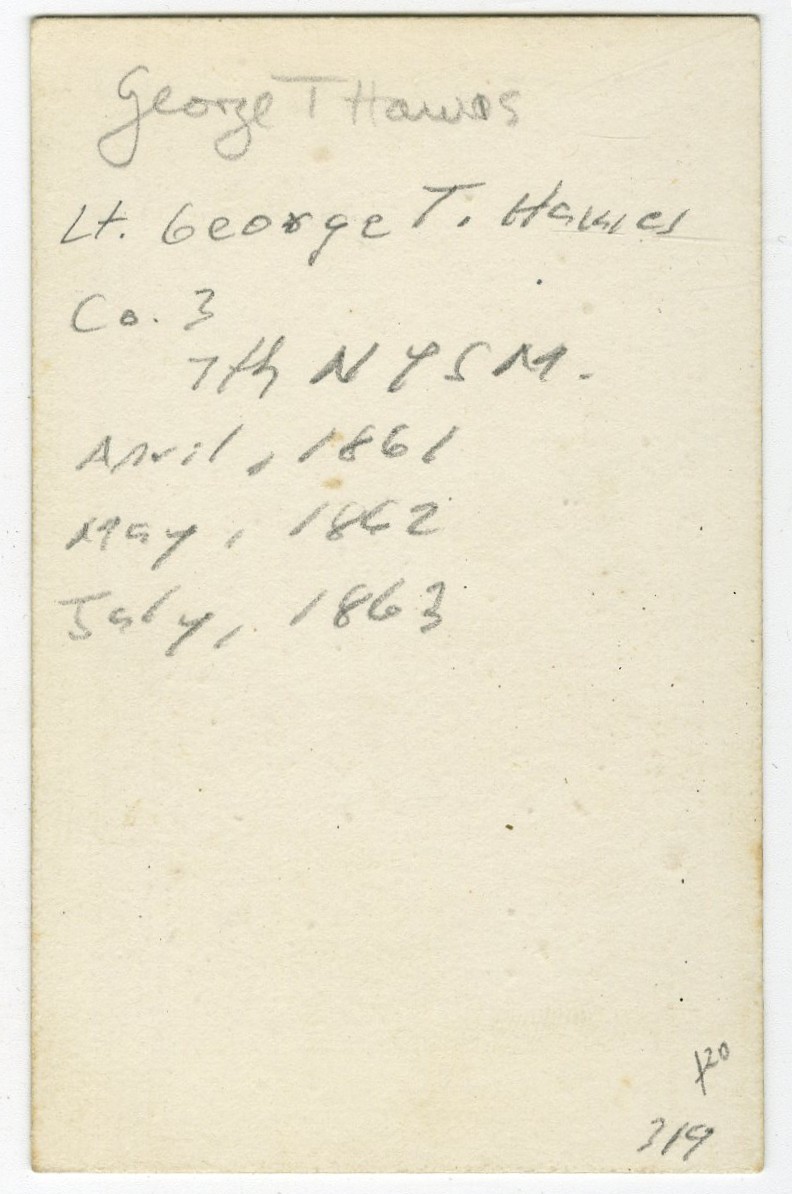
CWCDV1793. Lt. George T. Hawes, 7th NY State Militia. VG. $225

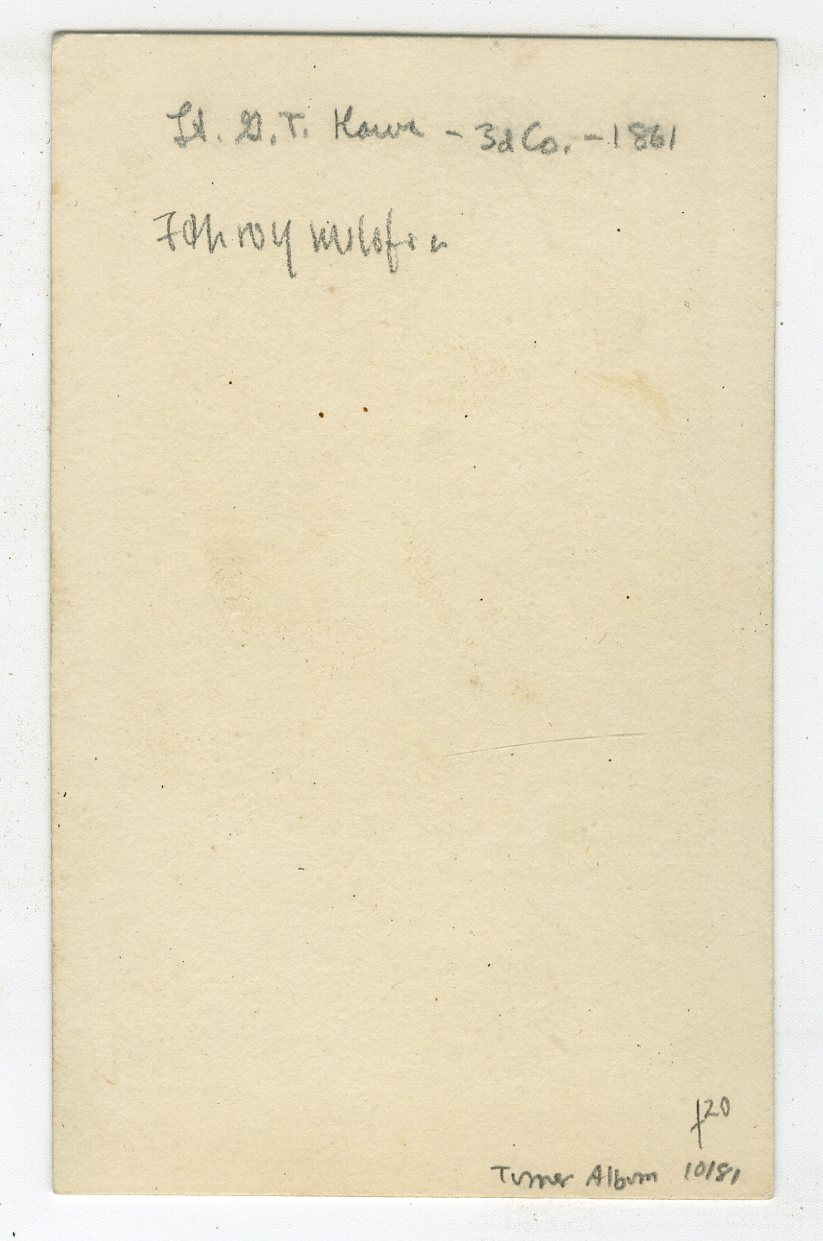
CWCDV1794. Lt. G.T. Howe, 3rd co., 1861. 7th NY State Militia. VG. $225
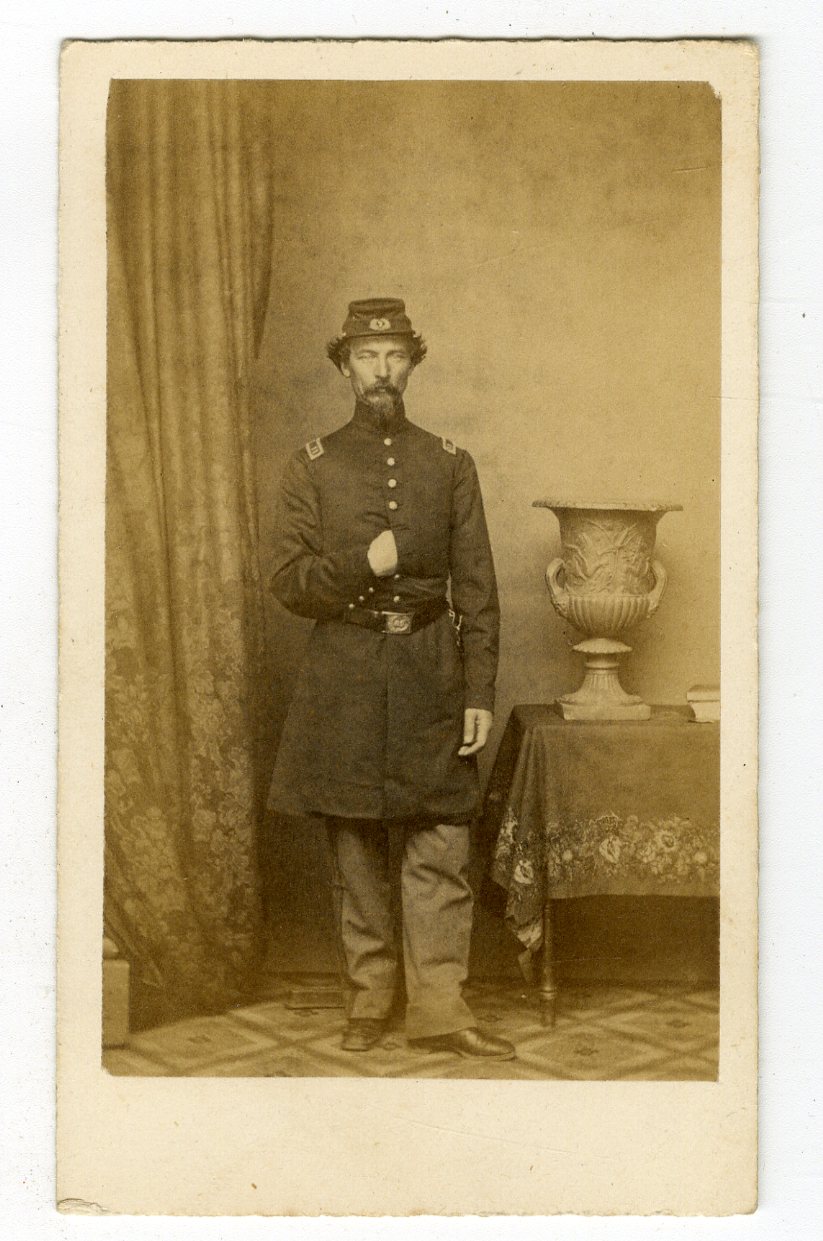
CWCDV1795. Captain William Bensel, Co. 2 7th NY State Militia, April-June 1861. VG. $225
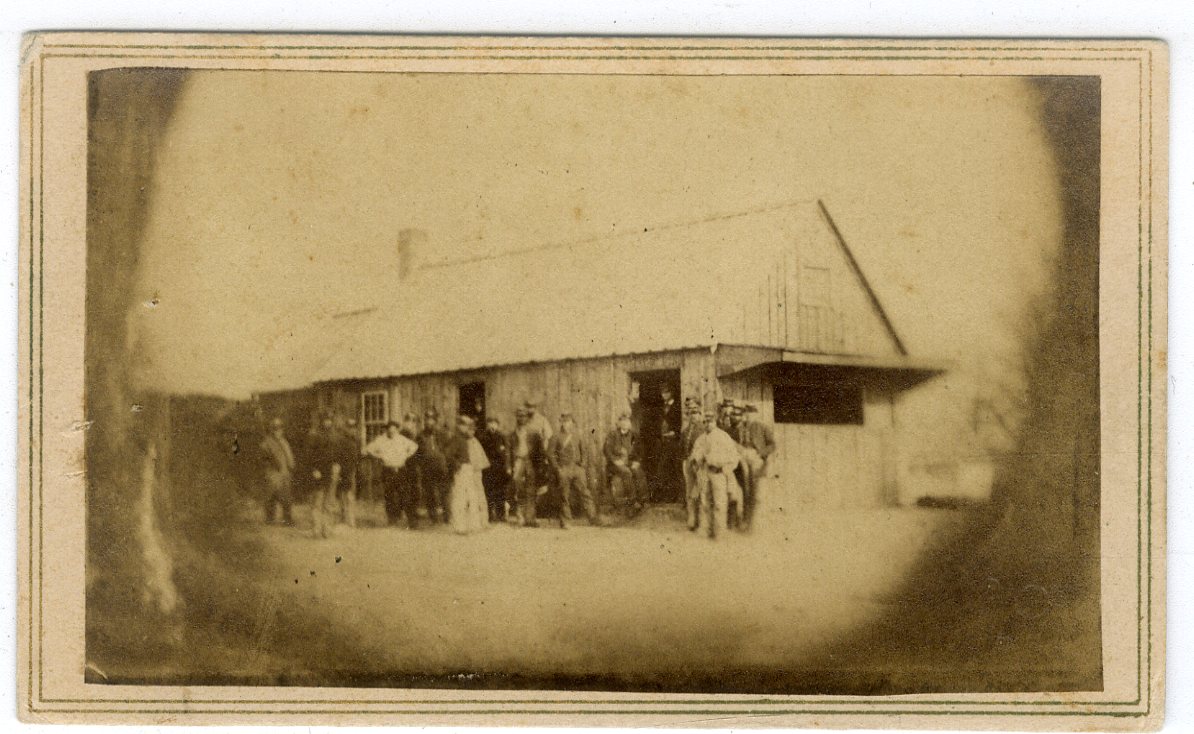
CWCDV1796. Rockwell, NY. Written on verso: “Union Barracks or Hospital Scene.” African-American soldier in view. G. $300
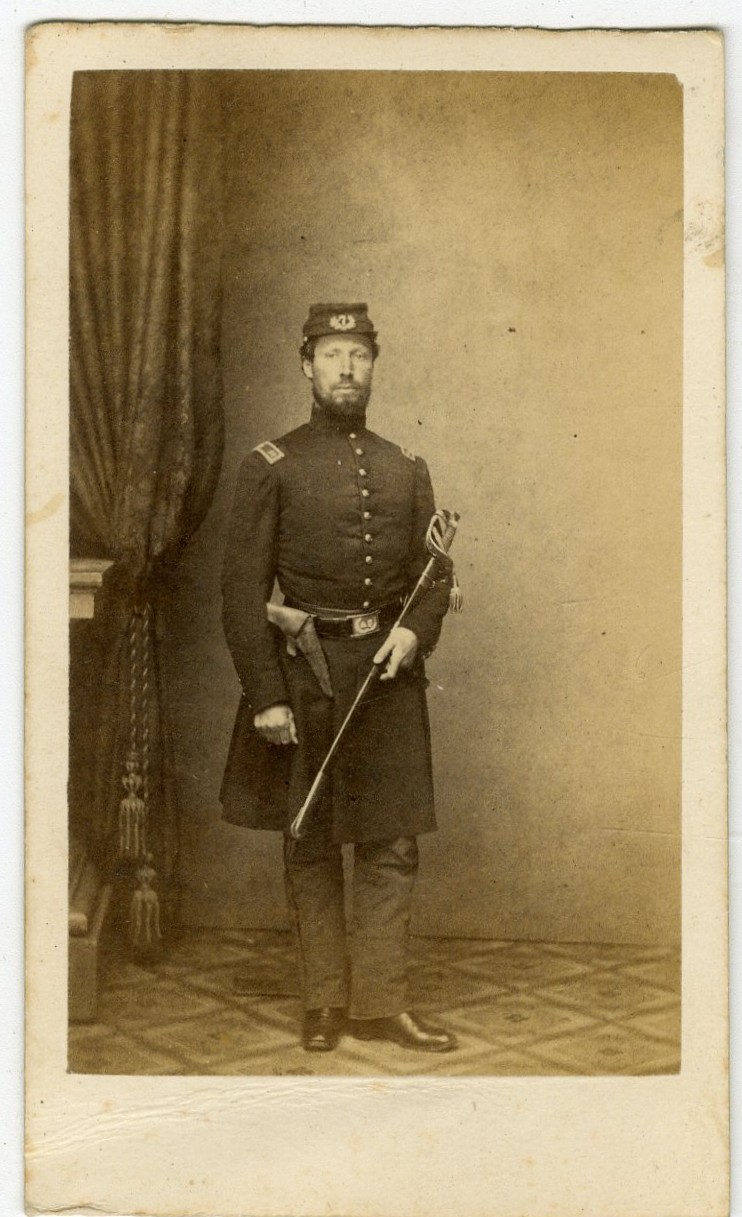
CWCDV1797. Captain james Pryce, Co. 3, 7th NY State Militia. April-June 1861. VG. $225

CWCDV1798. Charles Marse. Written on verso “The 7th Regiment 1863 from orig. album.” VG. $225
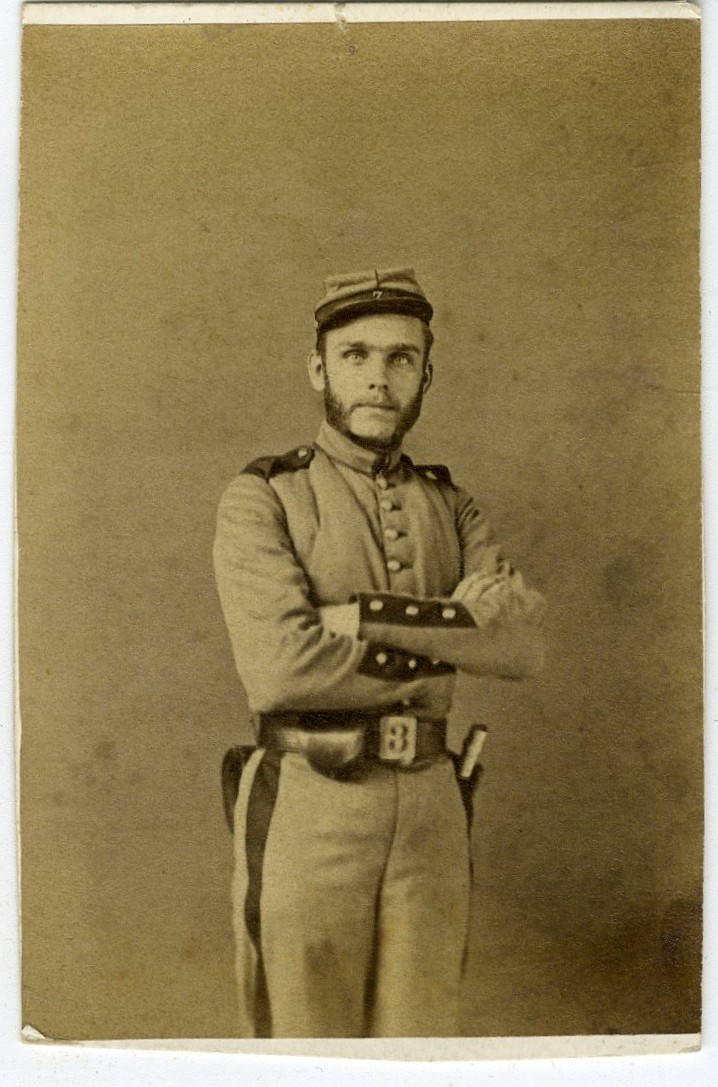
CWCDV1799. Joseph M. Stanford, 7th NY State Militia. VG. $225


CWCDV1800. Written on verso: “Compliments of Z.E.Hyde, Fort Federal Hill, Baltimore, July 22/62.” 7th NY State Militia. VG. $225
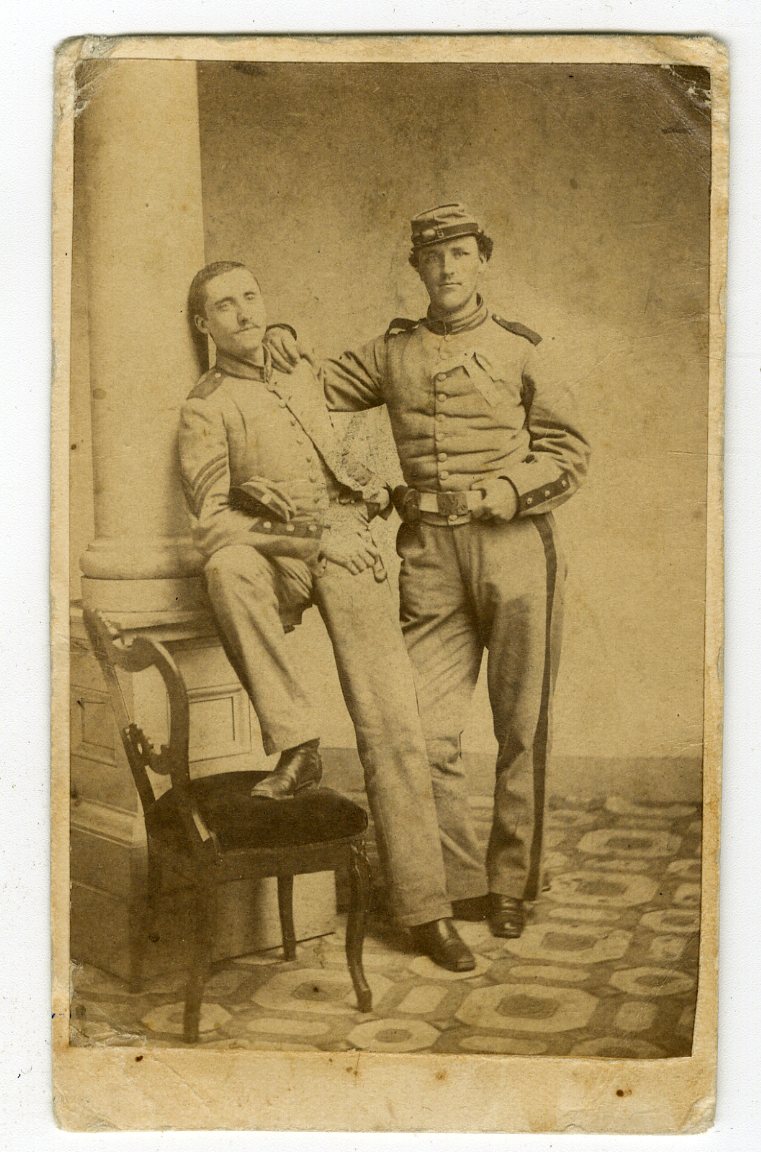
CWCDV1801. McClees, Philadelphia. Soldiers of the 7th NY State Militia. VG. $325
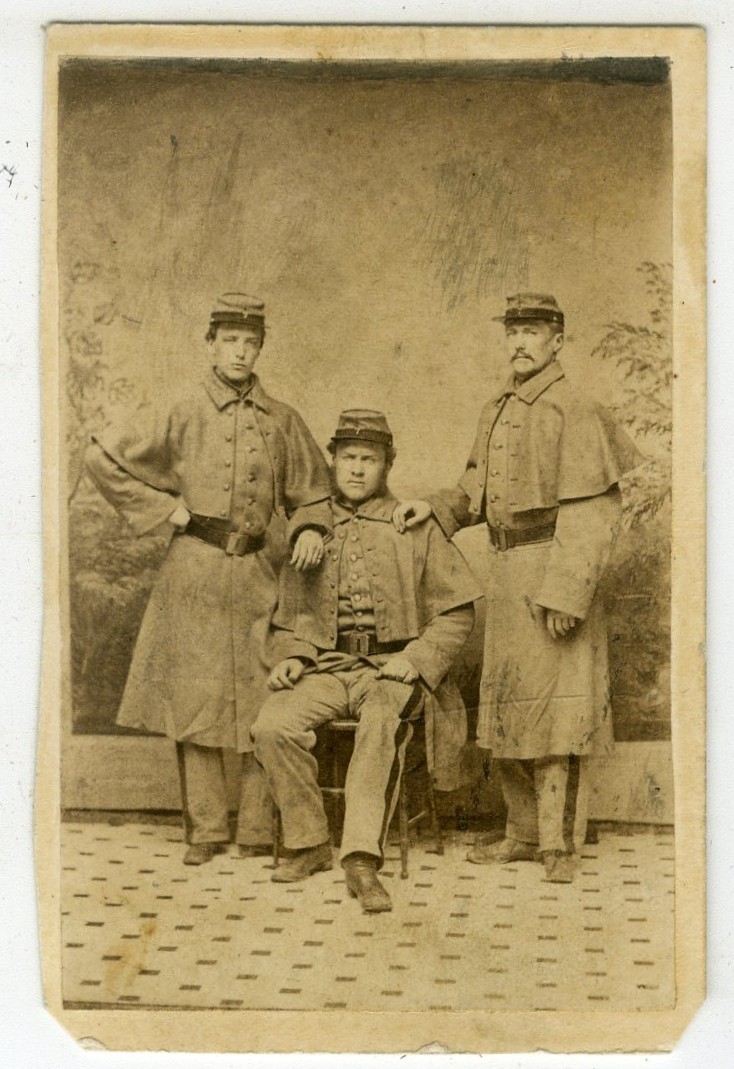
CWCDV1802. Frederick Dixon (standing at right). Soldiers of the 7th NY State Militia. VG. $325
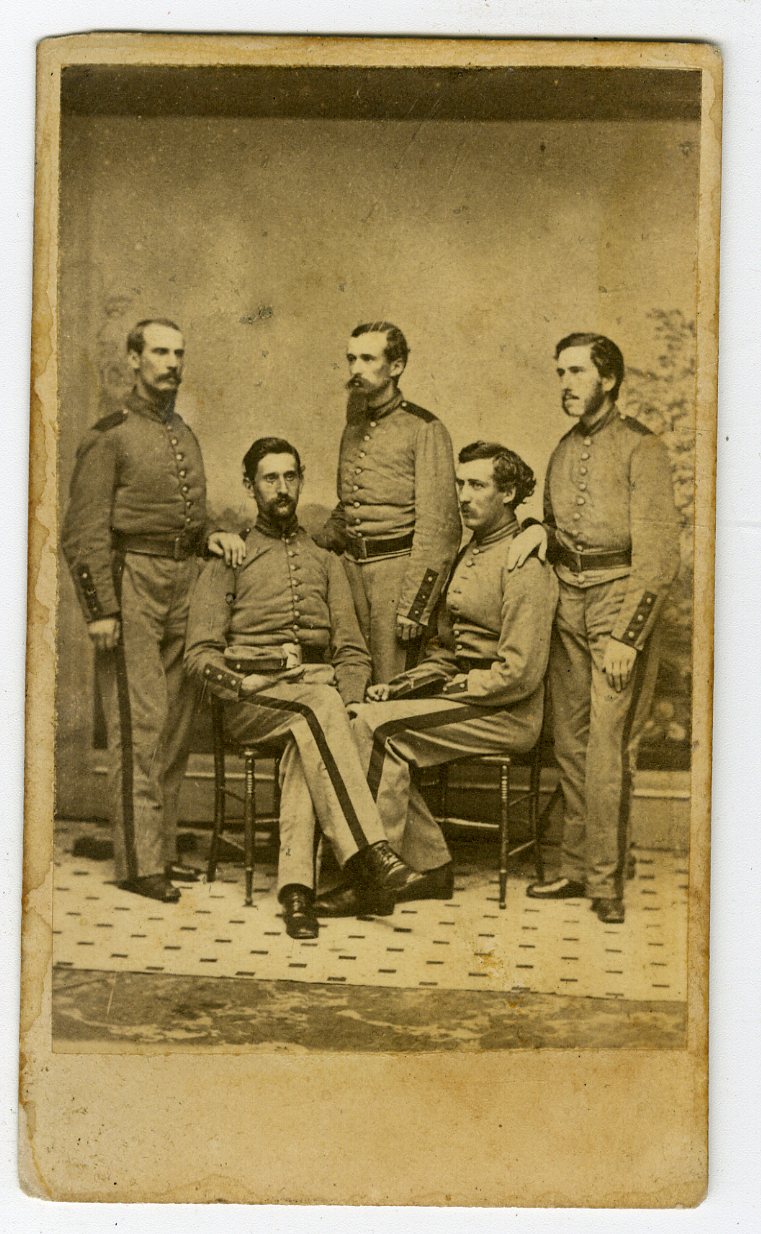
CWCDV1803. J.H. Young’s Photographic Galleries, Baltimore. Soldiers of the 7th NY State Militia. VG. $350
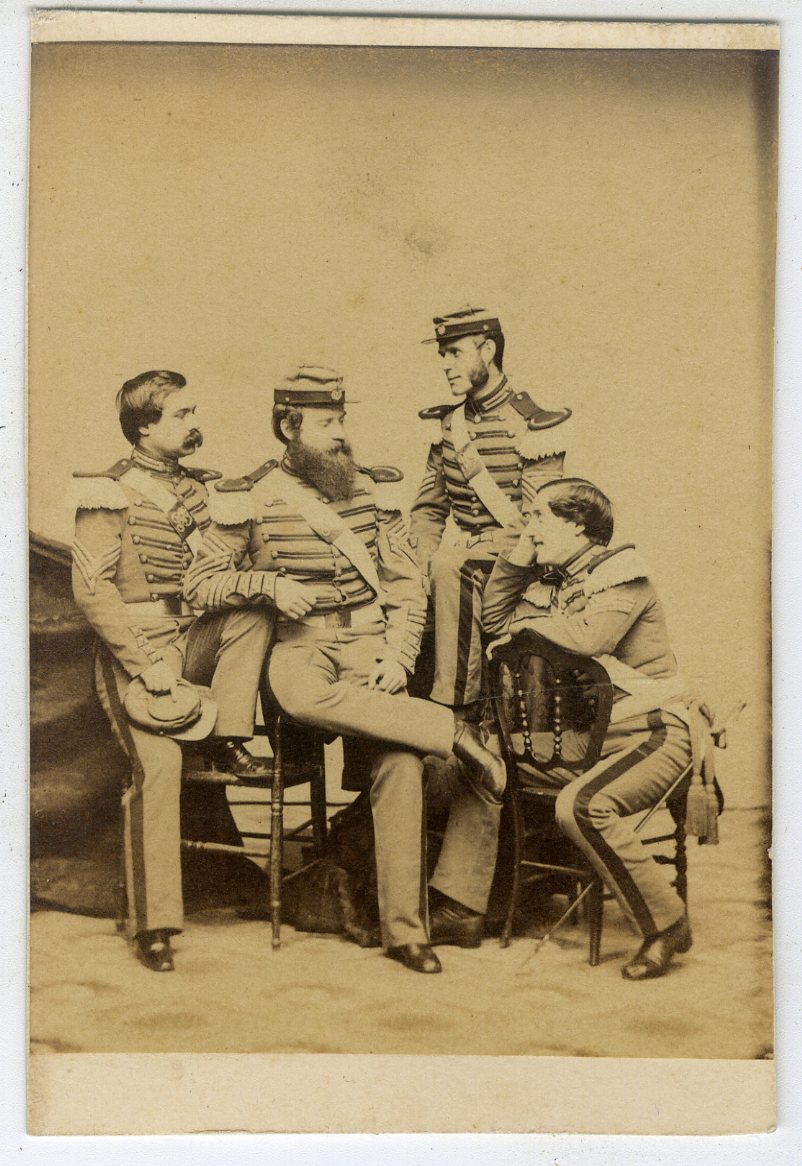
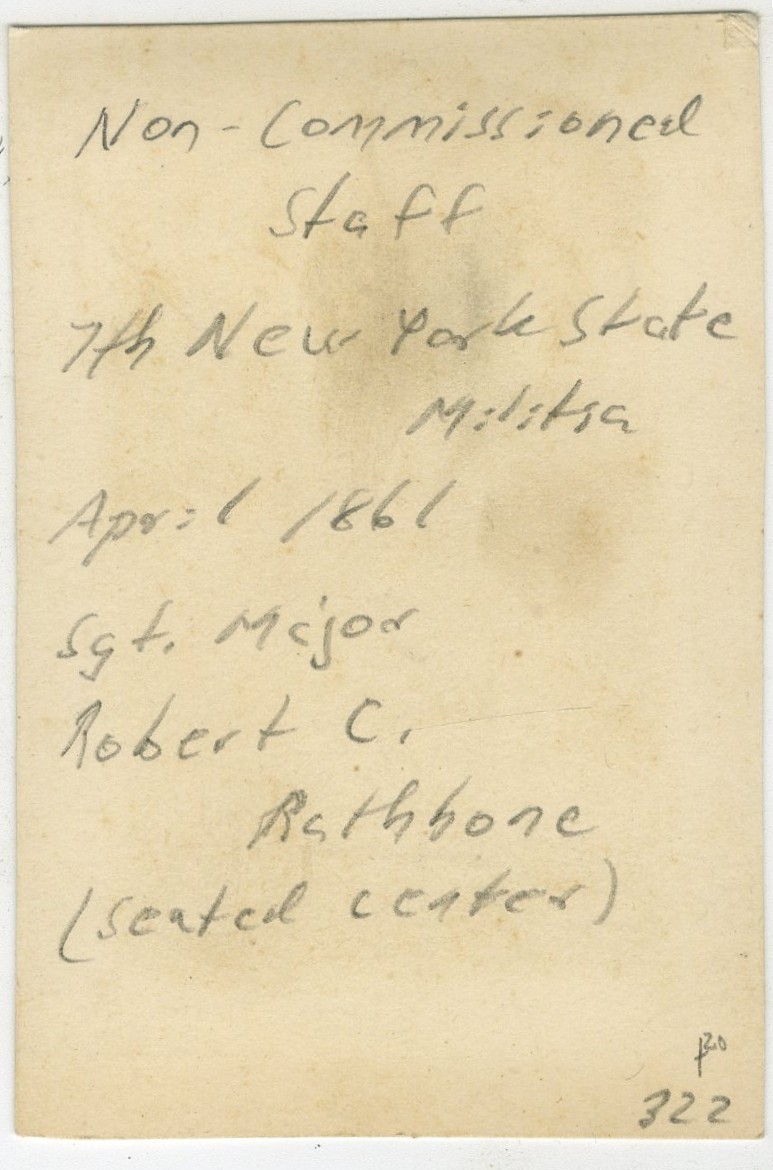
CWCDV1804. Non-commissioned staff of the 7th NY State Militia. April 1861. Sgt. Major Robert C. Rathbone, seated center. VG. $375

CWCDV1805. Brady’s National Photographic Galleries, Wash DC and New York. Lt. Charles Porter Mattocks. Residence Portland, ME; 21 years old. Enlisted on 8/2/1862 as a 1st Lieut. On 8/2/1862, he was commissioned into “A” Co. Maine 17th Infantry. He was Mustered Out on 6/4/1865 at Washington, DC. He was listed as: POW 5/5/1864 Wilderness, VA (Confined at Macon, GA & Columbia, SC); Escaped 11/28/1864 Columbia, SC. Promotions: Capt 12/4/1862; Major 12/22/1863; Brig-General 3/13/1865 by Brevet; Colonel 5/15/1865. Intra-regimental company transfers: 12/22/1863 From company A to Field & Staff. Born 10/11/1840 in Danville, VT. Died 5/16/1910 in Portland, ME. Buried: Evergreen Cemetery, Portland, ME. (Signed Petition Complaining of Camp Sorghum Conditions). Medal of Honor Information: He was awarded the Medal of Honor for action on 4/6/1865 at Sailor’s Creek, VA. (Displayed extraordinary gallantry in leading a charge). VG. $450

CWCDV1810. Nadar, Paris. CDV of George Richmond Fearing, Esq. (1839-1920). Taken when he was in Paris. Residence was not listed; 22 years old. Enlisted on 11/22/1861 as a 1st Lieut. On 11/22/1861, he was commissioned into US Volunteers Aide-De-Camp. He resigned on 2/1/1864. Promotions: Capt 4/4/1862; Major 3/13/1865 by Brevet. Born 6/2/1839 in New York City, NY. Died 1/24/1920 in New York City, NY. (Parents: Daniel Butler & Harriet (Richmond) Fearing. Wife: Harriet Travers). George Richmond Fearing (1839-1920) was a son of Daniel B. Fearing (1804-1870), a New York merchant banker from Massachusetts who was one of the earliest summer residents at Newport. George himself was a well-known society figure and President of the Knickerbocker Club. In Newport, he co-founded the Casino and was the uncle of Mayor Daniel B. Fearing II (1859-1918). He grew up between New York and Newport. He became Colonel of the Newport Artillery Company and during the Civil War served on the staff of General Ambrose E. Burnside. He lived at 998 Fifth Avenue in Manhattan. In 1871, Colonel Fearing commissioned a French architect to deliver a set of drawings of a French chateau for his Summer home at 180 Narragansett Ave in Newport. The drawings were based on an 18th century country house on the outskirts of Geneva, Switzerland. The esteemed Newport architectural firm of George Champlin Mason & Son took the drawings and adapted them to create The Orchard, a grand mansion built of yellow Milwaukee brick and Ohio limestone. It has been a landmark in Newport since 1873. VG. $75
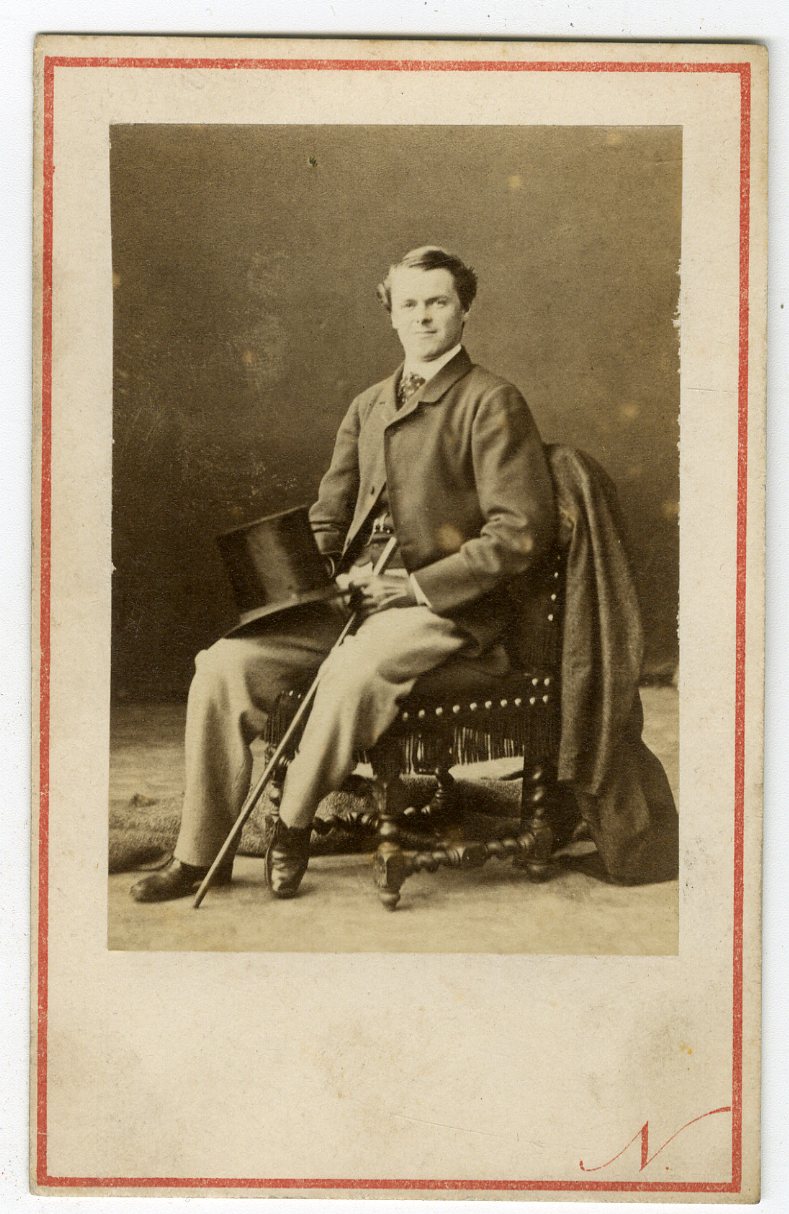
CWCDV1811. Nadar, Paris. CDV of George Richmond Fearing, Esq. (1839-1920). Taken when he was in Paris. Residence was not listed; 22 years old. Enlisted on 11/22/1861 as a 1st Lieut. On 11/22/1861, he was commissioned into US Volunteers Aide-De-Camp. He resigned on 2/1/1864. Promotions: Capt 4/4/1862; Major 3/13/1865 by Brevet. Born 6/2/1839 in New York City, NY. Died 1/24/1920 in New York City, NY. (Parents: Daniel Butler & Harriet (Richmond) Fearing. Wife: Harriet Travers). George Richmond Fearing (1839-1920) was a son of Daniel B. Fearing (1804-1870), a New York merchant banker from Massachusetts who was one of the earliest summer residents at Newport. George himself was a well-known society figure and President of the Knickerbocker Club. In Newport, he co-founded the Casino and was the uncle of Mayor Daniel B. Fearing II (1859-1918). He grew up between New York and Newport. He became Colonel of the Newport Artillery Company and during the Civil War served on the staff of General Ambrose E. Burnside. He lived at 998 Fifth Avenue in Manhattan. In 1871, Colonel Fearing commissioned a French architect to deliver a set of drawings of a French chateau for his Summer home at 180 Narragansett Ave in Newport. The drawings were based on an 18th century country house on the outskirts of Geneva, Switzerland. The esteemed Newport architectural firm of George Champlin Mason & Son took the drawings and adapted them to create The Orchard, a grand mansion built of yellow Milwaukee brick and Ohio limestone. It has been a landmark in Newport since 1873. VG. $75

CWCDV1813. Levitsky, Paris. CDV of George Richmond Fearing, Esq. (1839-1920). Taken when he was in Paris. Residence was not listed; 22 years old. Enlisted on 11/22/1861 as a 1st Lieut. On 11/22/1861, he was commissioned into US Volunteers Aide-De-Camp. He resigned on 2/1/1864. Promotions: Capt 4/4/1862; Major 3/13/1865 by Brevet. Born 6/2/1839 in New York City, NY. Died 1/24/1920 in New York City, NY. (Parents: Daniel Butler & Harriet (Richmond) Fearing. Wife: Harriet Travers). George Richmond Fearing (1839-1920) was a son of Daniel B. Fearing (1804-1870), a New York merchant banker from Massachusetts who was one of the earliest summer residents at Newport. George himself was a well-known society figure and President of the Knickerbocker Club. In Newport, he co-founded the Casino and was the uncle of Mayor Daniel B. Fearing II (1859-1918). He grew up between New York and Newport. He became Colonel of the Newport Artillery Company and during the Civil War served on the staff of General Ambrose E. Burnside. He lived at 998 Fifth Avenue in Manhattan. In 1871, Colonel Fearing commissioned a French architect to deliver a set of drawings of a French chateau for his Summer home at 180 Narragansett Ave in Newport. The drawings were based on an 18th century country house on the outskirts of Geneva, Switzerland. The esteemed Newport architectural firm of George Champlin Mason & Son took the drawings and adapted them to create The Orchard, a grand mansion built of yellow Milwaukee brick and Ohio limestone. It has been a landmark in Newport since 1873. VG. $35
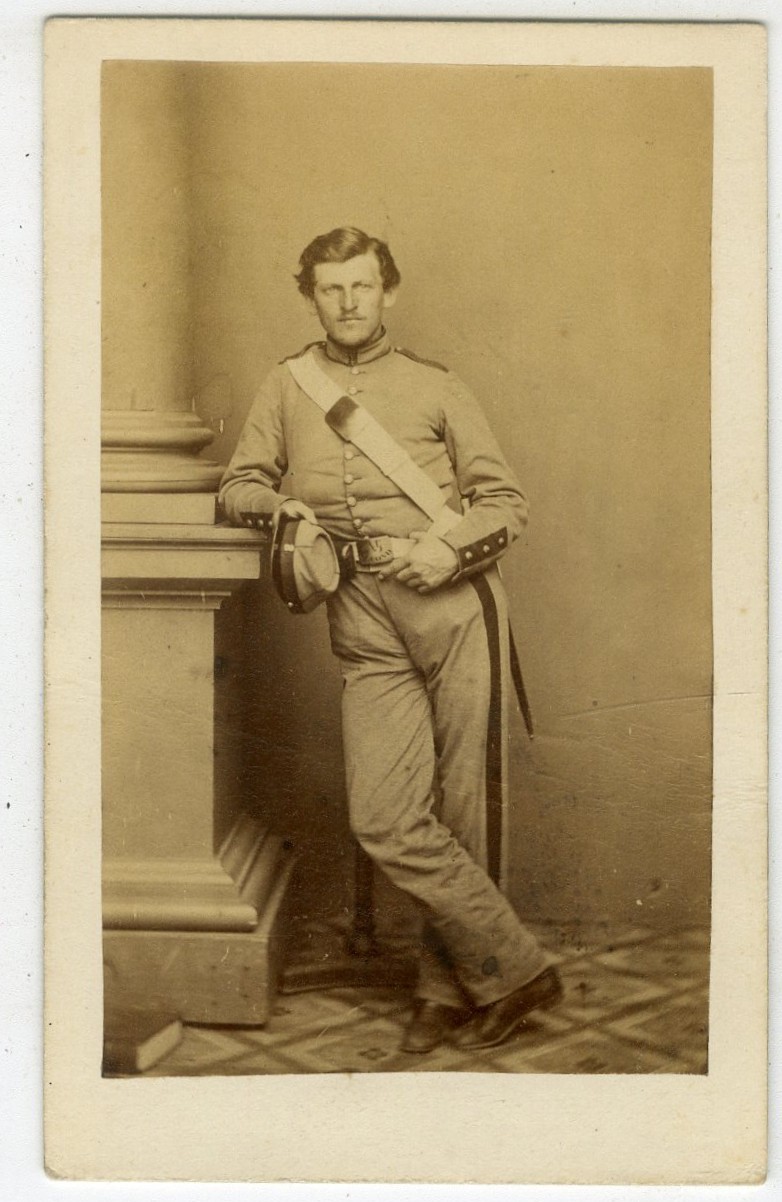
CWCDV1818. Taylor, 2nd Co., 7th NY State Militia. VG. $200

CWCDV1819. Soldier from the 7th NY State Militia. VG. $200
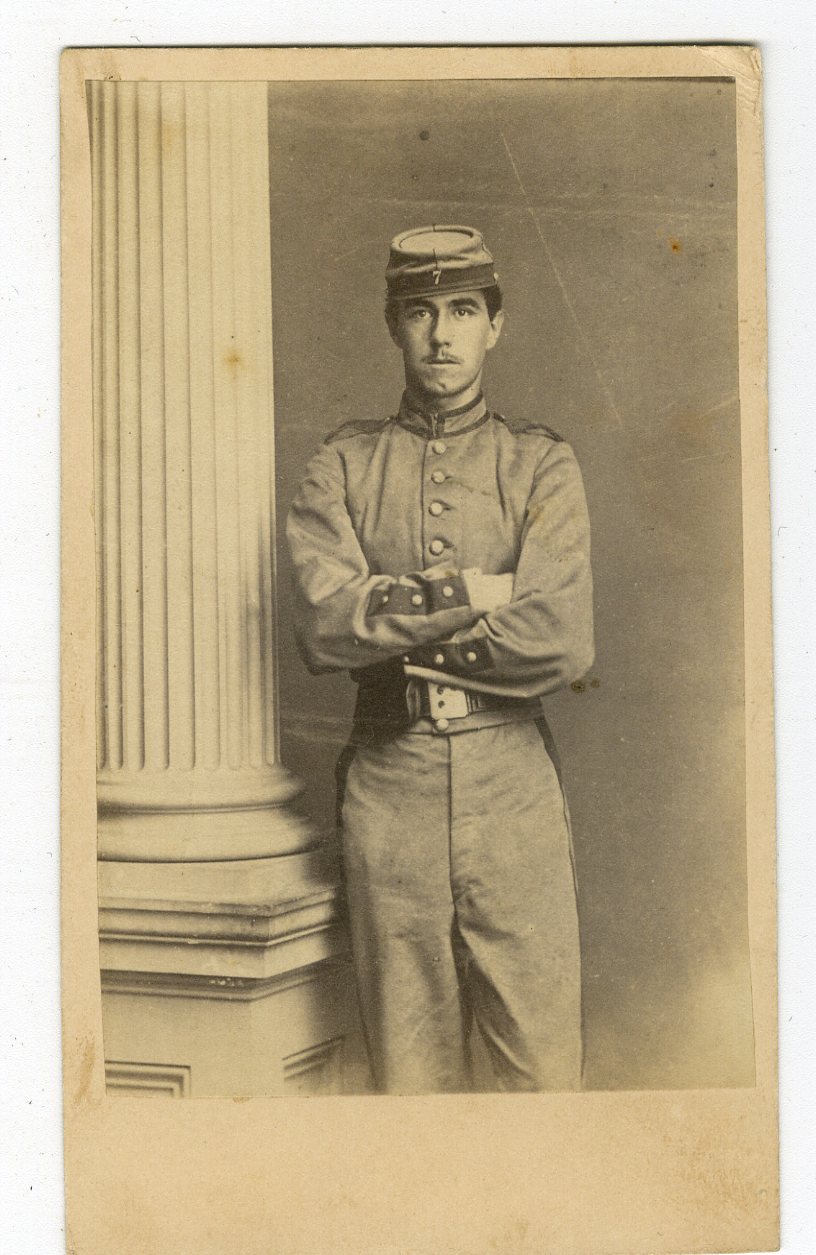
CWCDV1820. Soldier from the 7th NY State Militia. VG. $200
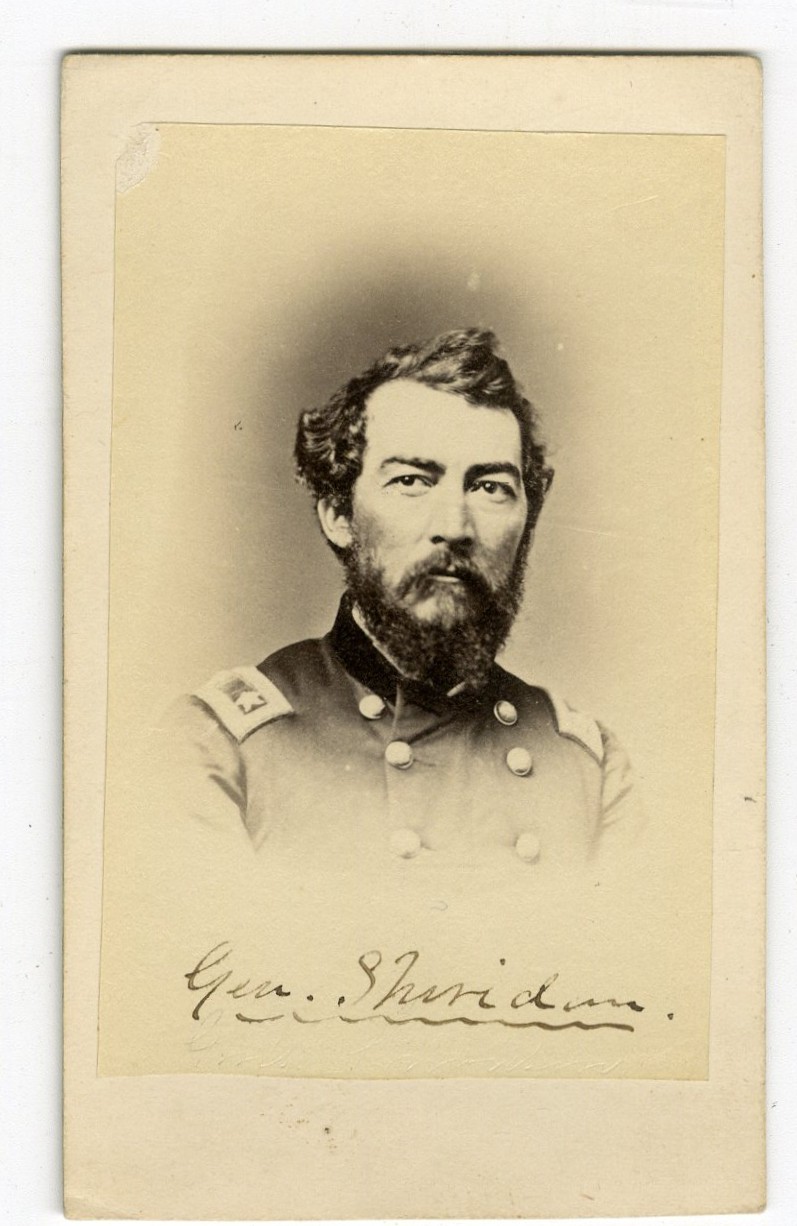
CWCDV1821. General Philip H. Sheridan. Residence Marietta, OH; a 31-year-old US Army Officer. Enlisted on 5/25/1862 as a Colonel. On 5/14/1861, he was commissioned into US Regular Army 13th Infantry. He was discharged for promotion on 9/20/1864. (Prior service in US Army since 07/01/1853). On 5/25/1862, he was commissioned into Field & Staff Michigan 2nd Cavalry. He was discharged for promotion on 7/1/1862. On 7/1/1862, he was commissioned into US Volunteers General Staff. He was Mustered Out on 9/20/1864. On 9/20/1864, he was commissioned into US Regular Army General Staff. (Date and method of discharge not given.) (Subsequent service in US Army until his death). Promotions: Colonel 5/25/1862 (As of 2nd MI Cavalry); Brig-General 7/1/1862; Major-Gen 12/31/1862; Brig-General 9/20/1864; Major-Gen 11/8/1864. Born 3/6/1831 in Albany, NY. Died 8/5/1888 in Nonquitt, MA. Buried: Arlington National Cemetery, Arlington, VA. (Graduated USMA 1853).
Philip Henry Sheridan (March 6, 1831– August 5, 1888) was a career United States Army officer and a Union general in the Civil War. His career was noted for his rapid rise to major general and his close association with General-in-chief Ulysses S. Grant, who transferred Sheridan from command of an infantry division in the Western Theater to lead the Cavalry Corps of the Army of the Potomac in the East. In 1864, he defeated Confederate forces under General Jubal Early in the Shenandoah Valley and his destruction of the economic infrastructure of the Valley, called “The Burning” by residents, was one of the first uses of scorched-earth tactics in the war. In 1865, his cavalry pursued Gen. Robert E. Lee and was instrumental in forcing his surrender at Appomattox Courthouse.
In his later years, Sheridan fought in the Indian Wars against Native American tribes of the Great Plains. He was instrumental in the development and protection of Yellowstone National Park, both as a soldier and a private citizen. In 1883, Sheridan was appointed general-in-chief of the U.S. Army, and in 1888 he was promoted to the rank of General of the Army during the term of President Grover Cleveland. VG. $100
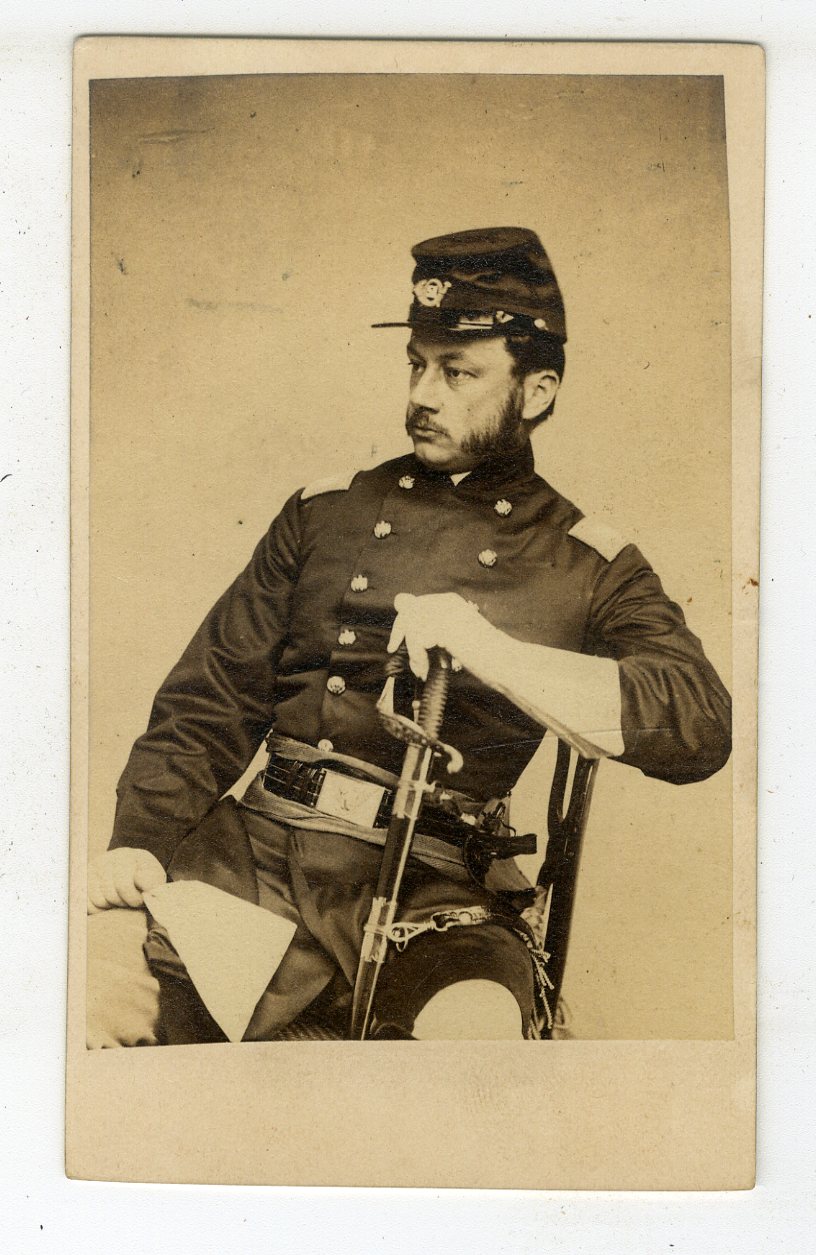
CWCDV1822. Brig. Genl. Robert Brown Potter. Residence was not listed; 32 years old. Enlisted on 10/12/1861 at New York City, NY as a Major. On 10/14/1861, he mustered into Field & Staff New York 51st Infantry. He was discharged for promotion on 3/29/1863. On 3/29/1863, he was commissioned into US Volunteers General Staff. He was Mustered Out on 1/15/1866. He was listed as: Wounded 3/14/1862 New Berne, NC; Wounded 7/30/1864 Petersburg, VA. Promotions: Brig-General 3/29/1863; Major-Gen 8/1/1865 by Brevet; Major-Gen 9/29/1865; Lt Colonel 11/1/1861; Colonel 9/20/1862. Born 7/16/1829 in Schenectady, NY. Died 2/19/1887 in Newport, RI.
Robert Brown Potter (July 16, 1829 – February 19, 1887) was an American lawyer and a Union Army general in the Civil War.
Potter was born in Schenectady, New York on July 16, 1829. He was the third son of Alonzo Potter, the bishop of the Episcopal Church of Pennsylvania, and Sarah Maria (née Nott) Potter. His mother was the only daughter of Eliphalet Nott, President of Union College. After the death of his mother in 1839, his father remarried in 1840 to his mother’s cousin, Sarah Benedict, with whom his mother had placed the children in the event of her death. Sarah also predeceased Bishop Potter, and three months before his death in 1865, he remarried to Frances Seton, who lived in Flushing until she died in 1909.
Potter had eight brothers and a sister, including Clarkson Nott Potter, a Democratic member of the U.S. House of Representatives; Howard Potter, an attorney and banker; Edward Tuckerman Potter, an architect who designed the Nott Memorial at Union College; Henry Codman Potter, who succeeded Horatio Potter as Bishop of New York in 1887; Eliphalet Nott Potter, an Episcopal priest and president of Hobart College; Maria Louisa Thompson, the wife of sculptor Launt Thompson; James Neilson Potter, a businessman; William Appleton Potter, an architect who designed the Church of the Presidents in Elberon, New Jersey, and Frank Hunter Potter, a journalist who was the choirmaster of the Cathedral of St. John the Divine.
Potter served as an attorney in New York City prior to the outbreak of the Civil War.
At the start of the Civil War, Potter enlisted as a private in the New York militia, was promoted to lieutenant, and then commissioned as a major on October 14, 1861. He was promoted to lieutenant colonel on November 1 of that year. He was wounded at the Battle of New Bern on March 14, 1862, while serving under Brig. Gen. Ambrose E. Burnside. Potter commanded the 51st New York Volunteer Infantry in IX Corps at Second Bull Run. Promoted to the rank of colonel on September 10, he led the regiment at the Battle of Antietam. Potter was wounded while participating in Burnside’s attack on the Confederate right flank at Antietam. The wound was only “slight”, however, and Potter continued in command of the 51st NY regiment through the rest of the fall and winter of 1862; notably at the Battle of Fredericksburg.
Potter was promoted to the rank of brigadier general on March 13, 1863. He led the 2nd Division, IX Corps, in the siege of Vicksburg. He next commanded IX Corps in the Knoxville Campaign. After serving on recruiting duty in New York state, he was assigned in 1864 to command of the 2nd Division of IX Corps under Burnside. Potter led the division in the Overland Campaign and at the siege of Petersburg. He was wounded in the final assault on Petersburg on April 2, 1865, Potter’s third wound of the war.
Upon his recovery, he was given command of the Rhode Island and Connecticut district of the Department of the East. On his wedding day he was given his commission as full major general of volunteers.
He was honorably mustered out of the volunteer service, January 15, 1866.
After he retired from the military, he served for three years as receiver of the Atlantic and Great Western Railroad. He moved to England in 1869, but returned to Rhode Island in 1873, where he died in 1887.
On September 20, 1865, General Potter was married to Abigail Austin “Abby” Stevens (1836–1913). Abby was the daughter of prominent banker John Austin Stevens.
Potter died in Newport, Rhode Island on February 19, 1887. He was buried at Woodlawn Cemetery in the Bronx, New York City. VG. $275 ON HOLD

CWCDV1823. Brady, New York. Brig. Genl. Richard Busteed. Residence Chicago, IL; a 40-year-old Lawyer. Enlisted on 10/1/1861 at Chicago, IL as a Captain. On 10/1/1861, he was commissioned into Illinois Busteed’s Light Artillery. He was Mustered Out on 11/7/1861 at Chicago, IL. On 8/7/1862, he was commissioned into US Volunteers General Staff. He was disch on 3/4/1863. (Appointment expired). Promotions: Brig-General 8/7/1862. Born 2/16/1822 in Cavan, Ireland. Died 9/14/1898 in New York City, NY.
Richard Busteed (February 16, 1822 – September 14, 1898) was a soldier in the Union Army during the Civil War and a United States district judge of the United States District Court for the Middle District of Alabama, the United States District Court for the Northern District of Alabama and the United States District Court for the Southern District of Alabama.
Born on February 16, 1822, in County Cavan, Ireland, Busteed read law in 1846. He entered private practice in New York City, New York from 1846 to 1856. He was Corporation Counsel for New York City from 1856 to 1859. He was a Captain in the United States Army in 1861, and a Brigadier General from 1862 to 1863, during the Civil War.
Once when confronted with black men being thrown out of a white railroad car by the conductor, Busteed pulled his pistol and defended the black men allowing them to stay.
Busteed received a recess appointment from President Abraham Lincoln on November 17, 1863, to a joint seat on the United States District Court for the Middle District of Alabama, the United States District Court for the Northern District of Alabama and the United States District Court for the Southern District of Alabama vacated by Judge George Washington Lane. He was nominated to the same position by President Lincoln on January 5, 1864. He was confirmed by the United States Senate on January 20, 1864, and received his commission the same day. His service terminated on October 20, 1874, due to his resignation.
Alabamians generally considered Busteed corrupt and pro-Northern. In December 1867, he was shot on the street in Mobile, Alabama by United States Attorney Lucien V. B. Martin, who fired two more shots into him after he fell. Martin went to Texas and was never prosecuted, while Busteed recovered rapidly.
Busteed was nominated by President Ulysses S. Grant to the Supreme Court of the District of Columbia (now the United States District Court for the District of Columbia) on January 13, 1873. At the same time, President Grant nominated Judge David Campbell Humphreys, an Alabama native serving on the Supreme Court of the District of Columbia, to assume Busteed’s seat, each nomination made contingent on the other’s resignation. The Senate returned the nominations to the President as irregular in form on February 13, 1873.
In 1873, Busteed was the subject of an impeachment inquiry by the United States House of Representatives Judiciary Committee. The Committee recommended his impeachment on charges of failing to maintain a residence in his judicial district, failing to hold scheduled terms of court, and using his official position to promote his personal interests (specifically, by remitting a fine due to the Federal government in order to obtain release from a personal judgment against him in a State court). Busteed resigned before the full House could vote on the recommendation. Representatives Butler and Wilson emphasized the revived (previously settled by Blount in 1799) but still-minority position that resignation was no bar to later impeachment, yet voted with the rest of the committee to terminate proceedings.
Following his resignation from the federal bench, Busteed resumed private practice in New York City starting in 1874. He died on September 14, 1898, in New York City.
On the bottom recto of the CDV is written the erroneous ID of “His Excellency John A. Andrew, Gov. of Massachusetts.” G. $200


CWCDV1824. Brady’s National Portrait Gallery, published by E&HT Anthony. George Henry Thomas. Residence was not listed; a 44-year-old US Army Officer. Enlisted on 4/25/1861 as a Lieut Colonel. On 4/25/1861, he was commissioned into Field & Staff US Regular Army 2nd Cavalry. He transferred out on 8/3/1861
(Prior service in US Army since 07/01/1840). On 8/3/1861, he transferred into Field & Staff US Regular Army 5th Cavalry. He was discharged for promotion on 10/27/1863. On 8/3/1861, he was commissioned into US Volunteers General Staff. He was Mustered Out on 10/27/1863. On 10/27/1863, he was commissioned into US Regular Army General Staff. (Date and method of discharge not given.) (Subsequent service in US Army until his death). Promotions: Colonel 5/3/1861; Brig-General 8/3/1861; Major-Gen 4/25/1862; Brig-General 10/27/1863; Major-Gen 12/15/1864. Born 7/31/1816 in Southhampton County, VA. Died 3/28/1870 in San Francisco, CA. (Graduate USMA 07/01/1840).
George Henry Thomas (July 31, 1816 – March 28, 1870) was an American general in the Union Army during the Civil War and one of the principal commanders in the Western Theater. Thomas served in the Mexican–American War, and despite being a Virginian whose home state would join the Confederate States of America during the Civil War, he was a Southern Unionist who chose to remain in the U.S. Army.
Thomas won one of the first Union victories in the war, at Mill Springs in Kentucky, and served in important subordinate commands at Perryville and Stones River. His stout defense at the Battle of Chickamauga in 1863 saved the Union Army from being completely routed, earning him his most famous nickname, “the Rock of Chickamauga.” He followed soon after with a dramatic breakthrough on Missionary Ridge in the Battle of Chattanooga. In the Franklin–Nashville Campaign of 1864, he achieved one of the most decisive victories of the war, destroying the army of Confederate General John Bell Hood, his former student at West Point, at the Battle of Nashville.
Thomas had a successful record in the Civil War, but he failed to achieve the historical acclaim of some of his contemporaries, such as Ulysses S. Grant and William T. Sherman. He developed a reputation as a slow, deliberate general. In an environment rife with jealousy and avarice for promotion and recognition, Thomas stood out as an oddball for occasionally refusing promotions to positions he thought he was still incapable of fulfilling. Conversely, he sometimes regretted his refusals or found it offensive that he was passed over for promotion. After the war, he did not write memoirs to advance his legacy and died only five years after the war ended. Partial 2-cent, cancelled tax stamp on verso. VG. $150

CWCDV1825. E&HT Anthony. Brig. Genl. David Sloan Stanley. Residence was not listed; a 32-year-old US Army Officer. Enlisted on 3/16/1861 as a Captain. On 3/16/1861, he was commissioned into US Regular Army 1st Cavalry. He was discharged for promotion on 12/1/1863. (Prior service in US Army since 07/01/1852). On 9/28/1861, he was commissioned into US Volunteers General Staff. He was Mustered Out on 2/1/1866. On 12/1/1863, he was commissioned into Field & Staff US Regular Army 5th Cavalry. (Date and method of discharge not given.) (Subsequent service in US Army until retiring 06/01/1892). He was listed as: Wounded 11/30/1864 Franklin, TN (Severely wounded). Promotions: Brig-General 9/28/1861; Major-Gen 11/29/1862; Lt Colonel 12/31/1862 by Brevet (Stone River, TN); Major 12/1/1863 (As of 5th US Army Cavalry); Colonel 5/15/1864 by Brevet (Resaca, GA); Brig-General 3/13/1865 by Brevet (Ruff’s Station, GA); Major-Gen 3/13/1865 by Brevet (Franklin, TN); Colonel 7/28/1866. Born 6/1/1828 in Cedar Valley, OH. Died 3/13/1902 in Washington, DC. (Graduate USMA 07/01/1852). Medal of Honor Information: He was awarded the Medal of Honor for action on 11/30/1864 at Franklin, TN. (At critical moment rode to front of one of his brigades and gallantly led it in a successful assault).
David Sloane Stanley (June 1, 1828 – March 13, 1902) was a Union Army general during the Civil War. Stanley took part in the Second Battle of Corinth and the Battle of Stones River as a division commander. He was later made a corps commander under William Tecumseh Sherman and sent to Tennessee to oppose John Bell Hood’s Army of Tennessee. At a critical moment in the Battle of Franklin (November 1864), he saved part of George D. Wagner’s division from destruction, earning America’s highest military decoration, the Medal of Honor. Later he explored the Yellowstone River, and his favorable reports encouraged settlement of this region.
Stanley was born in Cedar Valley, Wayne County, Ohio. He graduated from West Point in 1852 and went to the Western frontier to survey railroad routes. He engaged in Indian fighting and was promoted to captain in March 1861, shortly before the outbreak of the Civil War. Stanley was on duty at Fort Washita in Indian Territory when war broke out. He led his men to Fort Leavenworth, Kansas.
He fought at several battles in Missouri, including the Battle of Wilson’s Creek, where he guarded the supply trains. President Abraham Lincoln appointed Stanley as brigadier general of U.S. Volunteers September 28, 1861, although the U.S. Senate did not confirm the appointment until March 7, 1862. Fighting in the Western Theater, he participated in the operations against New Madrid, Missouri and the Battle of Island Number Ten. He was involved in numerous major battles, including the Siege of Corinth, Battle of Iuka, and Second Battle of Corinth, where he commanded a division of infantry of the Army of the Mississippi, and the Battle of Stones River, in which he led the cavalry of the Army of the Cumberland. On March 11, 1863, Stanley was appointed major general of volunteers to rank from November 29, 1862. Stanley also led the Union cavalry in the Tullahoma Campaign. He fell ill late in 1863 and missed the Battle of Chickamauga. In 1864, he fought under William Tecumseh Sherman as a division commander in the IV Corps of the Army of the Cumberland during the Atlanta campaign, and he was promoted to command of the corps when Maj. Gen. Oliver O. Howard was named commander of the Army of the Tennessee. After the capture of the city, instead of employing him marching to the sea, Sherman dispatched Stanley and his IV Corps to Tennessee to help protect the state from invasion by John Bell Hood’s Army of Tennessee.
For leading one of his brigades in a successful counterattack during a critical moment in the fighting at the Battle of Franklin on November 30, 1864, the President of the United States on behalf of the United States Congress presented him with the Medal of Honor on March 29, 1893. Two of his divisions having been reassigned to the defensive lines of the XXIII Corps before the battle, Stanley had no actual command. Two brigades of the remaining division, under Brig. Gen. George D. Wagner, were overwhelmed by the initial Confederate assault, having been left in an exposed position. It was for his role in the counterattack by the 3rd Brigade of Wagner’s division that Stanley was awarded the medal. He was wounded in the neck at the same time and had his horse shot out from under him. Maj. Gen. Jacob Cox, commanding the defenses, provided Stanley a remount with which to seek medical attention, and Stanley did not participate further in the battle. He returned to corps command only after the Battle of Nashville.
After the war, Stanley was appointed colonel of the 22nd U.S. Infantry, primarily serving in the Dakota Territory until 1874. He commanded the Yellowstone Expedition of 1873, successfully conducting his troops through several unmapped areas, and his favorable reports on the country led to subsequent settlement of the region. In 1879, Stanley and his regiment were reassigned to Texas to suppress Indian raids in the western portion of the state. He was ordered to Santa Fe, New Mexico, in 1882, and placed in command of the District of New Mexico. In March 1884, he was appointed a brigadier general in the regular army, and assigned command of the Department of Texas. He retired in 1892.
Stanley was interred at the United States Soldiers’ and Airmen’s Home National Cemetery in Washington, D.C.
He was a First Class Companion of the Military Order of the Loyal Legion of the United States and a Hereditary Companion of the Military Order of Foreign Wars. In 1894 he became a member of the District of Columbia Society of the Sons of the American Revolution. He died in Washington DC in 1902.
His son-in-law, Willard Ames Holbrook (married to his daughter, Anna Huntington Stanley, American Impressionist artist), also served as a major general in the U.S. Army. His only son, David Sheridan Stanley, and five of his grandsons (including Willard Ames Holbrook, Jr.) would later graduate from West Point. Additionally, his son, David Sheridan Stanley was the principal founder of the Army Navy Country Club, located in Arlington, VA.
Medal of Honor: Rank and Organization:
Major General, U.S. Volunteers. Place and Date: At Franklin, Tenn., November 30, 1864. Entered Service At: Congress, Wayne County, Ohio. Born: June 1, 1828, Cedar Valley, Ohio. Date of Issue: March 29, 1893.
Citation: At a critical moment rode to the front of one of his brigades, reestablished its lines, and gallantly led it in a successful assault.
VG. $300

CWCDV1826. Brady’s National Portrait Gallery, published by E&HT Anthony. Edwin Henry Stoughton Residence Rockingham, VT; 24 years old.
Enlisted on 8/1/1861 as a Colonel. On 8/1/1861, he was commissioned into Field & Staff Vermont 4th Infantry. He was discharged for promotion on 11/5/1862. (Prior service in US Army from 07/01/1859 until 03/04/1861). On 11/5/1862, he was commissioned into US Volunteers General Staff. He was disch on 3/4/1863. Promotions: Brig-General 11/5/1862 (Appointment expired 3/4/63.). Born 6/23/1838 in Chester, Winsor County, VT. Died 12/25/1868 in New York City, NY. (Graduate USMA 07/01/1859).
Edwin Henry Stoughton (June 23, 1838 – December 25, 1868) was appointed a brigadier general in the Union Army during the Civil War, but his appointment expired after it was not confirmed by the U.S. Senate. Four days later, on March 8, 1863, he was captured by Confederate partisan ranger John S. Mosby while asleep at his headquarters in the Virginia village of Fairfax Court House. The incident became well known, and Stoughton became an object of ridicule as a result. He was included in a prisoner exchange two months later but resigned his commission after he was not reappointed as a brigadier general.
Stoughton was born in Chester, Vermont, the son of Henry Evander and Laura (Clark) Stoughton.
Stoughton was appointed a cadet at the U.S. Military Academy on July 1, 1854, and graduated with the class of 1859. He served garrison duty as a brevet second lieutenant in the 4th U.S. Infantry from July to September 1859. He was promoted to second lieutenant and transferred to the 6th U.S. Infantry.
Stoughton resigned his regular commission in March 1861 and in September was appointed commander of the 4th Vermont Infantry with the rank of colonel. He was only 23 at the time of his appointment and was said to be the youngest colonel in the army. He led his command in the Peninsula Campaign, and his effective performance led to his selection for promotion and command of a brigade.
In November 1862, he was appointed brigadier general of Volunteers, and he assumed command of the 2nd Vermont Brigade on December 7, replacing Colonel Asa P. Blunt. Stoughton’s brother, Charles B. Stoughton, assumed command of the 4th Vermont Infantry in his stead. Stoughton’s appointment was never confirmed by the U.S. Senate, and it expired March 4, 1863, less than a week before Mosby’s Fairfax Court House Raid.
Mosby’s Rangers (led by Confederate officer John S. Mosby) led a daring raid into Union Territory and captured Stoughton at Fairfax Court House on March 9, 1863. Stoughton had hosted a party for his visiting mother and sister, who were staying at the home of Confederate spy Antonia Ford. After leaving the party, Stoughton retired to a nearby house that served as his headquarters. Mosby allegedly found Stoughton in bed, supposedly rousing him with a slap to his rear. Upon being so rudely awakened, the general shouted, “Do you know who I am?” Mosby quickly replied, “Do you know Mosby, general?” “Yes! Have you got the rascal?” “No but he has got you!” In his own written account of Stoughton’s capture, which appeared in Volume III of 1888’s Battles and Leaders of the Civil War, Mosby did not mention the supposed “spanking” incident. It is however mentioned in Mosby’s Memoirs.
Allegedly, Stoughton was not popular with the officers and men of the brigade, and few mourned his loss. U.S. President Lincoln, on hearing of the capture, said that “he did not so much mind the loss of a brigadier general, for he could make another in five minutes; ‘but those horses cost $125 apiece!'” Blunt resumed command and led the brigade until he turned command over to Brigadier General George J. Stannard on April 20. Stannard led the brigade until the Battle of Gettysburg.
After a two-month stay in Richmond’s Libby Prison, Stoughton was exchanged, but saw no further service. The U.S. Senate had not confirmed his initial appointment, and he was not re-appointed. He resigned from the Union Army in May 1863 and moved to New York.
Stoughton was an attorney in New York City after the war, practicing with his father and with his uncle, Edwin W. Stoughton. In November 1864, Confederate spies calling themselves the Confederate Army of Manhattan attempted to set fire to New York City. Most escaped, but Stoughton’s West Point classmate Robert Cobb Kennedy was captured. Stoughton defended him at his trial; Cobb was convicted, and in March 1865, he became the last Confederate soldier to be executed by Union authorities.
Stoughton died of tuberculosis in Dorchester, Massachusetts on December 25, 1868. He was buried at the Immanuel Cemetery at the Immanuel Episcopal Church in Bellows Falls, Vermont. The Grand Army of the Republic post in Bellows Falls was named for him.
G. $200
CWCDV1827. F. Gutekunst, Phila. Written on verso: “Possibly Captain Francis Chadwick, Capt., Co I, 90th PA.” VG. $150
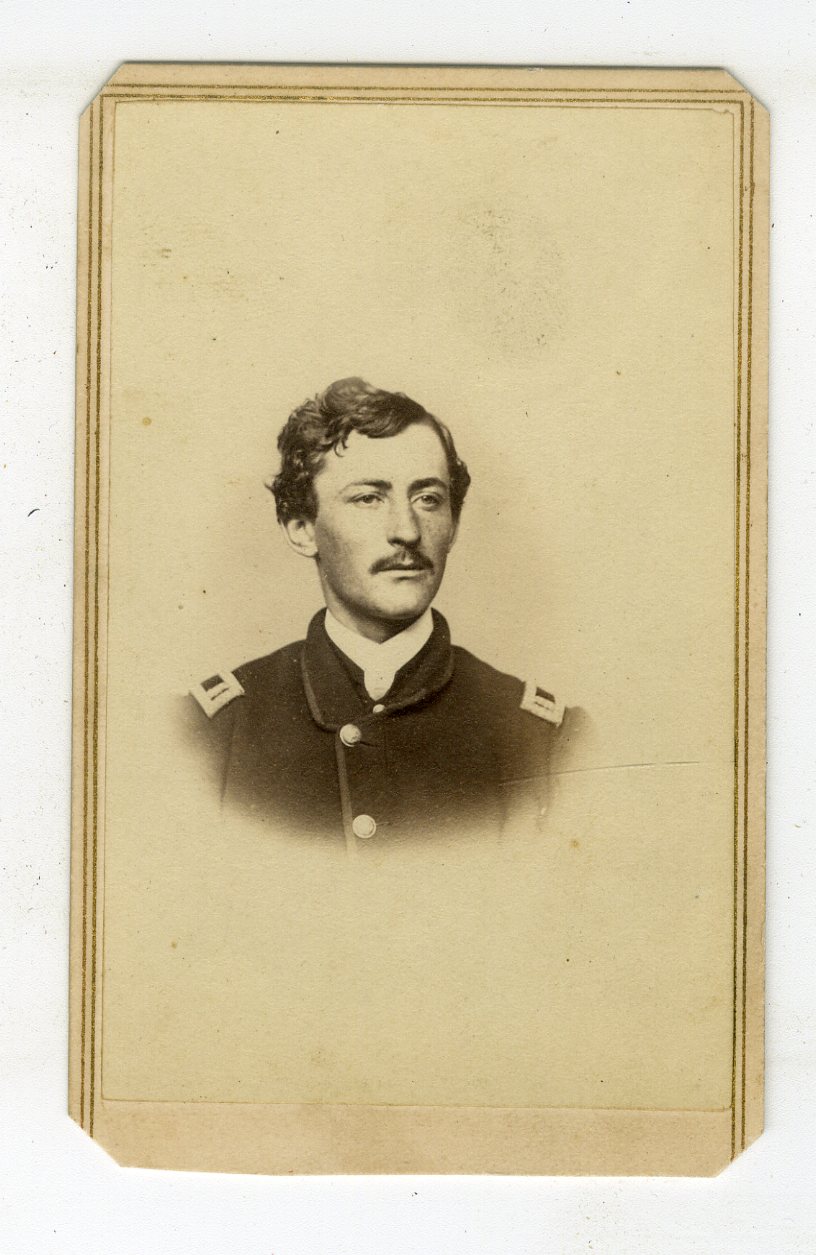
CWCDV1828. Whitehurst Gallery, Washington, DC. J.J. Powers, Photographer. Unidentified 1st lieut. VG. $125
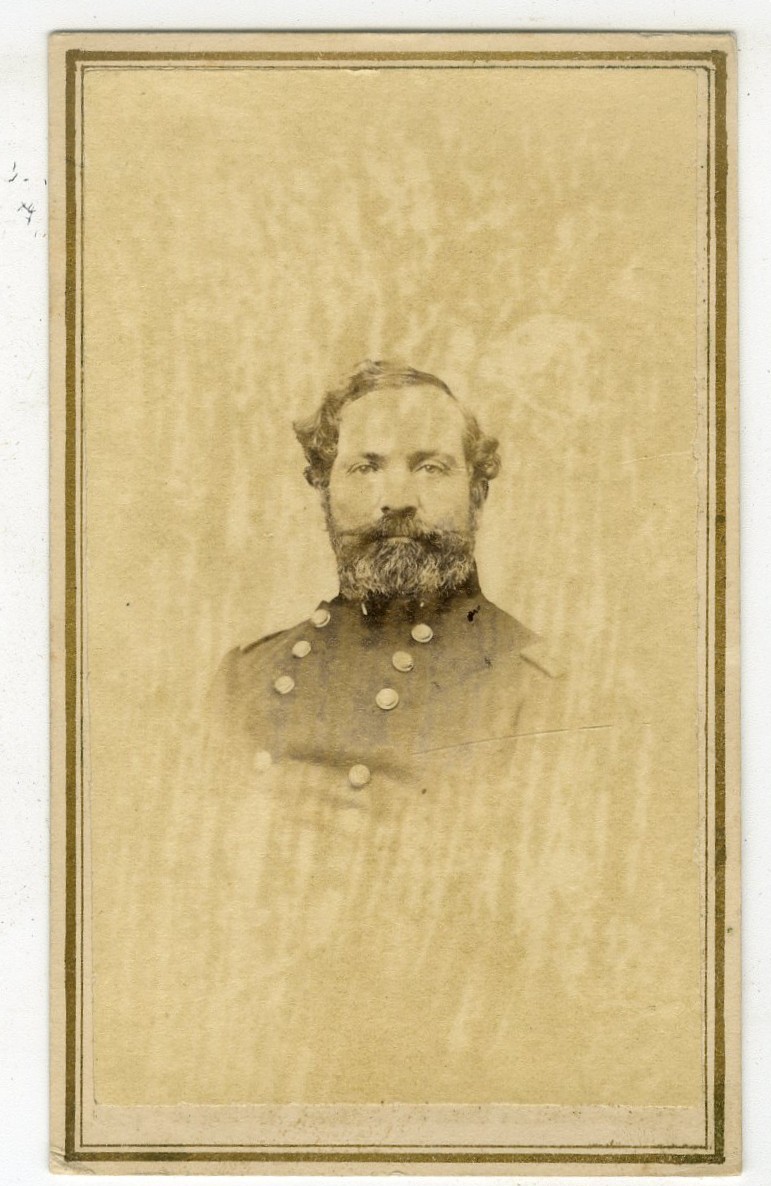
CWCDV1830. Geo. G. Rockwood, NY. General John Sedgwick. John Sedgwick (September 13, 1813 – May 9, 1864) was an American military officer who served as a Union Army general during the Civil War.
Sedgwick was wounded three times at the Battle of Antietam while leading his division in an unsuccessful assault against Confederate forces, causing him to miss the Battle of Fredericksburg. Under his command, the VI Corps played an important role in the Chancellorsville Campaign by engaging Confederate troops at the Second Battle of Fredericksburg and the Battle of Salem Church. His corps was the last to arrive at the Battle of Gettysburg and did not see much action. Sedgwick was killed by a sharpshooter at the Battle of Spotsylvania Court House on May 9, 1864, making him and Major Generals James B. McPherson, Joseph K. Mansfield, and John F. Reynolds the highest-ranking Union officers to be killed in the war. He is remembered for an ironic remark among his last words: “They couldn’t hit an elephant at this distance.” G. $150
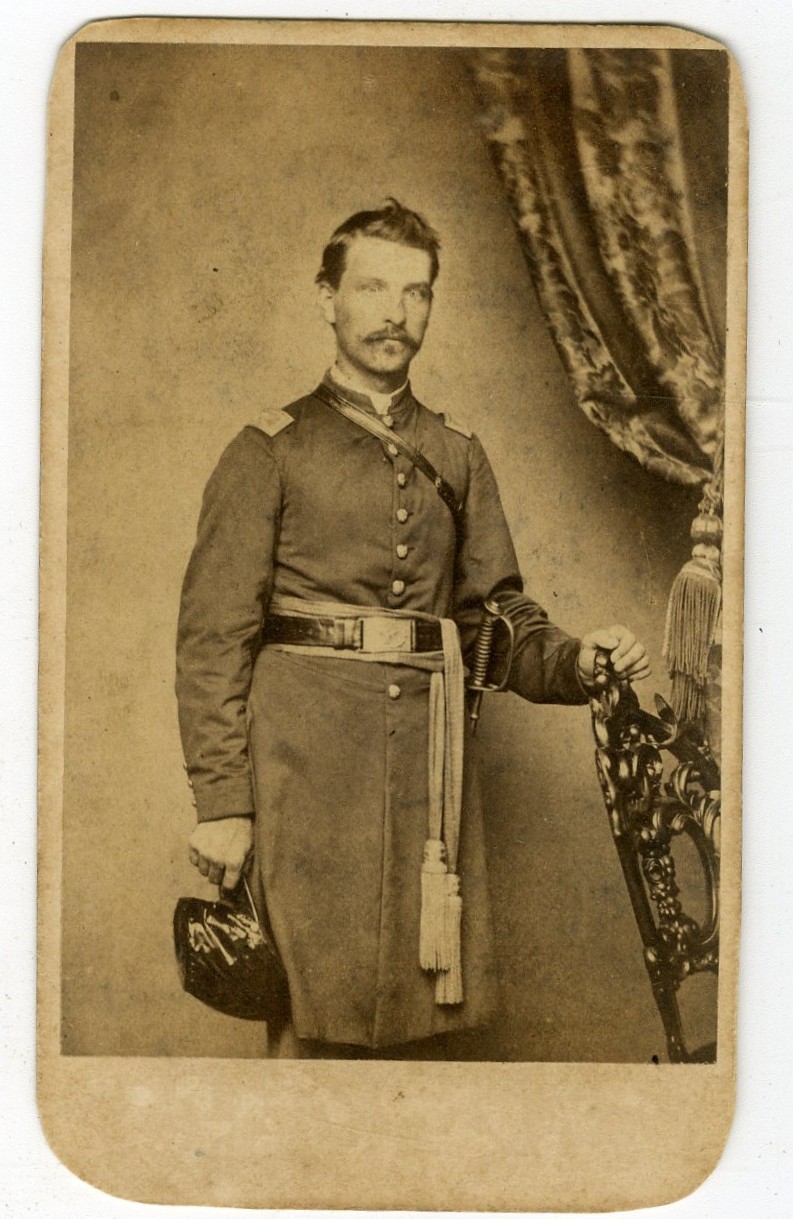
CWCDV1831. B.F. Reimer, Philadelphia. Unidentified line officer standing with hand on chair and holding kepi with rain cover. G. $125
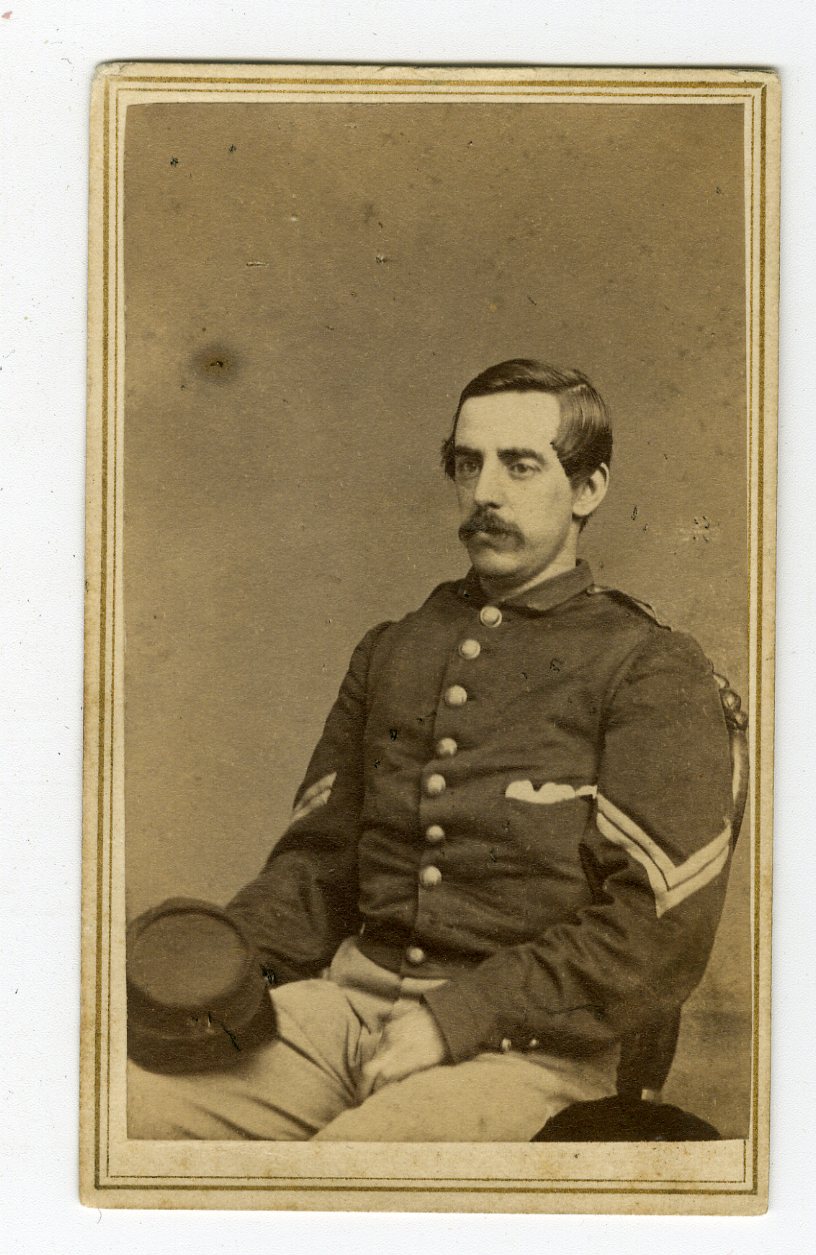
CWCDV1832. Clarke’s Union Photographic Gallery, NY. From another copy of this CDV owned by Ryan Sandy comes the name “Ammerman,” and the following information: “Brother of Peter and Son of Abraham Ammerman/Amerman as attributed by other CDVS sold by the seller at the same time. I missed the relatives but have some saved evidence of these. His brother was in a NY artillery regiment. This Corporal’s regiment is still unknown to me at this time.” While it looks like “Leonard J. Ammerman,” but I can’t find anything on anyone by that name. G. $100
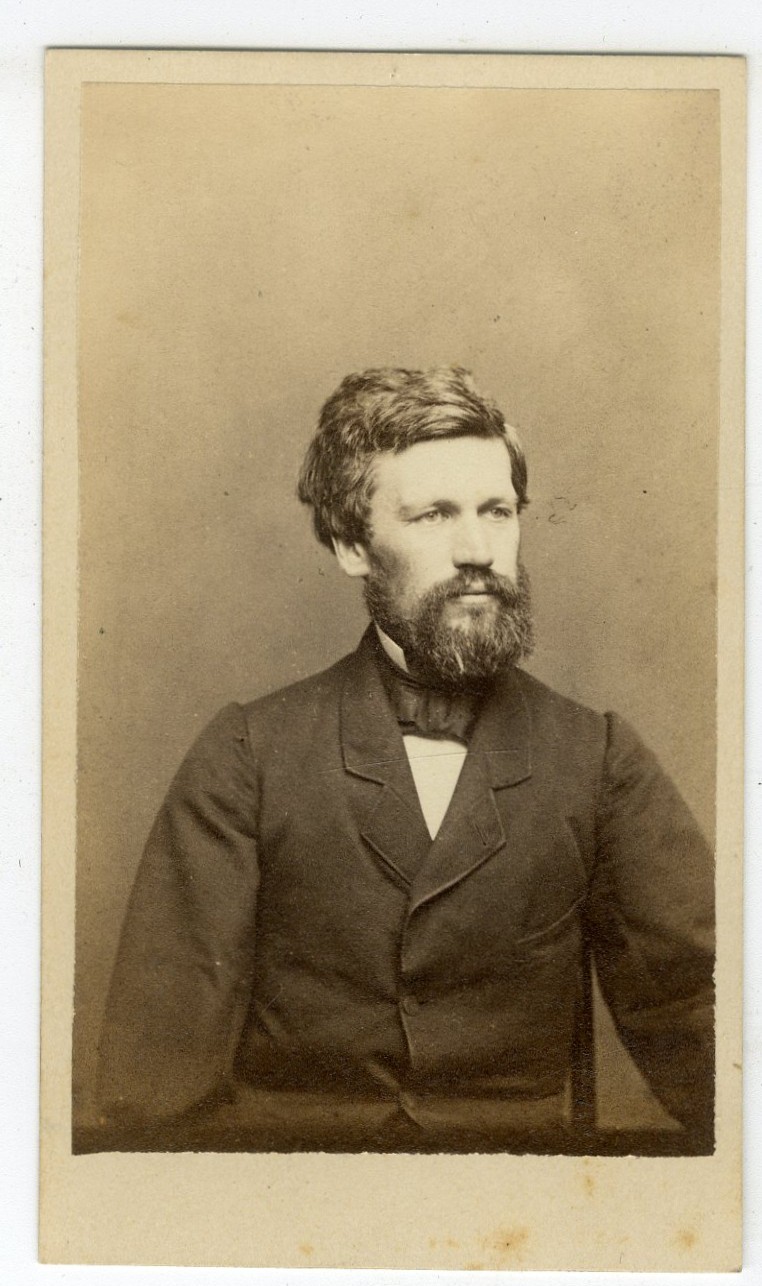
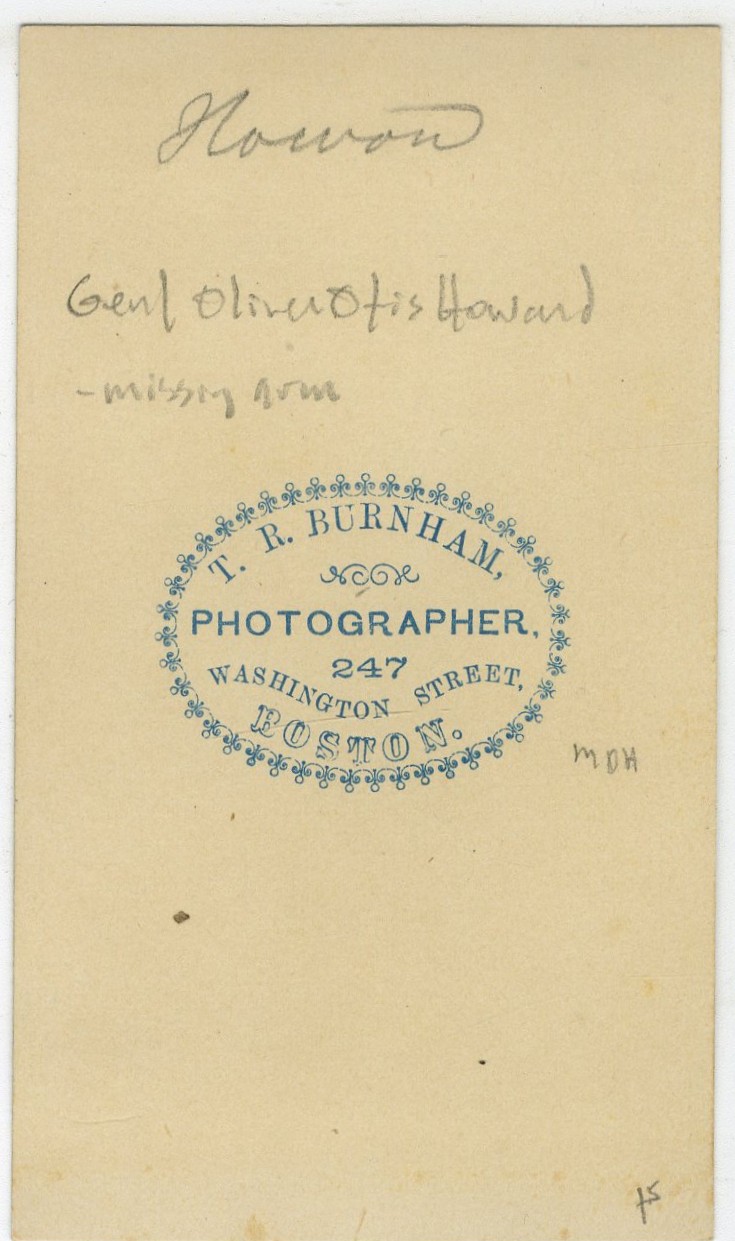
CWCDV1833. T.R. Burnham, Boston. General Oliver Otis Howard seated pose as civilian missing his arm. Residence Leeds, ME; 30 years old. Enlisted on 5/28/1861 as a Colonel. On 5/28/1861, he was commissioned into Field & Staff Maine 3rd Infantry. He was discharged for promotion on 9/3/1861. On 9/3/1861, he was commissioned into US Volunteers General Staff. He was Mustered Out on 1/1/1869. He was listed as: Wounded 6/1/1862 Fair Oaks, VA (Severe wound in right arm, amputated); Returned 8/1/1862 (place not stated). Promotions: Brig-General 9/3/1861; Major-Gen 11/29/1862; Brig-General 12/21/1864; Major-Gen 3/13/1865 by Brevet. Born 11/8/1830 in Leeds, ME. Died 10/26/1909 in Burlington, VT. (Graduate of Bowdoin College and West Point.) Medal of Honor Information: He was awarded the Medal of Honor for action on 6/1/1862 at Fair Oaks, VA. (Lead forces during desperate fighting, repulsing enemy). After the war, he lived in San Francisco, CA.
Oliver Otis Howard (November 8, 1830 – October 26, 1909) was a career United States Army officer and a Union general in the Civil War. As a brigade commander in the Army of the Potomac, Howard lost his right arm while leading his men against Confederate forces at the Battle of Fair Oaks/Seven Pines in June 1862, an action which later earned him the Medal of Honor. As a corps commander, he suffered a major defeat at Chancellorsville and his performance was questioned at Gettysburg in May and July 1863. However, he recovered from possible career setbacks as a successful corps and later army commander, commanding the Army of the Tennessee from July 27, 1864, until May 19, 1865, leading the army in the battles of Ezra Church, Battle of Jonesborough, Sherman’s March to the Sea, and the Carolinas campaign in the Western Theater.
Known as the “Christian General” because he tried to base his policy decisions on his deep, evangelical piety, he was given charge of the Freedmen’s Bureau in mid-1865, with the mission of integrating the former slaves into Southern society and politics during the second phase of the Reconstruction Era. Howard took charge of labor policy, setting up a system that required freed people to work on former plantation land under pay scales fixed by the Bureau, on terms negotiated by the Bureau with white land owners. Howard’s Bureau was primarily responsible for the legal affairs of the freedmen. He attempted to protect freed blacks from hostile conditions but lacked adequate power and was repeatedly frustrated by President Andrew Johnson.
Howard’s allies, the Radical Republicans, won control of Congress in the 1866 elections and imposed Radical Reconstruction, with the result that freedmen were given the vote. With the help and advice of the Bureau, freedmen joined Republican coalitions and won at the ballot boxes of most of the southern states. Howard was also a leader in promoting higher education for freedmen, most notably in founding Howard University in Washington, D.C., of which he is the namesake. He served as its president from 1867 to 1873, and he aided in the charter of both Howard University and Atlanta University (now Clark Atlanta University) in 1867.
After 1874, Howard commanded troops in the West, conducting a famous campaign against the Nez Perce tribe, led by Chief Joseph. Utley (1987) concludes that his leadership against the Apaches in 1872, Nez Perce in 1877, Bannocks and Paiutes in 1878, and the Sheepeaters in 1879 all add up to a lengthy record, although he did not fight as much as George Custer or Nelson Miles. VG. $200